All posts by David Swart

High school science teacher

Toxins: Chapter 13 Quiz

With the short week, students have the opportunity to use Thursday to:

  • Catch up on missing work (Lesson 72 Q#4 and Lesson 73 Qs #1-7)
  • Practice balancing equations using the new HTML5 (Chromebook compatible!) Balancing Chemical Equations PhET Simulation
  • Finish categorizing the types of reactions (Lesson 73 WS)
  • Complete the Chapter 13 Quiz, which will consist of the Chapter 13 Summary questions #1-4 on page 379 of the textbook (due Monday).

Toxins: Types of Reactions

We began class with a review exercise intended to help students bring together the concepts of molarity and balancing equations.  We returned to the photosynthesis equation example from yesterday, this time reversing it to model cellular respiration.  Students then calculated the molecular mass of each of the molecules involved in cellular respiration, and used the balanced equation as evidence to support the Law of Conservation of Mass.  We then briefly reviewed the connection between moles and particle number, using Avagadro’s number to calculate the number of water molecules in 6 moles of water.  Notes from the white board are pictured below:

We then transitioned to classifying the types of reactions by focusing on the Lesson 73 PowerPoint slide 8.  Students are encouraged to review the full slide deck, including the vocabulary defined on slides 9-12.  Students then received the Lesson 73 Worksheet and Toxic Reaction Cards to work on for the remainder of class.  For homework, students were assigned Lesson 73 textbook problems 1-7.

Toxins: Balancing Chemical Equations

Class began with the ChemCatalyst from the Lesson 72 PowerPoint.  With the lesson focusing on balancing chemical equations, we worked through the ChemCatalyst equation on the whiteboard, and then jumped into balancing the equation for photosynthesis (both pictured below):


Students learned how to count and add atoms on both sides of the equation, how to write the mole number in front of the reactants or products (when needed), and how to multiply the mole number by the subscript numbers.  For review, students are encouraged to watch the Crash Course video below (note – we have seen the first 9 minutes, so pick up at about the 9 minute mark to review about balancing equations).

Students then received the Lesson 72 Worksheet to work on in pairs.  We worked through worksheet question 2C, as well as Lesson 72 textbook questions 4A and 4G (for homework, students were assigned textbook question 4, all parts).  Work for those problems is shown below:

Evolution: Some of the Things That Molecules Do

We kicked off our Evolution Unit with Episode 2 of Neil deGrass Tyson’s reboot of the Cosmos series called Some of the Things That Molecules Do.  The video does an excellent job presenting evolution as the product of genetic mutation, and differentiates between natural and artificial selection.  Students received a worksheet and time to collaborate on the responses both during (intermission) and after the video.

Variation and Inheritance: Unit 4 Exam

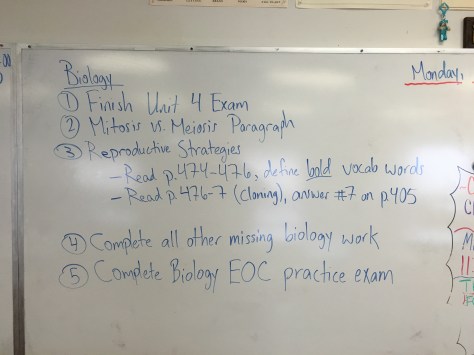
To conclude Unit 4, students received an April Fool’s packet consisting of a set of instructions, the 2014 Biology End of Course practice exam, and the Unit 4 Exam.  Due to some confusion on behalf of our substitute on Friday, April 1, many students needed additional clarification of the packet instructions, as well as additional time to complete the quiz.  So on Monday, April 11 (after Spring Break), students had the class period to complete the quiz and other missing work.  Quarter 3 grades will be entered into Illuminate tomorrow after school (April 12), so all student work must be in my possession by the end of the school day tomorrow to count toward the quarter grade.  A list of recent assignments was written on the white board all day today as a reminder to students and a picture of the list is shown below:

IMG_0729.JPG

Variation and Inheritance: Reproductive Strategies Presentations

Examples of student work are provided below:

Period 2

Period 3

Period 4

Period 5

Toxins: Physical versus Chemical Change

Because I am out of the school building tomorrow and prefer not to have our substitute conducting a lab, I’ve decided to have students work through Lesson 70 and we will revisit Lesson 69 soon.  For Lesson 70, students are welcome to review the Lesson 70 PowerPoint and then should work in small groups to complete the Lesson 70 Worksheet.

For additional background, watch the video below from Mr. Anderson of Bozeman Science:

Toxins: Chemical Equations

To begin class, students received an extra 20 minutes to complete their Unit 3 Exams from last week.  After that time (or before for students who were ready), students received the Lesson 68 Worksheet and Toxin Card Deck, along with a graphic organizer for analyzing the card deck.  After the time for the exam concluded, we worked through the first few slides of the Lesson 68 PowerPoint, and students watched a video showing the chemical reaction written on the worksheet.

Variation and Inheritance: Sources of Inherited Genetic Variation

March 30: Today is the final day of the project – tomorrow you present your work to the class!  To earn full credit for the presentation, you need to practice your presentation multiple times.  Practice pronouncing all of the words, and look up the definitions of the words you are using to clearly indicate you understand what you are saying.  The website Dictionary.com has a pronunciation feature – you can look up the definition of the word in question and also click the speaker to hear it pronounced.  It also has a translate feature.  If you are presenting with a partner, you need to decide in advance of your presentation who will say what.  You both need to know the content and how to pronounce all of the words.

March 29: Remember to read the project outline carefully!  For your presentation, you will make either a PowerPoint (Google Slides) or a poster.  Poster paper is available in the cardboard box against the wall under the whiteboard with the daily bell schedule.  For Google Slides presentations, you are welcome to include short videos (must be school appropriate!!!) depicting the reproductive strategies of one or both of the organisms you selected.  Remember, presentation time is limited, so the videos must be brief, or you must identify a segment of the video to show in advance.

Need more challenge?  Add an organism – but select one from a different biological kingdom than the organisms you have already researched.  Remember, you must have two organisms in your presentation to earn full credit.  However, for each additional organism you include, you will earn 5 points of extra credit!  The six different kingdoms are pictured below:

March 28: Download the Organism Reproductive Strategies Project.