Category Archives: Organization

Cells & Homeostasis: The Inner Life of a Cell

For our entry task today, students had the opportunity to check out a biology textbook.  The textbook should stay home, as we will have a class set of books to use at school.  Students who did not check out a book will be provided with copies of reading assignments as needed.

Next, we watched a video produced by the BioVisions group at Harvard University.  The video, The Inner Life of a Cell, provides a visually amazing introduction of cells to students who may not realize how dynamic cells really are.  After the video, students worked together to begin reading chapter 1 of the “purple book” – Inside the Cell.  Students used the following A/B Partner Paraphrase Reading strategy, with the goal of reading pages 6-13 of the book:

  • Partner A reads one section out loud
  • Partner B listens and then summarizes the section out loud back to Partner A
  • Partner A then summarizes Partner B’s summary out loud
  • Both Partner A and B write down the final summary

The purpose of the reading strategy is to provide students with the opportunity to read aloud and practice saying new vocabulary words, and also to help them distill key ideas through summarization.  Students who would like to order their own free copy of Inside the Cell should visit the National Institute of General Medical Sciences website and do so as soon as possible.  There are quite a few excellent freebies available from the NIGMS website, including magazines and posters.

We will complete the reading tomorrow and make flash cards tomorrow to help students learn about cell organelles.

Energy, Matter, and Organization: Ocean Acidification – Day 1

We kicked off the lesson with an entry task focused on why we use fossil fuel combustion (to produce energy).  Students were then asked to consider one unintended consequence of fossil fuel combustion (releasing carbon dioxide into the atmosphere).  We followed that discussion with a video about ocean acidification (below) before concluding the lesson with an experiment in which students re-created the conditions of ocean acidification by measuring the change in pH after exhaling through a straw placed in water for one minute.


Energy, Matter, and Organization: Combustion – Day 2

We continued our study of combustion with a review of why burning candles lose mass.  We watched a video in which Mr. Anderson describes not only the process of combustion but also the concept of Conservation of Mass.  At the end of the video, he mentions how neat a candle burning in the space shuttle looks, so I also included a video of the recent FLEX2 experiment aboard the International Space Station.  After the lesson, students completed a quiz connecting the concepts of combustion, cellular respiration, and photosynthesis.

Energy, Matter, and Organization: Combustion – Day 1

The lesson for Monday centered on the concept of combustion.  We dove into vocabulary about chemistry and even balanced an equation!  We then created a table comparing photosynthesis, cellular respiration, and combustion.  Because some classes were ready, we also discussed the combustion of paraffin wax in a burning candle.  Yesterday’s lesson can be viewed by clicking here.

Energy, Matter, and Organization: Revising a Scientific Conclusion

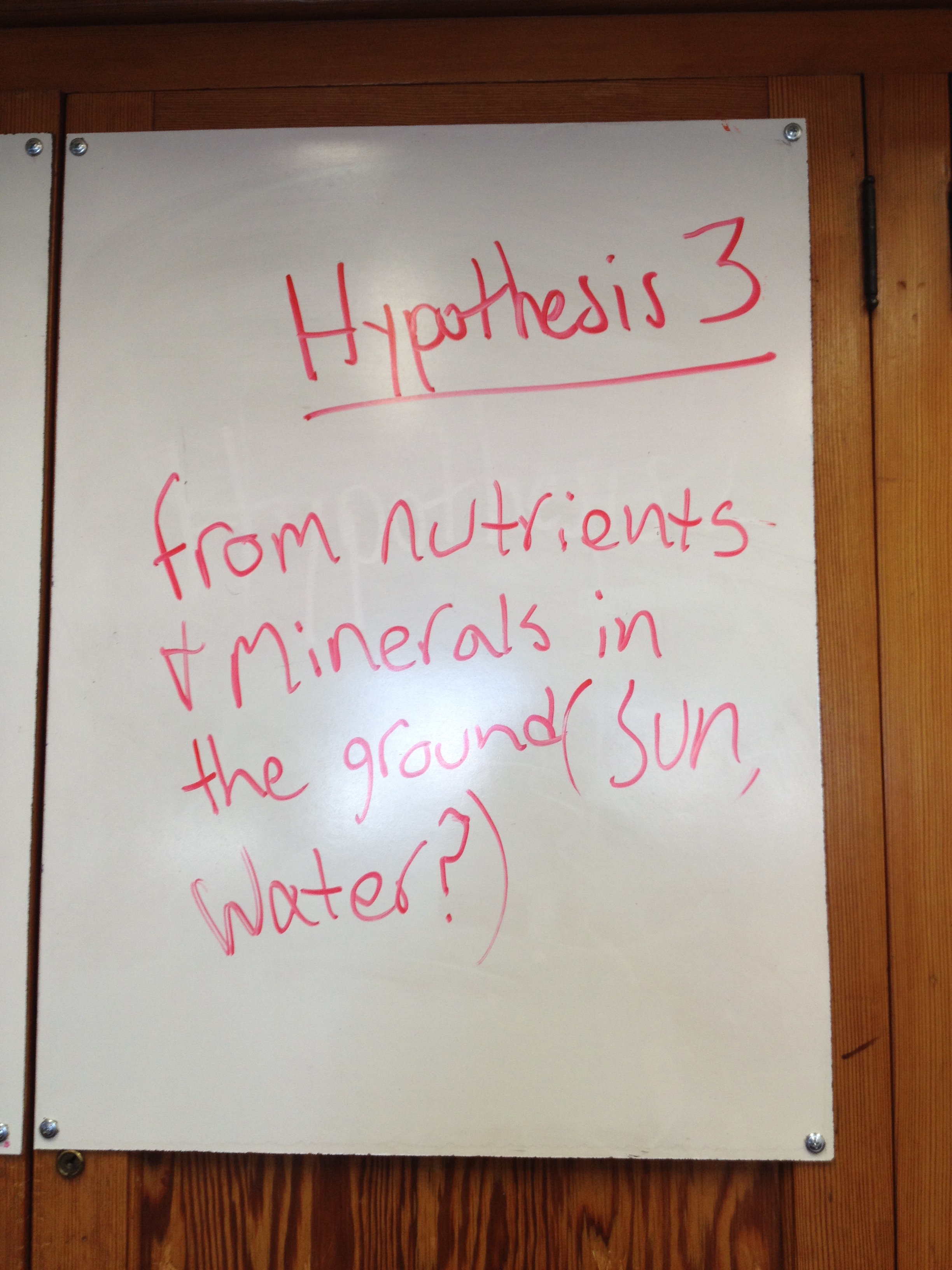
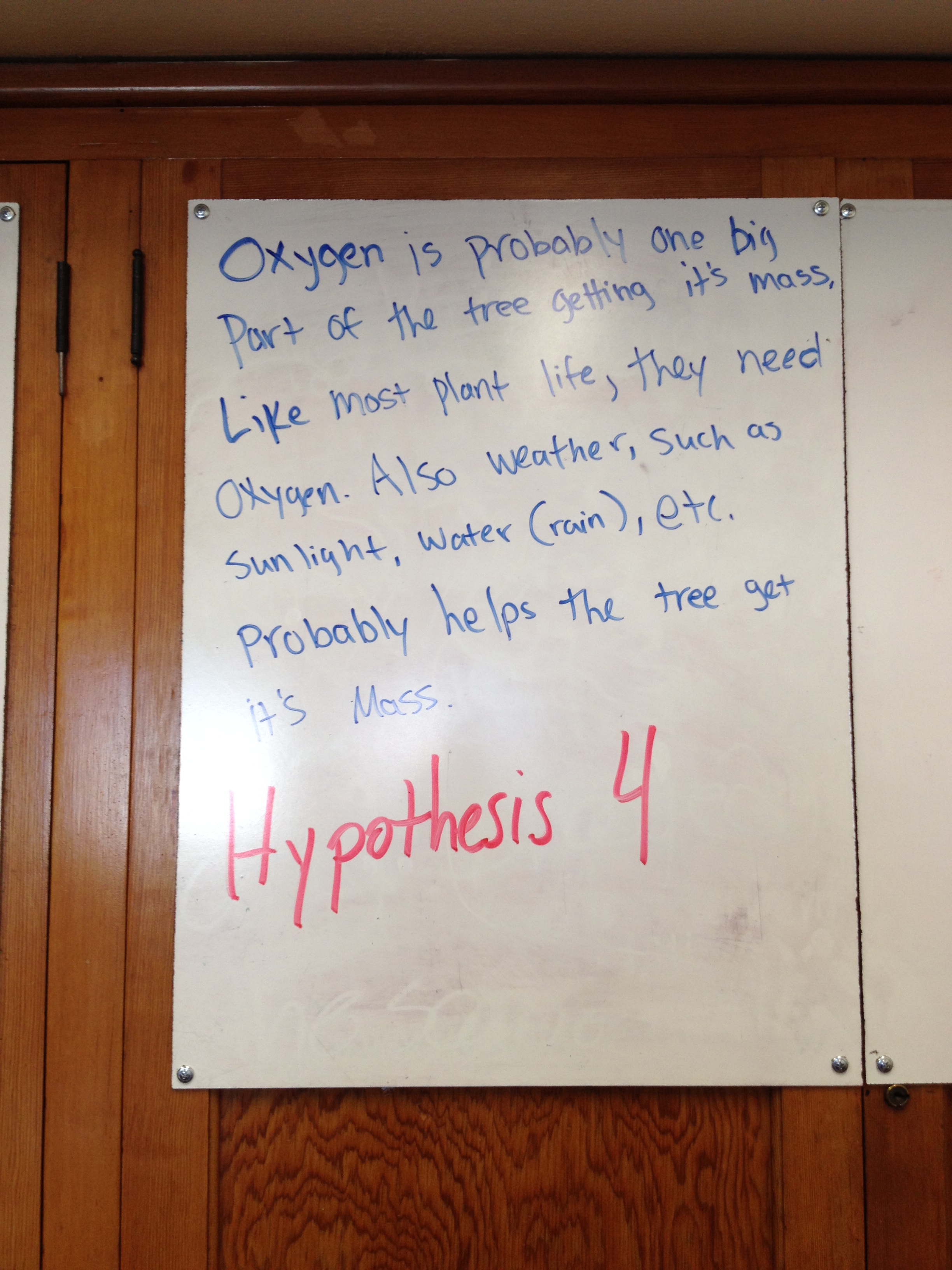
We began class with an entry task asking students to ponder: where do trees get their mass from?  Students had some time to think about the question and write or draw pictures describing their ideas.  Selected students or small groups of students were asked to share their ideas publicly on the class white boards (pictures below).  The ideas were labeled as possible hypothesis statements.  Students then had to select the hypothesis they believed to be the most correct and then wrote a conclusive statement explaining their understanding of the science behind the hypothesis statement.

IMG_6558IMG_6559IMG_6560IMG_6561IMG_6562

We followed that with a video:

After the video, students received the first draft of their conclusions back for more focused editing.  Slides 3 and 4 of the attached slide deck helped the students focus their scientific writing on clearly articulating the claim, evidence, and reasoning for their revised conclusion.

Energy, Matter, and Organization: Writing a Scientific Conclusion – Day 2

Lots of writing today.  We began class with an entry task in which students were instructed to describe the trends in the data found in the graph on page 2 of yesterday’s case study.  Students were provided with the sentence frame:

Plants grown in _____ hours of light increased/decreased in height over _____ weeks.

After some private think/write time, students shared their work with their table partner.  Students selected at random were asked to publicly share their learning by writing an assigned trend sentence on one of the class white boards.  After we reviewed the example trend sentences for plants grown in 0, 12, 17, or 24 hours of light, students were provided with an EOC-style conclusion worksheet (page 2).  Students had 20-30 minutes of silent write time, and students who finished early were encouraged to exchange papers with a friend and look for the 5 elements on pages 4-5 of the conclusion worksheet packet.

Energy, Matter, and Organization: Writing a Scientific Conclusion – Day 1

Welcome to second semester!  It was nice to see everyone, and I look forward to a second half of the year equally as full of learning as the first half.  Today we turned our sights to the Conclusion section of a scientific lab report.  Writing a conclusion statement requires higher-level analysis and is a skill all students should master.  Additionally, the Biology End-of-Course Exam will test the ability of students to write a scientific conclusion statement.

After starting off the lesson with a nuts-and-bolts slide, students read through a fictional scientific experiment case study.  I had the opportunity to read through student lab reports from the Baggie Garden experiment this weekend, and there were a few common recurring items that required addressing.  The case study was written to include the following:

  • An incorrectly written research question
  • A hypothesis statement not directly connected with the research question
  • Many clearly defined controlled variables
  • A graph with data that conflicts with students’ experience from class

After reading through the case study, students publicly identified the research question (bottom of page 1), the hypothesis (first paragraph of page 2), and the experimental variables (manipulated, responding, and at least three controlled).  We will continue our work tomorrow, with students using their learning to write a conclusion statement.