Category Archives: Chemistry

Molecular Formulas

For our first lesson of Unit 2, students were asked to respond to the following entry task:

  • What do you think is happening when you smell something?
  • Why do you think we have a sense of smell?

After a class share-out, we worked through the Lesson 28 PowerPoint and then students all participated in an activity (guided by the  Lesson 28 Worksheet) where they smelled five different scents and then compared their observations as a class.  Based on the class results, students made connections between molecular formulas, chemical names, and scents (fishy, minty, or sweet).  Remaining class time was used to read and summarize Lesson 28 from the textbook.

Extend Your Learning!

While not necessarily related to smells, students are encouraged to check out the NASA InSight Mars Landing feed starting at 11:30 this afternoon.  InSight is scheduled to touch down on Mars at 11:47 AM PST (according to a recent article in Forbes).  On-demand video recordings will be available after the landing completes.

Homework:

  • Read Lesson 28 in the textbook.  Login via hs.saplinglearning.com and enter your username and password:
    • Username: wahps****s-####### (**** = first 4 letters of your last name and ####### = student number).  Remember to include the dash between s and #.
    • Password: S-####### (the S must be capitalized)
  • Write notes for Lesson 28 on the Chapter 6 Notes handout.
  • Work through the practice problems at the end of Lesson 28.
  • Please ask questions about anything from Lesson 28 you do not yet fully understand.

Electroplating Metals

For our final lesson of Unit 1, the concept of electroplating metals was introduced by watching a short video featuring a garage-style setup with a guy who uses a spork and pickle juice to electroplate a part of his cart project:

After the video, we reviewed the Lesson 27 PowerPoint slide deck.  When we arrived at slide 7, students practiced the math skill of cross-multiplication to calculate how much of the materials in a 1.5 L stock solution are in a 200 mL sample of the stock solution.  Notes are provided below:

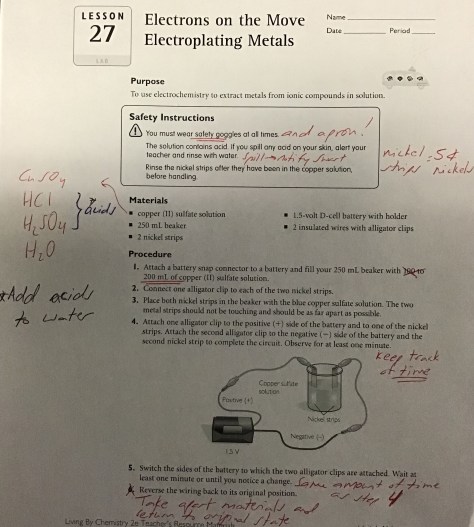
Students then received the Lesson 27 Worksheet and we worked through the front side, serving as the pre-lab for tomorrow.  An example of the marked up worksheet is shown below:


Update: 11/15 – We will be spending the day in the lab.  Students will work in groups of four, using the Electroplating Handout and the materials provided (1.5 V D-cell battery, battery holder, two aligator clips, beaker with 200 mL electroplating solution, and two nickels) to set up and conduct the lab.  Students who complete the lab efficiently will have the opportunity to extend their learning by modifying aspects of the lab using various teacher-supplied materials.

IMG_0105
Results of copper-plating nickel using a solution of copper sulfate, hydrochloric acid, and sulfuric acid in water. Both nickel balls were connected to 9V battery and immersed in CuSO4 solution. Nickel ball connected to negative battery terminal had bubbles form on exterior, then became copper-coated over time. Nickel ball connected to positive terminal did not appear changed.

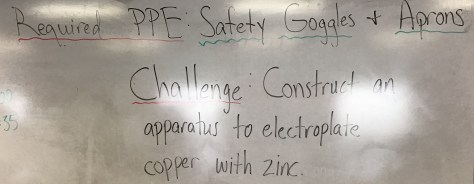
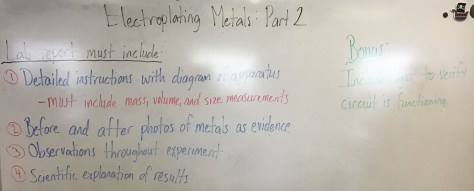
Update: 11/16 – To complete Lesson 27, students were challenged to complete the task outlined below, with a group lab report (due tomorrow) documenting the experience and explaining the learning:

IMG_0106
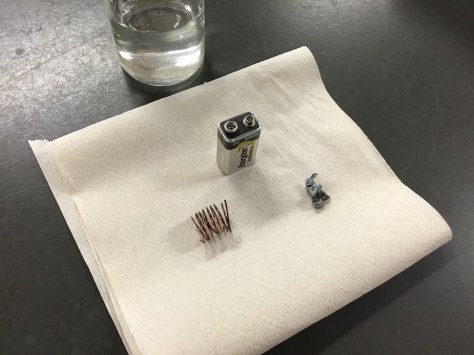
Copper coil connected to negative 9-volt battery terminal became partially zinc-coated (zinc connected to positive terminal) when immersed in acetic acid (vinegar) for 5 minutes.  Copper coil bubbled while zinc appeared unchanged during the experiment.

Homework for this week:

  • Read Lesson 27 in the textbook.  Login via hs.saplinglearning.com and enter your username and password:
    • Username: wahps****s-####### (**** = first 4 letters of your last name and ####### = student number).  Remember to include the dash between s and #.
    • Password: S-####### (the S must be capitalized)
  • Work through the homework problems at the end of Lesson 27 and then verify accuracy with the Lesson 27 Homework Answers.
  • Write notes for Lesson 27 on the Chapter 5 Notes handout.
  • Come to class tomorrow prepared to ask questions about anything from Lesson 27 you do not yet fully understand.

Classifying Substances

We enter the final chapter in Unit 1 with the Lesson 25 PowerPoint, introducing students to the concept of classifying substances based on properties of matter like conductivity and solubility.  After slide 6 in the PowerPoint, students will receive the Lesson 25 Worksheet and then work in groups of 4 students to test the conductivity and solubility of the substances listed on the worksheet.  By the end of class, students will compile all of the data from the lab into the table on page 2 of the worksheet.

Homework for this evening:

  • Read Lesson 25 in the textbook.  Login via hs.saplinglearning.com and enter your username and password:
    • Username: wahps****s-####### (**** = first 4 letters of your last name and ####### = student number).  Remember to include the dash between s and #.
    • Password: S-####### (the S must be capitalized)
  • Work through the homework problems at the end of Lesson 25 and then verify accuracy with the Lesson 25 Homework Answers.
  • Write notes for Lesson 25 on the Chapter 5 Notes handout.
  • Come to class tomorrow prepared to ask questions about anything from Lesson 25 you do not yet fully understand.

Unit 1 Project Launch

Unit 1 Project

Background: With our first unit of chemistry nearly complete, consider all you have learned thus far.  Our initial review of matter (including mass, volume, and density) led to an introduction of the periodic table.  While researching an element for our class periodic table and your element profile project, we expanded our learning to include a brief history of atomic models, and a deeper dive into our current understanding of how atoms are constructed (protons, neutrons, and electrons) and how changing those particles impact an atom.  We learned that the elements are born in stars, with heavier elements forged in the explosive forces of supernovae, while unstable atoms experience decay over time.  We learned that neutrons decay into protons, protons decay into neutrons, and atoms can gain or lose electrons according to well-defined rules (main-group elements) and less-well-defined rules (transition metals).  We learned how to assemble ions into compounds, how to identify the metals in ionic compounds using the flame test, and how to write electron configurations of elements according to the number of electrons in subshells.

“The cosmos is within us.  We are made of star stuff.  We are a way for the universe to know itself.”

What does this quote mean to you?  Your assignment for this project is to unpack Carl Sagan’s famous quote, applying what you have learned during chemistry in unit 1 to your own effort to know yourself.

Deliverable: A well-written essay shared with Mr. Swart as a Google Doc

Due Date: Tuesday, November 20, 2018

Assignment Criteria:  Using the analogy of “If I were an atom…” explore what makes you who you are.

  • Chapter 1: What are your intensive and extensive properties? What makes you who you are and you don’t see changing over time (intensive properties)?  How have you changed over time, and what changes do you anticipate for yourself in the future (extensive properties)?
  • Chapter 2: Where does your name come from? What does your name mean to you?  What does your name mean to others?  What symbols best represent who you are and why?  Consider your reactivity: what gets you excited?  If you were an element on the periodic table, what group would you be in and why?
  • Chapter 3: Perception and reality are not always easy to align. Just like the way scientists have revised models of the atom over time to better reflect new experimental data, perceptions of who we are should be updated as well – by ourselves and by others.  Think about how well your teacher and classmates know the real you.  How well do you know the real you?  What are your most important parts (your metaphorical protons, neutrons, and electrons).  Share insights about yourself that are not obvious to someone who doesn’t know you well and would like to know you better.  What are your needs (fusion)?  What are your gifts to the world (particles shared through decay – let’s make decay a good thing!)?  What are your hopes and dreams, and how will they positively impact others (fission)?
  • Chapter 4: How will you own your future?  What do you intend to accomplish this year, five years from now, ten years from now?  Neutral atoms are fairly predictable – what do you see as your most likely path when you look to the future?  How about your path if you were an ion, able to clear out or add a few extra electrons and make life really interesting for yourself – what would that look like?

Grading: Your essay will be evaluated as a unit exam, a category that comprises 20% of your semester grade.  Incorporate as many Unit 1 vocabulary words as possible (highlight in bold font), in a manner that isn’t forced, to demonstrate mastery of the unit and a deep understanding of yourself.  I look forward to learning more about you!

Grading Rubric:

A B C D
Vocab Words (from chapter 1-4 notes) 20 or more 15-19 10-14 Less than 10
Content Self-reflection from all 4 chapters thoroughly explored Self-reflection from 3 chapters thoroughly explored Self-reflection from 2-3 chapters moderately explored Self-reflection surface-level or more than two chapters missing


Electron Configurations

Our first order of business is for students to complete the isotopes post-assessment survey:

https://docs.google.com/forms/d/e/1FAIpQLScY6iElS_QzLMhB6MQA90kzIb1P79169GOBdUL_jqy9ACTzvg/viewform?usp=sf_link

After taking the survey, we returned to focusing our attention to electrons, culminating  with Lesson 24.  Class notes are shown below:

Student had the remainder of the class period to read Lesson 24 in the textbook to better help them understand the concept of sub-shells.  Students are encouraged to watch the Crash Course chemistry video below as optional homework.

For Friday’s lesson, we will work through the Lesson 24 PowerPoint followed by the Lesson 24 Worksheet.  Students will gain additional practice with electron configurations on Monday through the electron configuration Gizmo.

Keep Learning!

Extend your learning with additional videos focusing on electron orbitals and electron configurations.

Homework for this evening:

  • Read Lesson 24 in the textbook.  Login via hs.saplinglearning.com and enter your username and password:
    • Username: wahps****s-####### (**** = first 4 letters of your last name and ####### = student number).  Remember to include the dash between s and #.
    • Password: S-####### (the S must be capitalized)
  • Work through the homework problems at the end of Lesson 24 and then verify accuracy with the Lesson 24 Homework Answers.
  • Write notes for Lesson 24 on the Chapter 4 Notes handout.
  • Come to class tomorrow prepared to ask questions about anything from Lesson 24 you do not yet fully understand.

Transition Metal Chemistry

Today we learned about how to name compounds that involve transition metals.  To help launch the lesson, students watched a video by Tyler DeWitt titled Transition Metals in Ionic Formulas:

After watching the first video, we practiced writing ionic formulas with transition metals via the Lesson 23.1 worksheet.

Extend your learning!

Students are encouraged to review lesson content by watching the videos below:

Real-world application:

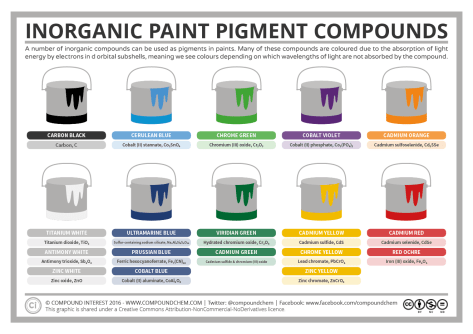
Click on the image below to learn more about how transition metals are used in the process of coloring paint.

Chemistry-of-Inorganic-Paint-Pigment-Compounds

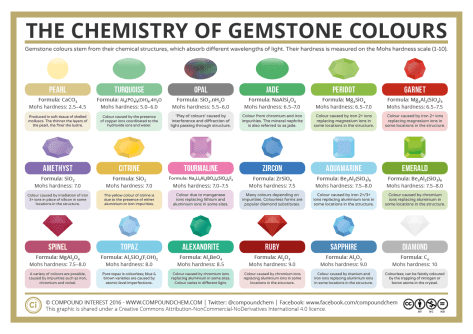
Next, click on the image below to learn how transition metals impact the color of gemstones:

The-Chemistry-of-Gemstone-Colours-2016

What do you notice about the two different images?  How can different transition metals turn different materials (paint and gemstones) similar colors?  How do similar chemical formulas result in different colors?  To help answer this, consider the difference between paint and gemstones: you light observes light reflected by both substances.  Does light interact with paint and gemstones differently?

Homework for this evening:

  • Read Lesson 23 in the textbook.  Login via hs.saplinglearning.com and enter your username and password:
    • Username: wahps****s-####### (**** = first 4 letters of your last name and ####### = student number).  Remember to include the dash between s and #.
    • Password: S-####### (the S must be capitalized)
  • Work through the homework problems at the end of Lesson 23 and then verify accuracy with the Lesson 23 Homework Answers.
  • Write notes for Lesson 23 on the Chapter 4 Notes handout.
  • Come to class tomorrow prepared to ask questions about anything from Lesson 23 you do not yet fully understand.

Polyatomic Ions

For lesson 22, students continued to explore ionic bonds, this time in the context of polyatomic ions.  We worked through the Lesson 22 PowerPoint and then students used the class period to practice creating and naming polyatomic ions and their chemical formulas by playing two different card games and then recording their learning on the Lesson 22 Worksheet.


Update: October 31, 2018: Notes from the Lesson 21/22 review are posted below.  Apologies to my 6th period students who lost an entire class period of learning after the three fire alarm pulls that occurred during that period, disrupting an hour of class for nearly 1200 students at our school.


Students are encouraged to review lesson content by watching the videos below:

Homework for this evening:

  • Read Lesson 22 in the textbook.  Login via hs.saplinglearning.com and enter your username and password:
    • Username: wahps****s-####### (**** = first 4 letters of your last name and ####### = student number).  Remember to include the dash between s and #.
    • Password: S-####### (the S must be capitalized)
  • Work through the homework problems at the end of Lesson 22 and then verify accuracy with the Lesson 22 Homework Answers.
  • Write notes for Lesson 22 on the Chapter 4 Notes handout.
  • Come to class tomorrow prepared to ask questions about anything from Lesson 22 you do not yet fully understand.

Formulas for Ionic Compounds

To help remind students of what we were studying prior to the Friday mini-quiz, we began class with the entry task question: What elements will combine with strontium, Sr, in a 1:1 ratio? Explain your thinking.

We then reviewed select problems from the back of the Lesson 20 worksheet before moving on to the process of creating and naming ionic compounds through the game Salty Eights.  Working in groups of four, students used the game pieces to play the game, recording the compound names and formulas  on the Lesson 21 Worksheet.

For additional support writing ionic formulas, students are encouraged to watch the video below:

Homework for this evening:

  • Read Lesson 21 in the textbook.  Login via hs.saplinglearning.com and enter your username and password:
    • Username: wahps****s-####### (**** = first 4 letters of your last name and ####### = student number).  Remember to include the dash between s and #.
    • Password: S-####### (the S must be capitalized)
  • Work through the homework problems at the end of Lesson 21 and then verify accuracy with the Lesson 21 Homework Answers.
  • Write notes for Lesson 21 on the Chapter 4 Notes handout.
  • Come to class tomorrow prepared to ask questions about anything from Lesson 21 you do not yet fully understand.

Ionic Compounds

We extended our learning about ions to the study of ionic compounds, reviewing Lesson 17-19 content in preparation for the mini-quiz tomorrow.  We then worked through the Lesson 20 PowerPoint which included the vocabulary terms of cation and anion and learning about how different numbers of anions and cations combine by following the Rule of Zero Charge.  Students received a handout containing common ions and their charges to use as a resource, and we worked through the first few problems on the back of the Lesson 20 Worksheet.  Students should continue working on the Lesson 20 worksheet after the mini-quiz tomorrow and this weekend as time permits.  We will review a selection of the problems from the worksheet on Monday.

Homework for this evening:

  • Review Lesson 17-19 content and prepare one (teacher-provided) note card of notes to use on the mini-quiz.
  • Read Lesson 20 in the textbook.  Login via hs.saplinglearning.com and enter your username and password:
    • Username: wahps****s-####### (**** = first 4 letters of your last name and ####### = student number).  Remember to include the dash between s and #.
    • Password: S-####### (the S must be capitalized)
  • Work through the homework problems at the end of Lesson 20 and then verify accuracy with the Lesson 20 Homework Answers.
  • Write notes for Lesson 20 on the Chapter 4 Notes handout.
  • Come to class Monday prepared to ask questions about anything from Lesson 20 you do not yet fully understand.

Ions

Our learning about electrons continued with the Lesson 19 PowerPoint introducing students to the concept of ions.  Students received the Noble Gas Envy handout and we walked through the example on the overhead:

IMG_0076

For classwork, students received the Lesson 19 Worksheet and the Ion Cards Game Cards that accompanies it.  Students worked in small groups to complete the back side of the worksheet.

For extra help, the video below will review ions:

Homework for this evening:

  • Read Lesson 19 in the textbook.  Login via hs.saplinglearning.com and enter your username and password:
    • Username: wahps****s-####### (**** = first 4 letters of your last name and ####### = student number).  Remember to include the dash between s and #.
    • Password: S-####### (the S must be capitalized)
  • Work through the homework problems at the end of Lesson 19 and then verify accuracy with the Lesson 19 Homework Answers.
  • Write notes for Lesson 19 on the Chapter 4 Notes handout.
  • Come to class Monday prepared to ask questions about anything from Lesson 19 you do not yet fully understand.