Category Archives: Chemistry

Valence and Core Electrons

We briefly reviewed the Lesson 17 PowerPoint before transitioning to the Lesson 18 PowerPoint.  There are several hand-outs for Lesson 18, including the Lesson 18 Worksheet, the Lesson 18 Shell Model, the Table of Electron Shells, and the Table of Valence and Core Electrons.

Homework for this evening:

  • Read Lesson 18 in the textbook.  Login via hs.saplinglearning.com and enter your username and password:
    • Username: wahps****s-####### (**** = first 4 letters of your last name and ####### = student number).  Remember to include the dash between s and #.
    • Password: S-####### (the S must be capitalized)
  • Work through the homework problems at the end of Lesson 18 and then verify accuracy with the Lesson 18 Homework Answers.
  • Write notes for Lesson 18 on the Chapter 4 Notes handout.
  • Come to class Monday prepared to ask questions about anything from Lesson 18 you do not yet fully understand.
Flame Tests Lab

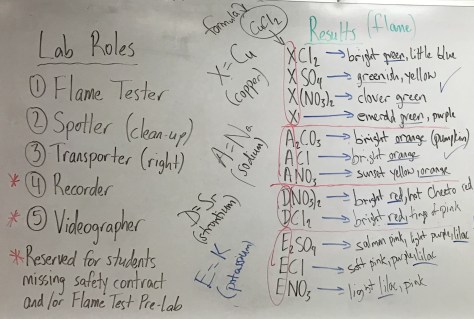
After conducting the flame tests lab, we will construct a data table of flame tests results.  Time permitting, we will review the Lesson 17 PowerPoint and begin discussing the analysis questions from the Flame Test Lab.

Note: Students who missed the Flame Test Lab may work through the Virtual Flame Test Lab on Scratch and then use the learning to work through the analysis questions.

The video below demonstrates the results of a flame test lab involving compounds with potassium (K), copper (Cu), sodium (Na), and strontium (Sr).  Use your observations from the flame test lab you conducted with unknown metals (X, A, D, E) and try to decode the unknowns using the results of the flame test lab in the video.

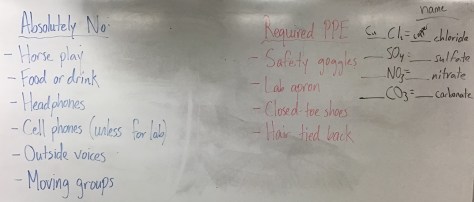
Whiteboard Notes:

IMG_0072IMG_0073

Homework for this evening:

  • Complete the Flame Test Lab analysis questions.
  • Read Lesson 17 in the textbook.  Login via hs.saplinglearning.com and enter your username and password:
    • Username: wahps****s-####### (**** = first 4 letters of your last name and ####### = student number).  Remember to include the dash between s and #.
    • Password: S-####### (the S must be capitalized)
  • Work through the homework problems at the end of Lesson 17 and then verify accuracy with the Lesson 17 Homework Answers.
  • Write notes for Lesson 17 on the Chapter 4 Notes handout.
  • Come to class tomorrow prepared to ask questions about anything from Lesson 17 you do not yet fully understand.
Flame Tests Pre-Lab

After the modified lock-down this morning impacting class times, out of fairness to all of my students, I decided to postpone the Chapter 3 test to tomorrow and instead guide students through the Lesson 17 Flame Test Pre-Lab.

First, we watched the video below so students could better understand what the lab would entail:

Next, students read the Flame Test Lab procedure and then answered the pre-lab questions.  Students also received the Chapter 4 Notes and had the remainder of the class period to read through Lesson 17 in the textbook and work on the notes.

Formation of Elements

To begin class, students were asked to share out a response to the question: where do the elements come from?  After a brief discussion, we watched the video below:

Next, we worked through the PowerPoint to learn more about the concepts of fusion and fission, and then students used the remainder of class to work on the Lesson 16 Worksheet.  This is the final textbook lesson of Chapter 3.  On Monday, we will continue our exploration of nuclear reactions with a Gizmo activity in preparation for the Chapter 3 test next Wednesday.

Homework for this evening:

  • Read Lesson 16 in the textbook.  Login via hs.saplinglearning.com and enter your username and password:
    • Username: wahps****s-####### (**** = first 4 letters of your last name and ####### = student number).  Remember to include the dash between s and #.
    • Password: S-####### (the S must be capitalized)
  • Work through the homework problems at the end of Lesson 16 and then verify accuracy with the Lesson 16 Homework Answers.
  • Write notes for Lesson 16 on the Chapter 03 Notes handout.
  • Come to class Monday prepared to ask questions about anything from Chapters 1-3 you did not yet fully understand.

Nuclear Reactions

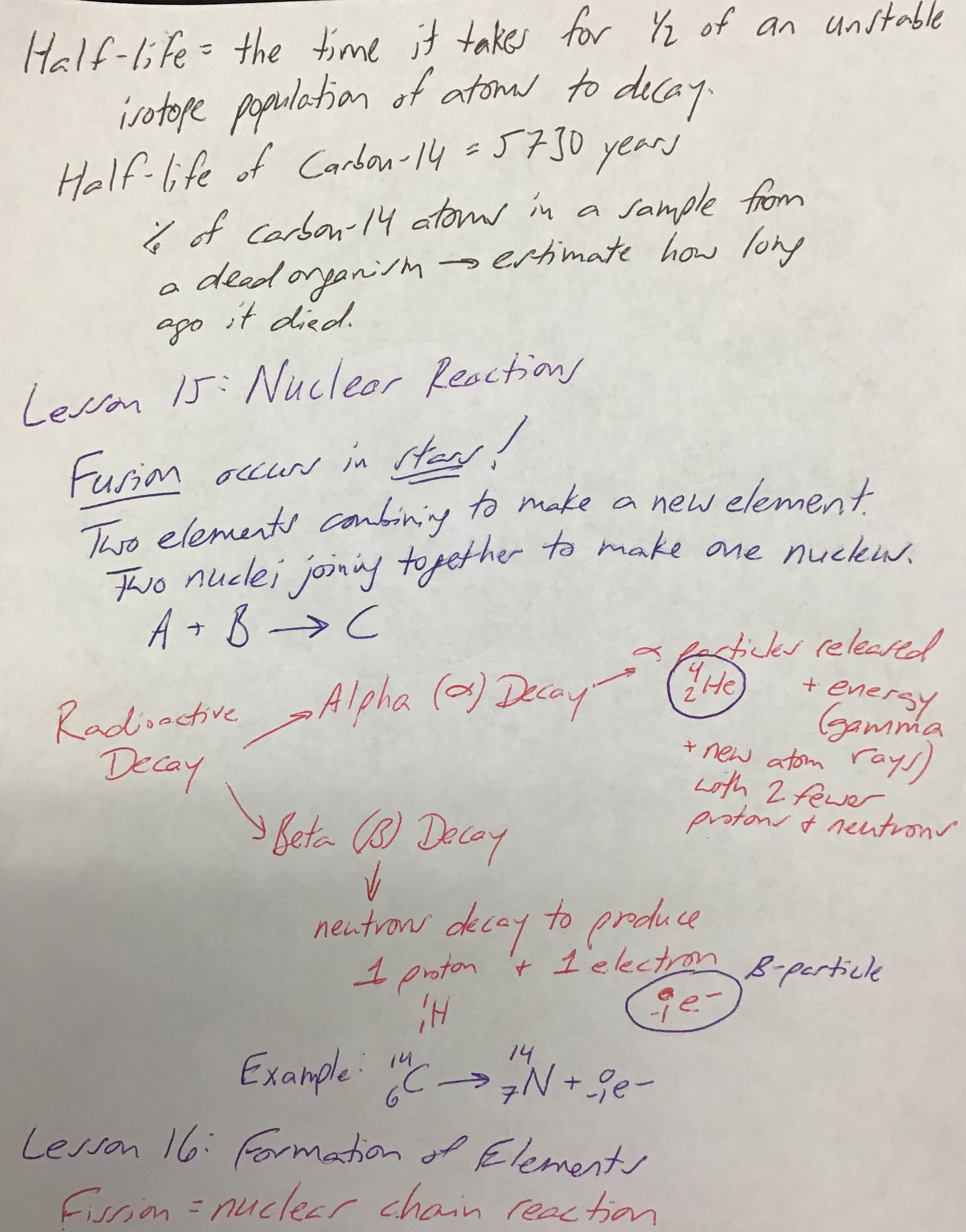
We continued our exploration of how the nucleus of an atom can change by launching into Lesson 15.  The lesson addressed the question: What are nuclear reactions?  We began with an illustration depicting the key vocabulary from the Lesson 15 PowerPoint in order to better understand the Nuclear Quest board game which is the hands-on learning for the day.

IMG_0053

For the game, students gathered into teams of four, with each team receiving the board, the three sheets of nuclear quest cards, the two sheets of radiation cards and the game instructions.  Students also received the Lesson 15 worksheet to help guide them through the key learnings in the game.  Also, the game requires dice which are in limited supply, so visit Random.org and use the virtual dice roller!

Extend Your Learning!

Homework for this evening:

  • Read Lesson 15 in the textbook.  Login via hs.saplinglearning.com and enter your username and password:
    • Username: wahps****s-####### (**** = first 4 letters of your last name and ####### = student number).  Remember to include the dash between s and #.
    • Password: S-####### (the S must be capitalized)
  • Work through the homework problems at the end of Lesson 15 and then verify accuracy with the Lesson 15 Homework Answers.
  • Write notes for Lesson 15 on the Chapter 03 Notes handout.
  • Come to class tomorrow prepared to ask questions about anything of the homework problems from Lesson 15 you did not understand.

Stable and Radioactive Isotopes

We began the class period with the following entry task: How are carbon-12, carbon-13, and carbon 14 similar?  How are they different?  Which isotope would you expect to find most often in nature?  Explain your thinking.

Next, we watched a segment of the NOVA video Hunting the Elements, beginning at 1:39:33 and ending at 1:52:04.  The video served to remind students about last week’s lesson about isotopes (Lesson 13) and to help prepare them for our work this week.

After the video, we reviewed the Lesson 14 PowerPoint.  Students then received copies of the Lesson 14 Worksheet and the Chart of Naturally Occurring Isotopes. working in pairs to complete the lesson by the end of the class period.

Homework for this evening:

  • Read Lesson 14 in the textbook.  Login via hs.saplinglearning.com and enter your username and password:
    • Username: wahps****s-####### (**** = first 4 letters of your last name and ####### = student number).  Remember to include the dash between s and #.
    • Password: S-####### (the S must be capitalized)
  • Work through the homework problems at the end of Lesson 14 and then verify accuracy with the Lesson 14 Homework Answers.
  • Write notes for Lesson 14 on the Chapter 03 Notes handout.
  • Come to class tomorrow prepared to ask questions about anything of the homework problems from Lesson 14 you did not understand.

Isotopes

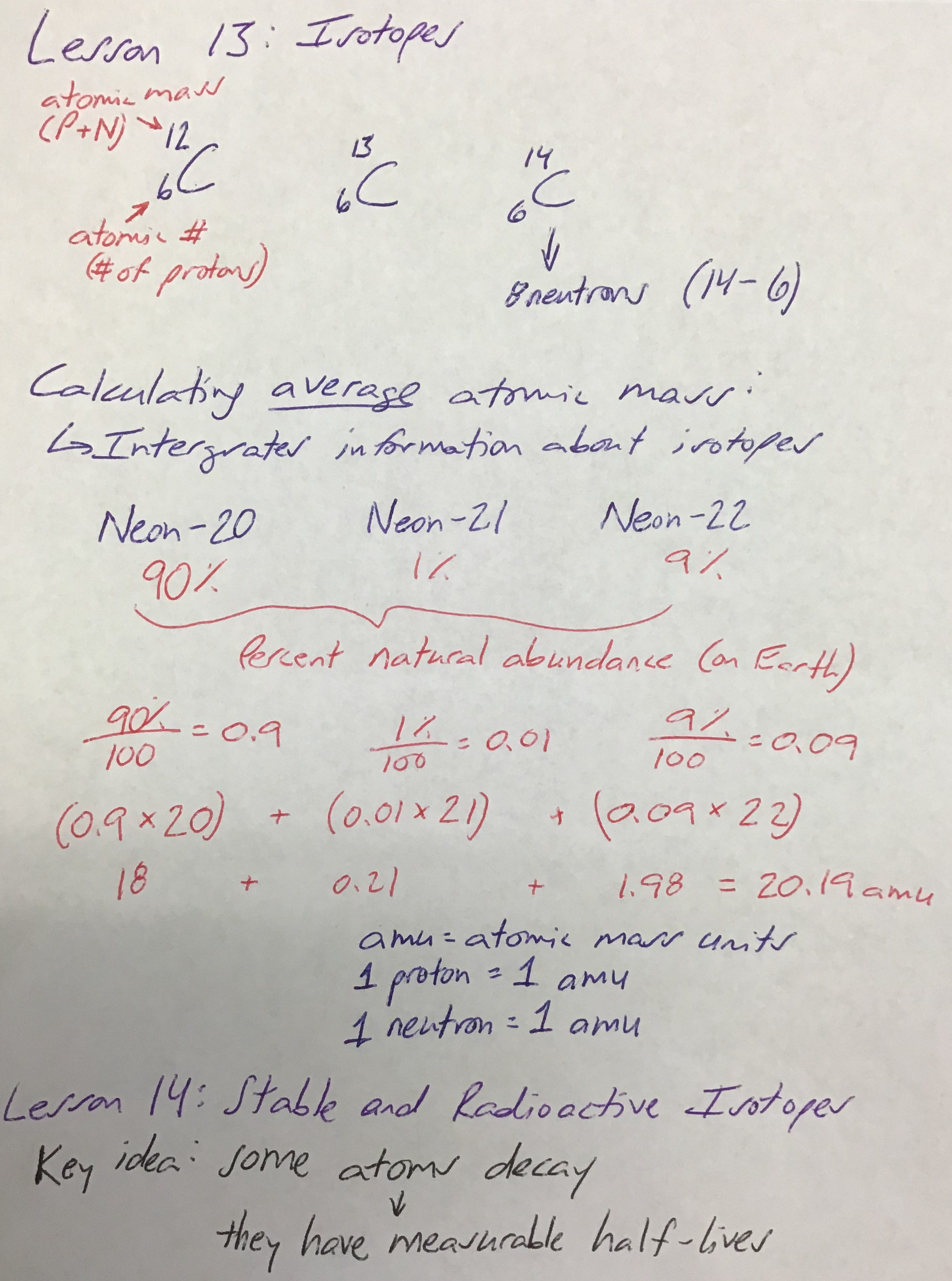
We extended our learning about neutrons yesterday with a lesson about isotopes.  The Lesson 13 PowerPoint explains how certain elements like carbon always contain the same number of protons, but may contain different numbers of neutrons.  Students then practiced calculating the number of protons, neutrons, and electrons on the Lesson 13 Worksheet.

Homework for this evening:

  • Read Lesson 13 in the textbook.  Login via hs.saplinglearning.com and enter your username and password:
    • Username: wahps****s-####### (**** = first 4 letters of your last name and ####### = student number).  Remember to include the dash between s and #.
    • Password: S-####### (the S must be capitalized)
  • Work through the homework problems at the end of Lesson 13 and then verify accuracy with the Lesson 13 Homework Answers.
  • Write notes for Lesson 13 on the Chapter 03 Notes handout.
  • Come to class tomorrow prepared to ask questions about anything of the homework problems from Lesson 13 you did not understand.

Periodic Table Project

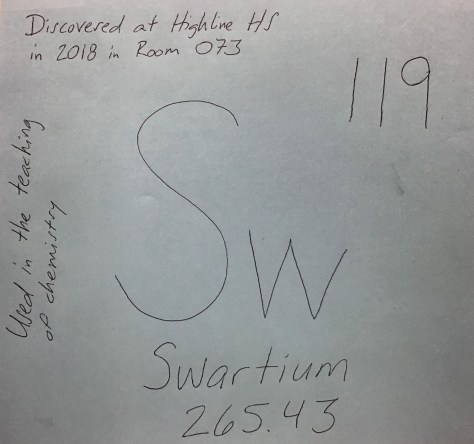
For the Periodic Table Project, students will create a small poster of the key information of their element as researched during the Element Profile Project.  Each student will receive a piece of colored paper measuring 22 cm long and 19 cm wide.  Note: the color of the paper is important!  Only use the color of paper provided to you.  For the Periodic Table Project, orient the paper in landscape (long sides on the top and bottom – this is really important!!!).

IMG_0049
Example panel of a fictitious element

The following information must be written clearly and big enough to be seen from across the room:

The following information must be written clearly and big enough to be seen from at least half-way across the room:

Please include at least two additional pieces of information someone could easily see if standing near your poster:

CompoundChem.com also has a treasure trove of really amazing infographics.  The links below are resources compiled from that website to help you in your quest to complete this assignment.  Determine the group your element is in, the click the link:

Atomic Number and Atomic Mass

Lesson 12 from the textbook was introduced with a brief review of atomic number and atomic mass.  Key learnings:

  • Atomic number = # of protons in one atom of a given element
  • Protons have a positive charge
  • Electrons have a negative charge
  • Neutral atoms have equal numbers of protons and electrons
  • Atomic mass = (# of protons) + (# of neutrons) in one atom of a given element
  • Neutrons have no charge

Example of Entry Task Notes:

IMG_0047

Students then worked in pairs to complete the Lesson 12 Worksheet.  Students who need more practice with this lesson are encouraged to work through the Element Builder Gizmo.  See Mr. Swart for the instruction packet.  Successful completion of the packet will earn students one bonus point.

Homework for this evening:

  • Read Lesson 12 in the textbook.  Login via hs.saplinglearning.com and enter your username and password:
    • Username: wahps****s-####### (**** = first 4 letters of your last name and ####### = student number).  Remember to include the dash between s and #.
    • Password: S-####### (the S must be capitalized)
  • Work through the homework problems at the end of Lesson 12 and then verify accuracy with the Lesson 12 Homework Answers.
  • Write notes for Lesson 12 on the Chapter 03 Notes handout.
  • Come to class tomorrow prepared to ask questions about anything of the homework problems from lesson 12 you did not understand.