All posts by David Swart

High school science teacher

Mitosis: Mitosis Project – Day 4

Today is the final big work day for student groups working on their Mitosis Projects.  The goal for today was to briefly assess the current state of the project, identify goals to work towards in bringing the project to a successful completion, and finally for group members to assign homework to complete any remaining project components outside of class.  Students recorded their group discussion on a worksheet.  Slides presented at the beginning of class can be viewed here.

Tomorrow we will wrap up the projects, putting finishing touches on the content and practicing presentations.  Students will also complete an assessment of the project.

Mitosis: Mitosis Project – Day 3

Student groups continue to make excellent progress in their Mitosis Projects.  To help students capture what has been contributed by each group member so far and what still needs to be accomplished, students completed an organizing worksheet as an entry task.  Students were also reminded about the required components of the project and that third quarter ends next Friday.  The slides for today are attached here.

Mitosis: Check-in

With the short period today, we reviewed how to identify credible scientific sources and how to properly cite those sources using APA format.  Students were introduced to the website Citation Machine which helps extract key citation information from websites and helps quickly build citations.  For the project, teams must cite a minimum of 5 credible scientific sources.  Because of the technological challenges faced during the Chromosome Project, student groups received a paper copy of a document prompting them to save sources.

Students worked the remainder of the class period to properly cite previously identified sources and continued making progress on Mitosis Projects, providing me with time to check in with each group to see how the projects are progressing and to ensure students have what they need to continue moving forward.

Mitosis: Mitosis project – Day 2

Today marked the second day students worked in groups to develop their Mitosis Projects.  Students began class with an entry task asking them to write 4 sentences explaining the connection between their group’s Mitosis Project research topic and mitosis.  Next, groups received their work from yesterday along with the Day 2 Activity Log.  In addition to sketching out their poster, groups began focusing on their “additional element” – the creativity of my students is incredible!  Groups are creating videos (acted out and claymation), a comic strip, an original game, a brochure, and presentations with PowerPoint and Prezi.


Mitosis: Mitosis project – Day 1

Today students launched in to the Mitosis Project.  After working through a brief starter activity (practice with an EOC-style unanticipated consequence question), students worked with their groups to make sense of their project assignment.  The Day 1 Activity Log was used to document student contributions and was turned in at the end of class.  Below are some resources for groups as they begin conducting research on their topic:

  1. Mitochondrial replication
  2. Chloroplast replication
  3. Binary fission in bacteria
  4. Muscle growth and repair
  5. Epigenetics and regulation of gene expression
  6. Homeobox genes in embryogenesis
  7. Limb regeneration in newts and salamanders
  8. C. elegans cell fate mapping
  9. Cancer and metastasis
  10. The effect of smoking on lung cells
  11. The effect of alcohol on liver cells
  12. Retrovirus infection

Mitosis: Modeling mitosis

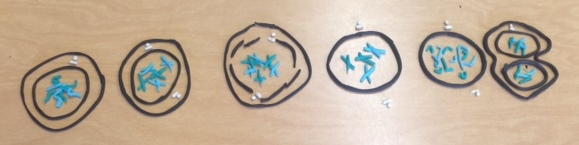
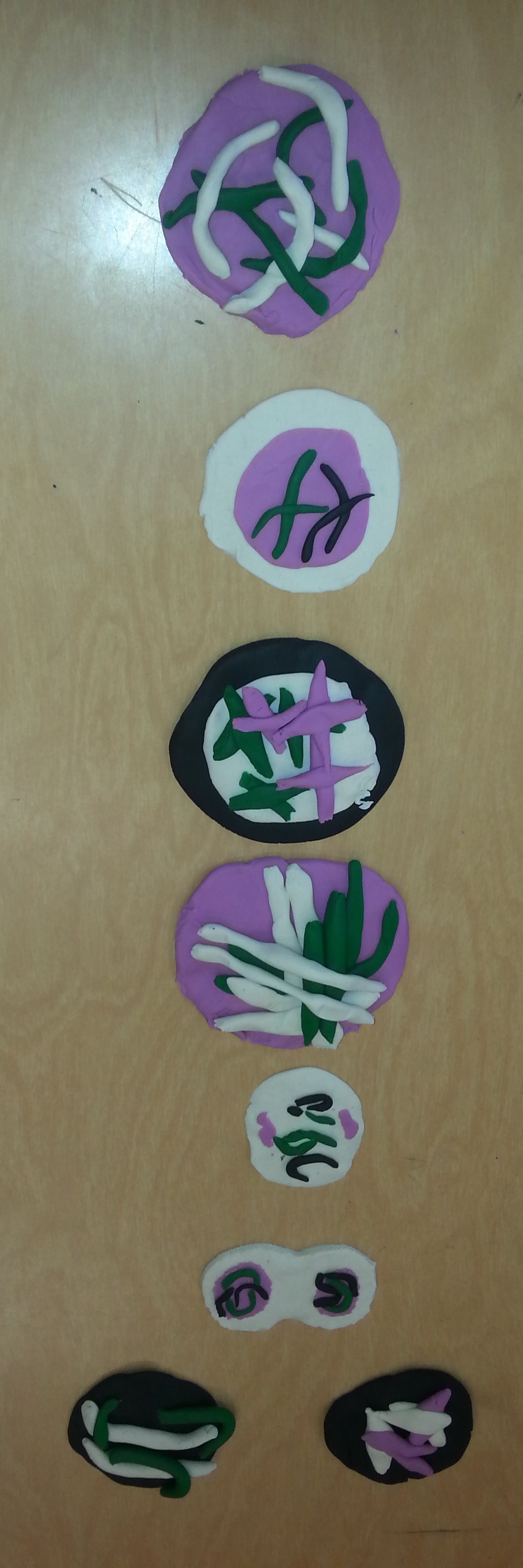
After assembling into project groups of 3-4 students, groups were tasked with modeling the process of mitosis using Play-Doh.  Students documented their work by taking pictures (extra credit for stop-motion video) and emailing them for posting on the class website.  The modeling activity served to help the team bond and identify team member strengths.  After modeling mitosis, students set their sites on the Mitosis Project worksheet.  Teams were tasked with researching the 12 available project options, picking their top 4 project selections, and then explaining why they should get their top pick (in the event of multiple groups picking the same topic).  Tomorrow, groups will receive their project assignments and begin working on the project.  Student work examples from the mitosis project are shown below:

IMG_5905

IMG_1480

Mitosis

Mitosis: Introduction to mitosis – Day 2

We kicked off the class period with an engaging science video from Late Night with Jimmy Fallon:

We then launched in to a continuation of Friday’s introduction to mitosis (click here for the slides).  Students reviewed their notes from the reading to discuss the entry task.  Next, students learned some key vocabulary terms for understanding and discussing mitosis.  Finally, we ended class with a Crash Course video about mitosis:

Students interested in learning more about the molecular biology of mitosis should check out this TED Talk from Drew Berry:

Mitosis: Introduction to mitosis – day 1

Today we launched into the study of mitosis by reading the first several pages of chapter 4 (Cellular Reproduction: Multiplication By Division) of Inside the Cell.   With the short class periods today, students were tasked with reading pages 46-51 and answering the following questions in their lab notebooks:

  1. Explain the purpose of mitosis.
  2. Which cells undergo mitosis?
  3. Describe the phases of mitosis in detail (words and drawings).
  4. Explain what happens when cells divide uncontrollably.  List the known causes of uncontrolled cell division.

This unit is focused specifically on NGSS Standard HS-LS1-4Use a model to illustrate the role of cellular division (mitosis) and differentiation in producing and maintaining complex organisms.  Students have previously been assessed on their understanding of how cellular expression of specific gene products (proteins) can result in unique cell types, and groups of unique cell types can form tissues.  Students learned about body structure and organization during Unit 3, including the organization of cells into tissues and organs.  In this mini-unit, students will be able to clearly connect the process of mitosis (cell division) with tissue organization and organism development.