Fall SLCs are scheduled for Tuesday, November 26 from 3:00-7:00 PM and Wednesday, November 27 from 8:00-11:00 AM. Students will complete the SLC Template for each class (available in English, Spanish, and Vietnamese), excluding Advisory. Students who need guidance will out the SLC Template can use the SLC Handout Exemplar for inspiration. Finally, our Video Productions class created a helpful how-to video so students understand the expectations around leading an SLC.
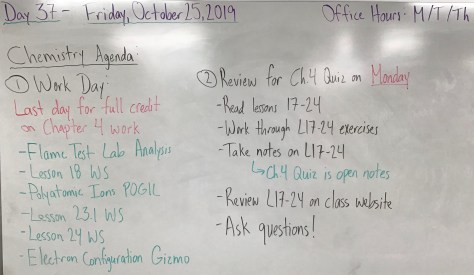
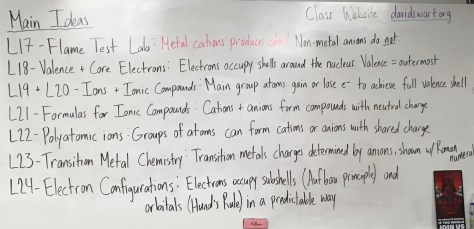
Students had the short Friday class period as a work / review day to catch up on all missing work and to prepare for Monday’s Chapter 4 Quiz. All work must be turned in today to receive full credit. After today, assignments will receive a maximum score of 60% credit.
For today’s work, students were assigned to read Lesson 115: Electromagnetic Radiation in the textbook, then answer the exercise questions at the end of the lesson. Answers to the questions will be turned in as an assignment.
Notes from class:
Homework:
Read Lesson 115 in the textbook. Login via hs.saplinglearning.com and enter your username and password:
Username: wahps****s-####### (**** = first 4 letters of your last name and ####### = student number). Remember to include the dash between s and #.
Password: S-####### (the S must be capitalized)
Work through the practice problems at the end of Lesson 115.
Please ask questions about anything from Lesson 115 you do not yet fully understand.
Opportunities For Help Outside of Class:
Mr. Swart’s office hours: Mondays, Tuesdays, and Thursdays after school until at least 3:00 (later with advanced notice)
Use the vast number of resources available on this website – check each lesson!
Email Mr. Swart for help if staying after school is not possible
Form a study group with other students to review concepts from class
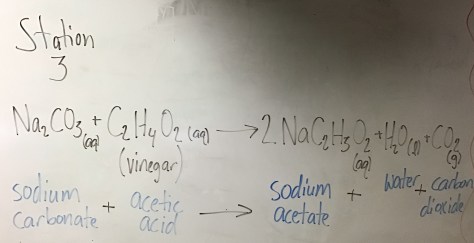
We briefly reviewed the Lesson 71 PowerPoint and then students had the remainder of the class period to work in groups to complete the lab described on the Lesson 71 Worksheet.
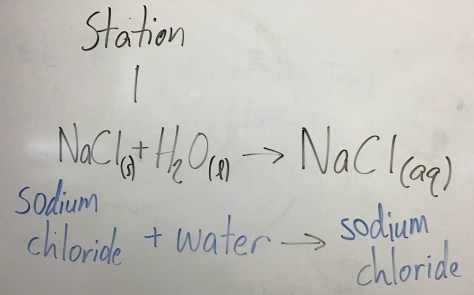
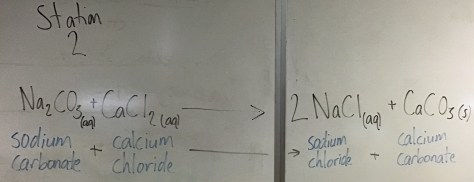
Notes from the whiteboard (lab stations):
Homework:
Read Lesson 71 in the textbook. Login via hs.saplinglearning.com and enter your username and password:
Username: wahps****s-####### (**** = first 4 letters of your last name and ####### = student number). Remember to include the dash between s and #.
Password: S-####### (the S must be capitalized)
Work through the practice problems at the end of Lesson 71.
Please ask questions about anything from Lesson 71 you do not yet fully understand.
Opportunities For Help Outside of Class:
Mr. Swart’s office hours: Mondays, Tuesdays, and Thursdays after school until at least 3:00 (later with advanced notice)
Use the vast number of resources available on this website – check each lesson!
Email Mr. Swart for help if staying after school is not possible
Form a study group with other students to review concepts from class
Having thoroughly explored gas laws involving two variables (Pressure & Volume, Pressure & Temperature, and Temperature and Volume), students were introduced to the Combined Gas Law, k=PV/T, at the end of class yesterday. We began class with the video below:
Next, students received a copy of a handout designed to accompany the Deriving the Gas Laws activity packet from yesterday. Students worked with their table partners to review, model, and explain the lab data. The handout, due at the end of class, included a combined gas law practice problem. Students had the remainder of the class period to:
Read Lesson 61 in the textbook and work through the practice exercises (assigned yesterday)
Complete the Lesson 61 worksheet handed out yesterday (due tomorrow, February 21)
Read Lesson 64 in the textbook and worth through the practice exercises.
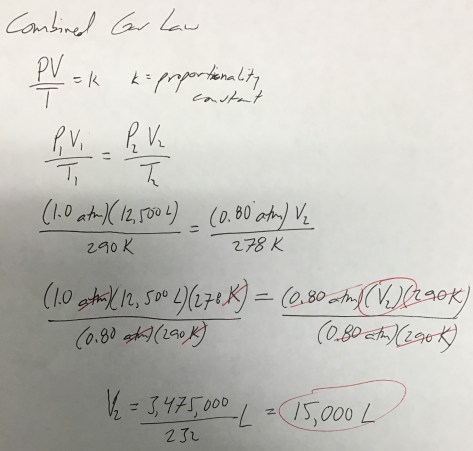
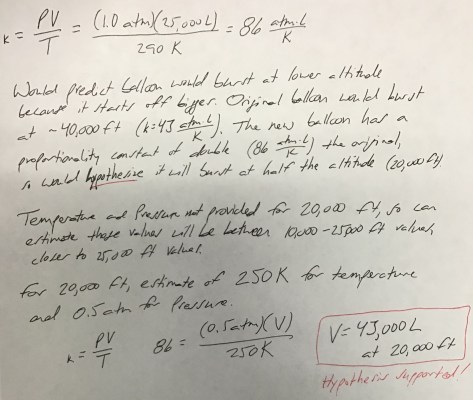
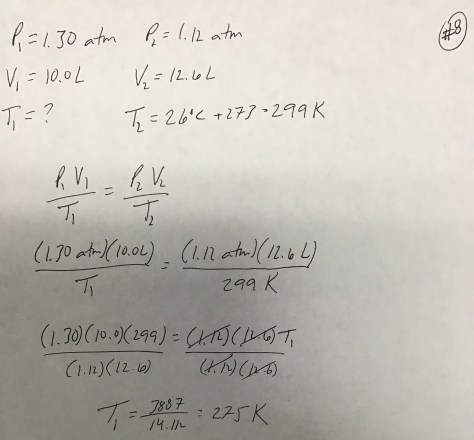
We spent an extra day working through Combined Gas Law problems (class periods were short as a result of the Curriculum Fair). We reviewed a few problems from the table on th efront of the Lesson 61 Worksheet, and we also worked through question 7 from a handout of additional Gas Law practice problems. Class notes are shown below:
Example of volume solved at 5,000 ft from the L61 WS tableExplanation of Q8 from L61 WS
Homework:
Read Lesson 64 in the textbook. Login via hs.saplinglearning.com and enter your username and password:
Username: wahps****s-####### (**** = first 4 letters of your last name and ####### = student number). Remember to include the dash between s and #.
Password: S-####### (the S must be capitalized)
Work through the practice problems at the end of Lesson 64.
Please ask questions about anything from Lesson 64 you do not yet fully understand.
Opportunities For Help Outside of Class:
Mr. Swart’s office hours: Mondays, Tuesdays, and Thursdays after school until at least 3:00 (later with advanced notice)
Use the vast number of resources available on this website – check each lesson!
Email Mr. Swart for help if staying after school is not possible
Form a study group with other students and meet regularly to review concepts from class (meet in person, online, by phone, social media, etc)
For our work today, students have the class period to complete their analysis of yesterday’s activity and then they can work in pairs to complete the Gas Laws Simulation and accompanying guided work packet.
Notes From Class:
Students received a handout with notes explaining how to convert between Fahrenheit, Celsius, and Kelvin (temperature units). The answer key for the questions within the notes is shown below:
After completing the Entry Task, students re-assembled into work groups from yesterday to complete Lesson 40. Students used the remainder of the class period to work through the Covalent Bonds Gizmo with a partner.
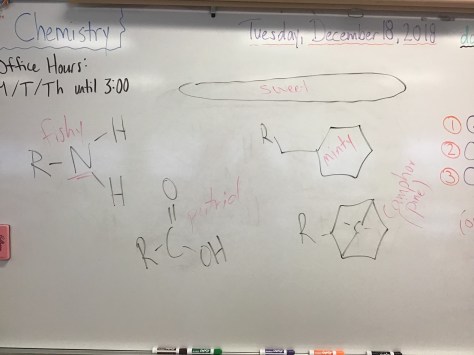
At the end of class, we reviewed the key learning from Lesson 40 with whiteboard notes pictured below:
For Lesson 40, students worked in small groups to organize a set of 24 cards containing compounds with different shapes and functional groups. The Lesson 40 PowerPoint includes a nice graphic organizer for studying the relationship between molecule name and functional group. The Lesson 40 Worksheet and Card Sort are available for download.
Homework:
Read Lesson 40 in the textbook. Login via hs.saplinglearning.com and enter your username and password:
Username: wahps****s-####### (**** = first 4 letters of your last name and ####### = student number). Remember to include the dash between s and #.
The Lesson 26 PowerPoint will introduce students to the four models of chemical bonding. Students will also receive a handout of the models with additional information. After the PowerPoint, students will work in pairs to organize the Substance Cards and record their learning on the Lesson 26 worksheet.
Homework for this evening:
Read Lesson 26 in the textbook. Login via hs.saplinglearning.com and enter your username and password:
Username: wahps****s-####### (**** = first 4 letters of your last name and ####### = student number). Remember to include the dash between s and #.
Password: S-####### (the S must be capitalized)
Work through the homework problems at the end of Lesson 26 and then verify accuracy with the Lesson 26 Homework Answers.
With the last few school days impacted by a string of fire alarm pulls, chemistry classes are out of sync. Our goal today is to bring classes back into alignment. Our agenda is as follows:
Students who complete the Gizmo should head back to the Lesson 24 post from last week and review the videos on electron configuration and orbitals to fully round out the learning about this topic.




 Science with Swart
You must be logged in to post a comment.