Category Archives: Chemistry

Polyatomic Ions

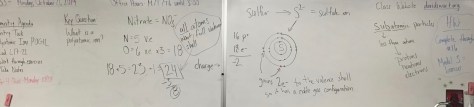
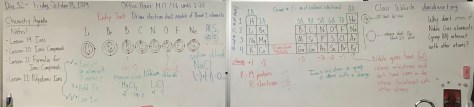
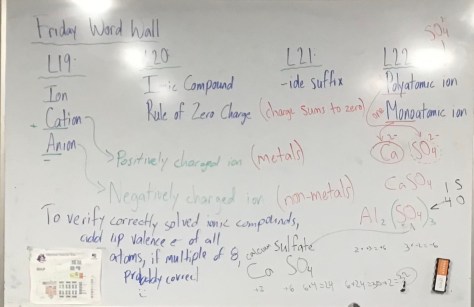
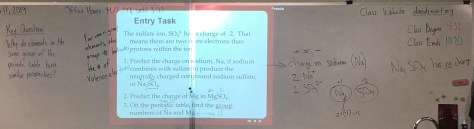
On Friday, students were introduced to the concept of ion, ionic compounds and polyatomic ions.  To practice writing formulas of polyatomic compounds, students used the handout containing common ions and their charges from Friday to use as a resource for completing the Polyatomic Ions POGIL activity today.

Students also received the instructions for creating a login so they can access the online version of our textbook.

Class Notes:

IMG_0574.jpg

Students are encouraged to review lesson content by watching the videos below:

Ions, Ionic Compounds, and Formulas

Our work today introduced students to the concept of ions: atoms with positive or negative charge.  Up to now, students have considered atoms to be neutral, because we have discussed atoms as having equal numbers of protons (positive charge) and electrons (negative charge).  While atoms can certainly remain neutral, many atoms exist in nature as ions.  Atoms gain or lose electrons in predictable ways to form ions, and ions partner up in predictable ways to form ionic compounds.

A neutral atom has equal numbers of protons and electrons.  When a neutral atom loses one or more electrons, the atom will have fewer electrons than protons, and thus will have a positive charge.  We call a positively charged atom a cation (an ion with a positive charge).  Cations are often metals.  When a neutral atom gains one or more electrons, the atom will have more electrons than protons, and thus will have a negative charge.  We call a negatively charged atom an anion (an ion with a negative charge).  Anions are often non-metals.

Just like the positive end of one magnet is attracted to the negative end of another magnet, cations and anions attract.  When a cation bonds with an anion, an ionic compound forms.  The bond between the ions is called an ionic bond.  Ionic compounds can be simple: one cation with a +1 charge bond will bond with one anion with a -1 charge.  Similarly, one cation with a +2 charge will bond with one anion with a -2 charge.  If a cation with a +2 charge bonds with an anion with a -1 charge, the +2 cation will actually bond with two -1 anions, creating an ionic compound with three ions: one cation and two anions.  This is because anions and cations bond together following the Rule of Zero Charge: the positive and negative charges sum to zero.  Ions commonly exist in charges of +1, +2, +3, -3, -2, -1.

The charge of an ion for a given element is predictable.  It’s actually built into the structure of the periodic table.  Focusing on the main group elements:

  • Group 1A elements readily give up one electron to form +1 cations.
  • Group 2A elements give up two electrons to form +2 cations.
  • Group 3A elements give up three electrons to form +3 cations.
  • Group 4A elements don’t often give up or take electrons and thus remain neutrally charged (no charge).
  • Group 5A elements take three electrons to form -3 anions.
  • Group 6A elements take two electrons to form -2 anions.
  • Group 7A elements greedily take one electron to form -1 anions.
  • Group 8A elements don’t give up or take electrons and remain neutrally charged (which is why they are called Noble Gases – they don’t interact with other elements).

We then practiced writing formulas of ionic compounds using our improved understanding of the periodic table.

Finally, we extended our understanding of ions to include cases where cations and/or anions consist of multiple atoms bonded together.  We call such cations and anions polyatomic ions.  The ammonium ion (NH3+) is a common polyatomic cation.  Hydroxide (OH-) is a common polyatomic anion.  Polyatomic ions commonly have charges ranging from +1 to -3 depending on the atoms that come together to form the polyatomic ion.  Just like cations and anions attract, polyatomic cations attract anions and polyatomic anions.  Similarly, polyatomic anions attract cations and polyatomic cations.

To practice writing formulas of polyatomic compounds, students received a handout containing common ions and their charges to use as a resource for completing the Polyatomic Ions POGIL activity on Moday.

Notes from class:

IMG_0571

IMG_0572

For extra help, the video below will review ions:

For additional support writing ionic formulas, students are encouraged to watch the video below:

Flame Test Lab

To begin class, students received back their Chapter 3 quizzes.  We briefly reviewed the quizzes and then turned our attention to our first big lab of the year: The Flame Test Lab.  To prepare for the flame test lab tomorrow, we watched the video below:

Next, students received a copy of the Flame Test Lab and we read through the procedure and then answered the pre-lab questions.


Tuesday, October 15: Flame Test Lab

After completing the lab, students were assigned to complete analysis questions 1 and 2 as homework.


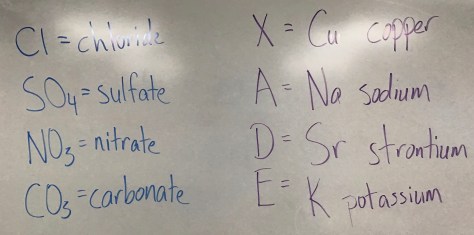
Wednesday, October 16: Notes from the white board (very short class period because of the PSAT) are below.  Students had the class period to complete the table and analysis questions during class.  Those who did not finish should complete the work as homework.

IMG_0568

IMG_0569

Students are encouraged to review the Lesson 17 PowerPoint.

Homework for this evening:

  • Read Lesson 17 in the textbook.  Login via hs.saplinglearning.com and enter your Synergy username and password.
  • Work through the exercises at the end of Lesson 17.
  • Come to class tomorrow prepared to ask questions about anything from Lesson 17 you do not yet fully understand.

Extend Your Learning!

Unit 1 Project

Unit 1 Project

Background: With the end of our first unit of chemistry in sight, consider all you have learned thus far.  Our initial review of matter (including mass, volume, and density) led to an introduction of the periodic table.  We learned about the history of atomic models, explored how atoms are constructed (protons, neutrons, and electrons) and how changing those particles impact an atom.  We learned that the elements are born in stars, with heavier elements forged in the explosive forces of supernovae, while unstable atoms experience decay over time.  We learned that neutrons decay into protons, protons decay into neutrons, and atoms can gain or lose electrons according to well-defined rules (main-group elements) and less-well-defined rules (transition metals).  We learned how to assemble ions into compounds, how to identify the metals in ionic compounds using the flame test, and how to write electron configurations of elements according to the number of electrons in subshells.

“The cosmos is within us.  We are made of star stuff.  We are a way for the universe to know itself.”

What does this quote mean to you?  Your assignment for this project is to unpack Carl Sagan’s famous quote, applying what you have learned during chemistry in unit 1 to your own effort to know yourself.

Deliverable: A well-written essay shared with Mr. Swart as a Google Doc.  Incorporate as many Unit 1 vocabulary words as possible (highlight in bold red font if you want them to count toward your total!), in a manner that isn’t forced, to demonstrate mastery of the unit and a deep understanding of yourself.  I look forward to learning more about you!

Due Date: Friday, November 8, 2019

  • Chapter 1: What are your intensive and extensive properties? What makes you who you are and you don’t see changing over time (intensive properties)?  How have you changed over time, and what changes do you anticipate for yourself in the future (extensive properties)?
  • Chapter 2: Where does your name come from? What does your name mean to you?  What does your name mean to others?  What symbols best represent who you are and why?  Consider your reactivity: what gets you excited?
  • Chapter 3: Models of the atom have changed over time – just like people!  Think about how well your teacher and classmates know the real you.  How well do you know the real you?  What are your most important parts (your metaphorical protons, neutrons, and electrons).  Share insights about yourself that are not obvious to someone who doesn’t know you well and would like to know you better.  What are your needs (fusion)?  What are your gifts to the world (particles shared through decay – let’s make decay a good thing!)?  What are your hopes and dreams, and how will they positively impact others (fission)?
  • Chapter 4: Electrons are the way atoms interact with each other?  We can predict how an atom will interact with other atoms based on its electron structure.  What about you?  Are you that predictable?  What do you intend to accomplish this year, five years from now, ten years from now?  What do you see as your most likely path when you look to the future?  How about your path if you were an ion, able to clear out or add a few extra electrons and make life really interesting for yourself – if there were no constraints on your future, what would you want to accomplish?

Grading: Your essay will be evaluated as a unit exam, a category that comprises 25% of your semester grade.

Grading Rubric:

A B C D
Vocab Words (from chapter 1-4 notes) 20 or more 15-19 10-14 Less than 10
Content Self-reflection from all 4 chapters thoroughly explored Self-reflection from 3 chapters thoroughly explored Self-reflection from 2-3 chapters moderately explored Self-reflection surface-level or more than two chapters missing

List of Unit 1 Vocabulary Words


Unit 1 Project – Example Introduction

The Story of David Swart

My name is Dave, a name I inherited from my father.  My story began 41 years ago in Burien, Washington, at a hospital known today as Highline Hospital.  My intrinsic properties, the things that haven’t changed for as long as I can remember, are that I am an inquisitive person and I have a very strong sense of fairness.  Some of my earliest memories are of playing with Legos and building spaceships, dreaming of a future with endless possibilities for exploring the unknown.  I would always look forward to visiting with my grandfather.  He served in World War II (something he never talked about), and lived in Port Orchard on the Kitsap Peninsula.  Because he lived so far away, we wouldn’t see him often, but when we did I would explore his garden, his garage, and the beach below his house overlooking Seattle.  I thought it was so neat that someone could literally grow food, something my family didn’t do.  I loved being in his garage and watching him work with wood, turning it into so many different amazing projects.  And I really loved walking the beach, looking for treasures, trying not to step on rocks covered with barnacles or slip on the seaweed, often looking up at the big buildings of downtown Seattle and hoping one day to have a job where I could work there.


Unit 1 Project – Example Introduction

The Story of Johnny

My name is Johnny. I am currently attending Highline College in hoping to transfer to a four year university to get a degree in communications. If I were to make a hypothesis on what my future career would look like, I would say I would be in broadcasting. I am my own element. I am unique, and there is nobody who is exactly like me. I guess you can say my identical brother is pretty close though. In that case he is an isotope. We have the same genetic makeup, but different characteristics.


List of Unit 1 Vocabulary Words

Formation of Elements

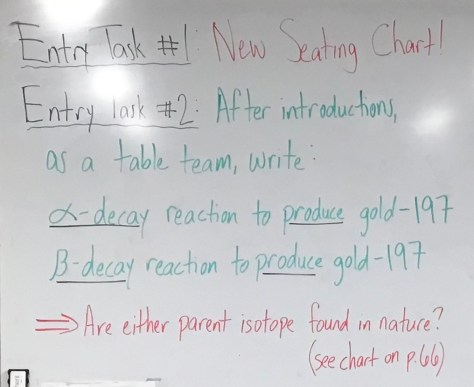
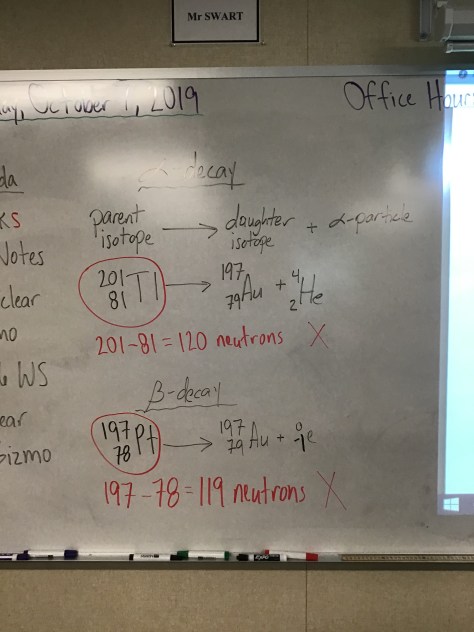
To begin class, students moved to their new seats and then attacked entry task question #2 with their new seat partners.

IMG_0546

IMG_0547

IMG_0548

IMG_0549

Next, students were asked to share out a response to the question: where do the elements come from?  After a brief discussion, we watched the video below:

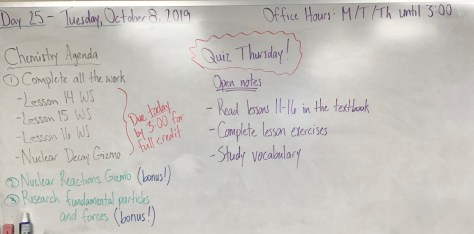
Next, we worked through the PowerPoint to learn more about the concepts of fusion and fission, and then students used the remainder of class to work on the Lesson 16 Worksheet.  This is the final textbook lesson of Chapter 3.  On Tuesday, we will continue our exploration of nuclear reactions with a Gizmo activity in preparation for the Chapter 3 test on Thursday.

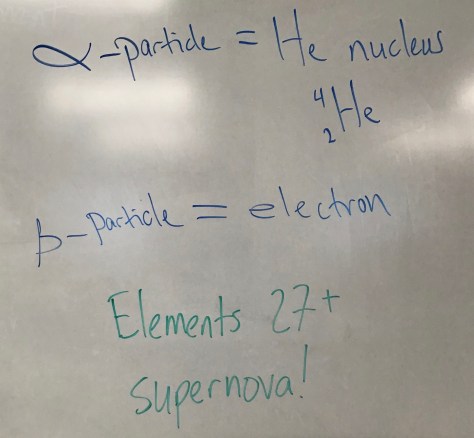
Class notes for October 8:

IMG_0550.jpg

Nuclear Reactions

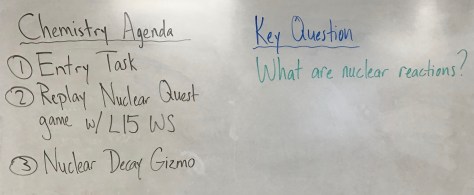
For our first day of Lesson 15, we continued our exploration of how the nucleus of an atom can change.  The lesson addressed the question: What are nuclear reactions?  We began with an illustration depicting the key vocabulary from the Lesson 15 PowerPoint in order to better understand the Nuclear Quest board game which is the hands-on learning for the day.

IMG_0053

For the game, students gathered into teams of four, with each team receiving the board, the three sheets of nuclear quest cards, the two sheets of radiation cards and the game instructions.  Also, the game requires dice which are in limited supply, so visit Random.org and use the virtual dice roller!


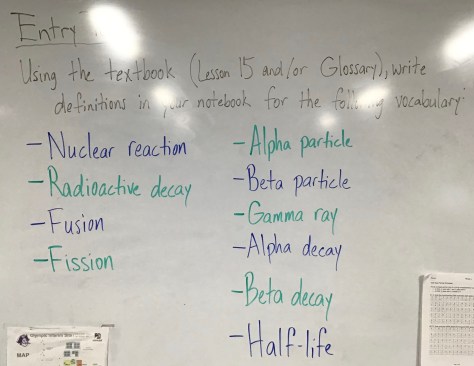
For our second day of Lesson 15, we began with an entry task instructing students to look up in their textbook 10 important vocabulary terms to write down  in their lab notebooks.

IMG_0539

IMG_0538

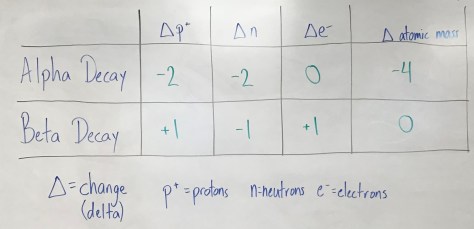
Next, we briefly reviewed the net effects of alpha and beta decay on the parts of an atom:

IMG_0540

Finally, students replayed the Nuclear Quest game from yesterday, this time focusing on understanding the types of reactions and their effects on atoms.  Students also received the Lesson 15 worksheet to help guide them through the key learnings in the game.  After completing the game, students received a copy of the Nuclear Decay Gizmo which they should plan to complete by the end of class tomorrow.

Extend Your Learning!

Stable and Radioactive Isotopes

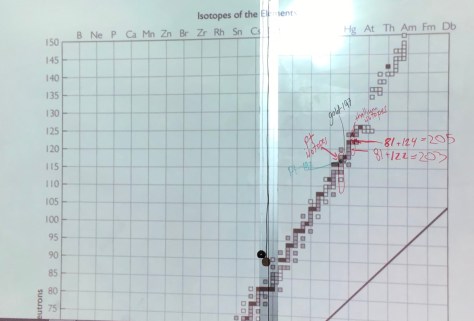
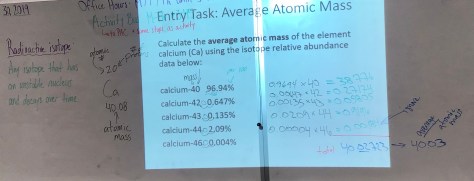
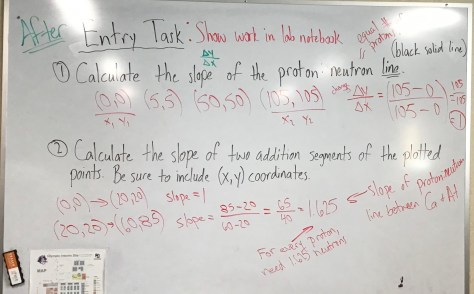
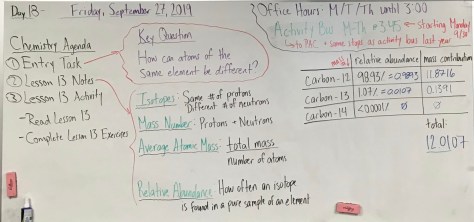
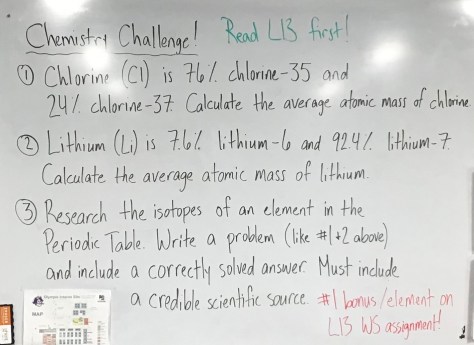
We began the class period with an entry task (solution shown below) to review average atomic mass calculations.  We followed it with an “After” Entry Task which introduced students to the Chart of Naturally Occurring Isotopes. Pictures of both are shown below:

IMG_0529

IMG_0530

Next, we watched a segment of the NOVA video Hunting the Elements, beginning at 1:39:33 and ending at 1:52:04.  The video served to remind students about last week’s lesson about isotopes (Lesson 13) and to help prepare them for our work this week.

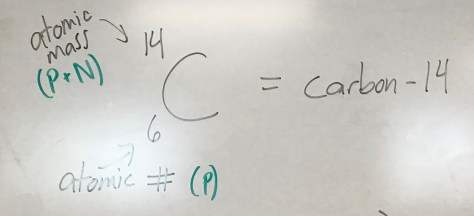
After the video, students received copies of the Lesson 14 Worksheet and had time to complete the front side of the worksheet before class ended. Students were introduced to yet another way to write isotopes (below):

IMG_0531

We will work through the remainder of the handout tomorrow.  The Lesson 14 PowerPoint is provided for reference.

Atomic Number and Atomic Mass

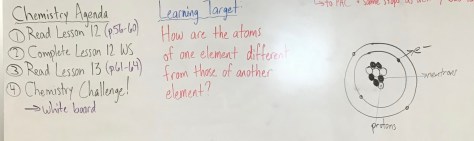
Our work today address the Key Question: How are the atoms of one element different from those of another element?  To get started, the entry task asked students to draw a model of a boron (B) atom and label the parts.

After the Entry Task, students received their graded Chapter 2 Quiz and we reviewed as a class.

Next, students reviewed the parts of atoms by watching the Crash Course video below:

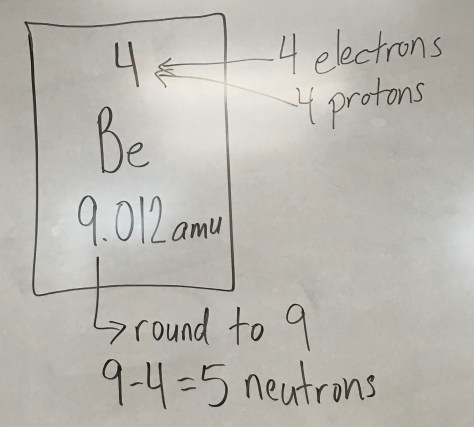
After the video, we briefly reviewed the main ideas from lesson 12 from the textbook and students had the opportunity to update their model of a boron atom from the Entry Task.  Key learnings:

  • Atomic number = # of protons in one atom of a given element
  • Protons have a positive charge
  • Electrons have a negative charge
  • Neutral atoms have equal numbers of protons and electrons
  • Atomic mass = (# of protons) + (# of neutrons) in one atom of a given element
  • Neutrons have no charge

Finally, students had the remainder of the class period to worked on the Lesson 12 Worksheet.  Students who need more practice with this lesson should ask the teacher for  the Element Builder Gizmo packet which will earn students credit for one bonus assignment.

Notes from class:

IMG_0518

IMG_0520

IMG_0521