All posts by David Swart

High school science teacher

Formation of Elements

To begin class, students were asked to share out a response to the question: where do the elements come from?  After a brief discussion, we watched the video below:

Next, we worked through the PowerPoint to learn more about the concepts of fusion and fission, and then students used the remainder of class to work on the Lesson 16 Worksheet.  This is the final textbook lesson of Chapter 3.  On Monday, we will continue our exploration of nuclear reactions with a Gizmo activity in preparation for the Chapter 3 test next Wednesday.

Homework for this evening:

  • Read Lesson 16 in the textbook.  Login via hs.saplinglearning.com and enter your username and password:
    • Username: wahps****s-####### (**** = first 4 letters of your last name and ####### = student number).  Remember to include the dash between s and #.
    • Password: S-####### (the S must be capitalized)
  • Work through the homework problems at the end of Lesson 16 and then verify accuracy with the Lesson 16 Homework Answers.
  • Write notes for Lesson 16 on the Chapter 03 Notes handout.
  • Come to class Monday prepared to ask questions about anything from Chapters 1-3 you did not yet fully understand.

Nuclear Reactions

We continued our exploration of how the nucleus of an atom can change by launching into Lesson 15.  The lesson addressed the question: What are nuclear reactions?  We began with an illustration depicting the key vocabulary from the Lesson 15 PowerPoint in order to better understand the Nuclear Quest board game which is the hands-on learning for the day.

IMG_0053

For the game, students gathered into teams of four, with each team receiving the board, the three sheets of nuclear quest cards, the two sheets of radiation cards and the game instructions.  Students also received the Lesson 15 worksheet to help guide them through the key learnings in the game.  Also, the game requires dice which are in limited supply, so visit Random.org and use the virtual dice roller!

Extend Your Learning!

Homework for this evening:

  • Read Lesson 15 in the textbook.  Login via hs.saplinglearning.com and enter your username and password:
    • Username: wahps****s-####### (**** = first 4 letters of your last name and ####### = student number).  Remember to include the dash between s and #.
    • Password: S-####### (the S must be capitalized)
  • Work through the homework problems at the end of Lesson 15 and then verify accuracy with the Lesson 15 Homework Answers.
  • Write notes for Lesson 15 on the Chapter 03 Notes handout.
  • Come to class tomorrow prepared to ask questions about anything of the homework problems from Lesson 15 you did not understand.

Stable and Radioactive Isotopes

We began the class period with the following entry task: How are carbon-12, carbon-13, and carbon 14 similar?  How are they different?  Which isotope would you expect to find most often in nature?  Explain your thinking.

Next, we watched a segment of the NOVA video Hunting the Elements, beginning at 1:39:33 and ending at 1:52:04.  The video served to remind students about last week’s lesson about isotopes (Lesson 13) and to help prepare them for our work this week.

After the video, we reviewed the Lesson 14 PowerPoint.  Students then received copies of the Lesson 14 Worksheet and the Chart of Naturally Occurring Isotopes. working in pairs to complete the lesson by the end of the class period.

Homework for this evening:

  • Read Lesson 14 in the textbook.  Login via hs.saplinglearning.com and enter your username and password:
    • Username: wahps****s-####### (**** = first 4 letters of your last name and ####### = student number).  Remember to include the dash between s and #.
    • Password: S-####### (the S must be capitalized)
  • Work through the homework problems at the end of Lesson 14 and then verify accuracy with the Lesson 14 Homework Answers.
  • Write notes for Lesson 14 on the Chapter 03 Notes handout.
  • Come to class tomorrow prepared to ask questions about anything of the homework problems from Lesson 14 you did not understand.

Isotopes

We extended our learning about neutrons yesterday with a lesson about isotopes.  The Lesson 13 PowerPoint explains how certain elements like carbon always contain the same number of protons, but may contain different numbers of neutrons.  Students then practiced calculating the number of protons, neutrons, and electrons on the Lesson 13 Worksheet.

Homework for this evening:

  • Read Lesson 13 in the textbook.  Login via hs.saplinglearning.com and enter your username and password:
    • Username: wahps****s-####### (**** = first 4 letters of your last name and ####### = student number).  Remember to include the dash between s and #.
    • Password: S-####### (the S must be capitalized)
  • Work through the homework problems at the end of Lesson 13 and then verify accuracy with the Lesson 13 Homework Answers.
  • Write notes for Lesson 13 on the Chapter 03 Notes handout.
  • Come to class tomorrow prepared to ask questions about anything of the homework problems from Lesson 13 you did not understand.

Periodic Table Project

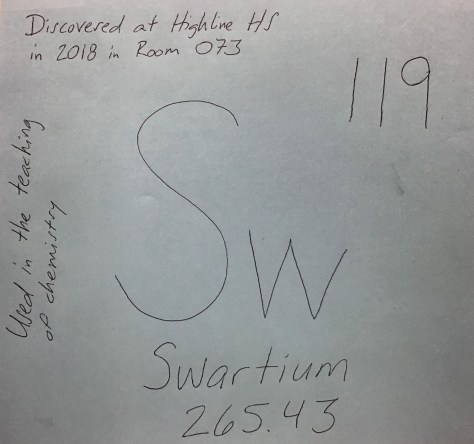
For the Periodic Table Project, students will create a small poster of the key information of their element as researched during the Element Profile Project.  Each student will receive a piece of colored paper measuring 22 cm long and 19 cm wide.  Note: the color of the paper is important!  Only use the color of paper provided to you.  For the Periodic Table Project, orient the paper in landscape (long sides on the top and bottom – this is really important!!!).

IMG_0049
Example panel of a fictitious element

The following information must be written clearly and big enough to be seen from across the room:

The following information must be written clearly and big enough to be seen from at least half-way across the room:

Please include at least two additional pieces of information someone could easily see if standing near your poster:

CompoundChem.com also has a treasure trove of really amazing infographics.  The links below are resources compiled from that website to help you in your quest to complete this assignment.  Determine the group your element is in, the click the link:

Atomic Number and Atomic Mass

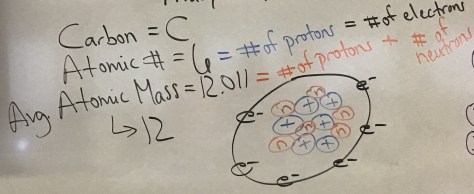
Lesson 12 from the textbook was introduced with a brief review of atomic number and atomic mass.  Key learnings:

  • Atomic number = # of protons in one atom of a given element
  • Protons have a positive charge
  • Electrons have a negative charge
  • Neutral atoms have equal numbers of protons and electrons
  • Atomic mass = (# of protons) + (# of neutrons) in one atom of a given element
  • Neutrons have no charge

Example of Entry Task Notes:

IMG_0047

Students then worked in pairs to complete the Lesson 12 Worksheet.  Students who need more practice with this lesson are encouraged to work through the Element Builder Gizmo.  See Mr. Swart for the instruction packet.  Successful completion of the packet will earn students one bonus point.

Homework for this evening:

  • Read Lesson 12 in the textbook.  Login via hs.saplinglearning.com and enter your username and password:
    • Username: wahps****s-####### (**** = first 4 letters of your last name and ####### = student number).  Remember to include the dash between s and #.
    • Password: S-####### (the S must be capitalized)
  • Work through the homework problems at the end of Lesson 12 and then verify accuracy with the Lesson 12 Homework Answers.
  • Write notes for Lesson 12 on the Chapter 03 Notes handout.
  • Come to class tomorrow prepared to ask questions about anything of the homework problems from lesson 12 you did not understand.


Models of the Atom

Chapter 3 begins with a historical study of how early chemists used experimentation and reasoning to assemble models of the atom.  The Lesson 11 PowerPoint provides key vocabulary around the components of the atom (proton, electron, neutron, and nucleus). To help bring these concepts to life, we watched the Crash Course video below:

After the video, students worked with a partner through the Lesson 11 Worksheet, using a handout explaining the five models of the atom.  Notes from class are shown below:

IMG_0046.jpg

Extend Your Learning!

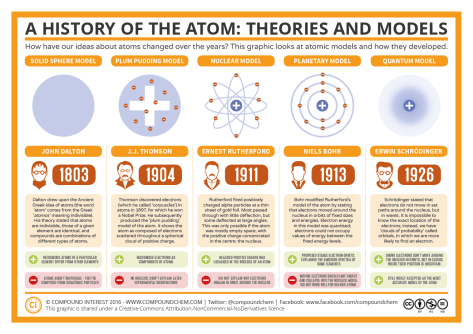
Click on the CompoundChem.com infographic below to enlarge the graphic.  There is an excellent article accompanying the infographic as well that is highly encouraged reading.

The-History-of-the-Atom-–-Theories-and-Models

Wonder what an atom actually looks like?  Using a “quantum-style” microscope, atoms of hydrogen can be seen – check out the article “Smile Hydrogen, You’re on Quantum Camera” from New Scientist magazine (2013).

Homework for this evening:

  • Read Lesson 11 in the textbook.  Login via hs.saplinglearning.com and enter your username and password:
    • Username: wahps****s-####### (**** = first 4 letters of your last name and ####### = student number).  Remember to include the dash between s and #.
    • Password: S-####### (the S must be capitalized)
  • Work through the homework problems at the end of Lesson 11 and then verify accuracy with the Lesson 11 Homework Answers.
  • Write notes for Lesson 11 on the Chapter 03 Notes handout.
  • Come to class tomorrow prepared to ask questions about anything of the homework problems from lesson 11 you did not understand.

Element Profile Project

For your assigned element, research the following information:

All sources must be cited.  Only include information from credible scientific sources.  If unsure, ask!

Collect all of this information into a Google Slides and share with Mr. Swart.


Updated: October 9 – Our collection of completed element profiles is growing!  Please visit the Element Profiles page and check out the slide decks of the elements in the periodic table.  


Homework

Study for the Chapter 2 test on Friday.  Make sure to complete your Chapter 02 Notes to use on the test.

The Periodic Table

Class began with a video about Dmitri Mendeleev and the Periodic Table.  During the video, students received their graded Chapter 1 Tests.  Students were encouraged to review the answer key as needed.  Students who struggled on the density questions (#13-15) on the test may obtain full credit for those three problems upon successful completion of the Density Laboratory Gizmo packet.  The complete packet must be returned along with the test for credit.

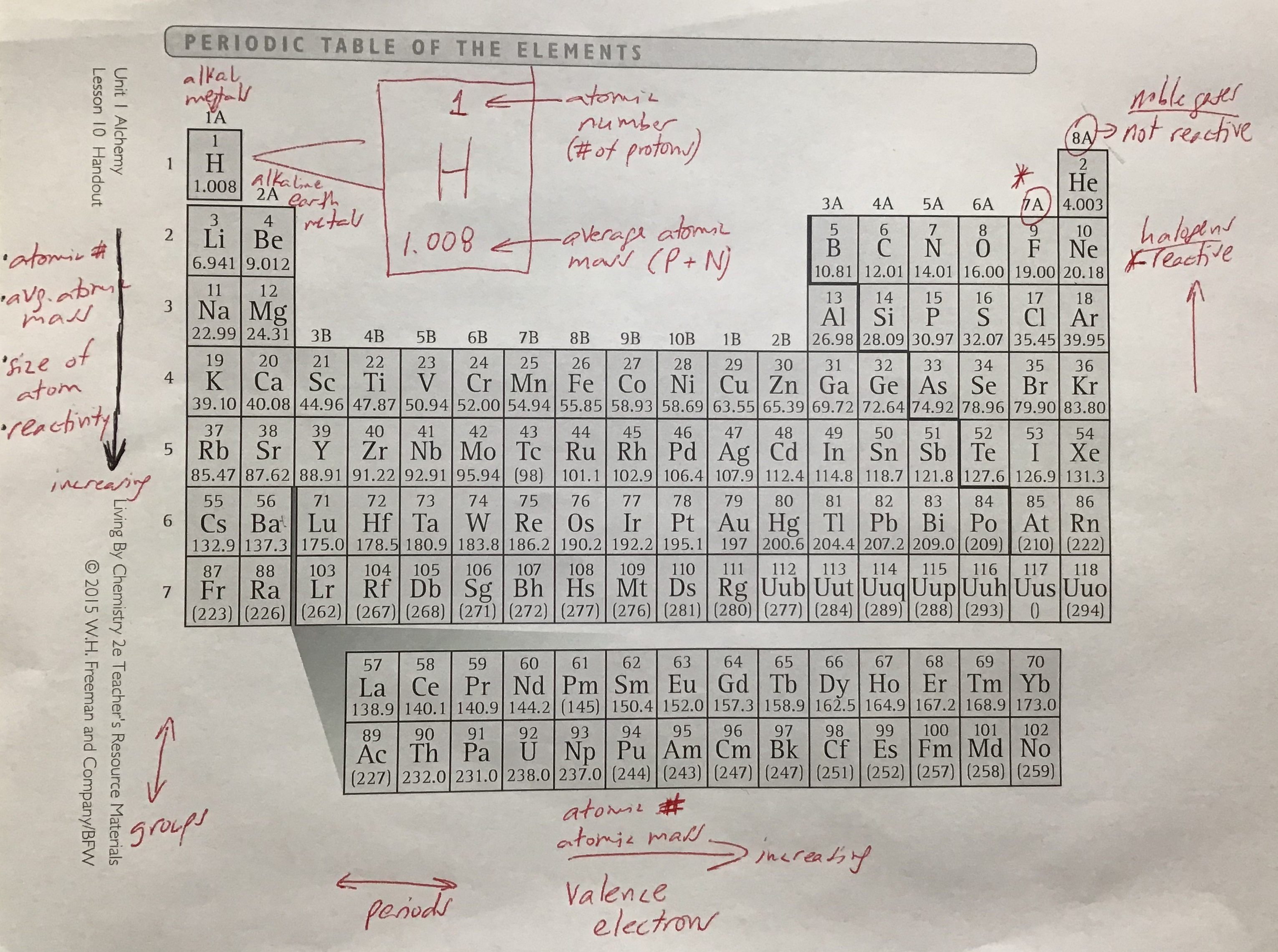
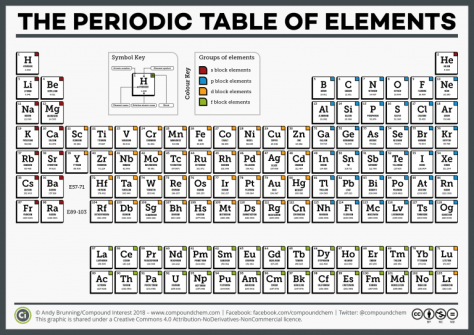
Next, students went back to work in small groups, tackling the Lesson 10 worksheet with their groups from Lesson 9.  They reconstructed their periodic tables using the cards from Lesson 9, then identified trends in the table to fill in the worksheet.  After completing the worksheet, students received a paper copy of the Periodic Table to use on exams and quizzes and then had the remainder of the class period to read and take notes on lesson 10 using the textbook as well as the Power Point slides.

CI-Simple-Periodic-Table-of-the-Elements-2018-768x543

Bonus Learning Opportunity

For pleasure, students should consider reading a few pages from Sam Kean’s book titled The Disappearing Spoon.  Click this link for the section of the book about Ytterby Lanthanides.  It begins with the sentence “In 1701, a braggadocian teenager…” and you will need to click the hyperlinked blue “Page >>” in the upper left hand corner to reveal the full reading passage.  Continue reading through the next three full pages ending in “…Galapagos Island of the periodic table.”  You will be glad you did!

Homework for this evening:

  • Read Lesson 10 in the textbook.  Login via hs.saplinglearning.com and enter your username and password:
    • Username: wahps****s-####### (**** = first 4 letters of your last name and ####### = student number).  Remember to include the dash between s and #.
    • Password: S-####### (the S must be capitalized)
  • Work through the homework problems at the end of Lesson 10 and then verify accuracy with the Lesson 10 Homework Answers.
  • Write notes for Lesson 10 on the Chapter 02 Notes handout.
  • Answer the Lesson 10 questions in the Chapter 2 Study Guide.
  • Come to class tomorrow prepared to ask questions about anything of the homework problems from lesson 10 you did not understand.