
Category Archives: Uncategorized

Electronegativity and Polarity

We began class with students receiving copies of their progress reports and a copy of the Lesson 43 Worksheet and accompanying cartoon.  After reading through the cartoon, we briefly worked through parts of the Lesson 43 PowerPoint and students received a copy of the periodic table that includes the electronegativity values for each element.

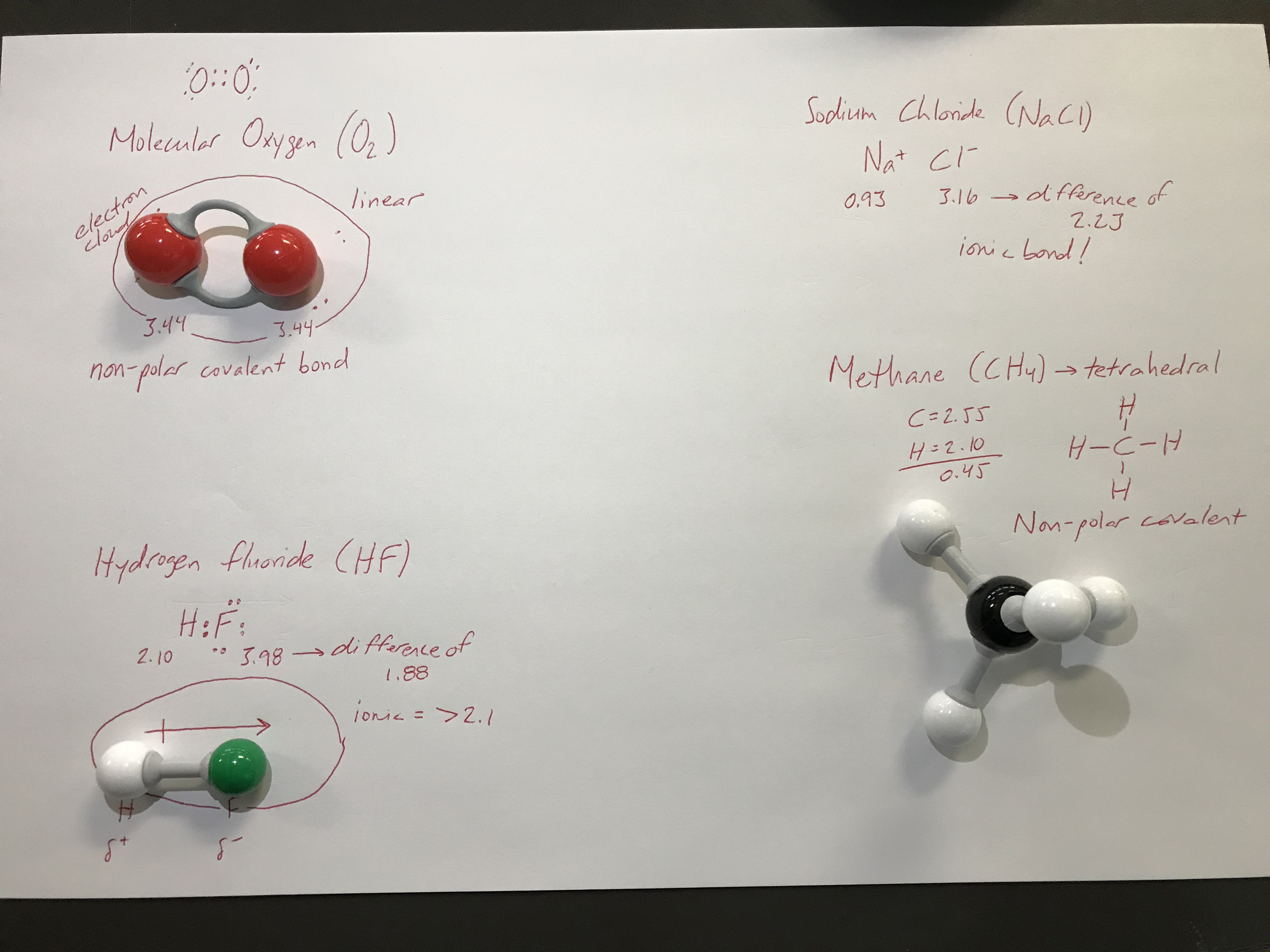
We then investigated four different molecules and discussed the connection between molecule geometry, atomic composition, and how to calculate the difference in electronegativity between two atoms.  Students learned that non-polar covalent bonds have a difference in electronegativity of 0.5 or less.  An electronegativity difference greater than 2.1 results in an ionic bond.  Values between 0.5-2.1 result in polar covalent bonds.
For more on dipole moment, check out the Khan Academy video below:


For homework, students are assigned questions 1-4 on page 226.

Covalent Bonds Gizmo

For today’s Covalent Bonds Gizmo activity, complete the following steps:

  1. Go to the Explore Learning website.
  2. Click the Login/Enroll button (upper right).
  3. Select Chemistry from your list of classes.
  4. Launch the Covalent Bonds Gizmo.
  5. Complete the Covalent Bonds Gizmo worksheet with a partner.

For students who have not yet created an account:

  1. Enter the class code (P2 = HF4JLBZBLL and P3 = Z7WCNPXCV4).
  2. Click the Enroll in Class button.
  3. Choose “I need to create…” option.
  4. Enter your First and Last name (not email!)
  5. Use your student numer (s-#######) as your username.
  6. Enter birthdate as password (MMDDYYYY)
  7. Click “Submit”
  8. Launch the Covalent Bonds Gizmo.
  9. Complete the Covalent Bonds Gizmo worksheet.

Space-Filling Models

Lesson 39 introduces students to the concept of space-filling models.  The lesson calls for students to use space-filling models which we do not have access to at our school.  Rather than continue to use the ball-and-stick models, students instead worked in pairs and used MolView, a free software program available online.  Using MolView, students searched for the compounds in the Lesson 39 Worksheet using the search tool.  They then visualized the molecules as space-filling models using the van der Waals Spheres option located under the Model tab.  Although not particularly helpful, the Lesson 39 PowerPoint is included.  For homework, students are assigned questions 3-7 from page 203 of the textbook.

Functional Group Poster – Day 1

On the day before Thanksgiving Break, we began class with the Lesson 33 PowerPoint which introduced the concept of functional groups.  We reviewed the functional groups illustrated in Lesson 33 of the textbook and then students assembled into groups of no more than four students to begin working on the Functional Group Project.  For the first day of the project, students worked together to begin researching the various aspects of the functional group they selected.  Many students were confused by the “R-group” nomenclature.  With so many students absent due to the short holiday week, we will discuss the R-group concept when we reconvene on Monday.  For students looking to supplement the Lesson 33 textbook content, here’s a brief video to hold you over until Monday:

Lesson 25 / demo lab

Because of the earthquake drill disrupting the quiz yesterday, students in both chemistry classes received the first 10 minutes of class to complete their quiz.  As a result of the shortened class period, the Lesson 25 PowerPoint was abbreviated to include key vocabulary and the Lesson 25 lab was conducted as a teacher demo with student assistance.  All students received the Lesson 25 Worksheet and those who finished their quiz had time to make predictions about whether the test substances would conduct electricity and/or dissolve in water.  Students shared out their predictions with the class and then we proceeded to test those predictions during the demonstration.  After collecting the results, students were tasked with completing the front of the worksheet as homework.

Chapter 4 Review

In preparation for the Chapter 4 quiz tomorrow, students worked through the Review Exercises on page 122 of the textbook.  They had the remainder of the class period to prepare one page of notes to use on the quiz and access to computers for further review of electron configurations via the Gizmo from last Friday.

For the quiz tomorrow, students should be prepared to:

  • Determine the products of two reacting ionic compounds
  • Name compounds
  • Write and interpret formulas involving transition metals
  • Write the electron configuration for a given element
  • Locate elements on the periodic table from a given electron configuration
  • Explain the connection between electron configuration and the structure of the periodic table

Formulas for Ionic Compounds

Although we did not use it today, the Lesson 21 PowerPoint is available for download.  Instead, we jumped into the Salty Eights game, with students working in groups of four to create and name ionic compounds.  Compounds created by individual students were recorded on the Lesson 21 worksheet.

After completing the game, students had the remainder of the class period to work on the Lesson 21 homework: questions 4-8 on pages 107-108 in the textbook.