
Today students were tasked with completing their graphs, analyzing their graphs for patterns or trends, and then writing the Analysis and Discussion sections of their lab reports. We started class with an entry task designed to help students identify possible sources of experimental error possible impacts of those errors on their experimental data. We assembled a class list of those errors which can be located within the slide deck for today. Students received a Discussion Section Organizer worksheet to help them write the discussion. We will be in the computer lab in room 235 tomorrow to finish writing the reports. Reports must be turned in by the end of the school day on Friday for credit.
Category Archives: Matter
Energy, Matter, and Organization: Lab Report Introduction and Graphing
Students were tasked with completing their lab report Introduction sections and creating a graph of their data. Previously, students were instructed to write their own Introduction sections. However, given the time constraints, students were encouraged to collaborate today and create one strong Introduction section per lab group. Prior to collaborating, students reviewed one particularly strong Introduction section written by one of my students. After completing Introduction paragraphs, students worked with their lab partners to create at least one graph of their data. Many students used class time to work on the classroom computers, with encouragement to use Microsoft Excel as the graphing program.
Energy, Matter, and Organization: Friday Catch-Up
With the short Friday, students were directed to spend their time on one of the following activities:
- Peer editing lab report
- Continue typing lab report
- Check grades in Illuminate
- Check folder for missing work
- Print out missing work
The semester ends January 23, the same day lab reports are due. There is no school Monday, January 19, in honor of Dr. Martin Luther King, Jr.
Energy, Matter, and Organization: Computer Lab – Day 1
We spent the day in the computer lab today. Students were tasked with typing their Introduction, Materials, Procedure, and Data Tables into their Baggie Garden lab report. We will be back in the computer lab one last day next Thursday, so students are encouraged to continue typing up their report outside of class.
Energy, Matter, and Organization: Lab Report Introduction
I was home sick today, so my sub instructions are given below, and accompany this slide deck.
Slide 1 – Objectives are also written on the board by the door. Yesterday, students learned that seeds require water, oxygen, and a certain temperature range to germinate. We reviewed that seeds use cellular respiration available because of the nutrients in the seed to power seedling growth until the seedling can begin doing photosynthesis.
Slide 2 – Provide students with 3-5 minutes of writing time depending on engagement level.
Slide 3 – Partner share with lab notebook entry (slide 2). For today, Partner B is seated on the window side of the desk. Monitor discussions and select a few students to share out based on level of engagement and understanding.
Slide 4 – Remind students that in a seed, the nutrients used during cellular respiration are stored in the cotyledons which themselves cannot do photosynthesis. The cotyledons fuel the seedling until it can begin doing photosynthesis to capture sunlight energy.
Slide 5 – Textbooks are located on a table in the back of the room. There are enough for one per table, so students will need to share. They should begin by reading pages 358-9 and taking notes on the three stages of cellular respiration. Students may also continue reading (skimming or even just looking at the figures is fine) through page 365 if time permits. The goal for the day is writing the Introduction paragraph of the lab report, so students should budget their time accordingly.
Slide 6 – Hand out the copies on my desk (one per student) to help the students structure their Introduction paragraphs. Students should already have the Experimental Purpose, Research Question, and Hypothesis written in their lab notebooks. The reading and their learning from class should help with the background content (the first few sentences). Students who wish to type their paragraph may use the class computers. Please remind students that we will be in computer lab 245 tomorrow, and they need to bring their Intro worksheet along with their lab notebooks which have their Materials, Procedure, and Data Tables.
Slide 7 – If time permits, during the last few minutes of class, request students who appear to have successfully written their Intro section to share the key ideas from their background section. This will help students who need help narrowing their focus.
Energy, Matter, and Organization: Seed Germination Requirements
Today we held a class discussion focusing on the variables tested in the Baggie Garden experiments. To begin, students considered how their own manipulated variable affected seed germination. We then collected data from each group and used that information to identify temperature as one of the key factors in determining whether a seed will germinate. We also made the observation that seeds in the presence of water at room temperature did germinate, while seeds purchased from the store and kept dry at room temperature do not germinate. Therefore, water is another key factor for seed germination. Finally, we revisited the process of cellular respiration, identifying oxygen as the final requirement for seed germination.
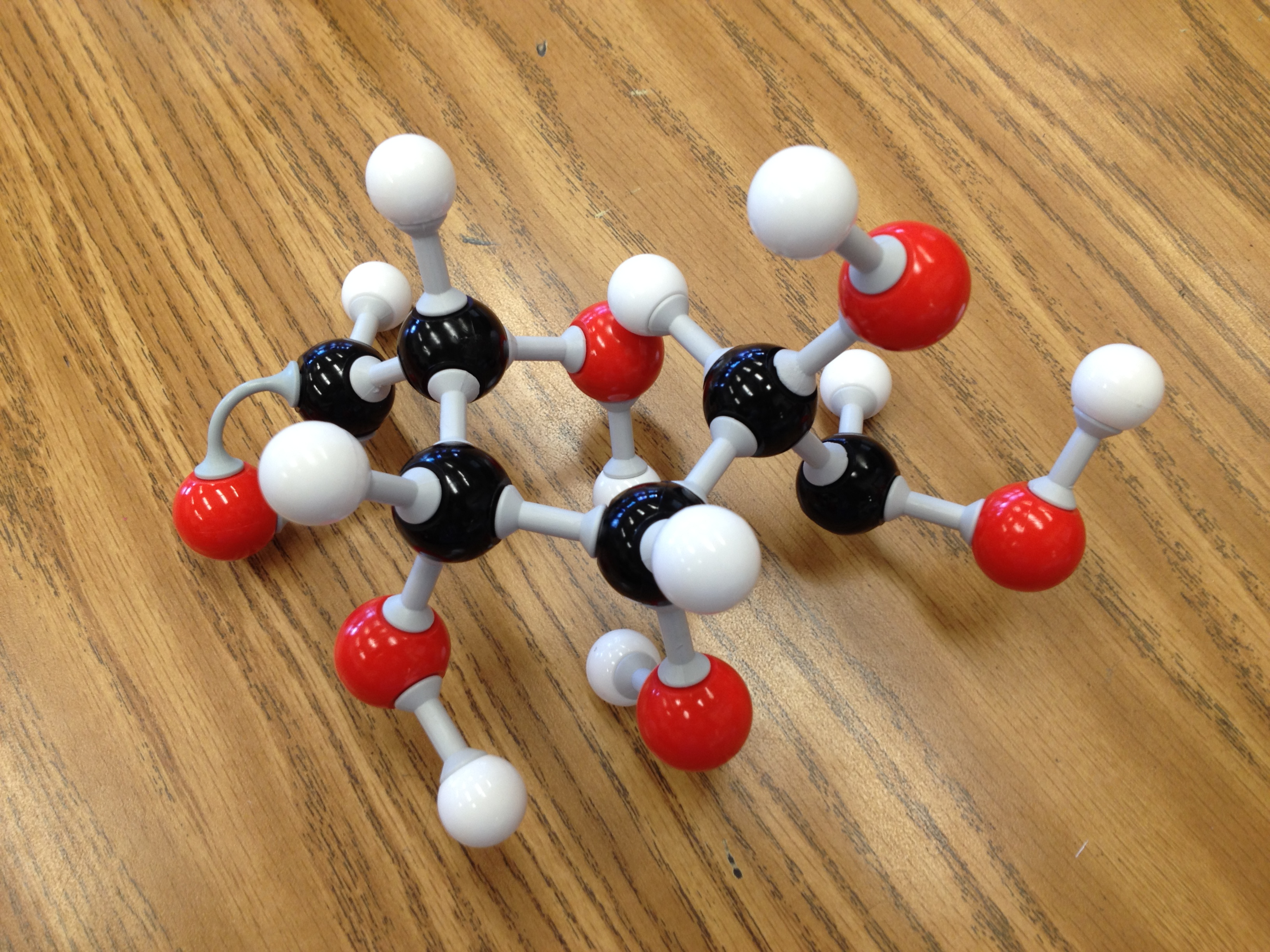
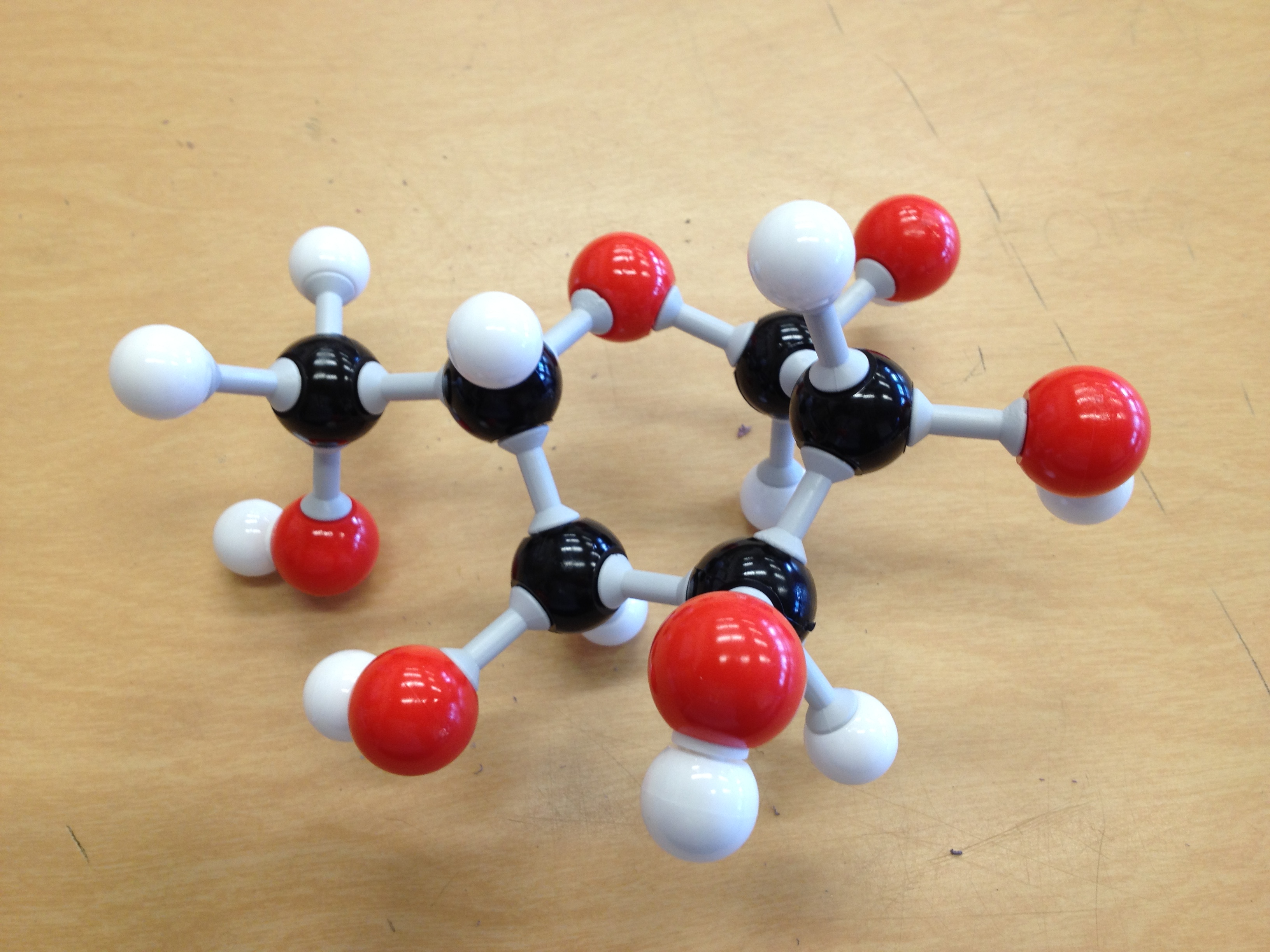
Following the discussion, students had two options for the remainder of the class period. First, they could choose to read about cellular respiration in the textbook (pages 358-359, taking notes on the three stages of cellular respiration). Alternatively, students had the opportunity to build molecules using our new molecular modeling kits. Instructions for both activities can be found in the attached slide deck. Two students successfully modeled glucose, shown both in linear form (below left) and in ring form (below right).
Energy, Matter, and Organization: Baggie Garden Experiment – Day 6
Today marked the final day of observations and data collection for the Baggie Garden experiment. Before looking at their bags, students received instruction about the process of data analysis (see attached slides). We discussed the importance of providing written context to data table content, as well as things to consider when selecting the appropriate type of graph for a lab report. After entering their final observations of their baggie gardens in their lab notebooks, students had the option of taking their bags of seeds home and continuing to make observations outside of class for extra credit. We will be in the computer lab on Thursday, and students are encouraged to write the Materials and Procedure sections of their lab reports using Microsoft Word in advance of Thursday.
Note: Highline Public Schools students receive a free copy of Microsoft Office 365 for use at home! Students should use their school email and password to log in at https://login.microsoftonline.com/ to download the software.
Energy, Matter, and Organization: Chemistry!
As we continue through our unit on energy, matter, and organization, we will deploy our new molecular modeling kits. The kits, provided courtesy of our Donors Choose grant, will enable students to gain experience modeling molecules in three dimensions. In a previous lesson, students modeled cellular respiration using two-dimensional paper molecules of glucose and oxygen (which they converted to carbon dioxide and water using scissors and tape). We will be using our molecular modeling kits to model the process of photosynthesis, with various learning opportunities available to help explain the baggie garden results. Time permitting, we will also use the kits to model how glucose models can link together to form more complicated molecules like starch and cellulose. Students will have opportunities to model amino acids and nucleic acids as in future units.
Want to learn more about the exciting field of chemistry? Visit Theodore Gray’s Periodic Table website (look familiar?) to learn about all of the known elements. Then check out “Hunting the Elements” and skip ahead to 31:58 where the host introduces the concept of proton number as the definition of what makes elements unique. For the next 15 minutes or so, the host meets up with Theodore Gray – for extra credit, write up a summary of what you learn from this segment!
Energy, Matter, and Organization: Baggie Garden Experiment – Day 5
We wrapped up the week with a final day of observations of the baggie gardens. Students once again measured radicle growth, sketched seed germination and labeled parts, and measured the temperatures of the locations where their seeds were stored. Students were also encouraged to relocate their bags away from the cold windows to a warmer part of the room. We will observe the seeds again on Monday and then make a decision about whether to extend or conclude the experiment.
Energy, Matter, and Organization: Baggie Garden Experiment – Day 4
Observations were in full-swing today. We began class with a brief review of how to create a data table. Students were also introduced to seed germination vocabulary and instructed to sketch out and label the parts of visible to them as their seeds germinate. The slides are attached here. Several students took advantage of the temperature probes and recorded the temperature of their seeds in each of the location where they are being kept during the experiment. Students also had access the supplies used during the experiment (to complete the Materials section of their lab reports) and were also encouraged to edit their Procedures as needed. Finally, students had access to the class computers and were encouraged to begin writing out the Materials and Procedure sections of their lab reports.
Note: I conferenced with students identified as being in danger of failing (currently holding a D or an F in biology for the semester). I explained how each student could improve their grade and earn credit. Students then signed and returned copy of the Notification of Failing Grade / Action Plan form, and took another copy home to be signed by a parent. Signed forms must be returned by Monday, January 12.
 Science with Swart
You must be logged in to post a comment.