We returned to the molecular modeling kits in Lesson 38, this time using the kits to learn about the shape of molecules. We worked through the Lesson 38 PowerPoint, learning vocabulary terms to describe molecular shape. Students then worked in small groups to complete the Lesson 38 Worksheet.
Homework:
Read Lesson 38 in the textbook. Login via hs.saplinglearning.com and enter your username and password.
Write notes for Lesson 38 and work through the practice problems at the end of Lesson 38.
Please ask questions about anything from Lesson 38 you do not yet fully understand.
Our lesson today combines textbook lesson 37 (electron domains) and lesson 38 (molecule shape). We will work through the PowerPoint and students will concurrently take notes on the Handout for this lesson while also building molecules with molecular modeling kits. Students will then complete the Lesson 38 Worksheet.
Key ideas:
noble gases (single atoms) are visualized as points
molecules consisting of two atoms (i.e. hydrogen fluoride) are linear
molecules consisting of three atoms can be bent (H2O) or linear (CO2)
molecules consisting of four atoms, like ammonia (NH3) are called pyramidal
molecules consisting of five atoms, like methane (CH4) are called tetrahedral
larger molecules consist of multiple shapes put together
Homework:
Read Lessons 37 and 38 in the textbook. Login via hs.saplinglearning.com and enter your username and password.
Write notes for Lessons 37 and 38 and work through the practice problems at the end of Lessons 37 and 38.
Please ask questions about anything from Lessons 37 and 38 you do not yet fully understand.
For the first lesson of Chapter 7, students applied the 3-dimensional ball-and-stick model to bridge the concepts of molecular shape, functional groups, and smell. The Lesson 36 PowerPoint introduced students to the model, during which time they passed around actual models constructed with molecular modeling kits. Next, students transitioned to the activity portion of the lesson, experiencing the scents of five different compounds, connecting the smells to molecular structure, and recording observations and analysis responses in the Lesson 36 Worksheet.
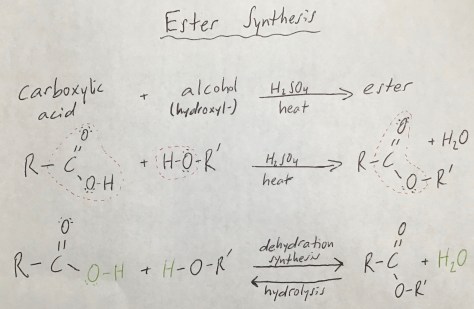
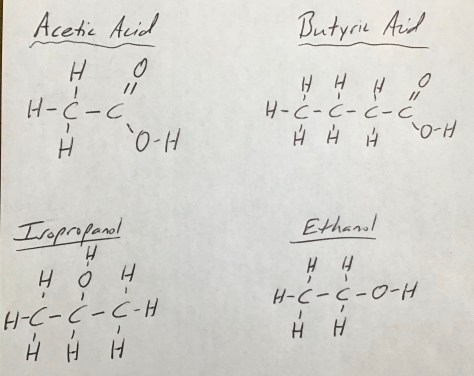
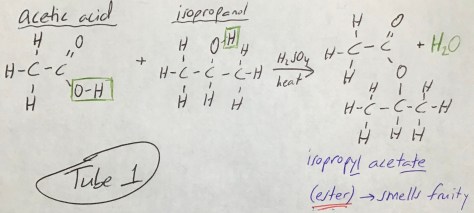
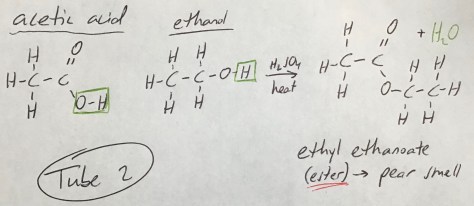
For our final lesson of Chapter 6, students were tasked with analyzing the ester synthesis lab from yesterday. The Lesson 35 Student Worksheet guides students through the analysis process.
Notes from class:
Keep Learning!
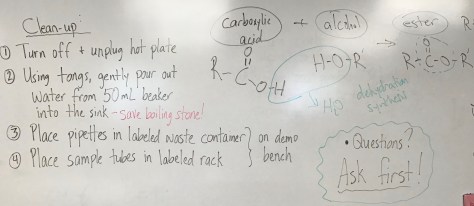
Wondering why the O and H from the carboxylic acid partner up with the H from the alcohol to form water during the ester synthesis reaction? The answer is far from simple! Check out the chemistry involved in Fischer Esterification, courtesy of the University of Calgary department of Chemistry.
Homework:
Read Lesson 35 in the textbook. Login via hs.saplinglearning.com and enter your username and password.
Write notes for Lesson 35 and work through the practice problems at the end of Lesson 35.
Please ask questions about anything from Lesson 35 you do not yet fully understand.
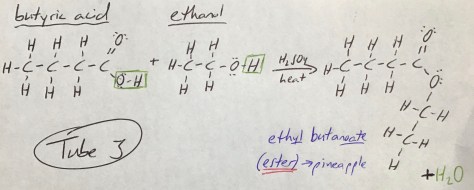
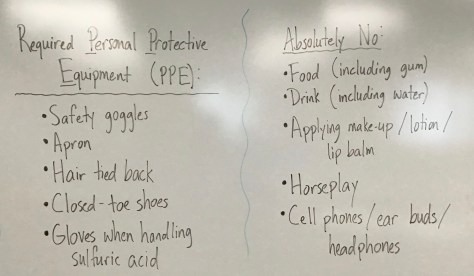
Lesson 34 Lab: Our work today is to conduce the Ester Synthesis Lab. Class will begin with a class discussion of the experiment, with emphasis placed on lab safety. For the lab, students will use the Lesson 34 Student Worksheet to guide them through the lab.
We began class with students watching the video below (except for 5th period which lost half of the class due to Pep Assembly prep):
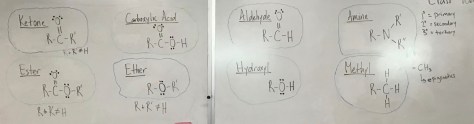
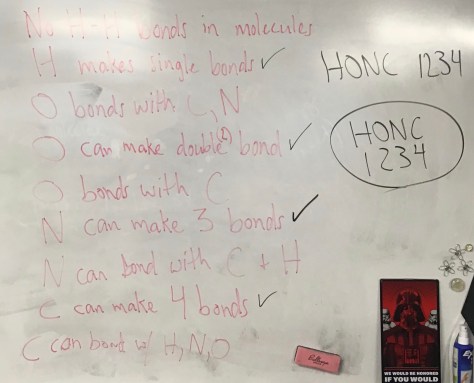
After the video, students copied the notes from the whiteboard pictured below to their notebooks. (Although we did not use it today, the Lesson 33 PowerPoint is provided here as a learning resource.)
Students then gathered into Functional Group project teams and began working on the Functional Group Project. Students will have the full class period tomorrow and then may also work on Monday and Tuesday if needed while students who are finished are treated to Hunting the Elements. The posters will be utilized by the class during the Chapter 6 test.
Homework:
Read Lesson 33 in the textbook. Login via hs.saplinglearning.com and enter your username and password.
Write notes for Lesson 33 and work through the practice problems at the end of Lesson 33.
Please ask questions about anything from Lesson 33 you do not yet fully understand.
We continued our study of Lewis Dot Structures by investigating the Octet Rule through the lens of double and triple bonds. Students applied the HONC 1234 rule with their understanding of valence electrons (octet = eight electrons) to build molecules that share one or more bonds. We worked through the Lesson 32 PowerPoint and then students used the Lewis Dot puzzle pieces from Lesson 31 to work through the Lesson 32 worksheet.
Homework:
Read Lesson 32 in the textbook. Login via hs.saplinglearning.com and enter your username and password.
Write notes for Lesson 32 and work through the practice problems at the end of Lesson 32.
Please ask questions about anything from Lesson 32 you do not yet fully understand.
With a number of students out of school for the day on an AVID field trip, class today focused on reviewing the types of bonds formed between atoms, and extending into modeling electrons using Lewis Structures.
For our entry task today, students were asked to take a brief survey about science electives they are interested in taking next school year. Students may click this survey link or use the QR code below:
After the entry task, students have the following options (must turn in something today to receive credit for class – an assignment, a shared document, or an email with notes is sufficient):
Catch-up Day:
Complete and turn in worksheets for Lessons 28-30
Turn in or revise Unit 1 Project*
Turn in or revise Electroplating Lab Report*
*Amnesty Day today = 80% max credit. After today, 60% max credit. After Friday, no credit.
To accommodate students who missed class yesterday because of the field trip, we had a two-pronged Entry Task. Students who missed yesterday were directed to quickly take the Science Elective Survey. Students who completed the survey (and those who finish in time today) were directed to complete the alternate entry task. Resources for both are provided below:
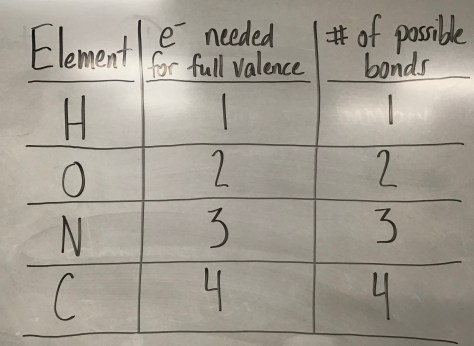
We extended our learning of the HONC 1234 rule from Friday by introducing the concept of Lewis Dot Symbols and Structures. To solve the alternate entry task, students were reminded about how the HONC 1234 rule connects the concepts of valence electrons to the number of bonds each atom can make:
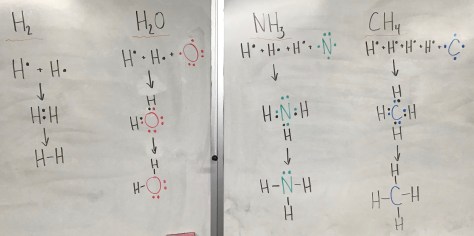
We used that understanding to solve the Lewis Dot Structures for the entry task:
Next, we worked through the Lesson 31 PowerPoint, writing down key vocabulary and reviewing Lewis Dot Symbols and how they assemble to create Lewis Dot Structures in our class notes. Students had the remainder of the class period to work in groups of four on the Lesson 31 Worksheet using the Lewis Dot Puzzle Pieces.
Keep Learning!
The videos below all include information about Lewis Dot symbols. You are strongly encouraged to review them!
Homework:
Read Lesson 31 in the textbook. Login via hs.saplinglearning.com and enter your username and password.
Write notes for Lesson 31 and work through the practice problems at the end of Lesson 31.
Please ask questions about anything from Lesson 31 you do not yet fully understand.
In the Lesson 30 PowerPoint, students were introduced to the HONC 1234 rule. We then worked together as a class on the first three problems of the Lesson 30 Worksheet and students had the remainder of the class period to complete the worksheet.
Notes from the whiteboard:
Homework:
Read Lesson 30 in the textbook. Login via hs.saplinglearning.com and enter your username and password.
Write notes for Lesson 30 and work through the practice problems at the end of Lesson 30.
Please ask questions about anything from Lesson 30 you do not yet fully understand.




 Science with Swart
You must be logged in to post a comment.