Category Archives: Chemistry

Amino Acids and Proteins

The final lesson of Unit 2 explores how amino acids connect to make proteins.  The Lesson 48 PowerPoint includes the vocabulary terms of amino acid and protein.  Lesson 48 connects with Lesson 47, as amino acids are chiral molecules.  Notably, all of the 20 different amino acids in human proteins are “left-handed” (as opposed to the mirror-image “right-handed” isomers), meaning they all have the L conformation (L for laevus, Latin for “left”) rather than the D conformation (D for dexter, Latin for “right”).  Students will work in pairs to complete the Lesson 48 Worksheet, learning about the properties of amino acids and how they bind together to form proteins.  For more on the D and L convention, click on the picture below.

As noted previously, there are 20 different amino acids.  All amino acids share the same base structure of a central carbon atom bound to a carboxylic acid (-COOH), an amino group (-NH2), and a hydrogen (H).  The central carbon is also bound to an R group, with R indicating any one of the 20 different amino acid structures.  The structures each have different physical properties.  When individual amino acids link together, a polypeptide chain is formed (and a molecule of water is removed as each new amino acid is linked to the chain).  The polypeptide chain, composed of a string of amino acids, folds into a particular shape determined by the interactions of all of the amino acids.  The shape of a protein determines its function in the body.  Mr. Anderson of Bozeman Science has a fantastic video explaining the nature of proteins:

For students looking for a good review of Central Dogma (DNA > RNA > Protein > Trait), the Crash Course Biology video DNA, Hot Pockets, & The Longest Word Ever is a good resource:

Finally, for students with access to a home computer, the Fold.It website will have you folding proteins in no time!

Homework:

  • Read Lesson 48 in the textbook.  Login via hs.saplinglearning.com and enter your username and password.
  • Write notes for Lesson 48 and work through the practice problems at the end of Lesson 48
  • Please ask questions about anything from Lesson 48 you do not yet fully understand.
Mirror-Image Isomers

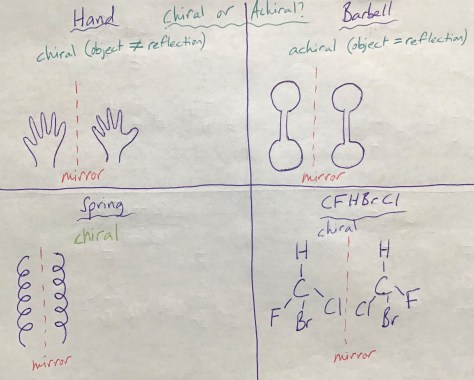
Yesterday, students were introduced to the concept of mirror-image isomers, chiral objects (an object that is not equal to its superimposed reflection), and achiral objects (an object that is equal to its superimposed reflection).  We applied the terms chiral and achiral to real-world 3-dimensional objects all students are familiar with like hands, springs, and barbells:

Lesson 47 Picture 1

We then watched a video to more fully understand how to apply those terms to central carbon atoms with less than 4 different groups (achiral carbons) and 4 different groups (chiral carbons):

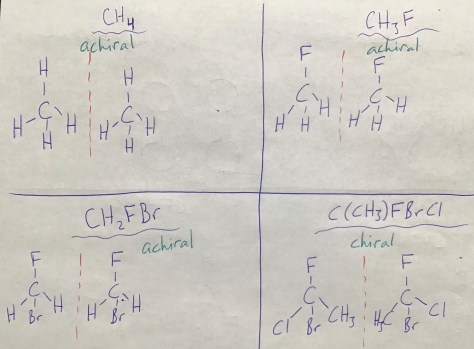
After the video, we applied drew molecules with a central carbon atom and increasing numbers of attached groups.  Students had the opportunity to build the molecules and their mirror-images using molecular modeling kits in order to better visualize superimposability.

Lesson 47 Picture 2

Next, we applied the concept of chirality to molecular smell.  Students smelled extracts containing one of two different mirror-image isomers containing a chiral carbon, finding one to smell like mint and the other like pickles.  This evidence supports the concept of receptor-site theory, where molecules with highly specific shapes are recognized by distinct receptors in the olfactory system, resulting in the perception of distinct smells.

Students then received the Lesson 47 Worksheet, working in pairs to model the compounds using the class set of molecular modeling kits.

Day 2: We will begin class today with an extension of the concept of chirality.  Prior to 1961, scientists did not fully appreciate the profound biological importance of chirality as it relates to medicine.  The tragic story of thalidomide illuminated scientists to a level of chemical complexity not previously appreciated as biologically relevant:

Keep Learning!

Want more?  Check out the blog post Perhaps looking-glass milk isn’t good to drink for an overview of Lewis Carroll, looking-glass milk, and L- and D-carvone.  Want more?  Joanna Shawn Brigid O’Leary from Rice University published an even more extensive investigation of how Lewis Carroll (author of Alice in Wonderland and Through the Looking Glass) weaved biochemistry into his fiction.  Her paper (available as a PDF), WHERE ‘THINGS GO THE OTHER WAY’: THE STEREOCHEMISTRY OF LEWIS CARROLL’S LOOKING-GLASS WORLD is well worth the read.  Perhaps it will even inspire students to read the book before the movie is released in theaters on May 27!

Homework:

  • Read Lesson 47 in the textbook.  Login via hs.saplinglearning.com and enter your username and password.
  • Write notes for Lesson 47 and work through the practice problems at the end of Lesson 47
  • Please ask questions about anything from Lesson 47 you do not yet fully understand.
Phase, Size, Polarity, and Smell

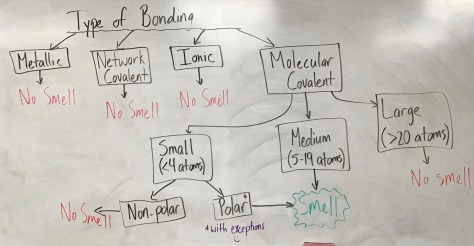
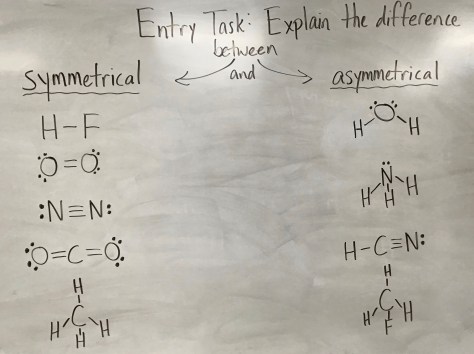
Chapter 8 concluded with the Lesson 46 PowerPoint and Lesson 46 Worksheet.  Lesson 46 brought together the various concepts needed to understand how molecules with certain properties can be detected by our noses, with our brain recognizing those molecules as having a specific smell.  The entry task (ChemCatalyst) asks students to model why perfume molecules can be smelled from across a room, but paper cannot (both placed near a sunny window).

Students also received a copy of the Chapter 8 Study Guide to use in preparation for the quiz on Tuesday.  Work through the quiz questions on your own, then compare your answers to the key.

Notes from class (January 10):

Lesson 46 Picture 1

Lesson 46 Picture 2

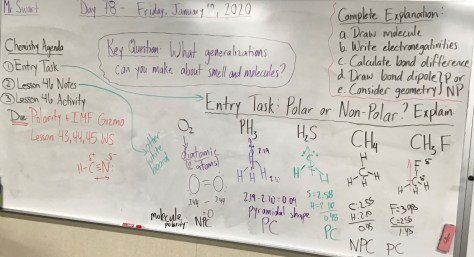
Notes from class (January 13):

Lesson 46 Day 2 Picture 1

Lesson 46 Day 2 Picture 2

Keep Learning!

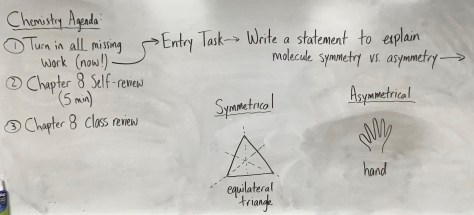
Wondering how to determine whether a molecule is symmetrical or asymmetrical?  Work through the slide deck from Dr. Fred Omega Garces and focus in on slide 15.  Look familiar?  Students received a copy of this flow chart in class today.

Homework:

  • Read Lesson 46 in the textbook.  Login via the Sapling website and enter your username and password.
  • Write notes for Lesson 46 and work through the practice problems at the end of Lesson 46
  • Please ask questions about anything from Lesson 46 you do not yet fully understand.

Polar Molecules and Smell

We continued our study of polarity, this time exploring how the polarity of molecules might impact our ability to smell the molecule.  Through the Lesson 45 PowerPoint, students learned that polar molecules are more likely to be detected by the nose as something with a scent although there are still polar molecules (like water) that do not smell.  We also visualized several molecules using a Java-based Molecule Polarity PhET simulation to give students a better sense of the concepts of electron density, bond dipoles, and molecule dipoles.  Emphasis was placed on the connection between bond electronegativity and overall molecule geometry.  During student work time, students cut out the molecules in the molecules handout and used the molecules to complete the Lesson 45 Worksheet.

Homework:

  • Read Lesson 45 in the textbook.  Login via the Sapling website and enter your username and password.
  • Write notes for Lesson 45 and work through the practice problems at the end of Lesson 45
  • Please ask questions about anything from Lesson 45 you do not yet fully understand.
Electronegativity Scale

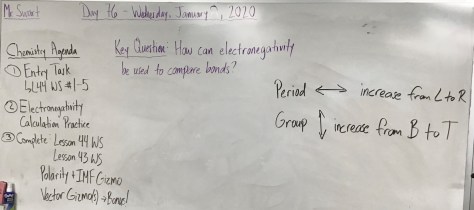
After learning about the concepts of electronegativity and polarity in yesterday’s lesson, students learned that scientist Linus Pauling assigned electronegativity values to individual atoms as a measure of how strongly an atom attracts electrons (click here for a deeper dive into how he calculated electronegativity).  Although not used in class, the Lesson 44 PowerPoint is provided here as a resource and includes a copy of the periodic table with electronegativity values for each element.  It also explains the difference in electronegativity between covalent bonds (0.5 and less), polar covalent bonds (between 0.5-2.1), and ionic bonds (greater than 2.1).

After practicing how to calculate bond differences as a class, students worked through the Lesson 44 Worksheet using the Electronegativity Scale and Bonding Continuum handout.

Students who finish the work early had time to complete yesterday’s Lesson 43 worksheet and Monday’s Polarity and Intermolecular Forces Gizmo.  Students who are fully caught up have the opportunity to investigate vectors and may earn bonus credit for completing one or both vector-related Gizmos.

Notes from class:

Lesson 44 Picture 1

Lesson 44 Picture 2

Keep Learning!

Want more information about dipoles from yesterday’s lesson?  Read about how dipole moments are calculated.

Wondering how scientists measure the electronegativity of atoms?  One new technique involves atomic force microscopy.  Read more:  Electronegativity of a single atom scrutinized under the microscope.

The Pauling scale of electronegativity was updated in a paper published a year ago (January 2019, Journal of the American Chemical Society).  Read a summary of the work: New scale for electronegativity rewrites the chemistry textbook.  Want more?  Take a look at the supporting data for the journal article.

Homework:

  • Read Lesson 44 in the textbook.  Login via the Sapling website and enter your username and password.
  • Write notes for Lesson 44 and work through the practice problems at the end of Lesson 44
  • Please ask questions about anything from Lesson 44 you do not yet fully understand.

Electronegativity and Polarity

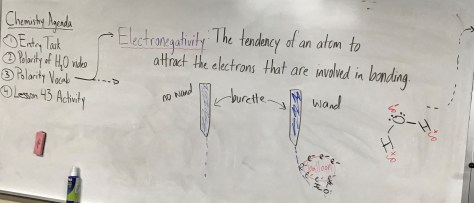
After completing the entry task on slide 3 of the Lesson 43 PowerPoint, we visualized the concept of a “charged wand” and it’s effect on polar molecules using a balloon, electrons gently extracted from the hair of a student volunteer, and a burette filled with water.  Students observed water flowing straight through the burette at the beginning of the demonstration, and then saw how water was attracted to the “charged wand” when the balloon was placed close to the stream of water.  Students were challenged to explain the observation using their understanding from our work yesterday (models drawn in the class notes below).  Next, we watched the Bozeman Science video below about the polarity of water molecules to review, extend, and apply the learning from yesterday to real-world scenarios:

We then talked through the definitions of electronegativity and dipole, relating both concepts back to molecules of water and carbon dioxide (see class notes below).  Finally, students received copies of the Lesson 43 Worksheet and accompanying cartoon to work through.

Notes from class:

Lesson 43 Picture 1

Lesson 43 Picture 2

Keep Learning!

Looking for more challenge?  When drawn as vectors, dipole arrows allow scientists to calculate the magnitude and direction of the overall dipole of a molecule.  Using vector addition, dipole arrows explain why water is polar while carbon dioxide is non-polar.  Brush up on vectors and vector addition using the Gizmo simulations.  Ask for one or both copies of the Gizmo handouts and grow your brain!

Homework:

  • Read Lesson 43 in the textbook.  Login via the Sapling website and enter your username and password.
  • Write notes for Lesson 43 and work through the practice problems at the end of Lesson 43
  • Please ask questions about anything from Lesson 43 you do not yet fully understand.
Attractions between Molecules

Thursday, December 19: We ended 2019 with an introduction to Lesson 42: Attraction Between Molecules.  For our entry task, students watched the Crash Course video below:

After the video, students worked on the Polarity and Intermolecular Forces Gizmo which will be due on Monday, January 6, 2020.

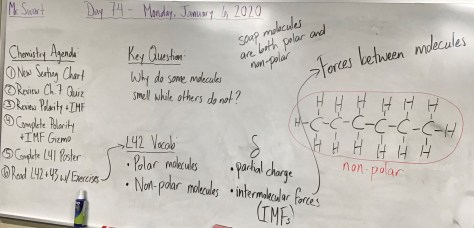
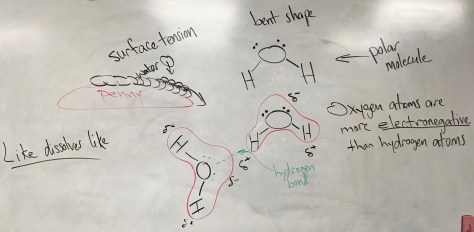
Monday, January 6: We began the year with a new student-selected seating chart.  While students arranged themselves, they received back the Chapter 7 quiz from December 18.  We then reviewed the quiz with students sharing out answers.  Next, we reviewed the concept of polarity and intermolecular forces (class notes shown below).  Finally, students had the remainder of the class period to complete the Gizmo, complete the Lesson 41 molecule poster project, and to read lessons 42 and 43 in the textbook and answer the lesson exercises.

Lesson 42 Picture 1

Lesson 42 Picture 2

Homework:

  • Read Lesson 42 in the textbook.  Login via the Sapling website and enter your username and password.
  • Write notes for Lesson 42 and work through the practice problems at the end of Lesson 42
  • Please ask questions about anything from Lesson 42 you do not yet fully understand.
Receptor Site Theory

For our final lesson of Chapter 7, we began with the TED-Ed video below to review the process of how we smell:

The Lesson 41 PowerPoint includes the key vocabulary concept of receptor site theory, where students learn the importance of molecule shape in determining recognition by receptor molecules involved in sensing smell.

Work for today (+10 assignment category bonus points for finished poster, due Monday, January 6, 2020):

  1. Complete the Winter Break Kahoot! Prep Google Form (for a fun Friday!)
  2. Research the molecule responsible for your favorite smell.  Example: limonene is the compound that gives orange peels their smell (CompoundChem has a huge list of aroma chemistry infographics)
  3. View the molecule on MolView.
  4. Research whether the olfactory receptor is known for the molecule.  A list of smell molecules and their olfactory receptors is located at OlfactionDB. For limonene, the olfactory receptors are coded for by the genes Olfr56 (mouse) and OR2V1 (human).
  5. Make a poster (8.5″ x 11″ paper)!  Your poster should include:
  • the name of the molecule
  • the structure
  • the smell
  • the name of the olfactory receptor (if known)

Keep Learning!

Homework:

  • Read Lesson 41 in the textbook.  Login via hs.saplinglearning.com and enter your username and password.
  • Write notes for Lesson 41 and work through the practice problems at the end of Lesson 41
  • Please ask questions about anything from Lesson 41 you do not yet fully understand.
Shape and Smell

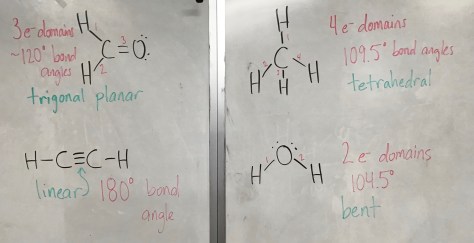
For Lesson 40, students worked in small groups to organize a set of 24 cards containing compounds with different shapes and functional groups.  The Lesson 40 PowerPoint includes a nice graphic organizer for studying the relationship between molecule name and functional group.  The Lesson 40 Worksheet and Card Sort are available for download.

Homework:

  • Read Lesson 40 in the textbook.  Login via hs.saplinglearning.com and enter your username and password.
  • Write notes for Lesson 40 and work through the practice problems at the end of Lesson 40.
  • Please ask questions about anything from Lesson 40 you do not yet fully understand.
Space-Filling Models

Click here to take the Pop Quiz!

After completing the quiz, read and follow the steps below:

  1. Read Lesson 39 in the textbook (pages 200-202).  Use a paper copy of the text or try logging in to the digital textbook (instructions at the bottom of this post).
  2. Write the definition for Space-Filling Model in your Chapter 7 Notes.  The definition is in the glossary (page G-20).
  3. Write a short summary of what you think are the most important things to remember from what you read in Lesson 39.
  4. Use MolView, a free molecular modeling software program available online, to search for the molecules shown in Lesson 39.  To begin, type methyl octanoate into the search bar to see the structure.
  5. Rotate the ball-and-stick model around by clicking and dragging the molecule.
  6. Use the Models > Representations menu and select the van der Waals Spheres option.  How does the ball-and-stick model compare with the van der Waals Spheres model?
  7. Repeat the process with the other molecules shown in Lesson 39.
  8. Research the name of the molecule responsible for your own favorite smell.  Can you find it in MolView?

Homework:

  • Read Lesson 39 in the textbook.  Login via hs.saplinglearning.com and enter your username and password.
  • Write notes for Lesson 39 and work through the practice problems at the end of Lesson 39.
  • Please ask questions about anything from Lesson 39 you do not yet fully understand.

Pop Quiz Answers (Shhhhh!!!!)

IMG_0659

IMG_0660