Category Archives: Chemistry

Molecular Structure and Properties: Receptor Site Theory

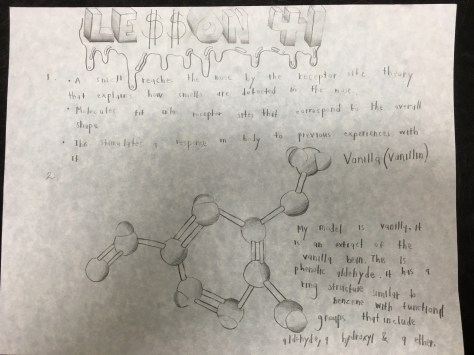
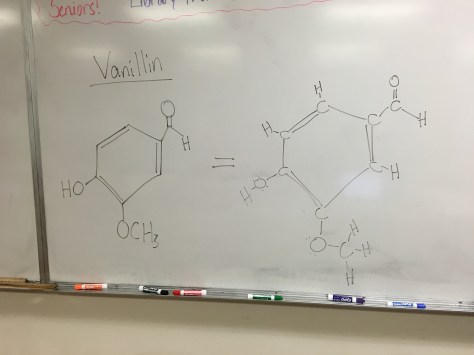
The final lesson of chapter 7 brings together student learning about how the olfactory system (the way we perceive smell) works.  The Lesson 41 PowerPoint includes the key vocabulary concept of receptor site theory, where students learn the importance of molecule shape in determining recognition by receptor molecules involved in sensing smell.  During class, we discussed how this concept is readily transferred across biology, extending beyond smell to areas like immunology.    Students received the Lesson 41 Worksheet, with the option to research their favorite smell, determine whether the olfactory receptor for that smell is known, and to model their favorite smell molecule with MolView rather than construct a poster.  Students also learned how to “read” an organic molecule structure traditionally used by chemists (see picture from the whiteboard below).  For homework, students may complete any 4 of the textbook questions for this lesson.
IMG_0394.JPG

Student work:

IMG_0396

Molecular Structure and Properties: Shape and Smell

For Lesson 40, students worked in small groups to organize a set of 24 cards containing compounds with different shapes and functional groups.  The Lesson 40 PowerPoint includes a nice graphic organizer for studying the relationship between molecule name and functional group.  The Lesson 40 Worksheet and Card Sort are available for download.  For homework, students are assigned questions 1, 2, and 5.

Molecular Structure and Properties: Space-Filling Models

Lesson 39 introduces students to the concept of space-filling models.  The lesson calls for students to use space-filling models which we do not have access to at our school.  Rather than continue to use the ball-and-stick models, students instead used MolView, a free software program available online.  Using MolView, students searched for the compounds in the Lesson 39 Worksheet using the search tool.  They then visualized the molecules as space-filling models using the van der Waals Spheres option located under the Model tab.  Although not particularly helpful, the Lesson 39 PowerPoint is included.  For homework, students are assigned questions 3 and 4 from the textbook.

Molecular Structure and Properties: Molecular Shape

We returned to the molecular modeling kits in Lesson 38, this time using the kits to learn about the shape of molecules.  We worked through the Lesson 38 PowerPoint, learning vocabulary terms to describe molecular shape.  Students then worked in small groups to complete the Lesson 38 Worksheet.  For homework, students were assigned textbook problems #1-6.  Notes from the whiteboard are shown below:

Molecular Structure and Properties: Electron Domains

We began the day with a brief review of Lesson 36 (the last slide of the PowerPoint) before transitioning to the Lesson 37 PowerPoint.  Students learned about electron domains and how they affect the shape of a molecule.  They then worked in pairs on the Lesson 37 Worksheet, substituting the molecular modeling kits for the entire activity (no candy in our classroom).  Students also received a copy of the January homework calendar which outlines the schedule along with assigned homework through the end of the month (and thus the end of the semester).  The assigned lesson 37 textbook questions are #3-6, 8, and 9.

Molecular Structure and Properties: Ball-and-Stick Models

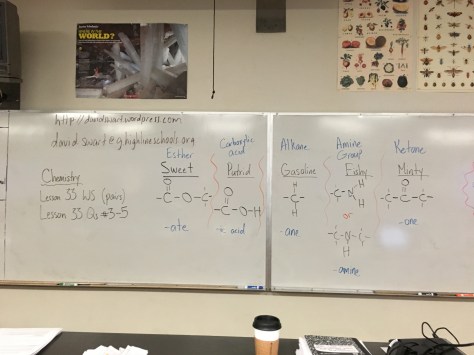
We kicked off the New Year with Lesson 36, the first lesson of Chapter 7.  The Lesson 36 PowerPoint introduced students to the vocabulary term “ball-and-stick model” and students worked in groups of four to complete the Lesson 36 Worksheet.  Students were assigned textbook questions 1-6 as homework.  Notes from the whiteboard are pictured below:

Molecular Structure and Properties: Key Vocabulary and Concepts

Students reviewed the key vocabulary terms in the Lesson 34 PowerPoint and Lesson 35 PowerPoint.  They received the Lesson 35 Worksheet as a study guide, and we briefly discussed the ester synthesis reaction that occurs when a compound with a carboxylic acid reacts with a compound with an alcohol functional group.  Students should work through textbook questions 1, 2, 3, 5, and 6, with question 4 available as extra credit.

With the Unit 6 quiz scheduled for Thursday, students will have the next two days to finish their research reports, review the practice quiz, and to ask questions from Unit 6.

12/15/15 Update:

Students worked through the Chapter 6 practice exam and then we reviewed the questions.  Notes from the white board are pictured below:

Molecular Structure and Properties: Biofabric Synthesis

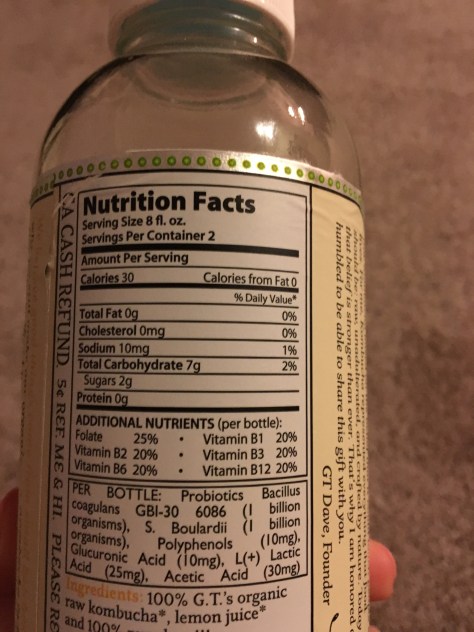
Rather than follow the lesson plans for Lessons 34 and 35, we decided to skip the butyric acid lab and instead grow biofabric using Suzanne Lee’s kombucha tea recipe.  We watched her TED Talk and then students had the opportunity to read the Popular Science article detailing how to prepare the tea (both available on a previous Biology class post from September 4 this year).  Students were also provided with the label from a bottle of store-bought kombucha pictured below:

IMG_0137

Plan for December 10:

  • Working in a group of 3-4 students:
  • Prepare the kombucha biofabric growth medium.  Following the recipe in the article, brew the green tea and add sugar sugar.  Cover with a cloth and allow to cool overnight.
  • Write a procedure for brewing kombucha tea for the sole purpose of producing bacterially-derived cellulose  (the scoby).  Document the steps in a research report.
  • Research how the bacterial strains known to be present in the store-bought kombucha (Bacillus coagulans GBI-30 6086 and Saccharomyces boulardii) metabolize the growth medium to produce cellulose.  Document sources and include findings in the report.
  • Research the chemical formula and structure of cellulose.  Identify the individual subunits of cellulose and explain how the subunits combine to form the cellulose polymer.  Document sources and include images in the report as appropriate.
  • Explain how cellulose might be modified to make it waterproof (hydrophobic).  Create a molecular model of your idea and take a picture of the molecule to include in the report.

Plan for December 11:

  • Add apple cider vinegar and kombucha bacterial culture to growth medium and include a piece of scobe.  Cover with a cloth and incubate with periodic observation over several weeks.
  • Continue working on the research report from the previous day.

Kombucha Tea Review (scientifically credible):

Additional Resources:

Molecular Structure and Properties: Octet Rule

For today’s starter activity, students were challenged to draw the molecular structures represented by the chemical equation for cellular respiration:

C6H12O6 + O2 -> H2O + CO2 + ATP

Many students were able to draw molecular oxygen (O2, with a double bond between the two oxygen atoms), water, and carbon dioxide (also with double bonds connecting the central carbon atom to the two oxygen atoms).  The molecular structure of glucose (C6H12O6) was far more challenging.  We transitioned into Lesson 32, which brought together the concepts of molecular structures, valence electrons, covalent bonding, and Lewis dot symbols.  We reviewed the Lesson 32 PowerPoint and then students worked in groups of four to complete the Lesson 32 worksheet.  To help students visualize molecular structures, we used the molecular modeling kits.  The kits were especially helpful in helping students understand double and triple bonds.