
In lesson 10, we continued with our study of osmosis, focusing on the extreme environment of the Great Salt Lake. Students learned that a railroad causeway was built across the lake more than 60 years ago, physically separating the lake into two sides. Only the south side of the lake receives a continuous supply of freshwater, causing the salinity of the south side to be much lower than the north side. As a result, the ecosystem of the south side of the lake is much more robust than the north side which is inhabited primarily be halobacteria. Considered extremophiles because of their unique ability to live in extremely salty water, halobacteria are present in such abundance that they color the water in the north side of the lake purple (because of the rhodopsin protein they produce). As evidence of their learning, students completed a case study worksheet and hypothesized what might happen to the existing Great Salt Lake ecosystem if the causeway were removed.
All posts by David Swart
Systems Biology – Lesson 9
In lesson 9, our first lesson of the week, we circled back to osmosis, a concept students learned about early in the school year. We connected the theme of “Water Follows Salt” with the reality that cell membranes contain pores and channels that regulate the flow of everything across the cell membrane. We discussed the vocabulary of osmosis in the context of blood, recognizing that blood cells in plasma (isotonic) behave much differently than blood cells in water (hypotonic) or in saltwater (hypertonic). We then thought about how salmon might be able to transition from freshwater to saltwater during their life cycle. By connecting pore protein expression (via the Central Dogma) with evolution, students now have the foundation necessary to explain how salmon can hatch from an egg fertilized in a freshwater stream, migrate through the brackish waters of an estuary out into the Puget Sound, travel for years in the salty Pacific Ocean, and eventually find their way back to the steam from which they were born to complete their life cycle. We wrapped up with a video about ice cave exploration, in which the concept of extremophiles was presented. Students then transitioned to Work Time where they read an article and answered questions about extremophiles.
Systems Biology – Lesson 8
Our exploration of the Tyee Campus ecosystem concluded with a return to modeling energy flow using Microsoft Excel 2013. Students worked individually to construct an energy flow model using a worksheet which provided the calorie requirements of a variety of organisms found on our campus. The worksheet also included the Excel formulas to connect the various pieces of data into a model. The lesson provided students with an opportunity to practice using the formula functions in Excel, taught them how to create a linked graph of the data, and asked them to derive explanations about why organisms are found in numbers approximating what might be anticipated by their understanding of the trophic pyramid.
Systems Biology – Lesson 7
Our efforts to understand how our campus ecosystem fits within the larger Puget sound ecosystem culminated today. During the first two class days this week, students worked in groups to create presentations comparing and contrasting the Tyee campus ecosystem with the larger Puget Sound region ecosystem. Students were tasked with identifying at least one aspect of CHON+Energy cycling absent from our campus that could be added back to make our campus more like the larger Puget Sound region ecosystem.
In the current lesson, students watched George Monbiot’s TED Talk about the concept of “rewilding” to encourage them to think big about how to improve the ecosystem of the Tyee campus. After watching the talk, students worked individually to complete an evaluation of the project their group proposed the previous day to improve the campus.
Consolidation of Crypto Holdings
In preparation for our lesson integrating the concept of cryptocurrencies into the ecosystems portion of our systems biology unit, I have been researching exchanges for the various eco-themed altcurrencies we have received from many generous donors. Ideally, there would be one exchange to house all of these currencies, but the reality is quite different. In an effort to maximize class time and provide students with an opportunity to learn how to execute trades, I have decided to consolidate currencies I have donated (from @dogetutor) on Cryptsy in the form of DogeCoins. I will discuss with students our options for handling the remaining donated coins. Options include:
1. Students sign up for additional exchanges to receive the altcurrency
2. Students download the altcurrency wallet on their own computer and send their deposit address
3. I trade our holding(s) for DogeCoins, transfer the DOGE to Cryptsy, and distribute to each student
My purpose in sharing this is to reinforce the importance of transparency. I have selected DOGE as the common currency because of the low transfer fee, it’s ubiquity on the various exchanges, and the interest students have shown in acquiring that particular currency. Feedback is welcome and appreciated!
Systems Biology – Lesson 6
What a week! We took advantage of the summer-like weather early in the week with a survey of our local school ecosystem. We then transitioned to a deep-dive reading of matter and energy cycling in an ecosystem, and wrapped up with Lesson 6, where students shared their learning with their group members to construct two models of matter and energy cycling. Students received a graphic organizer to help them compare and contrast the cycling of carbon, water, and nitrogen (CHON) as well as energy on two very different ecological scales. For the large scale, we evaluated matter and energy cycling of a more generic ecosystem like the Puget Sound region. For the smaller scale, we focused on our school campus. Students realized that some, but not all, aspects of matter and energy cycling are present on our school campus in contrast to what is found in the larger Puget Sound region. Next week they will craft and deliver presentations to the class explaining the ecological implications of, and possible solutions to, separating a school campus from the native local ecosystem.
Systems Biology – Lesson 5
This week, students are collecting data about the ecosystem of the Tyee Campus. There are a number of bunnies on our school campus, with coloration that suggests they may be recent descendants of pets released into the wild. I presented students with a scenario and a mission: Find the bunnies! Students spent most of the first class period canvassing the campus looking for bunnies and taking pictures of the habitat.
The next day, students were introduced to CHON (Carbon, Hydrogen, Oxygen, and Nitrogen) and discussed sources of CHON in an ecosystem. Students began working in groups to consider how to integrate their basic understanding of CHON into their understanding of the local campus ecosystem. Some groups began creating PowerPoint presentations, while others devised strategies to create a central repository of pictures in DropBox. If needed, students continued their field work, taking pictures of the local ecosystem to support their presentations.
For the third day of Lesson 5, we reviewed CHON and students began to conceptualize how to create a presentation with the Tyee bunnies as the central player. Students received a worksheet with a list of readings to help further their understanding of CHON and energy cycling in an ecosystem. All students must read one core section, while the additional reading sections are to be read by at least one student in the group and shared with the rest of the group using the jigsaw reading strategy.
Systems Biology – Lesson 4
On the first day of class this week, students took a quiz to demonstrate mastery of the Systems and Networks section of the unit. Afterward, students worked individually to construct one or more networks from a list of seemingly random biotic and abiotic factors. The list was actually populated by the names of the various cryptocurrencies students will receive at the end of the unit.
The next day, students shared the strategies they used to construct their networks. Specifically, we discussed what their edges represented – what was moving through their system. Many students modeled energy cycling by creating a food web. Others sought to include the abiotic factors and modeled things like the Earth-Moon-Sun system or the Water Cycle, integrating the biotic factors into that schema. During work time, students worked in groups of up to 4 students to integrate their individual systems into a larger representation of an ecosystem. This activity created the foundation for the computer modeling activity in the next lesson.
With a guest speaker scheduled for Friday, we once again are limited to only three days of class this week. For the third and final lesson of the week, students learned to use formulas to dynamically link individual cells in a Microsoft Excel 2013 spreadsheet. Students began by making a list of the organisms in their group models. Next, they assigned quantity values to each organism to represent the amount of each type of organism that must be consumed by a predator of that organism to sustain the predator. Students shared possible strategies that could be used to estimate those values. Students then created formulas to relate the organisms. The relationship formulas enable future modeling predictions based on scenarios that might occur. For example, we could model what might happen if an invasive species enters an ecosystem and reduces the quantity of one of the organisms in the network.
The sequencing of the Systems Biology unit has been adjusted from the original plan to account for scheduling realities. As a student teacher at Highline high School, our principal would frequently say, “Monitor and adjust.” Such insight! Our updated unit flow will now look something like:
1. Introduction to Systems
2. Ecosystems and Modeling
3. Integration of Economics into Ecosystems
4. Human Body Systems
Digital Microscope!
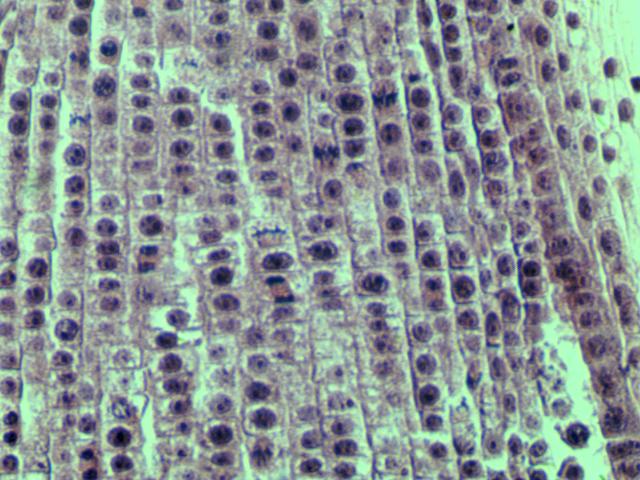
Thanks to a generous grant from the Southwest King School Retirees’ Association, we were able to purchase a digital microscope and a set of prepared slides. This equipment will enable us to recover some of the functionality of a lab in a classroom setting, and will extend our capabilities by allowing us to take digital pictures and movies and to conduct extensive analysis of those images.
Here are our first three images taken with the microscope:
1. Daphnia Head – 40x

2. Onion Root Tip – 40x

3. Onion Root Tip (mitosis!)- 100x
Systems Biology – Lesson 3
After learning how to define networks in lesson 1, and how to analyze a network in lesson 2, students were tasked with constructing a network in lesson 3. Students worked in groups of up to four people to construct an economic network, with each student contributing at least 5 nodes and 5 edges. The ability to understand how networks function, and how to analyze and construct a network will be valuable skills as we move forward in the unit and investigate human body systems, ecosystems, and the integration of the emerging cryptocurrency economy with our study of ecosystems.
 Science with Swart
You must be logged in to post a comment.