Toxins: Counting by Weighing

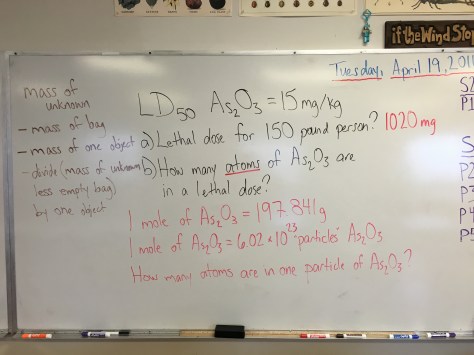
For Lesson 75, students were challenged to identify a procedure to count large numbers of objects using only a small sample of those objects.  The lesson began with the Lesson 75 PowerPoint ChemCatalyst activity.  We worked through part A and then students were challenged to complete part B as homework for 5 points of extra credit.  Notes from the activity are pictured below:
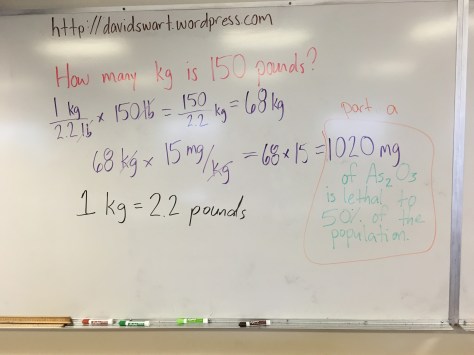
IMG_0762

IMG_0764.JPG

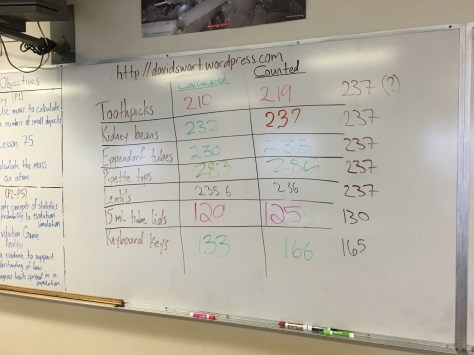
Students then received the Lesson 75 Worksheet and worked together in small groups to come up with and enact a common procedure to count unknown numbers of toothpicks, pinto beans, Eppendorf tubes, pipette tips, lentils, and keyboard keys.  An abbreviated procedure  is in the picture above and class results (calculated and actual) are pictured below.
IMG_0763.JPG

Evolution: Evolution Game

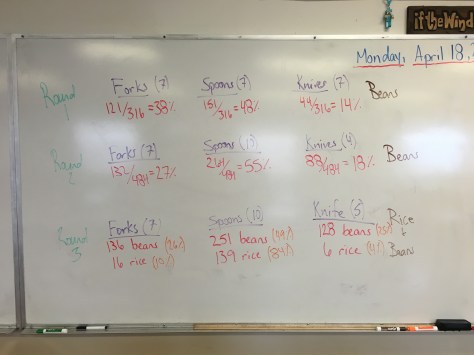
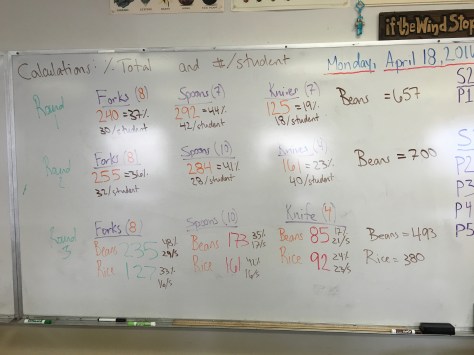
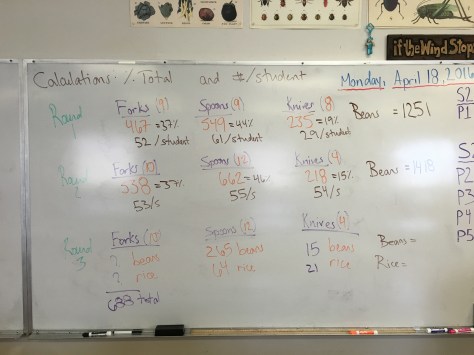
Taking advantage of the beautiful weather, we spent the majority of class outside today playing an evolution game.  The class was divided into thirds, with one-third of students receiving a plastic fork, spoon, or knife.  All students received a cup.  The cup served as the “mouth” and the eating utensil was the “hand”.  Dried pinto beans were scattered in a section of the front lawn, and students had to move the beans from the ground to the cup using only the utensil.  After three minutes, the students gathered in their utensil groups and counted the total number of beans collected.  We repeated the activity again, changing the number of students with each utensil and collecting data for round two.  For the third and final round, students foraged for both beans and rice.  We then went back into the classroom and analyzed our results.   Students calculated the percentage of beans obtained by each group (percent of total collected for each round) and the average number of beans collected by the students in each group.  Students then brainstormed factors that could have affected class results and those are reported below:

  • Number of people per group
  • Beans blended into grass
  • Amount of hunting space around each student
  • Area chosen by student for hunting
  • Shape of utensil
  • Speed each student hunted
  • Some people cheated (used hands)
  • Technique (some used the utensil non-traditionally)
  • Determination of each student (persistence to hunt for full 3 minutes)
  • Competition for territory
  • Some utensils broke during the hunt
  • Shifting focus from beans to rice
  • Forks got caught on the grass
  • Hunters became more competitive
  • Amount of time available to hunt for food
  • Rough terrain affected food collection
  • Hunters sabotaging each other

The data for each class period is shown in the pictures below:

IMG_0755
Period 2
IMG_0757
Period 3
IMG_0759
Period 4
IMG_0761
Period 5

Toxins: Toxicity

In the first lesson of Chapter 14, students were introduced to the concept of LD50 (the dose of a compound that is lethal to 50% of the population).  Students considered the ChemCatalyst in slide 3 of the Lesson 74 PowerPoint, and also recorded the LD50 definition on slide 6.  Students then received both the Lesson 74 Worksheet and accompanying Lethal Doses Handout to work on during class.  For homework, students were assigned Lesson 74 textbook questions 4 and 5.  Example LD50 calculations from the whiteboard are pictured below:

Toxins: Chapter 13 Quiz

With the short week, students have the opportunity to use Thursday to:

  • Catch up on missing work (Lesson 72 Q#4 and Lesson 73 Qs #1-7)
  • Practice balancing equations using the new HTML5 (Chromebook compatible!) Balancing Chemical Equations PhET Simulation
  • Finish categorizing the types of reactions (Lesson 73 WS)
  • Complete the Chapter 13 Quiz, which will consist of the Chapter 13 Summary questions #1-4 on page 379 of the textbook (due Monday).

Toxins: Types of Reactions

We began class with a review exercise intended to help students bring together the concepts of molarity and balancing equations.  We returned to the photosynthesis equation example from yesterday, this time reversing it to model cellular respiration.  Students then calculated the molecular mass of each of the molecules involved in cellular respiration, and used the balanced equation as evidence to support the Law of Conservation of Mass.  We then briefly reviewed the connection between moles and particle number, using Avagadro’s number to calculate the number of water molecules in 6 moles of water.  Notes from the white board are pictured below:

We then transitioned to classifying the types of reactions by focusing on the Lesson 73 PowerPoint slide 8.  Students are encouraged to review the full slide deck, including the vocabulary defined on slides 9-12.  Students then received the Lesson 73 Worksheet and Toxic Reaction Cards to work on for the remainder of class.  For homework, students were assigned Lesson 73 textbook problems 1-7.

Toxins: Balancing Chemical Equations

Class began with the ChemCatalyst from the Lesson 72 PowerPoint.  With the lesson focusing on balancing chemical equations, we worked through the ChemCatalyst equation on the whiteboard, and then jumped into balancing the equation for photosynthesis (both pictured below):


Students learned how to count and add atoms on both sides of the equation, how to write the mole number in front of the reactants or products (when needed), and how to multiply the mole number by the subscript numbers.  For review, students are encouraged to watch the Crash Course video below (note – we have seen the first 9 minutes, so pick up at about the 9 minute mark to review about balancing equations).

Students then received the Lesson 72 Worksheet to work on in pairs.  We worked through worksheet question 2C, as well as Lesson 72 textbook questions 4A and 4G (for homework, students were assigned textbook question 4, all parts).  Work for those problems is shown below:

Evolution: Some of the Things That Molecules Do

We kicked off our Evolution Unit with Episode 2 of Neil deGrass Tyson’s reboot of the Cosmos series called Some of the Things That Molecules Do.  The video does an excellent job presenting evolution as the product of genetic mutation, and differentiates between natural and artificial selection.  Students received a worksheet and time to collaborate on the responses both during (intermission) and after the video.

Variation and Inheritance: Unit 4 Exam

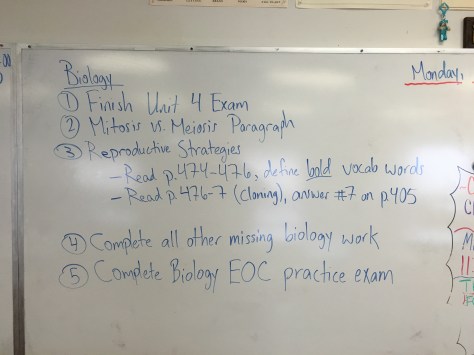
To conclude Unit 4, students received an April Fool’s packet consisting of a set of instructions, the 2014 Biology End of Course practice exam, and the Unit 4 Exam.  Due to some confusion on behalf of our substitute on Friday, April 1, many students needed additional clarification of the packet instructions, as well as additional time to complete the quiz.  So on Monday, April 11 (after Spring Break), students had the class period to complete the quiz and other missing work.  Quarter 3 grades will be entered into Illuminate tomorrow after school (April 12), so all student work must be in my possession by the end of the school day tomorrow to count toward the quarter grade.  A list of recent assignments was written on the white board all day today as a reminder to students and a picture of the list is shown below:

IMG_0729.JPG