Category Archives: Uncategorized

Molecular Structure and Properties: Ball-and-Stick Models

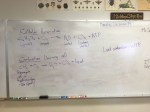
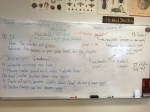
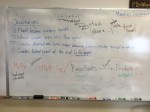
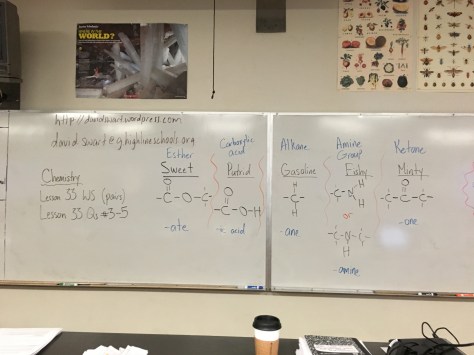
We kicked off the New Year with Lesson 36, the first lesson of Chapter 7.  The Lesson 36 PowerPoint introduced students to the vocabulary term “ball-and-stick model” and students worked in groups of four to complete the Lesson 36 Worksheet.  Students were assigned textbook questions 1-6 as homework.  Notes from the whiteboard are pictured below:

Energy, Matter, and Organization: Potato Catalase Lab Conclusion

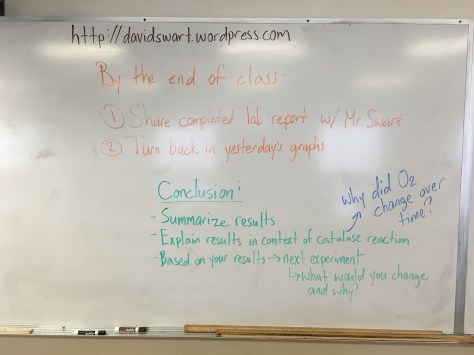
We wrapped up the calendar year with students working with their groups to write the conclusion section of the potato catalase lab report.  The picture below provides guidance for writing the conclusion.  When finished, students shared their lab report with the teacher and turned in their individually completed paper graphs.

IMG_0305

Energy, Matter, and Organization: Enzymes

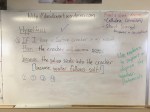
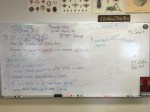
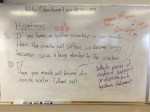
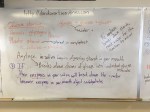
We opened class with a brainstorming session about what would happen if a person placed a Saltine cracker in their mouth and left it there.  Students in each class came up with two or three hypothesis statements, after which, they conducted the experiment.  Students were offered regular or whole wheat crackers.  We recorded observations, determined whether the observations supported or disproved the hypothesis statements, and then launched into a discussion of enzymes.  Students recorded the definitions of reactants, products, and enzymes taken from today’s Chemistry class Lesson 35 PowerPoint slide deck (on slide 11, the word “catalyst” was replaced with “enzyme” and “substance” was replaced with “protein”).  We reviewed the way that animals and plants created polymers of glucose to create glycogen (energy stored in animals), starch (energy stored in the plant organelle called the amyloplast), and cellulose (structural molecule in plants).  We then applied that learning to the discussion of how the salivary amylase enzyme digests the starch in the Saltine crackers, releasing glucose molecules.  A few students in each class who let the crackers sit in their mouths for a long time even reported the crackers tasted slightly sweet.  The discussion of enzymes set the stage for tomorrow’s potato catalase lab.

Pictures from the white boards for today’s classes:

Molecular Structure and Properties: Biofabric Synthesis

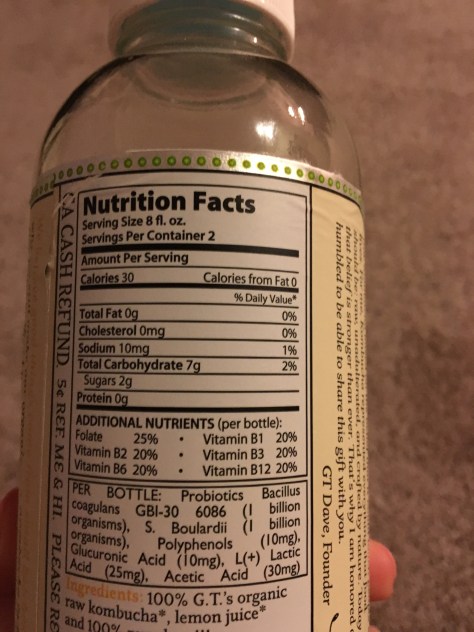
Rather than follow the lesson plans for Lessons 34 and 35, we decided to skip the butyric acid lab and instead grow biofabric using Suzanne Lee’s kombucha tea recipe.  We watched her TED Talk and then students had the opportunity to read the Popular Science article detailing how to prepare the tea (both available on a previous Biology class post from September 4 this year).  Students were also provided with the label from a bottle of store-bought kombucha pictured below:

IMG_0137

Plan for December 10:

  • Working in a group of 3-4 students:
  • Prepare the kombucha biofabric growth medium.  Following the recipe in the article, brew the green tea and add sugar sugar.  Cover with a cloth and allow to cool overnight.
  • Write a procedure for brewing kombucha tea for the sole purpose of producing bacterially-derived cellulose  (the scoby).  Document the steps in a research report.
  • Research how the bacterial strains known to be present in the store-bought kombucha (Bacillus coagulans GBI-30 6086 and Saccharomyces boulardii) metabolize the growth medium to produce cellulose.  Document sources and include findings in the report.
  • Research the chemical formula and structure of cellulose.  Identify the individual subunits of cellulose and explain how the subunits combine to form the cellulose polymer.  Document sources and include images in the report as appropriate.
  • Explain how cellulose might be modified to make it waterproof (hydrophobic).  Create a molecular model of your idea and take a picture of the molecule to include in the report.

Plan for December 11:

  • Add apple cider vinegar and kombucha bacterial culture to growth medium and include a piece of scobe.  Cover with a cloth and incubate with periodic observation over several weeks.
  • Continue working on the research report from the previous day.

Kombucha Tea Review (scientifically credible):

Additional Resources:

Molecular Structure and Properties: Octet Rule

For today’s starter activity, students were challenged to draw the molecular structures represented by the chemical equation for cellular respiration:

C6H12O6 + O2 -> H2O + CO2 + ATP

Many students were able to draw molecular oxygen (O2, with a double bond between the two oxygen atoms), water, and carbon dioxide (also with double bonds connecting the central carbon atom to the two oxygen atoms).  The molecular structure of glucose (C6H12O6) was far more challenging.  We transitioned into Lesson 32, which brought together the concepts of molecular structures, valence electrons, covalent bonding, and Lewis dot symbols.  We reviewed the Lesson 32 PowerPoint and then students worked in groups of four to complete the Lesson 32 worksheet.  To help students visualize molecular structures, we used the molecular modeling kits.  The kits were especially helpful in helping students understand double and triple bonds.

Molecular Structure and Properties: Bonding Tendencies

Students received their graded Unit 1 Exams back today.  The scores were generally very good, although one question missed by several students had to do with the origin of precious metals on Earth.  While the exams were being returned, students watched the video below explaining how those metals are formed when a star becomes a supernova.

After the video, we revisited Lesson 29 after students explained they were unable to locate the mystery scents yesterday.  As “luck” would have it, I was able to find butyric acid in the chemical supply room, so students had the option of experiencing a putrid smell in addition to the sweet smells of apricot and artificial rum extracts.  We connected the smells with the chemical name endings learned in Lesson 28 and then moved on to Lesson 30.  We reviewed the Lesson 30 PowerPoint and then worked together as a class on the first four problems of the Lesson 30 Worksheet.

Energy, Matter, and Organization: Biomolecules

We began the day with an entry task designed to pull forward student learning about cellular respiration just before the Thanksgiving holiday break.  The white board summary showing the entry task, as well as the formulas for both cellular respiration and photosynthesis are shown below:

We then transitioned to a class assignment where students were divided into four teams, with each team responsible for answering one quarter of the worksheet questions answered in the Crash Course Biomolecules video (below).  After the video, student groups worked together to talk through their responses to ensure consistency.  Finally, students re-grouped in order to share answers, thus serving to review the video content and provide students the opportunity to discuss and debate answers.

Energy, Matter, and Organization: Food: Our Body’s Source of Energy

Special thank you to Mr. Frank for helping guide my biology students through the day.  Students are expected to adhere to our new seating chart and use class time efficiently to complete the following work:

  1. Finish the Relating Nutrition & Chronic Disease worksheet packet from yesterday.  The packet should be turned in when completed.
  2. Complete the Google Classroom assignment Food: Our Body’s Source of Energy reading and Google Doc worksheet.
  3. Students who finish should ensure they have competed the previous Google Classroom assignment Why Can’t You Hold Your Breath Forever?
  4. The next assignment will be the Molecules Reading assignment already loaded in Google Classroom.