Category Archives: Chemistry

COVID-19

Monday, March 2, 2020: With the coronavirus (COVID-19) all over the news, we will take some time this week to better understand the science of the virus, learn about tools scientists use to study epidemiology, and investigate how treatments may eventually be developed.  After providing students some time to formulate and share questions and concerns, we will watch a comprehensive overview prepared by Dr. Arnaud Fontanet of the Institut Pasteur on February 20, 2020:

During his highly informative presentation, Dr. Fontanet references several of the following websites:

Coronavirus, SARS, MERS (and more) in the News

How About Treatment Options?

https://www.youtube.com/watch?v=lXMc15dA-vw

Virus Outbreak Simulations

Get Proactive!  The data is clear: the best way to control the spread of disease is through effective hand washing.  Students looking to earn bonus credit are encouraged to bring in the following supplies (+5 bonus each, +20 bonus max):

  • Hand Sanitizer
  • Paper Towels
  • Kleenex
  • Cleaning Wipes

Earn an additional +5 bonus credit by taking the HHS Public Health Survey (Student Bathrooms).
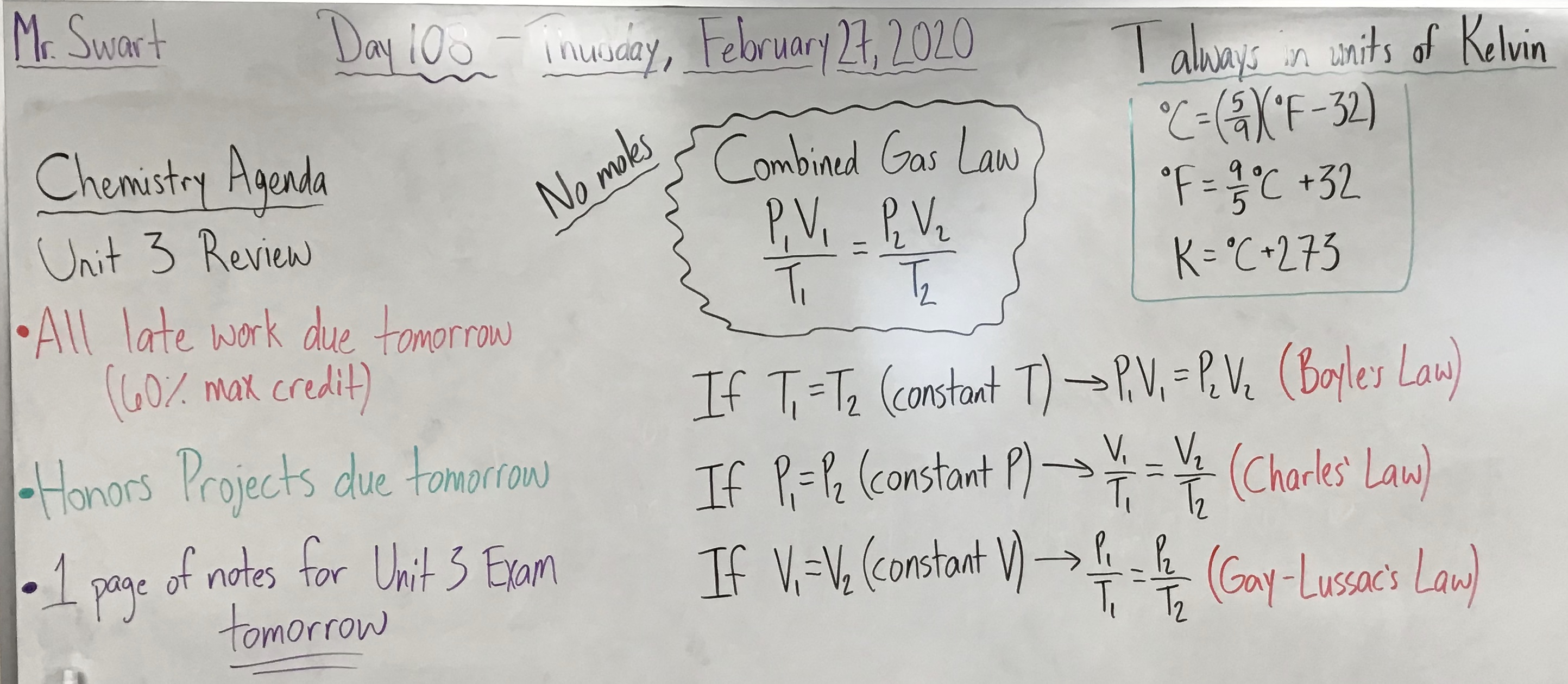
 

Gas Laws Mini-Unit Review

In preparation for the Mini-Unit 3 Exam tomorrow, students had the class period to:

  • Review for the exam
  • Complete Dry Ice Sublimation lab report
    • Due tomorrow at 11:59 PM – no exceptions
    • Share Google Doc with Mr. Swart
  • Complete and turn in all late Unit 3 work (60% max credit)
    • Due tomorrow – final deadline
  • Work on Honors projects
    • Due tomorrow – no exceptions

The notes below are provided to help students begin preparing for the exam tomorrow.  Students should ask all the questions today!  Do not wait until the test tomorrow to realize you need help.  Office hours are after school today until 3:00.

Combined Gas Law
Combined Gas Law
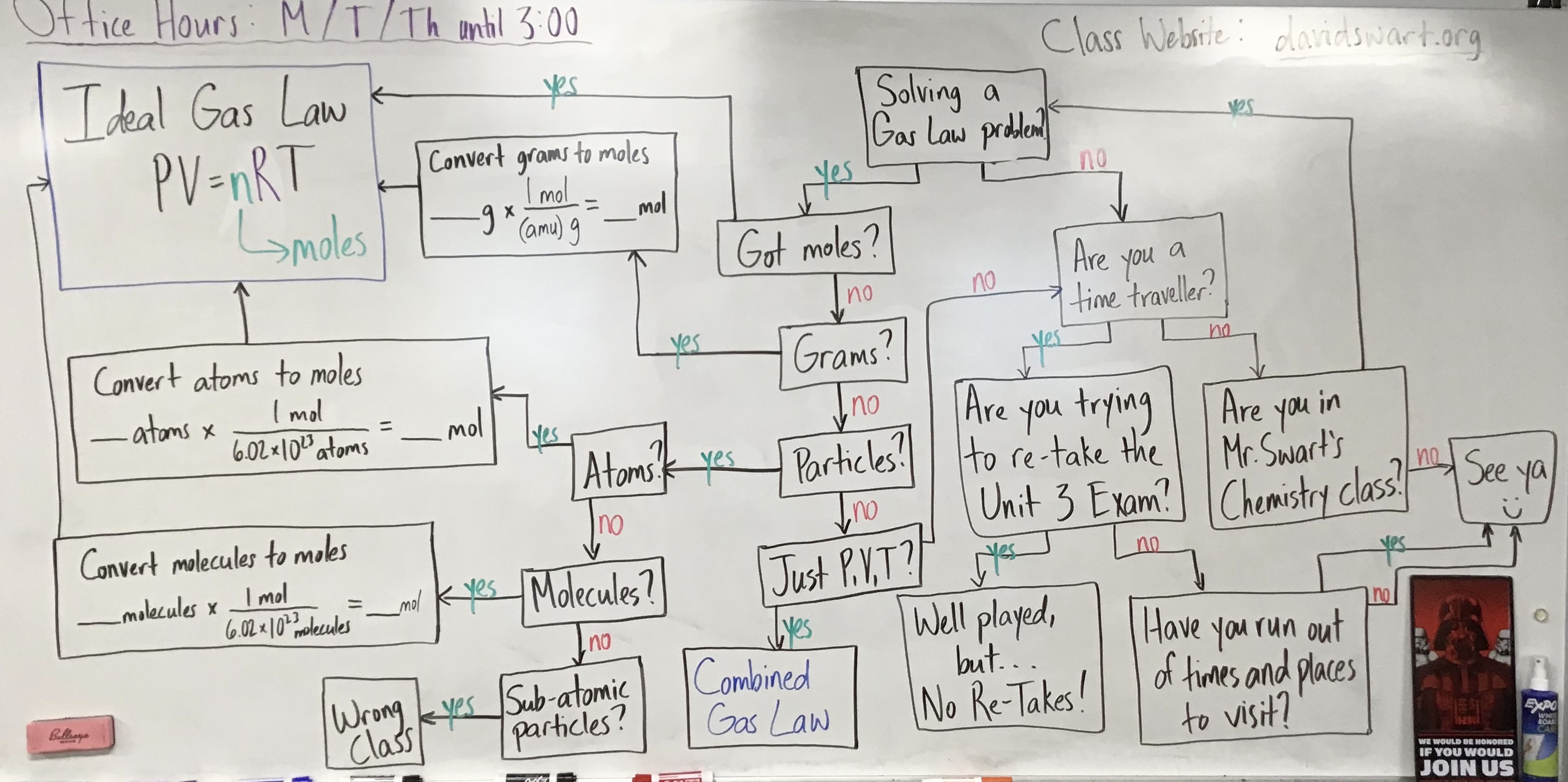
Ideal Gas Law Flow Chart
IMG_0790
Practice conversions (grams to moles to molecules to atoms)


Ideal Gas Law Lab

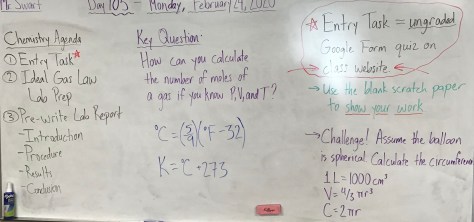
Today marks the start of the final week for our gas laws unit.  Class began with an entry task in the form of an ungraded Google Form quiz.  With our Unit 3 Exam scheduled for Friday, the quiz provides students with yet another opportunity to self-assess, and the results will help us focus our review as the week progresses.

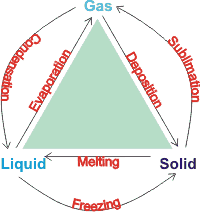
For our work today, in preparation for our lab tomorrow, students will review the diagram below which illustrates the connection between the three phases of matter commonly encountered on Earth, and the vocabulary associated with changing phase.  Click on the image to learn a whole lot more about the science of phase change.

To help students visualize the least familiar of the phase change reactions (the solid-to-gas and gas-to-solid phase changes), we will watch a brief video below, complete with spooky soundtrack:

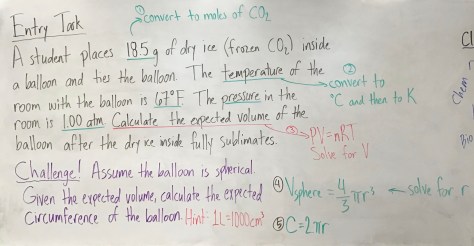
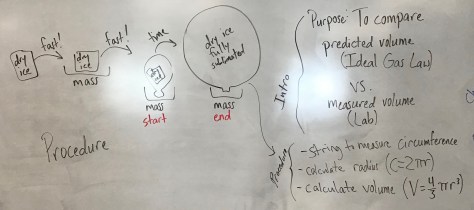
Next, students created a Google Doc and began pre-writing the Lab Report for the lab tomorrow in which we will actually conduct the experiment described in the entry task.  The intent is that students will follow their written Procedure tomorrow, collect data for the Results section, and understand the purpose of the lab (Introduction) so evaluating results in the Conclusion section will occur smoothly on Wednesday.  Lab reports will consist of:

  • Student name
  • Lab report title (Dry Ice Sublimation Lab)
  • Introduction (explain the purpose of the lab, including the connection between dry ice, sublimation, volume, and the Ideal Gas Law)
  • Procedure (numbered list of steps someone could follow to recreate your experiment)
  • Results (observations from the lab, focusing on mass and volume)
  • Conclusion (what was learned, comparison of calculated volume vs measured volume, three potential sources of error, and solutions to correcting those sources of error in the future)

Class Notes:

For homework, students received the Lesson 64 Worksheet to work this evening in preparation for class tomorrow.


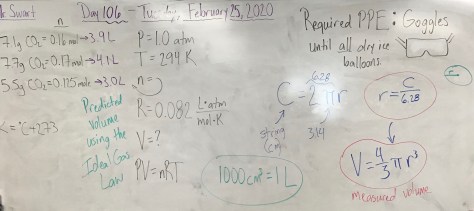
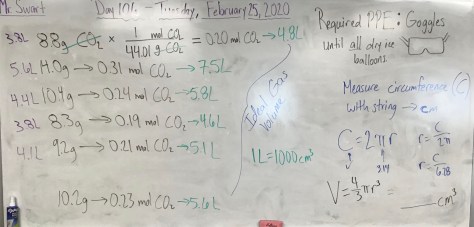
For the second lesson of the Gas Laws mini-unit, students worked with dry ice and watched a couple of teacher demonstrations involving dry ice.  To begin class, students worked in small groups to measure the mass of a small amount of dry ice, quickly transfer the dry ice into a balloon, and then quickly tie off the balloon to trap the sublimated carbon dioxide gas. Students then measured and recorded the mass of the dry ice added to the balloon at the beginning and at the end of the experiment, then measured the volume of the bag after the dry ice finished sublimating in order to calculate the density of carbon dioxide gas.

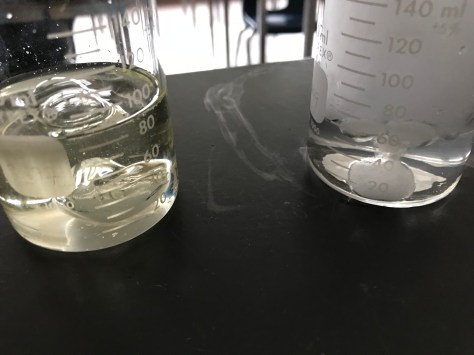
While waiting for the dry ice to sublimate, students hypothesized about what they might observe when water ice and dry ice were heated on a hot plate, and also what would happen when water and dry ice were added to liquid water or vegetable oil (pictured below).

Dry ice in vegetable oil (left) and water (right)

Class Notes:

Note: For students who missed class due to testing today, please watch the videos below as a substitute for participating in the lab.


For the final day of this lesson, students need to finish writing their lab report (Google Doc, shared with Mr. Swart) detailing their results from the dry ice in a balloon experiment.  The lab report must include the following clearly labeled sections:

  • Introduction (explain the purpose of the lab, including the connection between dry ice, sublimation, volume, and the Ideal Gas Law)
  • Procedure (numbered list of steps someone could follow to recreate your experiment)
  • Results – observations from the lab, including:
    • initial mass of the dry ice converted to moles of CO2
    • initial and final mass of the dry ice and balloon
    • final volume of the balloon as measured during the lab
    • calculated volume of the balloon using Ideal Gas Law (PV=nRT)
    • amount of time it took the dry ice to fully sublimate in the balloon
    • calculation of the rate of sublimation (mass of CO2 divided by sublimation time
  • Conclusion: Compare the volume measured via the Ideal Gas Law to the volume measured during the experiment.  Explain why the numbers are different.  Suggest at least two possible sources of experimental error.

The Mole and Avogadro’s Law

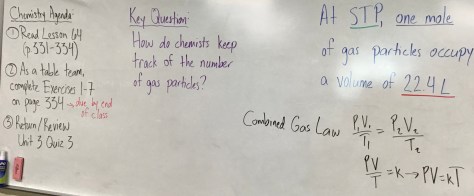
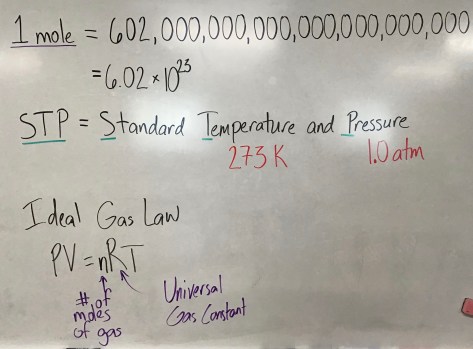
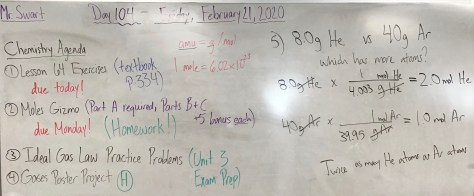
We continued our learning of gas laws by taking the combined gas law and adding in the concept of the mole to account for the number of particles contained within a sample of gas.  We began with class notes (pictured below).  Then, students were assigned to read Lesson 64 of our textbook: The Mole and Avogadro’s Law.  Students then worked in groups of 3-4 to complete the Exercises at the end of Lesson 64 (responses due by the end of class).  The Lesson 64 PowerPoint is provided for reference material. To conclude the class period, students received back their quiz from last Thursday.

IMG_0759

IMG_0760


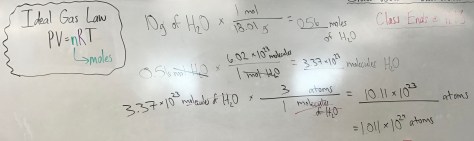
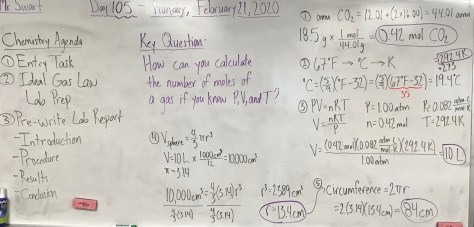
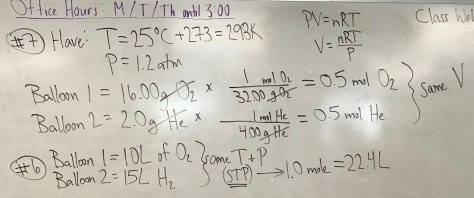
For day 2 of this lesson, students were greeted with an Ideal Gas Law entry task (solutions pictured below) which consumed the majority of the abbreviated class period.

This slideshow requires JavaScript.


For days 3 and 4 of this lesson, students were first tasked with completing the Lesson 64 Exercises from Tuesday, then working on the Moles Gizmo.

Additionally, students received a paper copy of Ideal Gas Law Practice Problems (pages 1-2 of the linked document).  Click the link and scroll to page 3 for the solutions to check your work.

Notes from class:

Extend Your Learning!

Interested in how scientists calculated the number of particles in one Mole?  Read about it at Wired Magazine.

Air Pressure

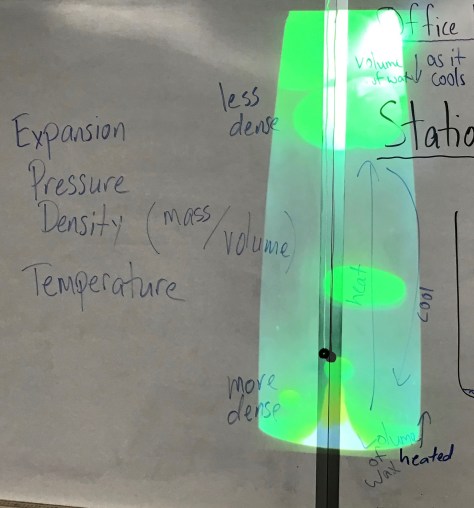
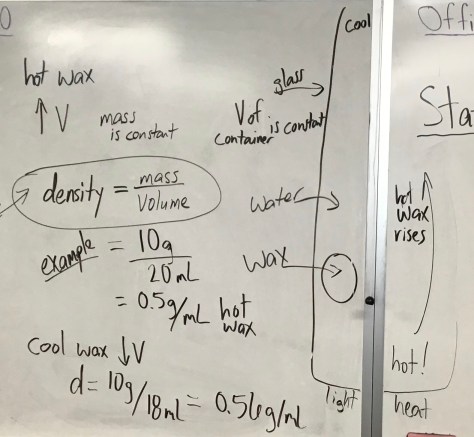
Our day begins with an entry task instructing students to watch the video below of a lava lamp, then explain the action of the lava lamp using volume (V), temperature (T), and pressure (P).

Student ideas:

200210 Chemistry Lava Lamp Picture

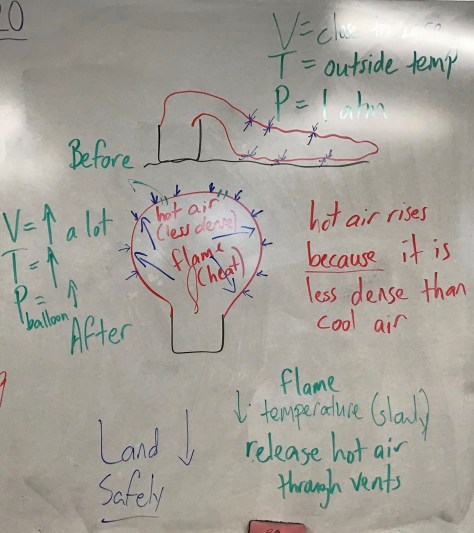
After discussing student ideas, students watched the short video of hot air balloons inflating and flying.  They were challenged to explain why hot air balloons fly, why they rise to a certain height and then stop, and how hot air balloons change altitude.

After a brief discussion, students were introduced to some new vocabulary terms included in the Lesson 57 PowerPoint.

Class Notes:

200210 Chemistry Balloon Picture

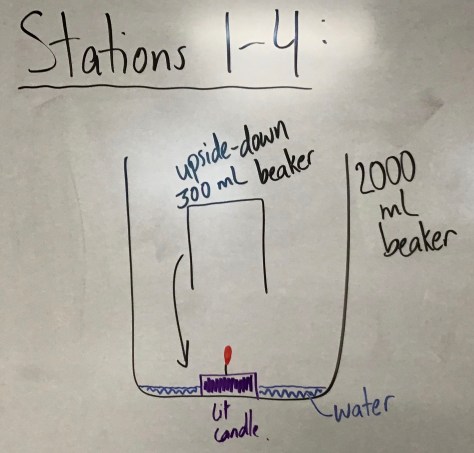
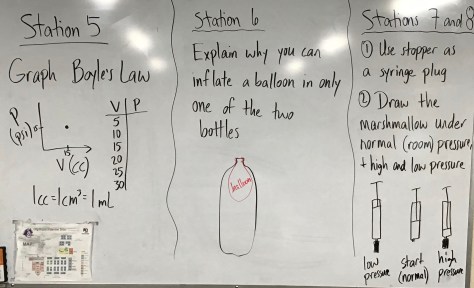
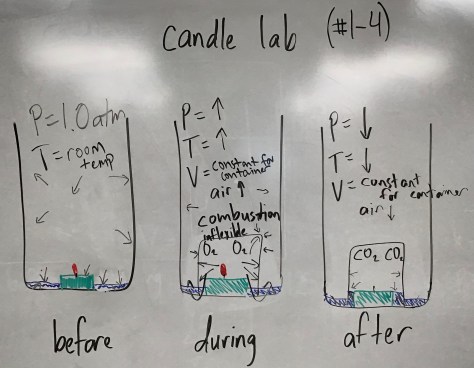
Finally, students rotated through four different stations to make observations and collect data on a modeling air pressure lab handout helping them to learn more about air pressure.

Station instructions:

Notes the next day showing molecule motion in the experiments

Keep Learning (at home!): Balloon in a bottle

Combined Gas Law

We began class with a brief review of the gas pressure experiments from yesterday.  Students shared results and ideas, then updated their models and explanations.

Next, having thoroughly explored gas laws involving two variables (Pressure & Volume, Pressure & Temperature, and Temperature and Volume), students were introduced to the Combined Gas Law, k=PV/T.  We began class with the video below:

For our work today, students were tasked with reading Lesson 61 in the textbook and then working through the Lesson 61 Worksheet.  For additional practice, students should work through the exercises at the end of Lesson 61 in the textbook.   

Gas Laws Simulation

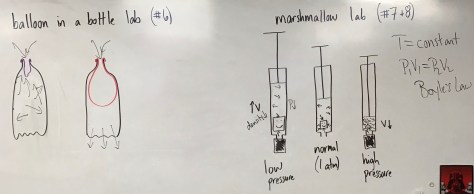
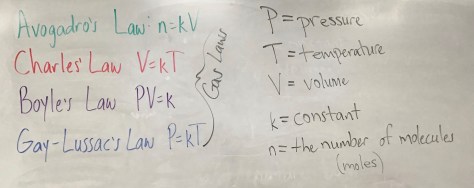
Monday, February 3: Last week, students were introduced to four different gas laws: Avogadro’s Law, Boyle’s Law, Charles’ Law, and Gay-Lussac’s Law.  We conducted a lab using marbles to determine the effect of volume, temperature, and “molecule” number on pressure.  We also practiced solving problems using Boyle’s Law and learned more about the variables of pressure and volume.

For our work today, students will complete guided notes focusing on Boyle’s, Charles’, and Gay-Lussac’s Laws.  We will also focus in on the variable of temperature, differentiating between Fahrenheit, Celsius, and Kelvin.  Students also received an Exit Task designed to illustrate the process and expectations for solving a gas laws type of story problem.

Notes from class:

This slideshow requires JavaScript.

Keep Learning!

Want to know more about Absolute Zero and the Kelvin Scale?  Check out the selection of videos below and expand your mind:


Tuesday, February 4: We will complete our in-depth look at the math and thinking behind Boyle’s, Charles’, and Gay-Lussac’s Laws by completing the notes handed out yesterday.  Students will then begin working through the Gas Laws Simulation and accompanying guided work packet (AACT resource – provided by Mr. Swart).

Students interested in pursuing the Honors Option this semester also received an optional Gases Poster assignment that will be due February 28 and which will be presented to the class that day.  Students may work alone or with a partner.

Class Notes:


Wednesday, February 5: All 10th grade students are out of the building on a career-day field trip.  Non-10th grade students will have the class period to work on the Gas Laws Simulation.


Thursday, February 6: Students will have the entire class period as a work day to complete the Gas Laws Simulation. Students will also receive back their Exit Task from Monday to use as a study tool for the quiz tomorrow. The answer key is provided below:

Note: The quiz tomorrow will include questions about the Gas Laws learned thus far, and will also include math problems that require the sort of algebra reviewed in Monday’s entry task.  Students may use the guided notes from Monday/Tuesday on the quiz.

Under Pressure – Introduction to Gas Laws

Class began with a brief review of yesterday’s exit task in which students were asked to analyze real data comparing the effect of exam color and having notes on the exam.  The data was graphed as individual dots, and the average (mean) was shown.  The analysis also included the p value for a t-test, and students learned how to interpret the p value in the context of statistical significance.  For details on how to conduct a t-test, see the Keep Learning! section at the bottom of this post.

Our mini Gas Laws unit began with a brief silent video introducing the Gas Laws.  Students were tasked with making written observations and then we held a class discussion and produced a chart of what they Know, Think They Know, and Need to Know.  Next, students were introduced to Robert Boyle, one of the great chemistry scientists from history who contributed greatly to our understanding of Gas Laws. Students completed a guided notes handout while watching the video and discussed responses after.  To watch the video outside of class, request a passcode from Mr. Swart.

Note: Many of the lesson materials for this unit are supplied by the American Association of Chemistry Teachers (AACT) and require a membership to access.

The lesson concluded with a gas pressure simulation lab activity in which students worked in groups to simulate the movement of gas molecules, observing how a changing the temperature, volume, and number of molecules affects the pressure of a gas.

Notes from class:

200129 Picture 1

200129 Picture 2

Keep Learning!

Want to learn more about the t-test?  Check out the video below:


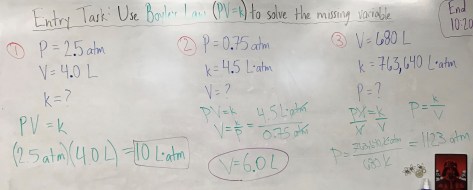
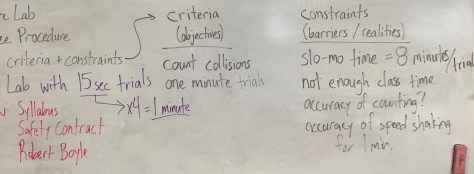
For the second day of the lesson, we began with an entry task in which students were instructed to use Boyle’s Law (PV=k) to solve three different problems, each missing one of the three variables in Boyle’s Law.  Next, we reviewed what went well and strategies for improving the lab we started yesterday based on criteria (lab objectives) and constraints (barriers/realities).  After agreeing on a plan forward, students had the remainder of the class period to work through the modified lab and then finish the analysis questions on the back of the lab handout.

Class Notes:

200130 Picture 1

200130 Picture 2


For the final day of the lesson, students will complete the Friday Quiz (click here!) and then have the remainder of class to complete the lab from yesterday.  For homework, students should analyze any remaining video from the lab and then work through the analysis questions on the back of the lab handout.  Students should also review the PowerPoint (Unit 3 Vocabulary).

Semester 2 Launch

Welcome to second semester!  A new semester brings fresh start and a new unit.  Before we dive in, we will roll out a new seating chart, welcome new faces to our classroom, review the class Syllabus and Safety Contract and hold a class discussion around expectations this semester.

Next, students will receive back their graded Unit 2 exams.  We will discuss any questions students have about the exam.  Students who took the Unit 1 exam will also receive it back graded.  Two groups of students took the exam:

  • Students with an A after the unit 2 exam was graded had the option of taking the Unit 1 exam.  The exam score does not affect the semester 1 grade.  However, students who earn a 70% or better on the exam will receive an Honors designation on their transcript for 1st semester chemistry.
  • Students who did not turn in the Unit 1 Project had the option of taking the Unit 1 exam.  The exam score (up to 60% max) will replace the missing score from the project.

Finally, we will wrap up 1st semester with an Exit Task designed to help them reflect on their successes and consider opportunities to grow during 2nd semester.  After the Exit Task, students should confirm access to the class textbook (full student gmail address and HighlineMM/DD where MM/DD are birth month and day) and the class Newsela account.

Unit 2 Review

Friday, January 17, 2020: For the entry task, students are assigned the job of accessing the Swart Chemistry Unit 2 Review Google Doc designed to facilitate the unit 2 review process.  Each student is responsible for:

  1. Selecting one question from the Unit 2 Review section of the textbook (pages 252-256) and writing both the question (including all multiple choice answers), highlighting the correct answer using bold text, and then explaining why the correct answer is correct along with including a page citation from the textbook.
  2. Selecting at least three exercise questions from Lessons 28-48 in the textbook.  The questions are found at the end of each lesson.  Follow the same steps as above.
  3. Note: If all Unit 2 Review questions have been addressed, verify one answer (include your name as the verifier) and then answer at least four questions from Lessons 28-48 in the text.

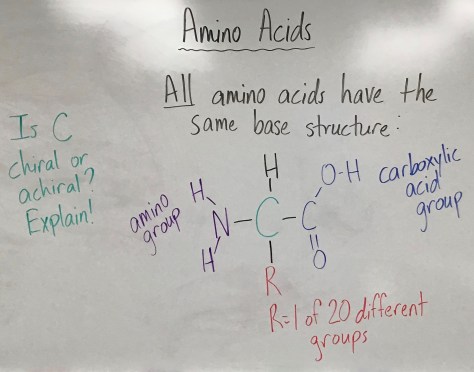
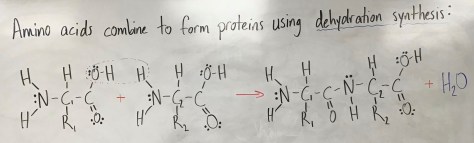
Tuesday, January 21, 2020: For our first day of review for the Unit 2 Exam taking place on Thursday, we briefly reviewed the vocabulary of chiral, achiral, and dehydration synthesis reactions (encountered in Lesson 34) by visualizing the reaction in the context of amino acids.  Class notes are shown below:

Unit 2 Review Picture 1

Unit 2 Review Picture 2

Next, students played a Kahoot! designed to test their understanding and retention of material they had the opportunity to study over the three-day weekend.  After the Kahoot!, students had the remainder of the class period to answer or verify answers on the class Google Doc started last Friday.  All students received a copy of a practice test to complete in class or as homework.  In addition, students were reminded to prepare one 8.5″ x 11″ page of notes (front and back) to use on the exam.


Wednesday, January 22, 2020: For our final day of review before the Unit 2 Exam, we began with reviewing question 18 from the multiple choice portion of the unit 2 review.  Next, students received the answer key to the practice quiz they received yesterday and had the opportunity to ask questions about any points of confusion.  Students had the remainder of the class period to ask questions, share ideas, add to or review the Google Doc, and add to notes that can be used on the exam tomorrow.  Areas of focused study should include:

  • Connection between molecule name, molecular formula, functional group, and smell
  • Larger molecule shapes and smells
  • HONC 1234 Rule
  • Connection between molecule size, polarity, and smell
  • Lewis dot diagrams (lone pairs, bonded pairs)
  • Molecule shape
  • Advantages and disadvantages of types of molecular models
  • Receptor-site theory
  • Electronegativity: calculations, partial charges, dipole, symmetry
  • Mirror-image isomers (chiral molecules)
  • Amino acids: how are they similar? different? R group polarity

Notes from the white board (click arrows to move through slide show):

This slideshow requires JavaScript.