Category Archives: Chemistry

Weather: Air Pressure

Lots of demonstrations today!  We will conduct as many demonstrations as time and resources permit.  Students are encouraged to watch the videos below to make additional observations and to help explain what is happening in each of the demonstrations.  Students will write observations and draw pictures of air molecules to visualize pressure using the space provided on the Lesson 57 Worksheet.  The Lesson 57 PowerPoint includes the definition of pressure.

Balloon in a bottle:

Soft drink can:

Submerged cup:

Air pressure mat:

Cup and card:

Balloon in a vacuum:

Marshmallows:

Egg in a bottle:

Weather: Gas Density

For the first lesson of Chapter 11, students worked with dry ice and watched a couple of teacher demonstrations involving dry ice.  To begin class, students quickly assembled into groups of four and transferred a small amount of dry ice (provided in a styrofoam cup) into a deflated plastic bag which they sealed closed.  Students measured and recorded the mass of the dry ice added to the bag (by subtracting the mass of the empty cup from the mass of the cup with dry ice).  Students then observed the plastic bag throughout the remainder of the class period.

In the interim, students hypothesized about what they might observe when water ice and dry ice were heated on a hot plate, and also what would happen when water and dry ice were added to liquid water or vegetable oil.  They then observed the outcomes and recorded their observations on the Lesson 56 Worksheet.  Students also recorded the definitions of sublimation and evaporation, both of which are included in the Lesson 56 PowerPoint.

Students also received back their graded Chapter 10 quizzes.  Notes from the short answer section are pictured below, along with calculations of how to measure the volume of carbon dioxide gas inflating the plastic bags from the lesson.  Students may replace their short answer scores from the quiz by substituting new numerical values for the problems and solving the problems with the new numbers.

Weather: Unit Conversion & Significant Figures

With the HHS teachers out of the classroom for a Professional Development meeting on Thursday, students worked independently in small groups on an activity called Can You Lift It? The activity called for students to measure and calculate the interior volume of the classroom and then use that volume, along with density values that needed to be researched, to calculate the mass of the room filled with the indicated materials.  The activity required students to successfully use dimensional analysis.

To help students better understand how to perform dimensional analysis calculations, the Dimensional Analysis section of Appendix A in the back of the textbook (pages A16-17) was offered as extra credit (+10EC).  Additionally, the Scientific Notation section (Appendix A, pages A14-16) was also offered.  Students are also encouraged to watch the Crash Course video below for additional instruction on both topics:

Weather: Chapter 10 Quiz

In preparation for the Chapter 10 Quiz, students worked together as a class to answer the Chapter 10 practice questions at the end of the chapter.  Pictures of their work written on the whiteboards are shown below:

Students may use one page of notes for the quiz.  After the quiz, students will prepare for tomorrow’s activity (they will have a substitute teacher) by writing a procedure for how to measure the interior volume of our classroom, taking into account the volume occupied by fixed structures.

Weather: Density, Temperature, and Fronts

In the final lesson of Chapter 10, students focused their learning of temperature and volume back on the concept of weather as it relates to warm and cold fronts and the formation of clouds.  We worked through the ChemCatalyst in the Lesson 55 PowerPoint and then watched a clip of Kenvin Delaney, Jimmy Fallon, and Lucy Liu experiment with matter of different densities:

Students then worked through the Lesson 55 Worksheet which calls for them to reference the Weather Variables worksheet from Lesson 49.  For homework, students were assigned textbook questions 1, 3, 4, and 5.

Weather: Charles’s Law

We formally connected observations about the relationship between temperature and volume by introducing Charles’s Law.  The Lesson 54 PowerPoint includes the definition of Charles’s Law and introduces k, the proportionality constant.  We worked through the ChemCatalyst and watched a few minutes of a YouTube video showing a lava lamp in action:

We sketched out a before/during/after model of how a lava lamp works and the white board notes are shown below.  Students then practiced working through Charles’s Law by completing the Lesson 54 Worksheet.  For homework, students were assigned textbook questions 1 and 7 (or Notes).


Weather: Thermometers

We jumped into the short week with a lab designed to help students understand the relationship between temperature and pressure.  The Lesson 52 Worksheet has two parts, and we conducted the lab for part 2.  We adjusted the lab procedure as follows:

  1. Bring 200 mL of water to 80 degrees Celsius, measuring temperature with a digital thermometer.
  2. Invert a 10 mL graduated cylinder and place in the heated water for 3 minutes.
  3. Quickly and carefully move the graduated cylinder from the heated water into 100 mL of room temperature water (colored blue with 2 drops of food coloring) and quickly add ice to chill the water.
  4. Record observations throughout the experiment.

Several groups had difficulty observing the intended outcome, so I conducted a quick demonstration toward the end of class and we discussed why the results occurred.  The picture below shows cold water entering the graduated cylinder and rising above the water line.IMG_0547
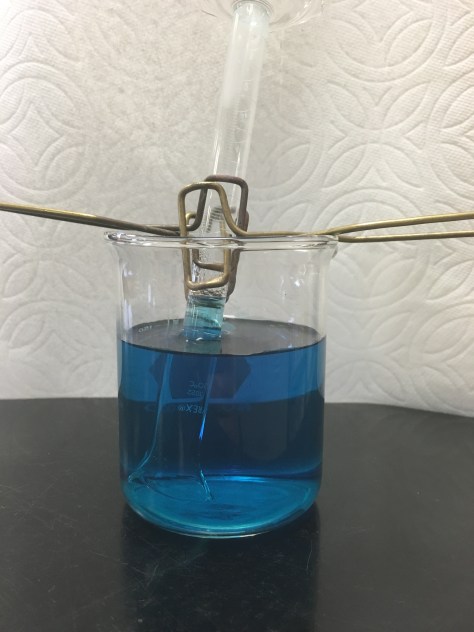
Students successfully reasoned that at the beginning of the experiment, the graduated cylinder contains room temperature air.  When placed in the heated water, the steam (evaporated water molecules) displace the room temperature air in the graduated cylinder, as evidenced by the bubbles observed leaving the graduated cylinder.  When the steam-filled graduated cylinder was transferred to the cold water, the decrease in temperature caused the steam to condense back into liquid form, and the volume of space occupied by the liquid water decreased.  As a result, cold water was drawn into the graduated cylinder.  The concepts of pressure and vacuum were introduced by students looking to explain further, and those concepts will be introduced in upcoming lessons.  For reference, the Lesson 52 PowerPoint is attached.  For homework, students should complete textbook questions 5-9 or take notes on the lesson.

Weather: Kelvin Scale

Because of the altered class schedule yesterday and the short class period today, we skipped Lesson 52 and moved ahead to Lesson 53.  We will return to Lesson 52, which involves a lab where students make rudimentary thermometers, when we return from the 4-day holiday break on Wednesday (2/17).  Today, class began with a short SciShow video about the Kelvin Scale:

After the video, students worked through the Lesson 53 Worksheet.  The Lesson 53 PowerPoint is available for review by clicking here.  For homework, students should complete textbook questions 6, 9, 11, and 12 or take notes on the lesson.