Category Archives: Chemistry

Toxins: Mass-Mole Conversions

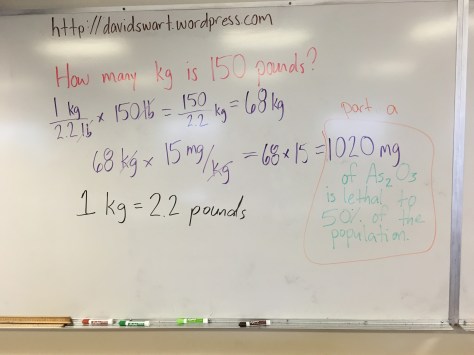
Lesson 78 provided students with additional practice converting from mass to moles and from moles to mass.  The Lesson 78 PowerPoint ChemCatalyst activity asked students to predict whether arsenic (As), arsenic oxide (As2O3), or arsenic sulfide (As2S3) was most toxic.  Students had to consider how many atoms of arsenic are in each molecule, and which has more molecules in a fixed mass.  Some of the work from the entry task is shown below:

For the Lesson 78 Worksheet, students worked in pairs to complete the questions.  For homework, students were assigned questions 5-8 from the textbook.

Evolution: The Beak of the Finch

After an eventful start to the day in which we briefly lost power at our school and our digital classroom wall clocks are hours off, we decided to start the class period with Jack Horner’s entertaining TED Talk in which he describes his research connecting dinosaurs and chickens.

After the video, we returned to our discussion of Darwin’s finches from yesterday’s lesson.  Students watched the HHMI video The Beak of the Finch (below) and then set to work on the accompanying worksheet packet.  We will continue our work tomorrow during the short Friday class period.  Students who finish early are encouraged to try the Finch Song Activity on the HHMI website.

Toxins: Avogadro’s Number

For Lesson 76, students gained practice working with scientific notation in the context of Avogadro’s Number (really big numbers) and the mass of small numbers of particles (really small numbers).  We began class by working through part B of the ChemCatalyst from Lesson 75.  Notes from the work are shown below:

We then transitioned into the Lesson 76 Worksheet (we did not use the Lesson 76 PowerPoint but it is provided here for reference).  We worked through some of the table on page 2 of the worksheet, and then students used the remainder of the class period to work together to complete the worksheet.  For homework, students were assigned to complete any 3 problems from the textbook.

Toxins: Counting by Weighing

For Lesson 75, students were challenged to identify a procedure to count large numbers of objects using only a small sample of those objects.  The lesson began with the Lesson 75 PowerPoint ChemCatalyst activity.  We worked through part A and then students were challenged to complete part B as homework for 5 points of extra credit.  Notes from the activity are pictured below:

IMG_0762

IMG_0764.JPG

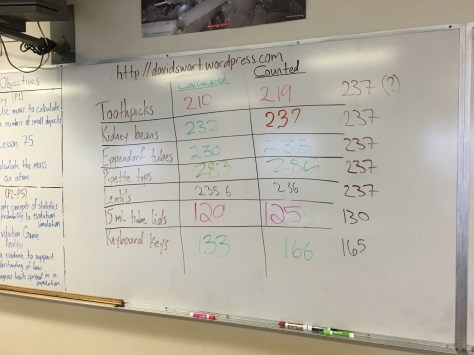
Students then received the Lesson 75 Worksheet and worked together in small groups to come up with and enact a common procedure to count unknown numbers of toothpicks, pinto beans, Eppendorf tubes, pipette tips, lentils, and keyboard keys.  An abbreviated procedure  is in the picture above and class results (calculated and actual) are pictured below.

IMG_0763.JPG

Toxins: Toxicity

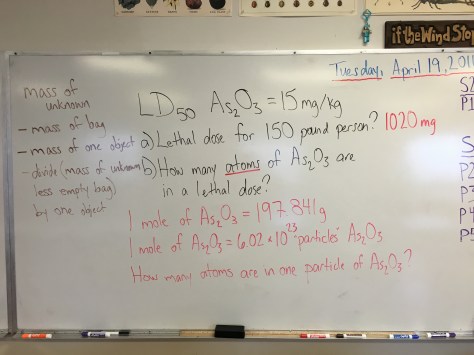
In the first lesson of Chapter 14, students were introduced to the concept of LD50 (the dose of a compound that is lethal to 50% of the population).  Students considered the ChemCatalyst in slide 3 of the Lesson 74 PowerPoint, and also recorded the LD50 definition on slide 6.  Students then received both the Lesson 74 Worksheet and accompanying Lethal Doses Handout to work on during class.  For homework, students were assigned Lesson 74 textbook questions 4 and 5.  Example LD50 calculations from the whiteboard are pictured below:

Toxins: Chapter 13 Quiz

With the short week, students have the opportunity to use Thursday to:

  • Catch up on missing work (Lesson 72 Q#4 and Lesson 73 Qs #1-7)
  • Practice balancing equations using the new HTML5 (Chromebook compatible!) Balancing Chemical Equations PhET Simulation
  • Finish categorizing the types of reactions (Lesson 73 WS)
  • Complete the Chapter 13 Quiz, which will consist of the Chapter 13 Summary questions #1-4 on page 379 of the textbook (due Monday).

Toxins: Types of Reactions

We began class with a review exercise intended to help students bring together the concepts of molarity and balancing equations.  We returned to the photosynthesis equation example from yesterday, this time reversing it to model cellular respiration.  Students then calculated the molecular mass of each of the molecules involved in cellular respiration, and used the balanced equation as evidence to support the Law of Conservation of Mass.  We then briefly reviewed the connection between moles and particle number, using Avagadro’s number to calculate the number of water molecules in 6 moles of water.  Notes from the white board are pictured below:

We then transitioned to classifying the types of reactions by focusing on the Lesson 73 PowerPoint slide 8.  Students are encouraged to review the full slide deck, including the vocabulary defined on slides 9-12.  Students then received the Lesson 73 Worksheet and Toxic Reaction Cards to work on for the remainder of class.  For homework, students were assigned Lesson 73 textbook problems 1-7.

Toxins: Balancing Chemical Equations

Class began with the ChemCatalyst from the Lesson 72 PowerPoint.  With the lesson focusing on balancing chemical equations, we worked through the ChemCatalyst equation on the whiteboard, and then jumped into balancing the equation for photosynthesis (both pictured below):


Students learned how to count and add atoms on both sides of the equation, how to write the mole number in front of the reactants or products (when needed), and how to multiply the mole number by the subscript numbers.  For review, students are encouraged to watch the Crash Course video below (note – we have seen the first 9 minutes, so pick up at about the 9 minute mark to review about balancing equations).

Students then received the Lesson 72 Worksheet to work on in pairs.  We worked through worksheet question 2C, as well as Lesson 72 textbook questions 4A and 4G (for homework, students were assigned textbook question 4, all parts).  Work for those problems is shown below:

Toxins: Physical versus Chemical Change

Because I am out of the school building tomorrow and prefer not to have our substitute conducting a lab, I’ve decided to have students work through Lesson 70 and we will revisit Lesson 69 soon.  For Lesson 70, students are welcome to review the Lesson 70 PowerPoint and then should work in small groups to complete the Lesson 70 Worksheet.

For additional background, watch the video below from Mr. Anderson of Bozeman Science:

Toxins: Chemical Equations

To begin class, students received an extra 20 minutes to complete their Unit 3 Exams from last week.  After that time (or before for students who were ready), students received the Lesson 68 Worksheet and Toxin Card Deck, along with a graphic organizer for analyzing the card deck.  After the time for the exam concluded, we worked through the first few slides of the Lesson 68 PowerPoint, and students watched a video showing the chemical reaction written on the worksheet.