Category Archives: Chemistry

Ions

With the short class period, lesson 19 was distilled down to the key vocabulary words:

Ion: An atom (or group of atoms) that has a positive or negative charge because it has lost or gained electrons.

Cation: An ion with a net positive charge. Usually these are formed from metal atoms.

Anion: An ion with a net negative charge. Usually these are formed from nonmetal atoms.

We referred back to the Flame Test lab as practice using the new vocabulary terms.  For example, the compound sodium chloride, NaCl, consists of a cation (Na+) and an anio (Cl-).  Students then have the remainder of the class period to complete the practice problems in the textbook (homework on page 97, questions 1-16).

Valence and Core Electrons / Pre-lab

In preparation for the Flame Lab tomorrow, students received the handout for the lab and were given the first 15 minutes of class to read the lab and begin working through the pre-lab questions (due tomorrow).  After, we worked through the Lesson 18 PowerPoint and then students partnered up to complete the Lesson 18 Worksheet and the Table of Valence and Core Electrons..  For homework, students should work through questions #1-10 at the end of Lesson 18 in the textbook in addition to completing the Flame Test pre-lab questions.

Atomic Number and Mass

Lesson 12 from the textbook was introduced with a brief review of atomic number and atomic mass.  Key learnings:

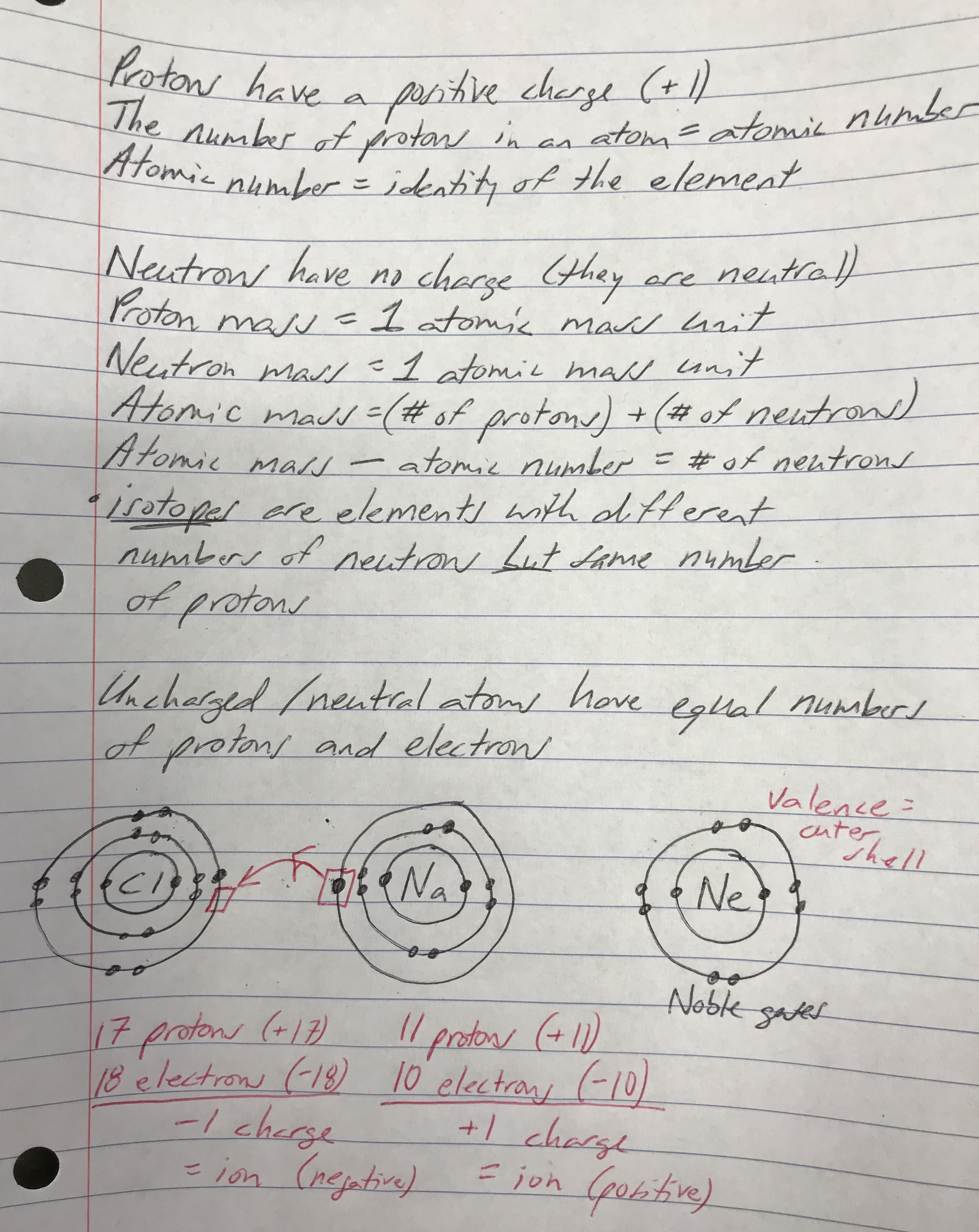
  • Atomic number = # of protons in one atom of a given element
  • Protons have a positive charge
  • Electrons have a negative charge
  • Neutral atoms have equal numbers of protons and electrons
  • Atomic mass = (# of protons) + (# of neutrons) in one atom of a given element
  • Neutrons have no charge

Students then worked in pairs to complete the Lesson 12 Worksheet.  For homework, students were assigned Lesson 12 textbook questions 1-7 (page 60).

All students also received a copy of their progress report.  Students should make every effort to catch up on missing work this weekend and take notes on chapters 1-3 in preparation for the quiz on Tuesday.

Families of Elements

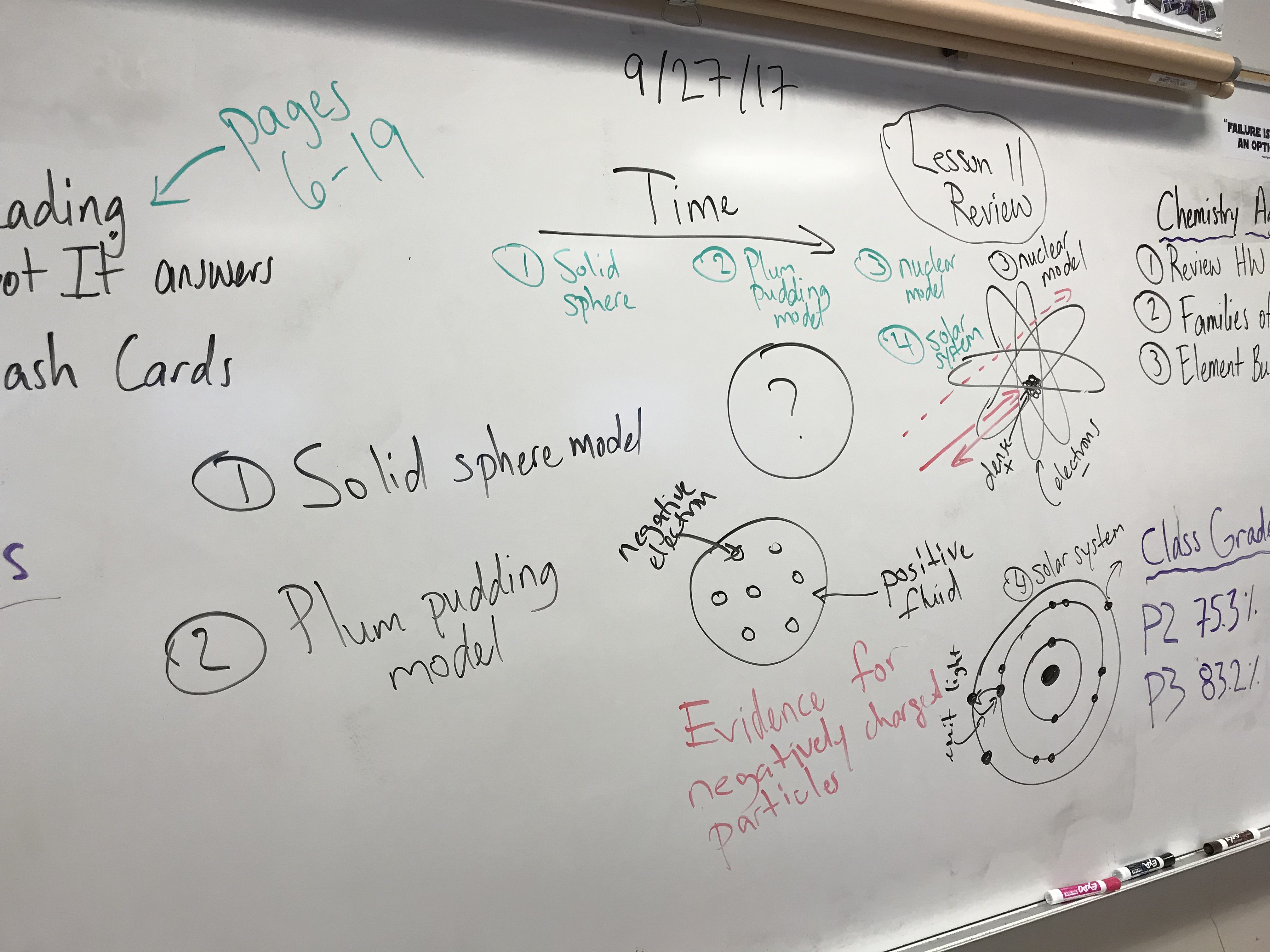
We decided to take a step back from the chemistry textbook treadmill today.  After a brief review of the Lesson 11 worksheet to help address some confusion students had about how to approach their work yesterday (whiteboard notes shown below), students assembled into groups of four to tackle the “Families of Elements” activity.  For their work, students divided up the reading for the activity, with each student responding to two of the questions in the accompanying worksheet.  After sharing answers as a group, students applied their enhanced understanding of the periodic table to a card sort activity.  Students grouped various attributes attributable to specific columns or sections of the periodic table, further reinforcing the key ideas we have learned thus far.

Models of the Atom

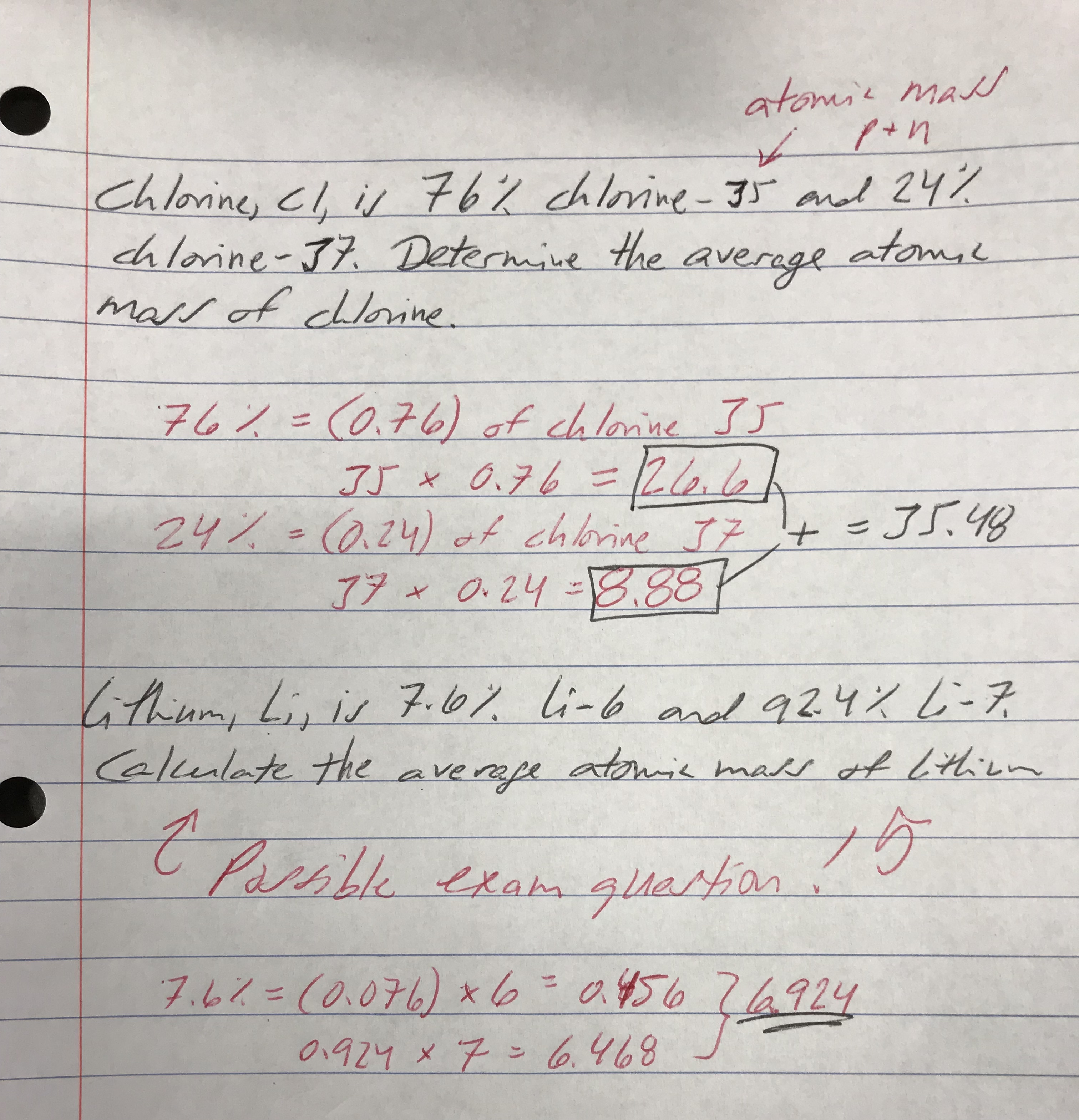
Chapter 3 began with a historical study of how early chemists used experimentation and reasoning to assemble models of the atom.  The Lesson 11 PowerPoint provides key vocabulary around the components of the atom (proton, electron, neutron, and nucleus).  In addition, we previewed the content in Lesson 12, introducing the concept of atomic mass (to go with atomic number) and noticing that by subtracting atomic number (the number of protons in an atom) from atomic mass (the sum of an atom’s protons and neutrons), we can calculate the number of neutrons in the nucleus of an atom.

To go along with the Lesson 11 Worksheet, students also received a handout explaining the five models of the atom.  For homework, students should complete questions 1-4 and 7-9 from the end of Lesson 11 in the textbook.

The Periodic Table

After conducting the Penny Lab yesterday, students went back to work in small groups, tackling the Lesson 10 worksheet with their groups from Lesson 9.  They reconstructed their periodic tables using the cards from Lesson 9, then identified trends in the table to fill in the worksheet.  For homework, students are to read Lesson 10 and complete questions 1, 2, and 4-8 on page 48.  Homework is due on Monday, September 25.

As a reminder, we have some scientists visiting us tomorrow as guest speakers.  Students should report directly to the PAC auditorium, sit as a class, and take notes during the event.  Students are encouraged to ask questions of the speakers!


Update: Monday, September 25

Our work for the day involved a thorough review of the key content included in Lesson 10.  The Power Point slides are available here.  Students also received a paper copy of the Periodic Table to use on exams and quizzes.  For homework, students should read Lesson 11.

For pleasure, students should consider reading a few pages from Sam Kean’s book titled The Disappearing Spoon.  Click this link for the section of the book about Ytterby Lanthanides.  It begins with the sentence “In 1701, a braggadocian teenager…” and you will need to click the hyperlinked blue “Page >>” in the upper left hand corner to reveal the full reading passage.  Continue reading through the next three full pages ending in “…Galapagos Island of the periodic table.”  You will be glad you did!

Properties of the Elements

We began our exploration of the Periodic Table by constructing our own.  In Lesson 9, students walk the path of the famous Russian chemist Dmitri Mendeleev who assembled the first predictive periodic table using the chemical and physical properties of the 63 elements known back in the 1860s.  We began the lesson with a PowerPoint that included the definition of reactivity (along with the video below), then worked through the Lesson 9 Worksheet by organizing elements via a card sort activity.  For homework, students should complete Lesson 9 textbook questions 1, 2, and 4.  Students must also complete the Penny Lab prelab questions (#1-8) in order to participate in the lab tomorrow.  As a reminder, students must also turn in a signed syllabus and safety contract to participate in the lab.

Conservation of Matter

After reviewing the homework problems assigned for Lesson 7, students were reintroduced to the Copper Cycle.  Because the Copper Cycle experiment involves steps that must be conducted in a fume hood, we opted to watch a video (below), with students taking observations on their Copper Cycle handout.  For reference, students also received a copy of the Copper Cycle experimental procedure.

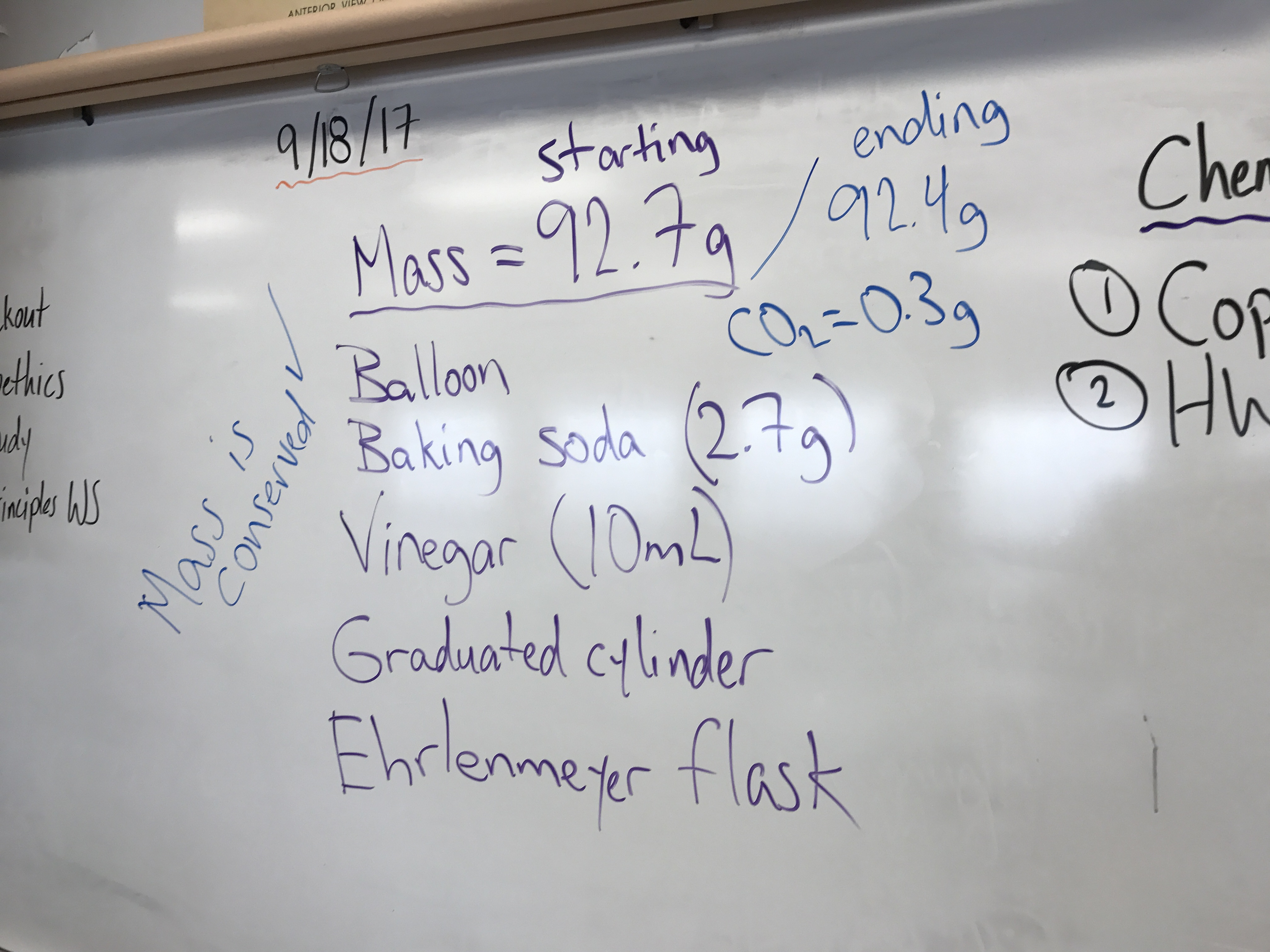
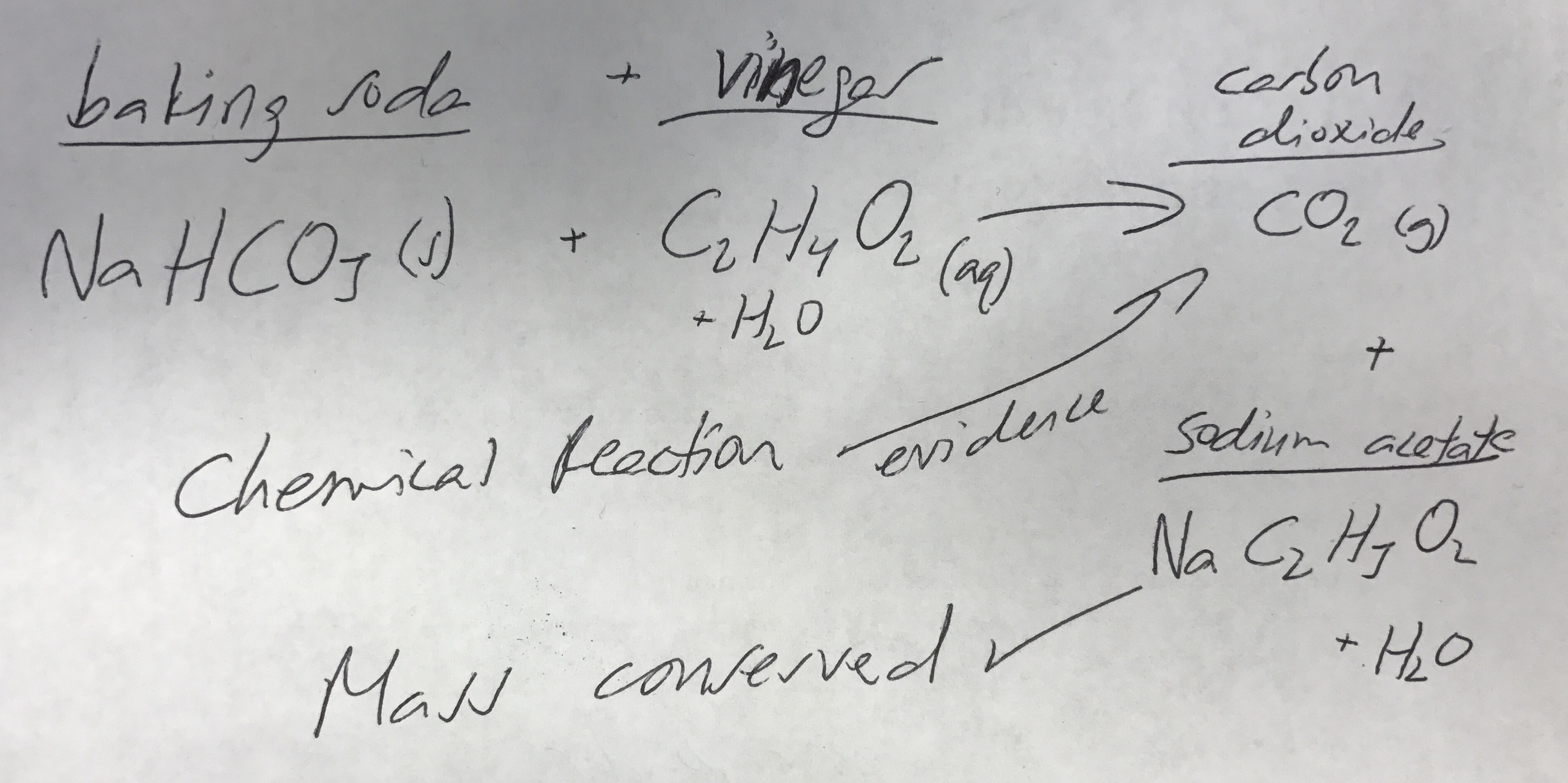
After the video, we discussed the concept of Conservation of Matter, transitioning to Lesson 8 in the textbook.  Because Lesson 8 continues an investigation of the Copper Cycle, and we are unable to safely conduct that lab, we instead investigated the related concept of Conservation of Mass.  Students participated in a classroom demonstration which involved combining baking soda and vinegar in a closed system and experimentally demonstrating that mass is conserved.  We measured the starting and ending mass, noting the slight decrease in mass at the end due to experimental error (vinegar and carbon dioxide leaking slightly).  At the end of the experiment, we removed the inflated balloon and noted a decrease in mass of 0.2-0.3 grams, indicating the carbon dioxide gas has a measurable mass.  Students also noted the change in volume of the products as evidenced by the partially inflated balloon compared with the volume of the reactants.

For homework, students were provided with a copy of the Penny Lab to read over in advance of Wednesday’s class.  Students were also reminded that a signed syllabus and safety contract must be turned in to enable participation in the lab.

Materials, Mass, and Volume
Chemical Reaction


The Copper Cycle

In their assigned homework reading of Lesson 7 of the textbook, students learned about chemical changes, and the lesson references the penny lab as an example (originally from lesson 2 in the textbook, we will conduct the penny lab next week).  For our abbreviated Friday class period, students were introduced to the concept of Conservation of Mass via the Copper Cycle.

Because the Copper Cycle experiment involves steps that must be conducted in a fume hood, we opted to watch a video (below), with students taking observations on their Copper Cycle handout.  For reference, students also received a copy of the Copper Cycle experimental procedure.

For homework, students were assigned Lesson 7 textbook questions 1, 5, and 6 (page 30).  In addition, students should read Lesson 8 prior to class on Monday.