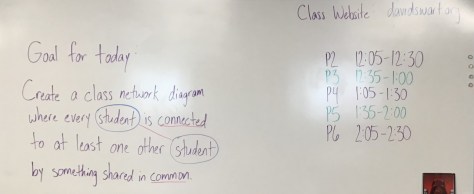
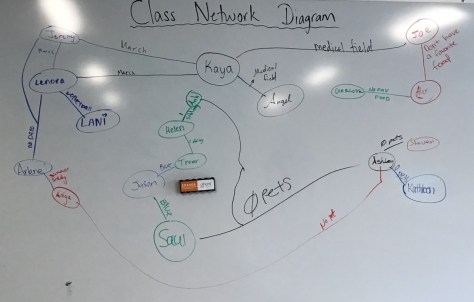
Welcome to Mr. Swart’s chemistry class! We made the most of our 25 minutes of class time together by filling out a Ten Facts About Me survey and then used the data to meet classmates and identify commonalities. Students then constructed a network diagram in which their name was a node (a circle with their name inside) and the commonality shared with another student was represented as an edge (a line) connecting the nodes for both students. The commonality was written on the edge. By the end of class, every student was represented as a node, and all parts of the network were connected to each other through at least one route. We are all connected!
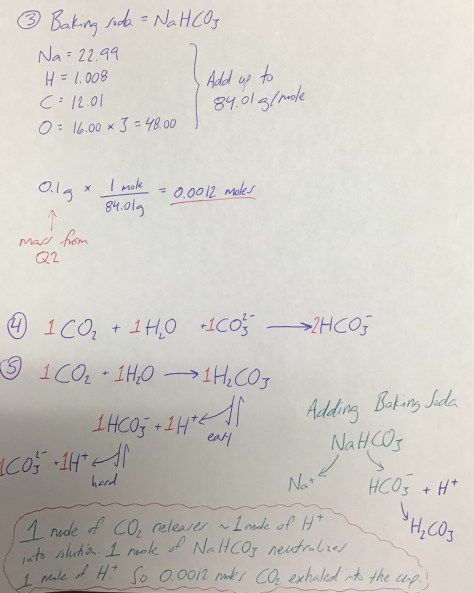
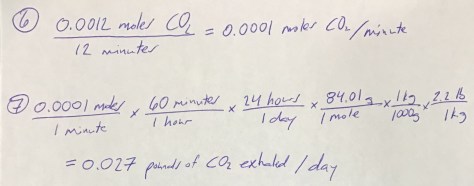
For our final lab of the school year, students worked together to calculate the amount of carbon dioxide exhaled in a given period of time. The lab brings together our study of color and pH (purple cabbage juice indicator) and our study of global warming and climate change from the end of our previous unit. Students will balance equations, calculate moles of carbon dioxide produced per minute, and calculate how many pounds of carbon dioxide the average person exhales each day. Students will complete the Lesson 88 Handout, which includes instructions for writing a lab report.
For the second day of this lesson, we began with a video describing the effect of ocean acidification on oyster larvae in the Pacific Northwest:
The video presents a dire vision of our future if ocean acidification is ignored. As scientists, we know there is always a solution out there, and to that end we watched the second part of this video series titled Solutions.
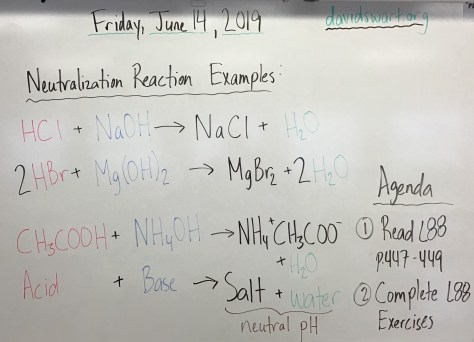
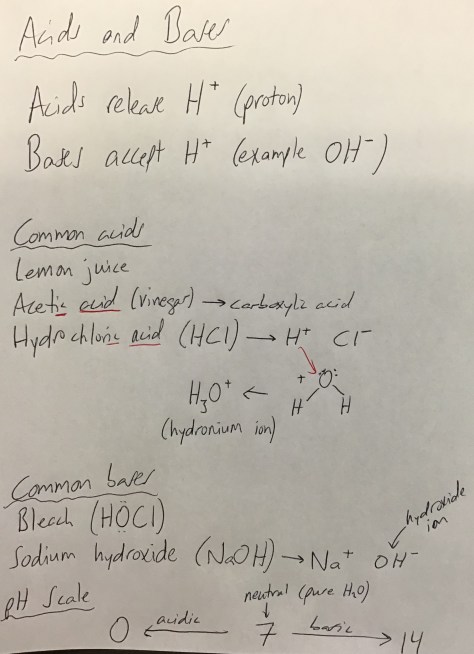
The remainder of class was used to work through the Lesson 88 handout. Notes from class are pictured below:
Read Lesson 88 in the textbook and complete the exercises assigned in the work packet. Login via hs.saplinglearning.com and enter your username and password:
Username: wahps****s-####### (**** = first 4 letters of your last name and ####### = student number). Remember to include the dash between s and #.
Password: S-####### (the S must be capitalized)
Please ask questions about anything from Lesson 88 you do not yet fully understand.
Opportunities For Help Outside of Class:
Mr. Swart’s office hours: Mondays, Tuesdays, and Thursdays after school until at least 3:00 (later with advanced notice)
Use the vast number of resources available on this website – check each lesson!
Email Mr. Swart for help if staying after school is not possible
Form a study group with other students to review concepts from class
To close out the week, we embarked on a study of dilution, a technique used by scientists to alter the concentration of a liquid. For our lesson, students worked with their lab groups to prepare serial dilutions of a solution colored with one or more food dyes. They measured the peak absorbance of their assigned colors at each dilution and then graphed their results, followed by analysis of the graph as outlined in the Lesson 87 section of the work packet for Lessons 85-87.
With so many activities last week keeping students out of class, only a few people were able to complete the Dilution Lab. We will complete the lab on Monday, with students watching a brief video explaining how a spectrophotometer works, and then they will receive a set of teacher-generated absorbance data for the diluted color samples. The data is contained in the Dilution Lab Slide Deck. Students will complete the Lesson 87 questions and then turn the packet in for credit.
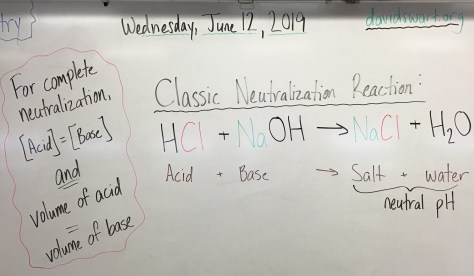
Notes from class (June 12 Review):
Tomorrow we will engage in our final lab of the year!
Homework:
Read Lesson 87 in the textbook and complete the exercises assigned in the work packet. Login via hs.saplinglearning.com and enter your username and password:
Username: wahps****s-####### (**** = first 4 letters of your last name and ####### = student number). Remember to include the dash between s and #.
Password: S-####### (the S must be capitalized)
Please ask questions about anything from Lesson 87 you do not yet fully understand.
Opportunities For Help Outside of Class:
Mr. Swart’s office hours: Mondays, Tuesdays, and Thursdays after school until at least 3:00 (later with advanced notice)
Use the vast number of resources available on this website – check each lesson!
Email Mr. Swart for help if staying after school is not possible
Form a study group with other students to review concepts from class
We elected to take our time working through Lesson 86, starting off by learning about the strongest acids and bases in the world:
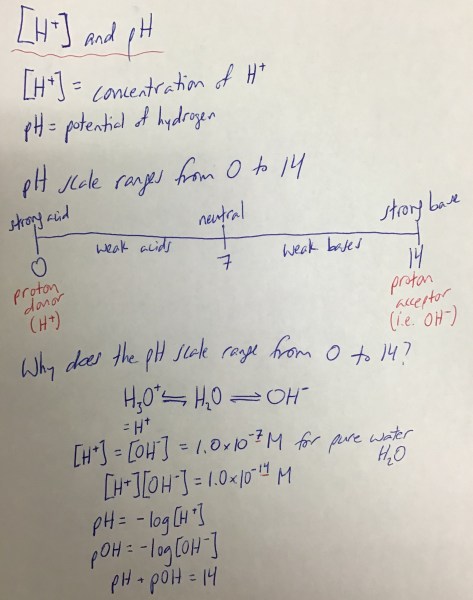
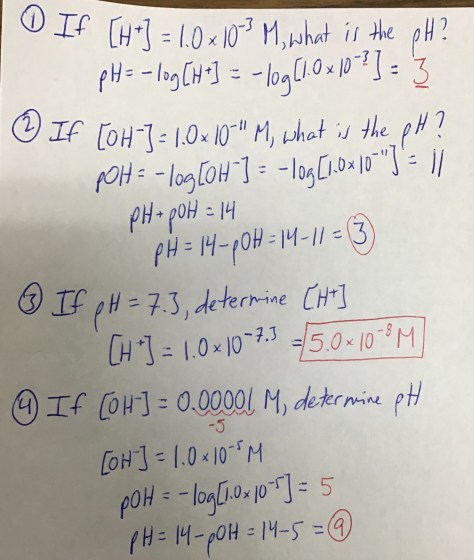
Next, we worked through a set of class notes and practice problems pictured below (the Lesson 86 PowerPoint is available for reference), connecting molar concentration of H+ or OH- with pH.
After the notes, students transitioned to the Lesson 86 section of the Lessons 85-87 packet.
The next day, we began class by practicing the skill of calculating pH from molarity and molarity from pH. Students were reminded that Google Chrome can be used as a calculator. Desmos.com offers a nice web-based scientific calculator as well. Students had the remainder of class to work through the Lesson 86 section of the Lessons 85-87 packet.
Some additional videos that might be helpful:
Students requiring further practice with the math in this lesson should watch the Crash Course video below:
Dude!
Homework:
Read Lesson 86 in the textbook and complete the exercises assigned in the work packet. Login via hs.saplinglearning.com and enter your username and password:
Username: wahps****s-####### (**** = first 4 letters of your last name and ####### = student number). Remember to include the dash between s and #.
Password: S-####### (the S must be capitalized)
Please ask questions about anything from Lesson 86 you do not yet fully understand.
Opportunities For Help Outside of Class:
Mr. Swart’s office hours: Mondays, Tuesdays, and Thursdays after school until at least 3:00 (later with advanced notice)
Use the vast number of resources available on this website – check each lesson!
Email Mr. Swart for help if staying after school is not possible
Form a study group with other students to review concepts from class
We extended our learning about acids and bases by learning and applying the Arrhenius and Bronsted-Lowry definitions via the Lesson 85 PowerPoint, the Lesson 85 worksheet, and the Acid-Base Solution Card sort activity. For homework, students were assigned textbook problems #1-8 from Lesson 85, provided to students in the form of a work packet for Lessons 85-87.
Note: While our intent is to complete the packet this week, we have the following scheduled interruptions and will adjust our timeline and learning goals accordingly:
WCAS Science Exam (all 11th grade students) on Tuesday, June 4 and Wednesday, June 5. Students will test either during periods 1-3 or 4-6, with a schedule forthcoming.
All 10th grade field trip on Wednesday, June 5.
Pirate Mutiny on Friday, June 7, schedule forthcoming.
Keep Learning!
Interested in learning more about acids and base chemistry? Check out the Crash Course video below:
Students who would like to further their understanding of Bronsted-Lowry acids and bases are encouraged to watch the Khan Academy video provided below:
Homework:
Read Lesson 85 in the textbook and complete the exercises assigned in the work packet. Login via hs.saplinglearning.com and enter your username and password:
Username: wahps****s-####### (**** = first 4 letters of your last name and ####### = student number). Remember to include the dash between s and #.
Password: S-####### (the S must be capitalized)
Please ask questions about anything from Lesson 85 you do not yet fully understand.
Opportunities For Help Outside of Class:
Mr. Swart’s office hours: Mondays, Tuesdays, and Thursdays after school until at least 3:00 (later with advanced notice)
Use the vast number of resources available on this website – check each lesson!
Email Mr. Swart for help if staying after school is not possible
Form a study group with other students to review concepts from class
Day 1: After completing the pH Gizmo and preparing red cabbage indicator solution, students were formally introduced to acids and bases via a lab. Having just learned about indicators (chemical solutions that change color in response to changes in pH, Lesson 117) we reviewed Day 1 of the Acid and Base Lab Report Packet. and then students had the remainder of the day to work through the Day 1 worksheet and prepare for the lab.
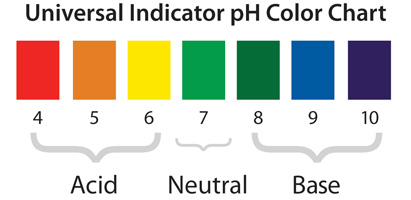
Day 2: For Day 2 of the Acid and Base Lab, students used their red cabbage juice indicator solution to measure the pH of eight different solutions (comparing the color of the indicator to a color chart for red cabbage indicator). Students repeated the process using universal indicator. Finally, students evaluated the effect of sodium bicarbonate (baking soda) on the pH of the solutions, as determined by the indicator colors. Students should carefully document all steps of the lab, taking pictures of the indicator solutions before and after addition of sodium bicarbonate. Indicator Solution Charts are provided below:
Universal Indicator Chart
Red cabbage indicator chart
Days 3+: Students will work with their assigned lab groups to write a lab report for the Acid and Base Lab. The lab report will consist of:
Introduction – a paragraph explaining the purpose of the lab
Safety Concerns – list all safety concerns associated with working with acids and bases, along with required precautions for the lab (explain why each piece of personal protective equipment is required)
Procedure – an ordered list of steps explaining:
how the red cabbage indicator solution was prepared
pH evaluation of all samples in universal indicator and red cabbage juice indicator solutions
pH evaluation of all samples after calcium carbonate added
pH measurement with pH probe
Results – data table with all results, pictures of all results, and one paragraph each of the outcomes of:
pH determined with red cabbage indicator solution
pH determined with universal indicator solution
pH determined with pH probe
pH determined after addition of calcium carbonate
Conclusions – one paragraph each explaining:
The effectiveness and consistency of indicator solutions, relative to the two indicator solutions compared with the pH probe
An explanation of how calcium carbonate affected pH
Bonus: An explanation of why the indicator solutions changed color (with sources cited)
Bonus: An explanation of why calcium carbonate affected pH (with sources cited)
Sources (if necessary)
Day 4: After a much-need 4-day weekend, we began class with the Lesson 84 PowerPoint which included a starter question helping students connect acid/base chemistry with the biology of heartburn. For the lab last week, students observed the effect of sodium bicarbonate (NaHCO3, or baking soda) on acids and bases. For the ChemCatalyst, students made the connection of acid neutralization with the related compound calcium carbonate (CaCO3, commonly found in antacids). Students have the remainder of the short week to complete the lab report from the lab last week. The group lab report packet is due at the end of school Friday, and the lab report must be shared with the teacher by midnight Friday. Late work will receive a maximum of 60% credit.
Groups who finished early will be provided with a variety of learning enrichment options related to our work thus far during the unit, including:
Evaluate absorbance and %transmission with a spectrophotometer, then create and analyze a graph
As we continue our study of pH, we need to explore techniques to determine whether a chemical is an acid, a base, or neutral. With yesterday’s Gizmo, students used digital pH paper to measure pH and then watched a video on how to prepare red cabbage indicator solution. Today we will prepare the red cabbage indicator solution that we will use in the lab tomorrow. In addition, students will read Lesson 117 in the textbook and answer exercise questions 1, 2, 3, and 6 in preparation for the Acid and Base Lab Report.
Homework:
Read Lesson 117 in the textbook. Login via hs.saplinglearning.com and enter your username and password:
Username: wahps****s-####### (**** = first 4 letters of your last name and ####### = student number). Remember to include the dash between s and #.
Password: S-####### (the S must be capitalized)
Work through the practice problems at the end of Lesson 117.
Please ask questions about anything from Lesson 117 you do not yet fully understand.
Opportunities For Help Outside of Class:
Mr. Swart’s office hours: Mondays, Tuesdays, and Thursdays after school until at least 3:00 (later with advanced notice)
Use the vast number of resources available on this website – check each lesson!
Email Mr. Swart for help if staying after school is not possible
Form a study group with other students to review concepts from class
This week, we are extending our study of light and color to include the study of pH. We will begin with some class notes (below the video), and then students will have the remainder of the class period to complete the pH Analysis Gizmo and watch the video below showing how to prepare cabbage juice indicator solution. Be sure to write down the procedure for how to prepare the indicator solution – it will be going in your lab report!
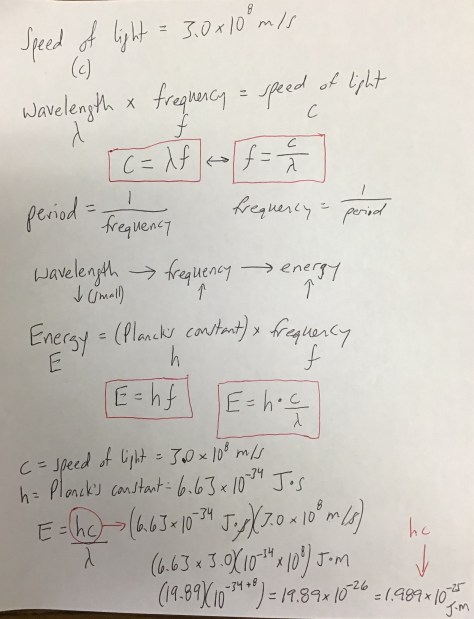
For our work today, we reviewed exercise questions 3-6 from Lesson 113, took some class notes to set students up for success on Lessons 114 and 115. Students had the remainder of the class period to work on the exercises for Lesson 114.
Class Notes:
Lesson 113 Questions 3 and 4Lesson 113 Questions 5 and 6Class NotesLesson 114 Question 4a and additional class notes
Homework:
Read Lesson 114 in the textbook. Login via hs.saplinglearning.com and enter your username and password:
Username: wahps****s-####### (**** = first 4 letters of your last name and ####### = student number). Remember to include the dash between s and #.
Password: S-####### (the S must be capitalized)
Work through the practice problems at the end of Lesson 114.
Please ask questions about anything from Lesson 114 you do not yet fully understand.
Opportunities For Help Outside of Class:
Mr. Swart’s office hours: Mondays, Tuesdays, and Thursdays after school until at least 3:00 (later with advanced notice)
Use the vast number of resources available on this website – check each lesson!
Email Mr. Swart for help if staying after school is not possible
Form a study group with other students to review concepts from class
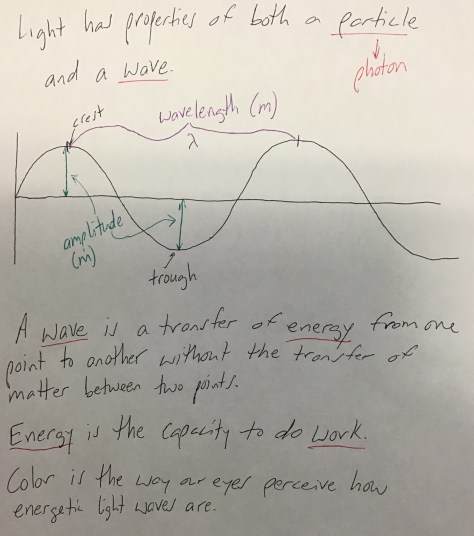
After discussing the handout from Cosmos: Hiding in the Light, we transitioned to an exploration of the properties of light as a wave. Class notes are posted below. For the lesson, students were assigned to read Lesson 113: Light Energy in the textbook, then answer the exercise questions at the end of the lesson. Answers to the questions will be turned in as an assignment.
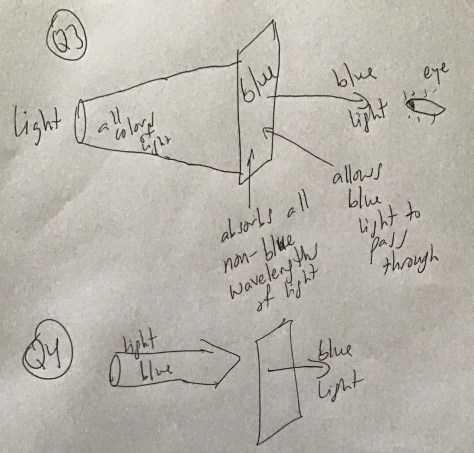
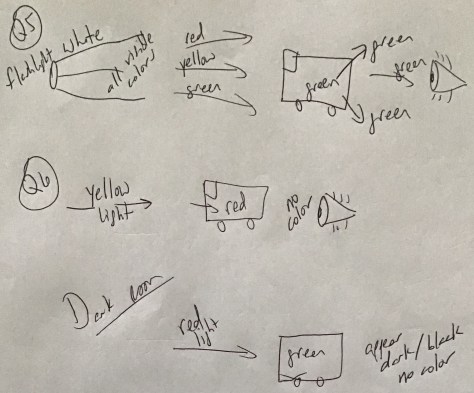
Notes from class:
Keep Learning!
Continue exploring the electromagnetic spectrum with NASA’s Astronomer’s Toolbox.
Homework:
Read Lesson 113 in the textbook. Login via hs.saplinglearning.com and enter your username and password:
Username: wahps****s-####### (**** = first 4 letters of your last name and ####### = student number). Remember to include the dash between s and #.
Password: S-####### (the S must be capitalized)
Work through the practice problems at the end of Lesson 113.
Please ask questions about anything from Lesson 113 you do not yet fully understand.
Opportunities For Help Outside of Class:
Mr. Swart’s office hours: Mondays, Tuesdays, and Thursdays after school until at least 3:00 (later with advanced notice)
Use the vast number of resources available on this website – check each lesson!
Email Mr. Swart for help if staying after school is not possible
Form a study group with other students to review concepts from class







 Science with Swart
You must be logged in to post a comment.