All posts by David Swart

High school science teacher

Inside the Cell / Organelle Flash Cards

Students were tasked with completing the reading from Chapter 1 of Inside the Cell (assigned yesterday) and turning in answers to the Got It questions on page 19.  Next, students received eight index cards on which to create flash cards of the following cell organelles:

  • cell membrane
  • cytoplasm
  • nucleus
  • ribosome
  • mitochondria
  • endoplasmic reticulum
  • Golgi apparatus
  • lysosome

On the front of the card, students wrote the name of the organelle.  On the back of the card, students explained the function of the organelle and were encouraged to draw a picture that would help them remember the function of the organelle.  The flash cards are due tomorrow and must be completed before the student can participate in the Gizmo simulations of cell structure and function.

Models of the Atom

Chapter 3 began with a historical study of how early chemists used experimentation and reasoning to assemble models of the atom.  The Lesson 11 PowerPoint provides key vocabulary around the components of the atom (proton, electron, neutron, and nucleus).  In addition, we previewed the content in Lesson 12, introducing the concept of atomic mass (to go with atomic number) and noticing that by subtracting atomic number (the number of protons in an atom) from atomic mass (the sum of an atom’s protons and neutrons), we can calculate the number of neutrons in the nucleus of an atom.

To go along with the Lesson 11 Worksheet, students also received a handout explaining the five models of the atom.  For homework, students should complete questions 1-4 and 7-9 from the end of Lesson 11 in the textbook.

Initial Model of the Cell

For our first lesson of our new unit, students were tasked with drawing an initial model of a cell.  They used the white boards on their desks to draw cells as they understand them, including the parts of cells (organelles).  Students shared out what types of cells they had drawn and what parts they could remember.  An example of student work is pictured below.

Next, we watched the Harvard BioVisions video Inner Life of a Cell, which presents a realistic animation of how cells move.

We concluded the lesson with students reading Chapter 1 of Inside the Cell.  The “Got It” questions on page 19 are due tomorrow by the end of class.  For homework, students are encouraged to read as much of Chapter 1 as necessary to be able to complete the reading in class tomorrow.

Unit Wrap-up

We concluded our Bioethics and the Nature of Science unit with the following activities:

  • Student feedback from Friday’s Guest Speakers
  • Student thank you “cards” for Guest Speakers
  • Return of all Unit 0 student work
  • Revise and resubmit justification paragraph (if needed)
  • Review Limits of Science worksheet packet

The Periodic Table

After conducting the Penny Lab yesterday, students went back to work in small groups, tackling the Lesson 10 worksheet with their groups from Lesson 9.  They reconstructed their periodic tables using the cards from Lesson 9, then identified trends in the table to fill in the worksheet.  For homework, students are to read Lesson 10 and complete questions 1, 2, and 4-8 on page 48.  Homework is due on Monday, September 25.

As a reminder, we have some scientists visiting us tomorrow as guest speakers.  Students should report directly to the PAC auditorium, sit as a class, and take notes during the event.  Students are encouraged to ask questions of the speakers!


Update: Monday, September 25

Our work for the day involved a thorough review of the key content included in Lesson 10.  The Power Point slides are available here.  Students also received a paper copy of the Periodic Table to use on exams and quizzes.  For homework, students should read Lesson 11.

For pleasure, students should consider reading a few pages from Sam Kean’s book titled The Disappearing Spoon.  Click this link for the section of the book about Ytterby Lanthanides.  It begins with the sentence “In 1701, a braggadocian teenager…” and you will need to click the hyperlinked blue “Page >>” in the upper left hand corner to reveal the full reading passage.  Continue reading through the next three full pages ending in “…Galapagos Island of the periodic table.”  You will be glad you did!

Limits of Science

To conclude our mini unit on bioethics and the nature of science, students worked through the Limits of Science work packet.  During the class period, students received 1:1 help from the teacher to facilitate learning and to ensure students were aware of which pieces of work needed to be turned in.  As a reminder, we will be meeting in the PAC to start class tomorrow where we will quickly take attendance (please sit together as a class!) and then the guest speakers will share their experiences.

Bioethical Case Study

We continued our study of bioethics by applying our learning about the Principles of Bioethics and the vocabulary term of stakeholders to the Rezip Case Study.  Students received a copy of the case study to read as homework at the end of class yesterday.  We reviewed the reading at the beginning class, identifying key stakeholders and working through the vocabulary.  Students received the Ethical Decision-Making Framework handout and worked in small groups and as a class to fill out the first 5 sections.  A completed copy of the first five sections is available here (front and back) for students to use as a reference.  Students were assigned the last section (write a justification paragraph) as homework.  A paragraph frame is available here for students who would like extra support in structuring their paragraph.

Properties of the Elements

We began our exploration of the Periodic Table by constructing our own.  In Lesson 9, students walk the path of the famous Russian chemist Dmitri Mendeleev who assembled the first predictive periodic table using the chemical and physical properties of the 63 elements known back in the 1860s.  We began the lesson with a PowerPoint that included the definition of reactivity (along with the video below), then worked through the Lesson 9 Worksheet by organizing elements via a card sort activity.  For homework, students should complete Lesson 9 textbook questions 1, 2, and 4.  Students must also complete the Penny Lab prelab questions (#1-8) in order to participate in the lab tomorrow.  As a reminder, students must also turn in a signed syllabus and safety contract to participate in the lab.

Conservation of Matter

After reviewing the homework problems assigned for Lesson 7, students were reintroduced to the Copper Cycle.  Because the Copper Cycle experiment involves steps that must be conducted in a fume hood, we opted to watch a video (below), with students taking observations on their Copper Cycle handout.  For reference, students also received a copy of the Copper Cycle experimental procedure.

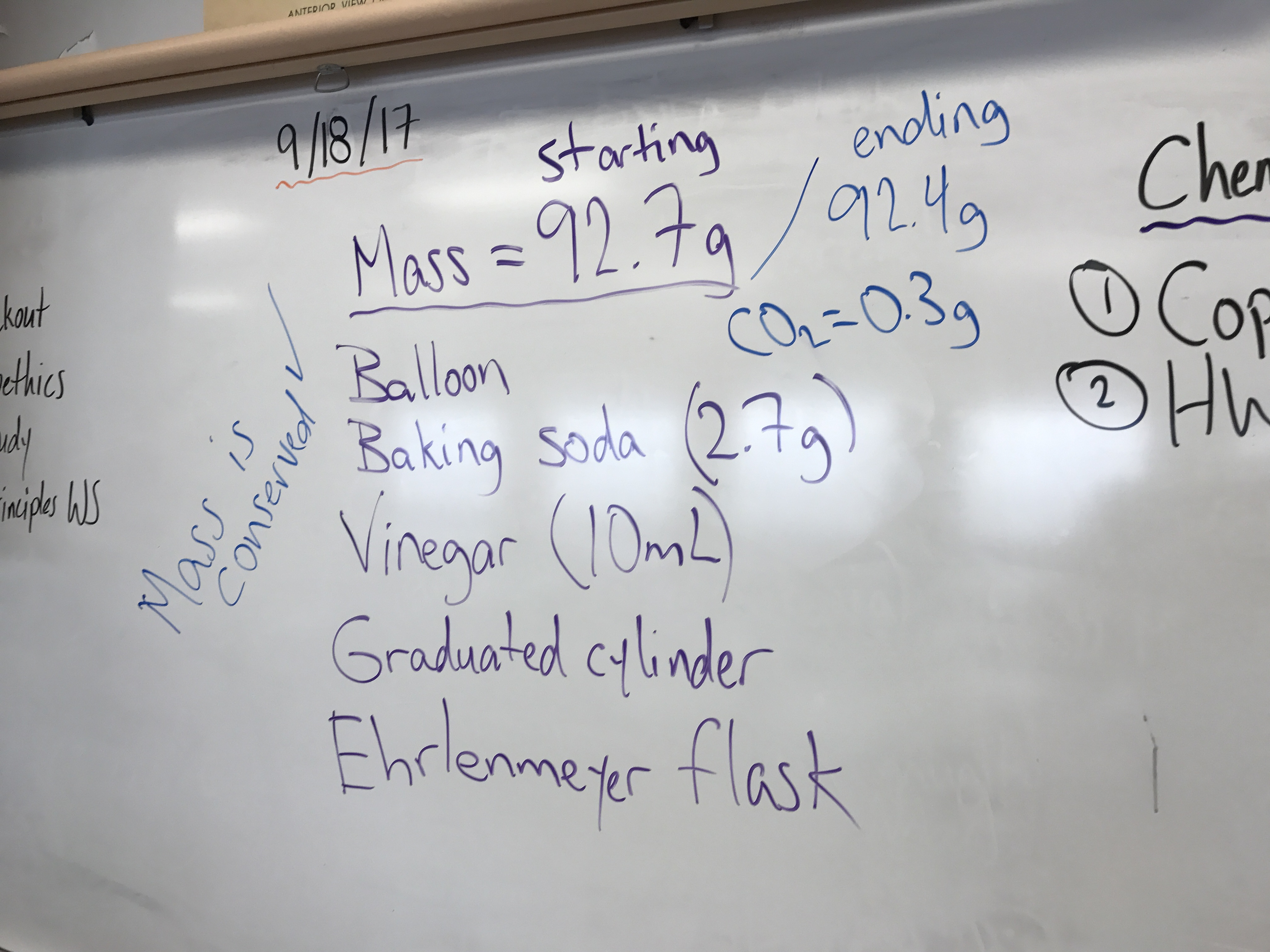
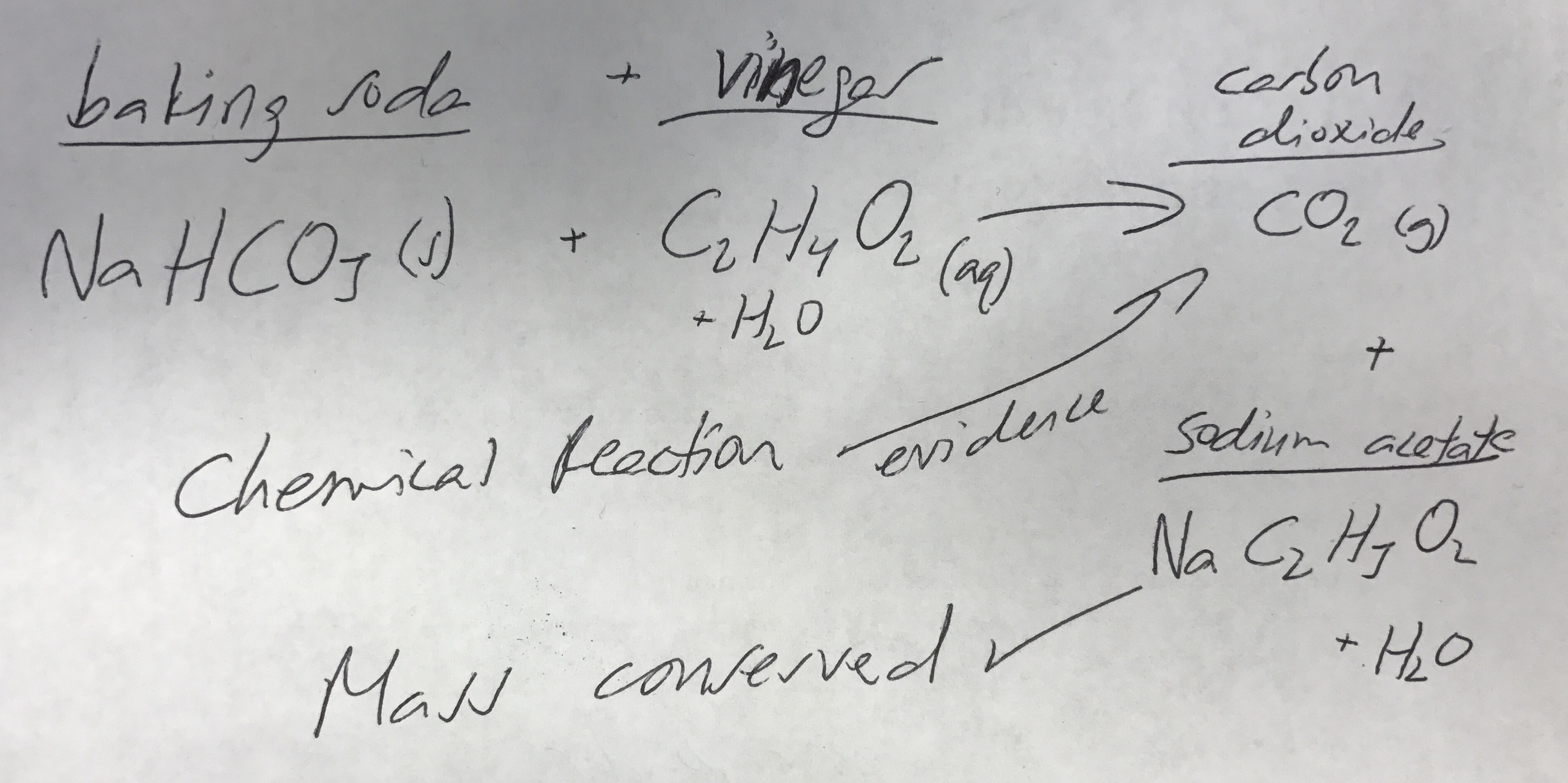
After the video, we discussed the concept of Conservation of Matter, transitioning to Lesson 8 in the textbook.  Because Lesson 8 continues an investigation of the Copper Cycle, and we are unable to safely conduct that lab, we instead investigated the related concept of Conservation of Mass.  Students participated in a classroom demonstration which involved combining baking soda and vinegar in a closed system and experimentally demonstrating that mass is conserved.  We measured the starting and ending mass, noting the slight decrease in mass at the end due to experimental error (vinegar and carbon dioxide leaking slightly).  At the end of the experiment, we removed the inflated balloon and noted a decrease in mass of 0.2-0.3 grams, indicating the carbon dioxide gas has a measurable mass.  Students also noted the change in volume of the products as evidenced by the partially inflated balloon compared with the volume of the reactants.

For homework, students were provided with a copy of the Penny Lab to read over in advance of Wednesday’s class.  Students were also reminded that a signed syllabus and safety contract must be turned in to enable participation in the lab.

Materials, Mass, and Volume
Chemical Reaction


Framework for Ethical Decisions

With textbook checkout taking a bit longer than anticipated on Friday, we began the week by finishing Friday’s lesson with students  taking notes on the Principles of Bioethics.  We then discussed the concept of a stakeholder, a person with an interest or concern in something.

We revisited the issue of people choosing not to have their children vaccinated (introduced on Friday) by watching another short video from Frontline (below).  Students were tasked with writing down a list of the stakeholders they observed in the news segment.

After the video, we created a class list of stakeholders and students used the list to help them fill out the Focus on the Principles worksheet with the ethical question of “Should healthy people choose not to be vaccinated?”  After some private think time, we shared out as a class and answered questions about the Principles of Bioethics.  Students were instructed to keep the worksheet as a resource to use in tomorrow’s work.

To conclude the lesson, students received a copy of the Rezip Case Study to read in class.  Students were assigned to complete the reading as homework if additional time outside of class was needed.


Optional additional learning opportunities (click the links):

US Dept of Health & Human Services definition of herd immunity

US Centers for Disease Control and Prevention (CDC) FastStats page for Measles, Mumps, and Rubella

Washington State Department of Health – certificate of exemption (note the provider section)

SciShow follow-up video about “The Science of Anti-Vaccination”

NOVA | Vaccines –– Calling the Shots | PBS – a video examining the science behind vaccinations, the return of preventable diseases, and the risks of opting out