All posts by David Swart

High school science teacher

Toxicity

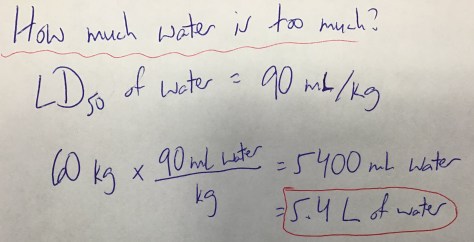
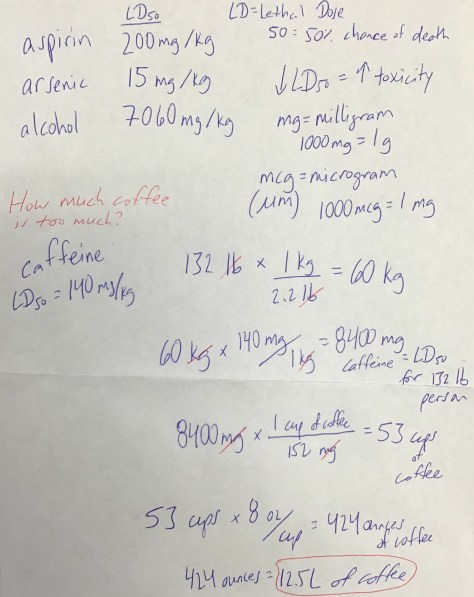
In the first lesson of Chapter 14, students were introduced to the concept of LD50 (the dose of a compound that is lethal to 50% of the population).  As our entry task, students considered the following:

Which substance do you think is most toxic to you –

  1. Alcohol (ethanol, C2H6O)
  2. Aspirin (salicylic acid, C7H8O3)
  3. Arsenic (III) oxide (As2O3)

Explain your thinking

We then identified the LD50 values for all three substances using the Lethal Doses Handout.  We discussed the meaning of LD50 (the lethal dose at which 50% of rats die after exposure to a given amount of a substance, often expressed in mg/kg) and students were shown a Material Safety Data Sheet (MSDS) for water (toxic at >90 mL/kg), providing students with evidence that all substances are toxic at high enough levels.  Students then received the Lesson 74 Worksheet to work on during class time.

Notes from class:
IMG_0266

IMG_0267

Extend Your Learning!

Wondering about how scientists define the kilogram?  Turns out the way we define the kilogram just changed late last year.  Read about it at PBS.org  or watch the video below:

Homework:

  • Read Lesson 74 in the textbook.  Login via hs.saplinglearning.com and enter your username and password:
    • Username: wahps****s-####### (**** = first 4 letters of your last name and ####### = student number).  Remember to include the dash between s and #.
    • Password: S-####### (the S must be capitalized)
  • Work through the practice problems at the end of Lesson 74.
  • Please ask questions about anything from Lesson 74 you do not yet fully understand.

Opportunities For Help Outside of Class:

  1. Mr. Swart’s office hours: Mondays, Tuesdays, and Thursdays after school until at least 3:00 (later with advanced notice)
  2. Use the vast number of resources available on this website – check each lesson!
  3. Email Mr. Swart for help if staying after school is not possible
  4. Form a study group with other students  to review concepts from class
  5. Attend MASH after school (M/T/Th in Library)
  6. Attend Math Lab after school (T/Th in Room 124)
Types of Reactions

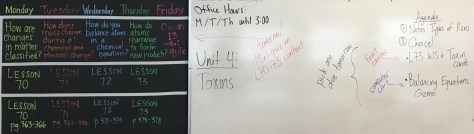
For the final lesson of chapter 13, students learned to classify the types of reactions as combination, decomposition, single exchange, or double exchange reactions.

  • Combination: A + B -> C
  • Decomposition: A -> B + C
  • Single Exchange: AB + C -> A + BC
  • Double Exchange: AB + CD -> AD + CD

We focused primarily slide 8 of the Lesson 73 PowerPoint.  Students are encouraged to review the full slide deck, including the vocabulary defined on slides 9-12.  Students then received the Lesson 73 Worksheet and Toxic Reaction Cards to work on for the remainder of class.  As an alternative, students who self-assessed as needing additional practice balancing equations were offered the opportunity to work through the Balancing Equations Gizmo.

Notes from the whiteboard:

IMG_0261

Homework:

  • Read Lesson 73 in the textbook.  Login via hs.saplinglearning.com and enter your username and password:
    • Username: wahps****s-####### (**** = first 4 letters of your last name and ####### = student number).  Remember to include the dash between s and #.
    • Password: S-####### (the S must be capitalized)
  • Work through the practice problems at the end of Lesson 73.
  • Please ask questions about anything from Lesson 73 you do not yet fully understand.

Opportunities For Help Outside of Class:

  1. Mr. Swart’s office hours: Mondays, Tuesdays, and Thursdays after school until at least 3:00 (later with advanced notice)
  2. Use the vast number of resources available on this website – check each lesson!
  3. Email Mr. Swart for help if staying after school is not possible
  4. Form a study group with other students  to review concepts from class
  5. Attend MASH after school (M/T/Th in Library)
  6. Attend Math Lab after school (T/Th in Room 124)
Balancing Chemical Equations

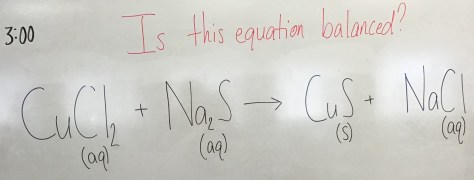
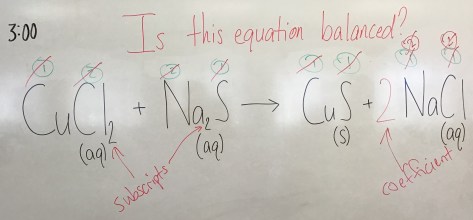
Class began with the ChemCatalyst from the Lesson 72 PowerPoint.  With the lesson focusing on balancing chemical equations, we worked through the ChemCatalyst equation with a focus on differentiating coefficients and subscripts (slides 11 and 12).  We used the remainder of the class period to practice balancing equations.

Notes from the whiteboard:

IMG_0260

IMG_0259

Extra Practice!

For students who would like additional instruction around balancing equations and enjoy learning by watching videos, I recommend Tyler DeWitt’s videos Introduction to Balancing Equations (above) and Balancing Chemical Equation Practice Problems (below):

Homework:

  • Read Lesson 72 in the textbook.  Login via hs.saplinglearning.com and enter your username and password:
    • Username: wahps****s-####### (**** = first 4 letters of your last name and ####### = student number).  Remember to include the dash between s and #.
    • Password: S-####### (the S must be capitalized)
  • Work through the practice problems at the end of Lesson 72.
  • Please ask questions about anything from Lesson 72 you do not yet fully understand.

Opportunities For Help Outside of Class:

  1. Mr. Swart’s office hours: Mondays, Tuesdays, and Thursdays after school until at least 3:00 (later with advanced notice)
  2. Use the vast number of resources available on this website – check each lesson!
  3. Email Mr. Swart for help if staying after school is not possible
  4. Form a study group with other students  to review concepts from class
  5. Attend MASH after school (M/T/Th in Library)
  6. Attend Math Lab after school (T/Th in Room 124)
Conservation of Mass

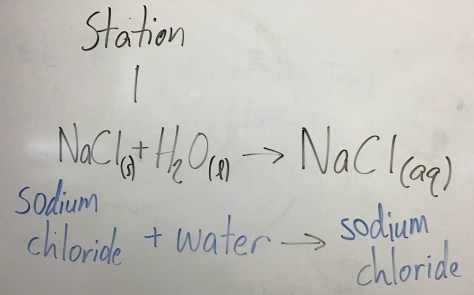
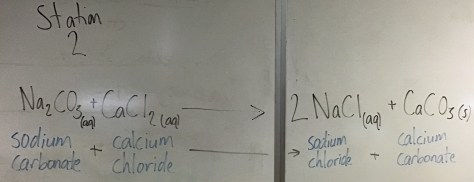
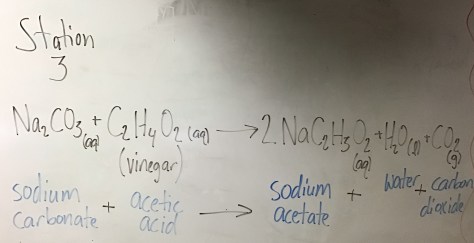
We briefly reviewed the Lesson 71 PowerPoint and then students had the remainder of the class period to work in groups to complete the lab described on the Lesson 71 Worksheet.

Notes from the whiteboard (lab stations):

IMG_0256

IMG_0257

IMG_0258

Homework:

  • Read Lesson 71 in the textbook.  Login via hs.saplinglearning.com and enter your username and password:
    • Username: wahps****s-####### (**** = first 4 letters of your last name and ####### = student number).  Remember to include the dash between s and #.
    • Password: S-####### (the S must be capitalized)
  • Work through the practice problems at the end of Lesson 71.
  • Please ask questions about anything from Lesson 71 you do not yet fully understand.

Opportunities For Help Outside of Class:

  1. Mr. Swart’s office hours: Mondays, Tuesdays, and Thursdays after school until at least 3:00 (later with advanced notice)
  2. Use the vast number of resources available on this website – check each lesson!
  3. Email Mr. Swart for help if staying after school is not possible
  4. Form a study group with other students  to review concepts from class
  5. Attend MASH after school (M/T/Th in Library)
  6. Attend Math Lab after school (T/Th in Room 124)
Physical versus Chemical Change

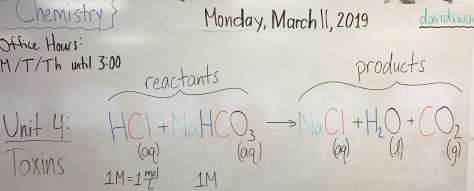
For our introductory lesson of Unit 4, we revisited the concepts of physical and chemical change in the context of chemical reactions.  The lesson began with a demonstration in which students were presented with a chemical equation, observed the chemical reaction, and then were challenged to prove whether the predicted product could be observed.  The demonstration led to a discussion of physical and chemical change via the Lesson 70 PowerPoint which includes an image of the following reaction: Cobalt (II) chloride (a solid with a rich blue color) + water (clear liquid) reacts to form a pink liquid.  Students had the remainder of the class period to complete the Lesson 70 Worksheet.  Class notes are shown below:

IMG_0251

Extend Your Learning!

Homework:

  • Read Lesson 70 in the textbook.  Login via hs.saplinglearning.com and enter your username and password:
    • Username: wahps****s-####### (**** = first 4 letters of your last name and ####### = student number).  Remember to include the dash between s and #.
    • Password: S-####### (the S must be capitalized)
  • Work through the practice problems at the end of Lesson 70.
  • Please ask questions about anything from Lesson 70 you do not yet fully understand.

Opportunities For Help Outside of Class:

  1. Mr. Swart’s office hours: Mondays, Tuesdays, and Thursdays after school until at least 3:00 (later with advanced notice)
  2. Use the vast number of resources available on this website – check each lesson!
  3. Email Mr. Swart for help if staying after school is not possible
  4. Form a study group with other students  to review concepts from class
  5. Attend MASH after school (M/T/Th in Library)
  6. Attend Math Lab after school (T/Th in Room 124)
Hunting the Elements

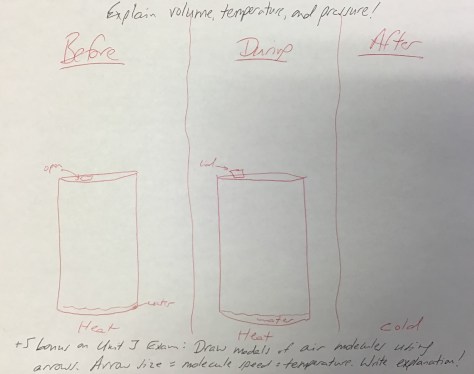
With half of our students taking the SAT on Wednesday and Thursday’s attendance impacted by the light snow we received Wednesday evening, we invested our class time in finishing Hunting the Elements and then students were offered the opportunity to earn 5 bonus points on their Unit 3 Exam.  To earn bonus points, students need to complete the model depicted below and write an explanation about what is happening to the drum (focusing on temperature, pressure, and volume in the before, during, and after parts of the experiment).  Watch the video below between 1:44 and 3:18 for the experiment.  Have fun!

Ideal Gas Law Lab

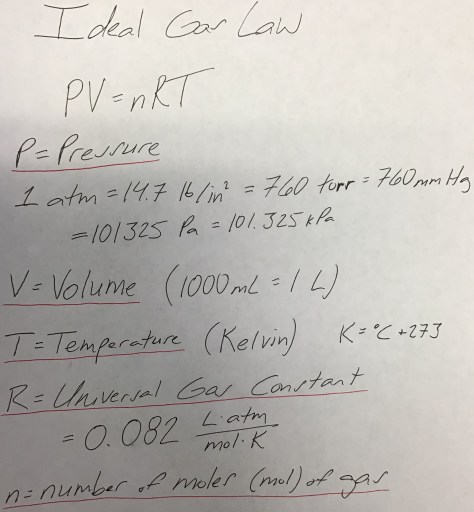
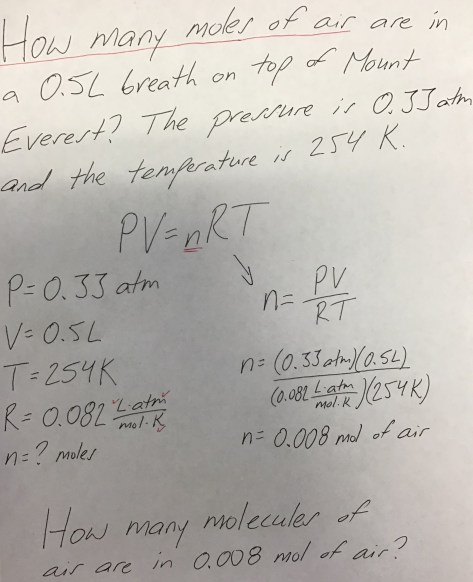
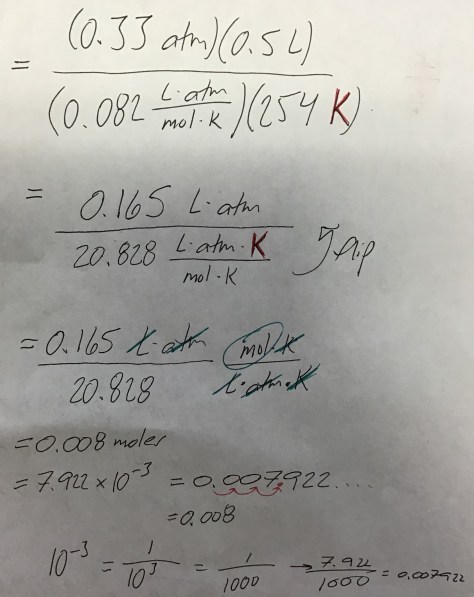
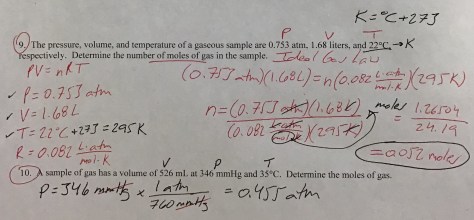
After reviewing and practicing the Ideal Gas Law yesterday, it was time to put theory to action!  We worked through the Lesson 65 Worksheet which included a lab designed to demonstrate the ideal gas law.  In the lab, students were divided into 8 teams and then worked together to calculate the volume of air in a breath (lung capacity).

Homework:

  • Read Lesson 65 in the textbook.  Login via hs.saplinglearning.com and enter your username and password:
    • Username: wahps****s-####### (**** = first 4 letters of your last name and ####### = student number).  Remember to include the dash between s and #.
    • Password: S-####### (the S must be capitalized)
  • Work through the practice problems at the end of Lesson 65.
  • Please ask questions about anything from Lesson 65 you do not yet fully understand.

Opportunities For Help Outside of Class:

  1. Mr. Swart’s office hours: Mondays, Tuesdays, and Thursdays after school until at least 3:00 (later with advanced notice)
  2. Use the vast number of resources available on this website – check each lesson!
  3. Email Mr. Swart for help if staying after school is not possible
  4. Form a study group with other students  to review concepts from class
  5. Attend MASH after school (M/T/Th in Library)
  6. Attend Math Lab after school (T/Th in Room 124)
 

The Mole and Avogadro’s Law

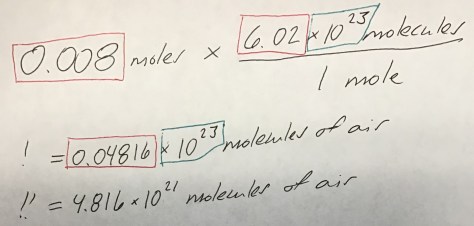
Friday, February 22: We concluded our learning for the week with Lesson 64 of our textbook: The Mole and Avogadro’s Law.  We worked through slides 5-7 of the Lesson 64 PowerPoint and then students received the Lesson 64 Worksheet to work through in small groups.  Students were instructed to complete the worksheet as homework over the weekend.


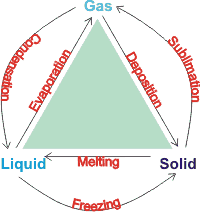
Monday, February 25: Our study of the mole and Avogadro’s number will continue today and tomorrow as students return from ELPA testing.  For our lesson today, we began with a review of dimensional analysis by way of also reviewing phase changes.  The diagram below illustrates the connection between the three phases of matter commonly encountered on Earth, and the vocabulary associated with changing phase.  Click on the image to learn a whole lot more about the science of phase change.

To help students visualize the least familiar of the phase change reactions (the solid-to-gas and gas-to-solid phase changes), we watched a brief video below, complete with spooky soundtrack:

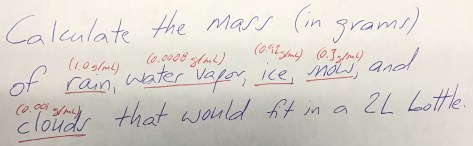
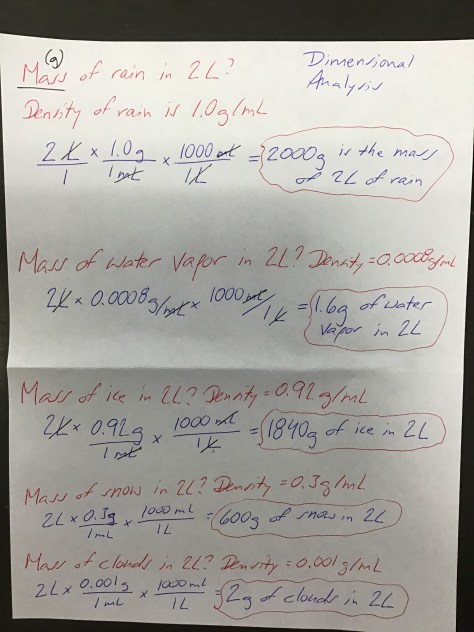
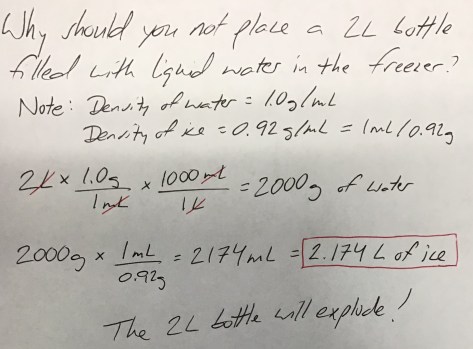
Next, we investigated the concept of number density by learning about the densities of different phases of water.  We calculated how much mass would be in a given volume of sample of each phase of water, appreciating the effect of phase on mass.  We then asked the question: how can we calculate the mass of a given amount of any particles of a substance?  To help answer that, we watched the Crash Course video below:

To end class, we learned how to use the periodic table to calculate mass of one mole of various molecules.

Class Notes:

IMG_0226IMG_0227IMG_0228


Class Notes from February 26:

IMG_0229IMG_0230IMG_0231IMG_0232IMG_0233


Extend Your Learning!

Interested in how scientists calculated the number of particles in one Mole?  Read about it at Wired Magazine.

Homework:

  • Read Lesson 64 in the textbook.  Login via hs.saplinglearning.com and enter your username and password:
    • Username: wahps****s-####### (**** = first 4 letters of your last name and ####### = student number).  Remember to include the dash between s and #.
    • Password: S-####### (the S must be capitalized)
  • Work through the practice problems at the end of Lesson 64.
  • Please ask questions about anything from Lesson 64 you do not yet fully understand.

Opportunities For Help Outside of Class:

  1. Mr. Swart’s office hours: Mondays, Tuesdays, and Thursdays after school until at least 3:00 (later with advanced notice)
  2. Use the vast number of resources available on this website – check each lesson!
  3. Email Mr. Swart for help if staying after school is not possible
  4. Form a study group with other students  to review concepts from class
  5. Attend MASH after school (M/T/Th in Library)
  6. Attend Math Lab after school (T/Th in Room 124)
Combined Gas Law

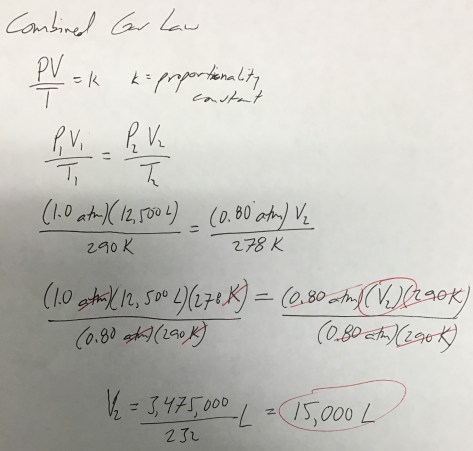
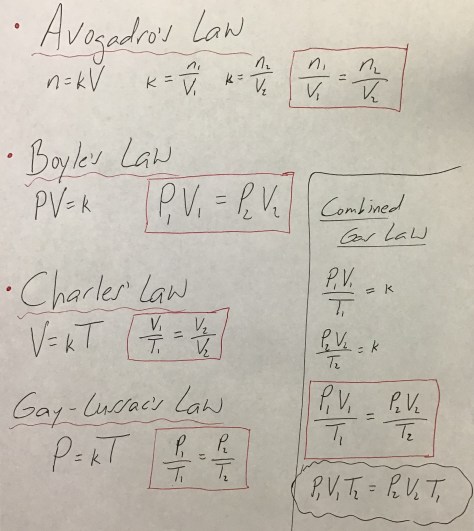
Having thoroughly explored gas laws involving two variables (Pressure & Volume, Pressure & Temperature, and Temperature and Volume), students were introduced to the Combined Gas Law, k=PV/T, at the end of class yesterday.  We began class with the video below:

Next, students received a copy of a handout designed to accompany the Deriving the Gas Laws activity packet from yesterday.  Students worked with their table partners to review, model, and explain the lab data.  The handout, due at the end of class, included a combined gas law practice problem.  Students had the remainder of the class period to:

  • Read Lesson 61 in the textbook and work through the practice exercises (assigned yesterday)
  • Complete the Lesson 61 worksheet handed out yesterday (due tomorrow, February 21)
  • Read Lesson 64 in the textbook and worth through the practice exercises.

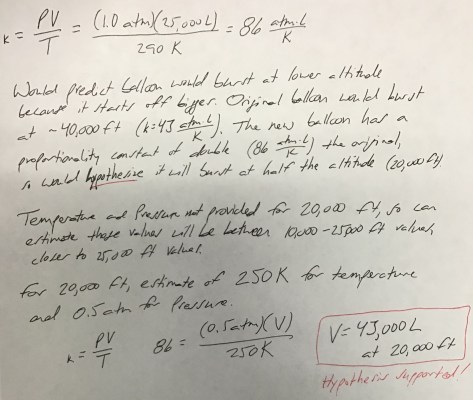
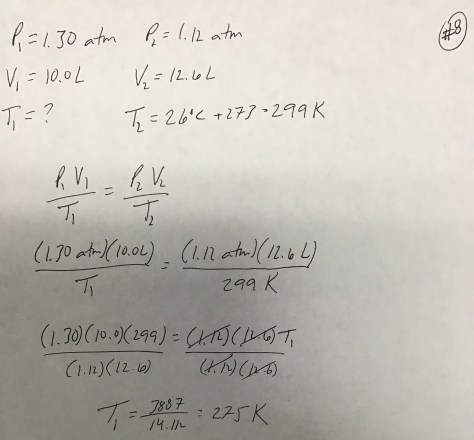
We spent an extra day working through Combined Gas Law problems (class periods were short as a result of the Curriculum Fair).  We reviewed a few problems from the table on th efront of the Lesson 61 Worksheet, and we also worked through question 7 from a handout of additional Gas Law practice problems.  Class notes are shown below:

Example of volume solved at 5,000 ft from the L61 WS table
Explanation of Q8 from L61 WS

Homework:

  • Read Lesson 64 in the textbook.  Login via hs.saplinglearning.com and enter your username and password:
    • Username: wahps****s-####### (**** = first 4 letters of your last name and ####### = student number).  Remember to include the dash between s and #.
    • Password: S-####### (the S must be capitalized)
  • Work through the practice problems at the end of Lesson 64.
  • Please ask questions about anything from Lesson 64 you do not yet fully understand.

Opportunities For Help Outside of Class:

  1. Mr. Swart’s office hours: Mondays, Tuesdays, and Thursdays after school until at least 3:00 (later with advanced notice)
  2. Use the vast number of resources available on this website – check each lesson!
  3. Email Mr. Swart for help if staying after school is not possible
  4. Form a study group with other students  and meet regularly to review  concepts from class (meet in person, online, by phone, social media, etc)
  5. Attend MASH after school
  6. Attend Math Lab after school

Deriving the Gas Laws Lab

We returned from mid-winter break with a return to our work studying the gas laws.  Our exploration included a series of activities designed to guide students through the process of not only deriving the Gas Laws, but ultimately to derive the Ideal Gas Law constant, R.  For today’s work, students were tasked with collecting data from all three stations and then completing Part 1 of the packet as a team.  We completed Part 2 as a class, ultimately deriving the Combined Gas Law.  For homework, students took home a copy of the Lesson 61 Worksheet with the expectation that they will work through the Lesson 61 worksheet and return to school prepared to use the Combined Gas Law.  Students should also read through Lesson 61 in the textbook (see below) and work through the exercises at the end of the lesson for practice.  For additional help, check out the video below.  Reminders about more opportunities for help are provided at the bottom of this post.

Notes from class:

IMG_0218

Highly Recommended Video:

Homework:

  • Read Lesson 61 in the textbook.  Login via hs.saplinglearning.com and enter your username and password:
    • Username: wahps****s-####### (**** = first 4 letters of your last name and ####### = student number).  Remember to include the dash between s and #.
    • Password: S-####### (the S must be capitalized)
  • Work through the practice problems at the end of Lesson 61.
  • Please ask questions about anything from Lesson 61 you do not yet fully understand.

Opportunities For Help Outside of Class:

  1. Mr. Swart’s office hours: Mondays, Tuesdays, and Thursdays after school until at least 3:00 (later with advanced notice)
  2. Use the vast number of resources available on this website – check each lesson!
  3. Email Mr. Swart for help if staying after school is not possible
  4. Form a study group with other students  to review concepts from class
  5. Attend MASH after school (M/T/Th in Library)
  6. Attend Math Lab after school (T/Th in Room 124)