All posts by David Swart

High school science teacher

Is Nature Over?

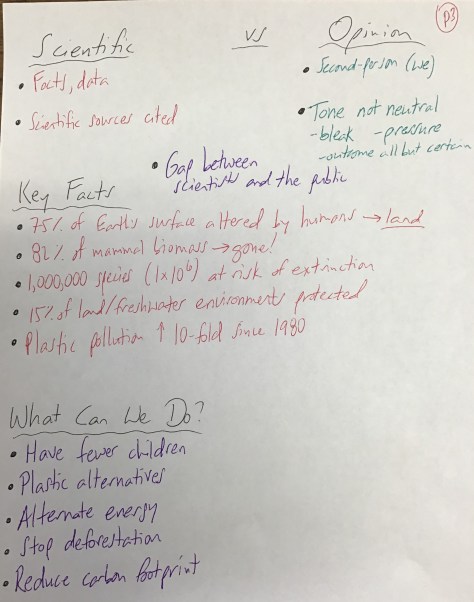
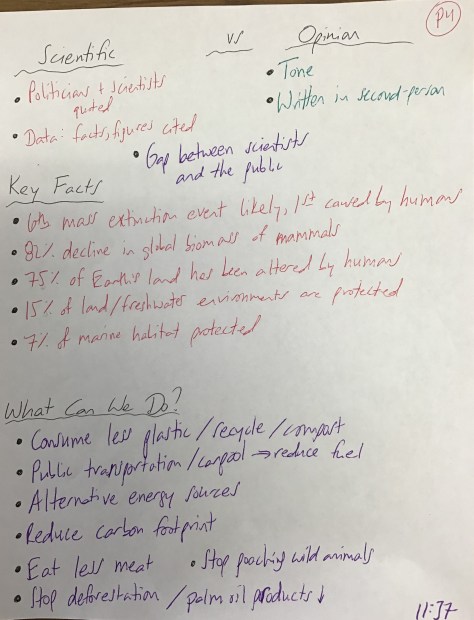
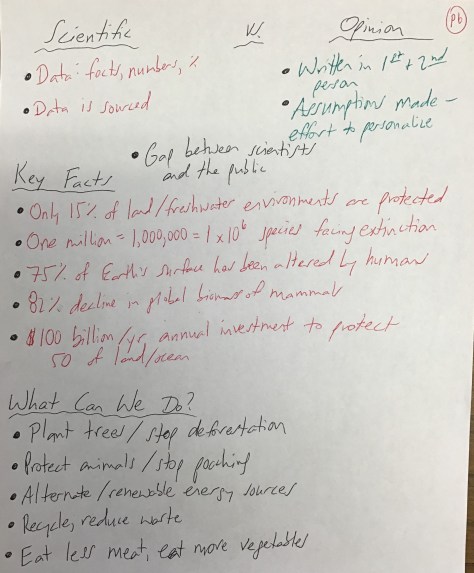
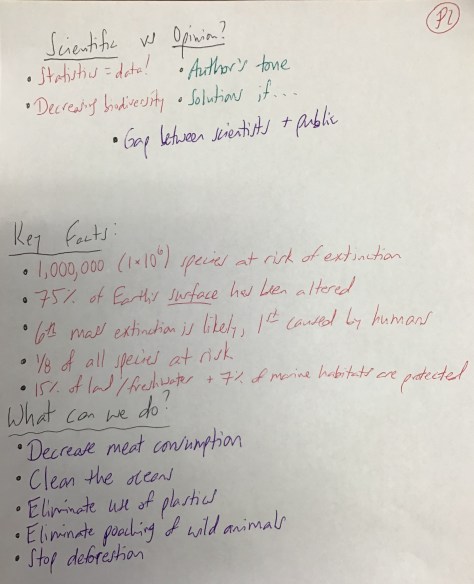
After concluding the chapter 13-15 test last week, we used our class period today to work through the logistics of the next few weeks (an accounting of how many students are taking AP tests and/or are attending field trips) and then focused on student feedback about how to invest our class time.  One theme that came up repeatedly was the application of chemistry to the environment through project work.  To honor that feedback, students were tasked with reading and analyzing an article released this morning by CNN titled “Is Nature Over? Maybe.”  After a class discussion (class notes below), we concluded the class period with the TED Talk below by George Monbiot on the concept of rewilding.  The intent is to push students beyond familiar and comfortable solutions to the question: What can we do climate change?

Class Notes:
Period 2 Notes
Period 3 Notes
Period 4 Notes
Period 5 Notes
Period 6 Notes

Mystery Solutions

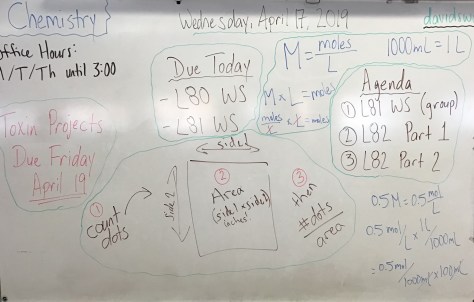
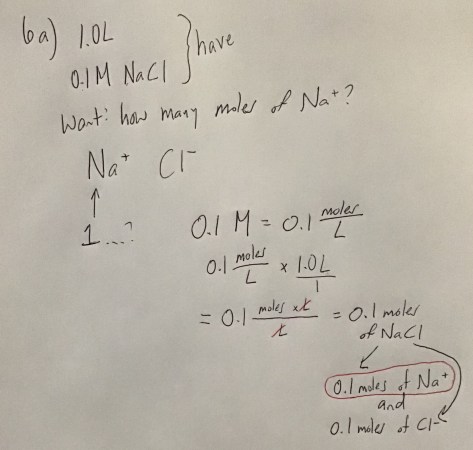
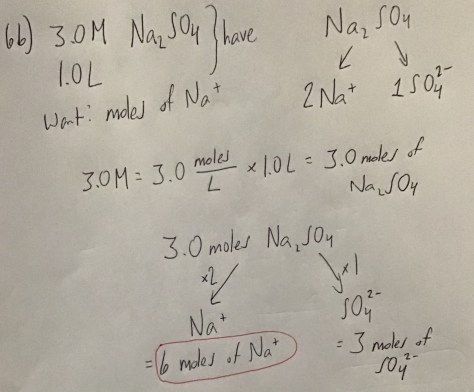
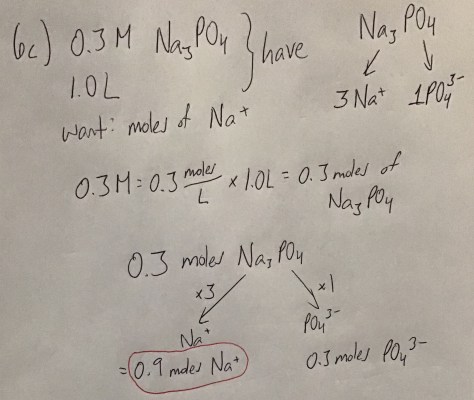
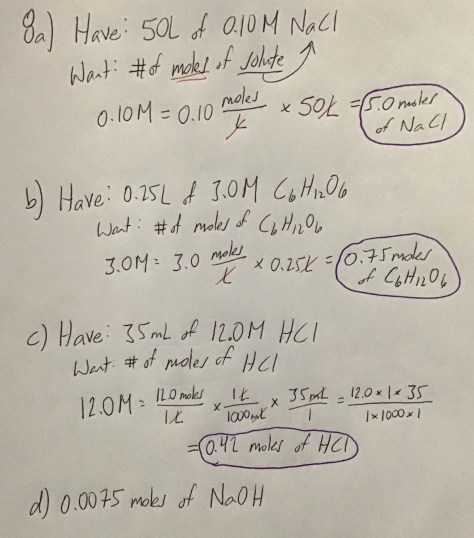
For today, students worked through the Lesson 83 Worksheet.  We approached Part 1 as a thought experiment and notes from the whiteboard are pictured below.  The Lesson 83 PowerPoint is included for reference.

Homework:

  • Read Lesson 83 in the textbook.  Login via hs.saplinglearning.com and enter your username and password:
    • Username: wahps****s-####### (**** = first 4 letters of your last name and ####### = student number).  Remember to include the dash between s and #.
    • Password: S-####### (the S must be capitalized)
  • Work through the practice problems at the end of Lesson 83.
  • Please ask questions about anything from Lesson 83 you do not yet fully understand.

Opportunities For Help Outside of Class:

  1. Mr. Swart’s office hours: Mondays, Tuesdays, and Thursdays after school until at least 3:00 (later with advanced notice)
  2. Use the vast number of resources available on this website – check each lesson!
  3. Email Mr. Swart for help if staying after school is not possible
  4. Form a study group with other students  to review concepts from class
  5. Attend MASH after school (M/T/Th in Library)
  6. Attend Math Lab after school (T/Th in Room 124)

Preparing Solutions

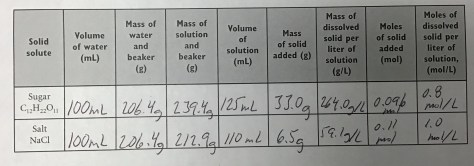
The Lesson 82 Worksheet called for students to work in groups to prepare salt solutions and work through the math to calculate the molarity of their assigned solution.  Although we did not review it in class, the Lesson 82 PowerPoint is available for download.

Additionally, students are encouraged to practice observing the relationship between moles, volume, and molarity using the University of Colorado Molarity PhET simulation below:

https://phet.colorado.edu/sims/html/molarity/latest/molarity_en.html

Homework:

  • Read Lesson 82 in the textbook.  Login via hs.saplinglearning.com and enter your username and password:
    • Username: wahps****s-####### (**** = first 4 letters of your last name and ####### = student number).  Remember to include the dash between s and #.
    • Password: S-####### (the S must be capitalized)
  • Work through the practice problems at the end of Lesson 82.
  • Please ask questions about anything from Lesson 82 you do not yet fully understand.

Opportunities For Help Outside of Class:

  1. Mr. Swart’s office hours: Mondays, Tuesdays, and Thursdays after school until at least 3:00 (later with advanced notice)
  2. Use the vast number of resources available on this website – check each lesson!
  3. Email Mr. Swart for help if staying after school is not possible
  4. Form a study group with other students  to review concepts from class
  5. Attend MASH after school (M/T/Th in Library)
  6. Attend Math Lab after school (T/Th in Room 124)

Molecular Views

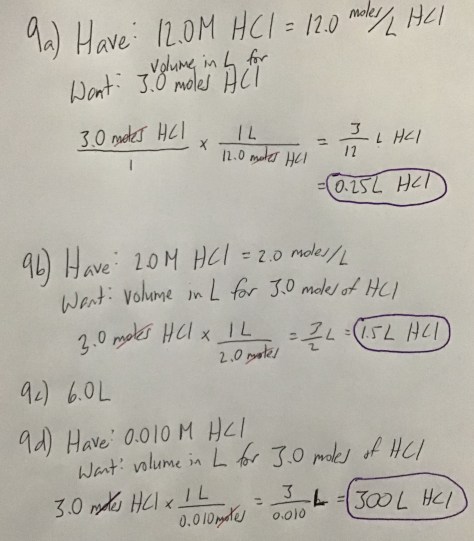
Our work today involved thinking about solutions from a molecular perspective.  Students briefly reviewed yesterday’s Gummy Bear portion of the lab via the ChemCatalyst on slide 3 of the Lesson 81 PowerPoint.  Students then received the Lesson 81 Worksheet and the Particle Views Handout.  The handout was used in Part 1 of the worksheet.  For Part 2, students assembled into groups and gathered around lab stations to gain experience diluting a 3.0 M stock solution to a 1.5 M solution.  They also observed how two different volumes of a solution with the same concentration both appear the same color.  The lesson helped illustrate the connection between molarity (M), particle density, and the number of moles (particle number) in a solution.

Notes from the whiteboard:

IMG_0352

Practice Problems from class (Lesson 81 Exercises from the textbook):

IMG_0353

IMG_0354

IMG_0356

IMG_0357

IMG_0358

Homework:

  • Read Lesson 81 in the textbook.  Login via hs.saplinglearning.com and enter your username and password:
    • Username: wahps****s-####### (**** = first 4 letters of your last name and ####### = student number).  Remember to include the dash between s and #.
    • Password: S-####### (the S must be capitalized)
  • Work through the practice problems at the end of Lesson 81.
  • Please ask questions about anything from Lesson 81 you do not yet fully understand.

Opportunities For Help Outside of Class:

  1. Mr. Swart’s office hours: Mondays, Tuesdays, and Thursdays after school until at least 3:00 (later with advanced notice)
  2. Use the vast number of resources available on this website – check each lesson!
  3. Email Mr. Swart for help if staying after school is not possible
  4. Form a study group with other students  to review concepts from class
  5. Attend MASH after school (M/T/Th in Library)
  6. Attend Math Lab after school (T/Th in Room 124)

Solution Concentration

For the first lesson of Chapter 15, students were immersed in the vocabulary of solution concentration.  The Lesson 80 PowerPoint includes six important vocabulary words that students recorded in their lab notebooks. Students received the Lesson 80 Worksheet and worked together in groups to complete Part 1.

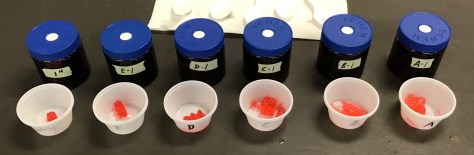
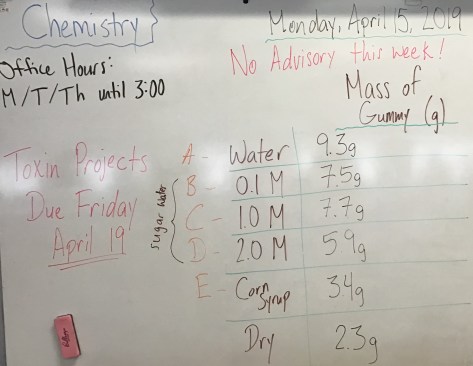
For Part 2 of the worksheet, students were shown gummy bears (Haribo) that had been placed overnight in either water, 0.1 M sugar, 1.0 M sugar, 2.0 M sugar, or corn syrup  The gummy bears were rinsed and the mass was measured.  The results are pictured below:

IMG_0348

IMG_0347

The video of the supersaturated salt solution shown in the PowerPoint is also available below:

Notes from class on April 16:

IMG_0349

IMG_0350

IMG_0351

Homework:

  • Read Lesson 80 in the textbook.  Login via hs.saplinglearning.com and enter your username and password:
    • Username: wahps****s-####### (**** = first 4 letters of your last name and ####### = student number).  Remember to include the dash between s and #.
    • Password: S-####### (the S must be capitalized)
  • Work through the practice problems at the end of Lesson 80.
  • Please ask questions about anything from Lesson 80 you do not yet fully understand.

Opportunities For Help Outside of Class:

  1. Mr. Swart’s office hours: Mondays, Tuesdays, and Thursdays after school until at least 3:00 (later with advanced notice)
  2. Use the vast number of resources available on this website – check each lesson!
  3. Email Mr. Swart for help if staying after school is not possible
  4. Form a study group with other students  to review concepts from class
  5. Attend MASH after school (M/T/Th in Library)
  6. Attend Math Lab after school (T/Th in Room 124)

Researching Toxins

To launch our Toxins Research Project, students are tasked with researching key information about five toxins of interest to them.  Information will be recorded on the Toxins Research Project handout (Day 1) which is due at the end of class.

The websites below are useful for getting started:

For inspiration, the websites below can help get you started:

Comparing Amounts

For the final lesson of Chapter 14, we worked through the Lesson 79 PowerPoint in which we ultimately compared the toxicities of regular and diet soda, containing fructose and aspartame, respectively.  Students then received the Lesson 79 Worksheet to work through for the remainder of class.  As a reminder, we have a mini-quiz on Thursday, so students should come to class tomorrow prepared with questions from our work in Chapter 14 (Lessons 74-79) and from the Chapter 13/14 Study Guide.

Homework:

  • Read Lesson 79 in the textbook.  Login via hs.saplinglearning.com and enter your username and password:
    • Username: wahps****s-####### (**** = first 4 letters of your last name and ####### = student number).  Remember to include the dash between s and #.
    • Password: S-####### (the S must be capitalized)
  • Work through the practice problems at the end of Lesson 79.
  • Please ask questions about anything from Lesson 79 you do not yet fully understand.

Opportunities For Help Outside of Class:

  1. Mr. Swart’s office hours: Mondays, Tuesdays, and Thursdays after school until at least 3:00 (later with advanced notice)
  2. Use the vast number of resources available on this website – check each lesson!
  3. Email Mr. Swart for help if staying after school is not possible
  4. Form a study group with other students  to review concepts from class
  5. Attend MASH after school (M/T/Th in Library)
  6. Attend Math Lab after school (T/Th in Room 124)

Moles and Molar Mass

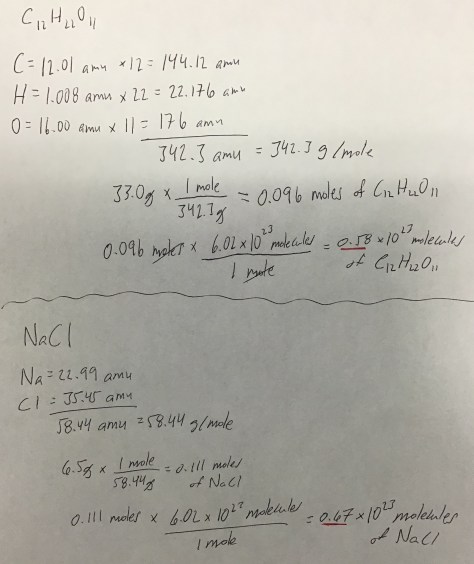
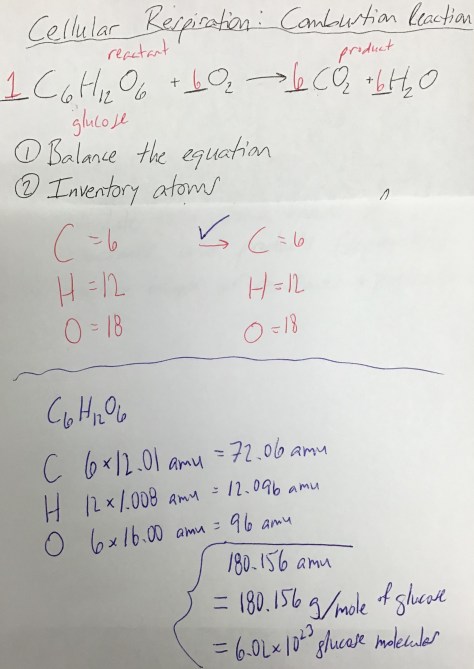
Class began with a review of the connection between moles and particles.  From there, students worked through an entry task requiring them to balance a combustion reaction, calculate atomic masses of the products and reactants from the reaction, and then to compare the results (thus demonstrating conservation of mass).

Next, students had the remainder of the class period to work through the Relative Mass and the Mole POGIL packet.  Key concepts from textbook lessons 76-78 are distilled into a PowerPoint slide deck from students who desire additional review.

Class Notes:

IMG_0274

IMG_0275

IMG_0273

IMG_0278
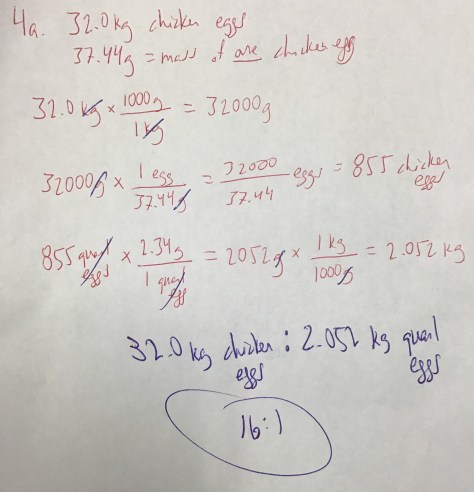
Q4a from p.2 of the POGIL

Video Review:

Homework:

  • Read Lessons 76-78 in the textbook.  Login via hs.saplinglearning.com and enter your username and password:
    • Username: wahps****s-####### (**** = first 4 letters of your last name and ####### = student number).  Remember to include the dash between s and #.
    • Password: S-####### (the S must be capitalized)
  • Work through the practice problems at the end of Lessons 76-78.
  • Please ask questions about anything from Lessons 76-78 you do not yet fully understand.

Opportunities For Help Outside of Class:

  1. Mr. Swart’s office hours: Mondays, Tuesdays, and Thursdays after school until at least 3:00 (later with advanced notice)
  2. Use the vast number of resources available on this website – check each lesson!
  3. Email Mr. Swart for help if staying after school is not possible
  4. Form a study group with other students  to review concepts from class
  5. Attend MASH after school (M/T/Th in Library)
  6. Attend Math Lab after school (T/Th in Room 124)

Counting by Weighing

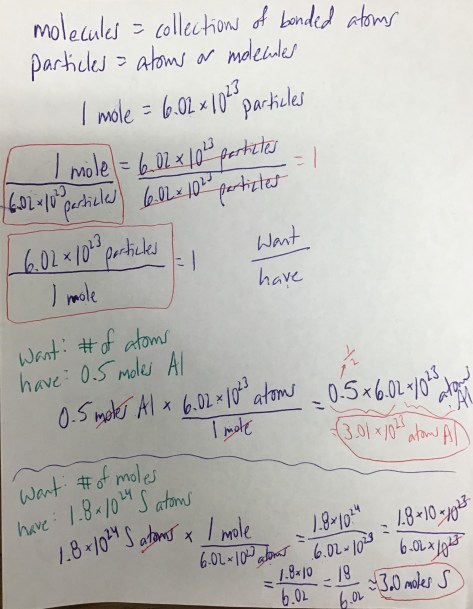
Our work today involved a Counting By Weighing activity.  Students recorded the mass of a small number of objects to then estimate the mass of a much larger number of objects.  The activity was designed to help students begin to make sense of the mole, a unit of chemistry that represents 6.02 x 10^23 of any given object.  In chemistry, we use the mole as a way to measure the number of atoms or molecules.  Students also received a copy of the Chapter 13/14 Study Guide as a tool to begin preparing for the quiz next Tuesday.

Notes from the whiteboard:

IMG_0268

Homework:

  • Read Lesson 75 in the textbook.  Login via hs.saplinglearning.com and enter your username and password:
    • Username: wahps****s-####### (**** = first 4 letters of your last name and ####### = student number).  Remember to include the dash between s and #.
    • Password: S-####### (the S must be capitalized)
  • Work through the practice problems at the end of Lesson 75.
  • Please ask questions about anything from Lesson 75 you do not yet fully understand.

Opportunities For Help Outside of Class:

  1. Mr. Swart’s office hours: Mondays, Tuesdays, and Thursdays after school until at least 3:00 (later with advanced notice)
  2. Use the vast number of resources available on this website – check each lesson!
  3. Email Mr. Swart for help if staying after school is not possible
  4. Form a study group with other students  to review concepts from class
  5. Attend MASH after school (M/T/Th in Library)
  6. Attend Math Lab after school (T/Th in Room 124)

Combustion

Class began with students receiving back their mini-quiz from last week which we reviewed together as a class.  Students were reminded that all work from lessons 70-73 (chapter 13) must be turned in no later than tomorrow for credit.  After the review, students voted on one of two options:

  1. Continue forward with Lesson 74: Toxicity
  2. Conduct an experiment focused on the combustion reaction

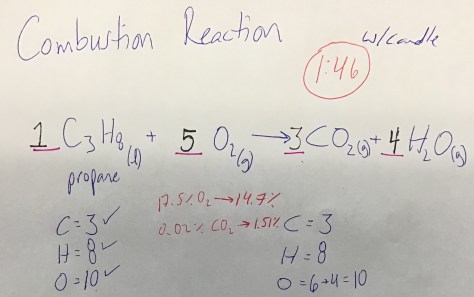
Students elected to learn about the combustion reaction, so we reviewed the combustion of propane and balanced the equation, then carried out an experiment in which a candle (made of paraffin wax, another hydrocarbon) is combusted under a bell jar.  We timed how long the candle burned for, and also measured the amount of oxygen and carbon dioxide in the room (before combustion) and under the bell jar (after the candle extinguished.

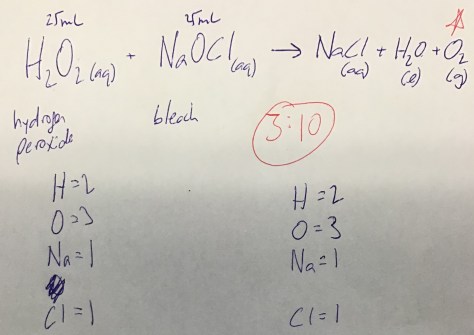
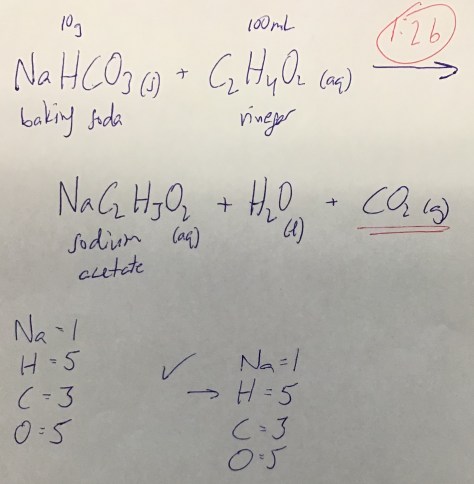
Next, we wrote the chemical equations for combining hydrogen peroxide and bleach (producing oxygen) and for combining baking soda and vinegar (producing carbon dioxide).  We evaluated the effect of combustion in the presence of excess oxygen or carbon dioxide, measuring how long the candle burned as our endpoint.  Class notes are provided below.

We will return to our regularly scheduled programming (lesson 74) tomorrow!