Fall SLCs are scheduled for Tuesday, November 26 from 3:00-7:00 PM and Wednesday, November 27 from 8:00-11:00 AM. Students will complete the SLC Template for each class (available in English, Spanish, and Vietnamese), excluding Advisory. Students who need guidance will out the SLC Template can use the SLC Handout Exemplar for inspiration. Finally, our Video Productions class created a helpful how-to video so students understand the expectations around leading an SLC.
We continued our study of Lewis Dot Structures by investigating the Octet Rule through the lens of double and triple bonds. Students applied the HONC 1234 rule with their understanding of valence electrons (octet = eight electrons) to build molecules that share one or more bonds. We worked through the Lesson 32 PowerPoint and then students used the Lewis Dot puzzle pieces from Lesson 31 to work through the Lesson 32 worksheet.
Homework:
Read Lesson 32 in the textbook. Login via hs.saplinglearning.com and enter your username and password.
Write notes for Lesson 32 and work through the practice problems at the end of Lesson 32.
Please ask questions about anything from Lesson 32 you do not yet fully understand.
With a number of students out of school for the day on an AVID field trip, class today focused on reviewing the types of bonds formed between atoms, and extending into modeling electrons using Lewis Structures.
For our entry task today, students were asked to take a brief survey about science electives they are interested in taking next school year. Students may click this survey link or use the QR code below:
After the entry task, students have the following options (must turn in something today to receive credit for class – an assignment, a shared document, or an email with notes is sufficient):
Catch-up Day:
Complete and turn in worksheets for Lessons 28-30
Turn in or revise Unit 1 Project*
Turn in or revise Electroplating Lab Report*
*Amnesty Day today = 80% max credit. After today, 60% max credit. After Friday, no credit.
To accommodate students who missed class yesterday because of the field trip, we had a two-pronged Entry Task. Students who missed yesterday were directed to quickly take the Science Elective Survey. Students who completed the survey (and those who finish in time today) were directed to complete the alternate entry task. Resources for both are provided below:
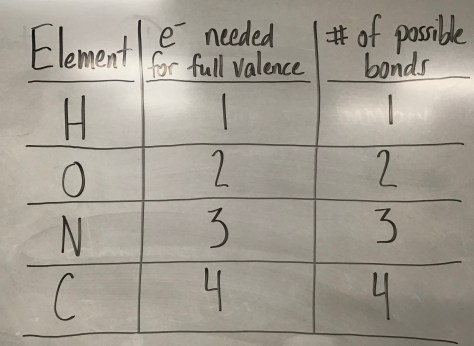
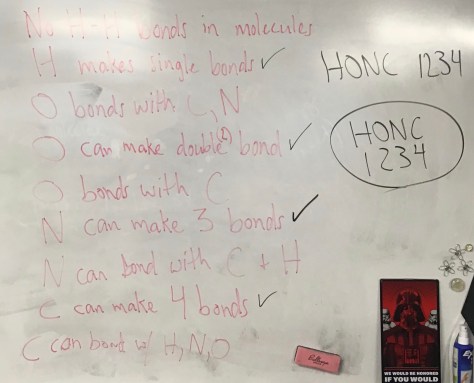
We extended our learning of the HONC 1234 rule from Friday by introducing the concept of Lewis Dot Symbols and Structures. To solve the alternate entry task, students were reminded about how the HONC 1234 rule connects the concepts of valence electrons to the number of bonds each atom can make:
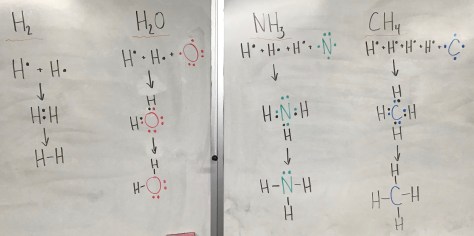
We used that understanding to solve the Lewis Dot Structures for the entry task:
Next, we worked through the Lesson 31 PowerPoint, writing down key vocabulary and reviewing Lewis Dot Symbols and how they assemble to create Lewis Dot Structures in our class notes. Students had the remainder of the class period to work in groups of four on the Lesson 31 Worksheet using the Lewis Dot Puzzle Pieces.
Keep Learning!
The videos below all include information about Lewis Dot symbols. You are strongly encouraged to review them!
Homework:
Read Lesson 31 in the textbook. Login via hs.saplinglearning.com and enter your username and password.
Write notes for Lesson 31 and work through the practice problems at the end of Lesson 31.
Please ask questions about anything from Lesson 31 you do not yet fully understand.
Monday, November 18, 2019 (HS-LS2-1): With the aquatic farming project behind us, students will begin class in their assigned seats, where they will invest in building relationships with new members of the class for the remainder of this semester when the current unit concludes.
For our entry task today, students were asked to take a brief survey about science electives they are interested in taking next school year. Students may click this survey link or use the QR code below:
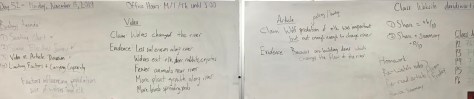
Our lesson will begin with a discussion of student learning from Friday’s work where they were assigned the task of writing a summary comparing a video and an article that present contrasting evidence about the effect of reintroducing wolves to Yellowstone National Park. Students will share out evidence from both sources and practice the art of debating whether the evidence supports or disproves either position. Notes from class:
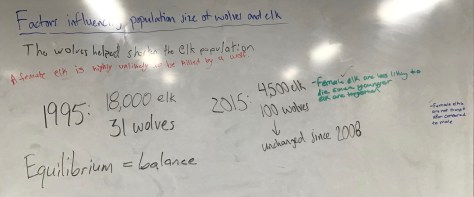
Next, we will advance our understanding of ecosystems by learning about the concepts of limiting factors and carrying capacity. We will watch the video below as an example of how the population of one species (wolves) directly influenced the population of another species (elk) after wolves were reintroduced to Yellowstone. During the video, students will take notes in their Google Doc focusing on factors that influence the population size of wolves and elk, and will write down facts about population sizes.
Notes from class:
Finally, students will read the article titled “Interdependence Involves Limiting Factors and Carrying Capacity” on pages 650-652 of the BSCS Biology textbook. Students will take notes and define vocabulary in their Yellowstone Google Doc.
A limiting factor is anything that can slow, or limit, the growth of a population.
Biotic factors: food supply and other organisms
Abiotic factors: space, raw materials, climate (the prevailing weather conditions in a given area through long periods of time), light
Carrying capacity is the maximum population of a particular species that the habitat can support. It changes as environmental conditions change.
Population density is the number of individuals in relation to the space the population occupies.
Tuesday, November 19, 2019 (HS-LS2-2): We will continue our learning about limiting factors and carrying capacity, concepts that help explain the population size of organisms in a given ecosystem, by bringing in the concept of trophic cascades. We will continue our study of Yellowstone, focusing on the effect of wolf reintroduction, with a guided activity where students will watch a segment (first 2:36) of Earth: A New Wild and then they will complete Part 1: Defining Trophic Cascade.
Wednesday, November 20, 2019 (HS-LS2-8): Students who need additional time to complete Part 1 and Part 2 from yesterday will work efficiently to complete those activities before moving forward. Parts 1 and 2 are due by the end of class today for full credit.
Students who are ready will begin researching the reproductive strategies used by various organisms within Yellowstone. Information will be collected into the Yellowstone Google Doc in a section titled “Survival and Reproductive Strategies of (insert selected species here) in Yellowstone National Park.” Complete research will include the following (note: some information may not be available or relevant depending on species being researched):
Common name and scientific name (Genus and species) of a specific organism that lives in Yellowstone National Park
Example: elk (Cervus canadensis)
Pictures of members of a species (male, female, baby)
Names given to members of a species
Examples: Male elk are called bulls, female elk are called cows, and baby elk are called calves
Diet type and preferred food sources
Diet type examples: herbivore, carnivore, omnivore
Preferred food sources examples: Elk eat grasses in the summer and woody growth in the winter months, and they snack on dandelions, violets, hawkweed, aster, clover and mushrooms.
Keep searching! If you find a great resource, let Mr. Swart know so we can add it to our lists.
Thursday, November 21, 2019 (HS-LS2-8): Continue researching! All student research will be used to construct a food web of Yellowstone National Park. We need as much information as possible to construct an accurate and complete food web. Students who complete research on an organism to continue researching additional organisms. Ideally, all students will thoroughly research the survival and reproductive strategies of at least one animal, one plant, and one extremophile (bacteria or archaea).
Remember, to receive credit for this important work, all research must be entered into the “Survival and Reproductive Strategies of (insert selected species here) in Yellowstone National Park” section of the Yellowstone Google Doc.
Friday, November 22, 2019 (HS-LS2-8): Final day for survival and reproductive strategies research. Student work will be assessed this weekend. Students will also complete the Student Led Conference worksheet in preparation for SLCs next Tuesday evening/Wednesday morning.
Students who finish early should add selected data from their Survival and Reproductive Strategies of (insert selected species here) in Yellowstone National Park to the Yellowstone Biomass Survey. The data will be used to build the Yellowstone Food Web next week.
In the Lesson 30 PowerPoint, students were introduced to the HONC 1234 rule. We then worked together as a class on the first three problems of the Lesson 30 Worksheet and students had the remainder of the class period to complete the worksheet.
Notes from the whiteboard:
Homework:
Read Lesson 30 in the textbook. Login via hs.saplinglearning.com and enter your username and password.
Write notes for Lesson 30 and work through the practice problems at the end of Lesson 30.
Please ask questions about anything from Lesson 30 you do not yet fully understand.
We continued our work from yesterday, beginning with the Lesson 29 PowerPoint. After preparing for the lesson, students worked through the Lesson 29 worksheet which included another “wafting” activity in which three additional scents were provided for students to smell and connect with molecular formulas. Students learned that two molecules can have the same molecular formula but smell very differently. One compound smelled like rum extract, while an isomer of that compound smells like stinky cheese. The compounds are isomers because they have the same chemical formula but different structural formula. The activity further enabled students to make connections between compound names, molecular formulas, structural formulas, and smell.
For our first lesson of Unit 2, students were asked to respond to the following entry task (written in their notebooks):
What do you think is happening when you smell something?
Why do you think we have a sense of smell?
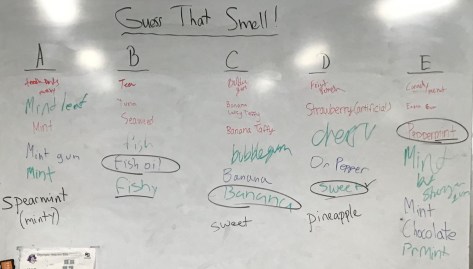
The first question directly tested student recall of the content learned yesterday. Students will review, revise, and expand on their understanding of what happens when they smell something throughout the unit. After a class share-out of why students think we have a sense of smell, we worked through the Lesson 28 PowerPoint and then students all participated in an activity (guided by the Lesson 28 Worksheet) where they smelled five different scents and then compared their observations as a class. To reinforce yesterday’s lesson in which students learned about the connection between smell, emotion, and memory, students listened to snippets of songs while smelling each of the compounds. We will revisit the songs and smells later in the unit to see whether music had an effect on student retention of smell identities. After completing the individual smell test, students shared their individual thinking about the identity of each smell to reach a group consensus which they then wrote on the whiteboard (example shown below). Once each group shared their thinking, the identity of each compound and the class of smell (minty, sweet, or fishy) was revealed.
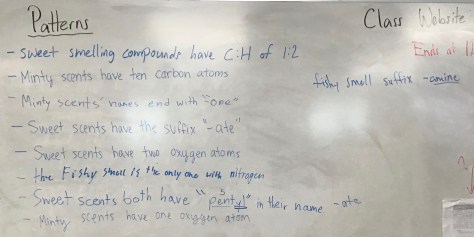
Based on the class results, students made connections between molecular formulas, chemical names, and scents (fishy, minty, or sweet). Each student group contributed a pattern observed from Table 2 of the Lesson 28 Worksheet and an example from one class is shown below:
To kick off our new chemistry unit focusing on organic chemistry (covalent bonds with an emphasis on carbon-containing molecules) and smell, we watched episode 6 of Cosmos. The most relevant segment of the video occurs between minutes 13 and 17, where Dr. Tyson explains how molecules are detected by our brain, resulting in the formation of memory associated with smell. Students completed the Unit 2 Initial Model handout (half-sheet) and turned that in as evidence of learning and engagement. We will revisit and add to the model of smell throughout the unit.
Monday, November 11, 2019: No School (Veteran’s Day)
Tuesday, November 12, 2019: Unit 1 Final Project Presentations (4 of 6 groups)
Wednesday, November 13, 2019: Unit 1 Final Project Presentations (last 2 groups)
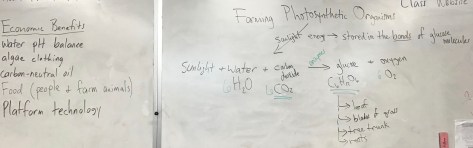
After completing the final presentations for the unit, we reviewed the major economic benefits shared by each group with respect to farming photosynthetic aquatic organisms. We concluded with the key idea that plants use the process of photosynthesis to remove carbon dioxide from the environment in order to create glucose which they then use as both an energy store and also to build biomass. We call this process “fixing” carbon – taking carbon dioxide from the air to build biomolecules – helps drive home the point that carbon dioxide gas (difficult to observe under everyday conditions) can be removed from the environment and utilized by photosynthetic organisms to make glucose (an energy-rich molecule) which can then be used by all organisms as a source of food and raw materials to build other biomolecules (proteins, lipids, carbohydrates, and nucleic acids).
For the final few minutes of class, students watched the TedTalk video below where scientist / artist / designer Suzanne Lee shares her efforts to create clothing from fabric derived from bacteria found in kombucha tea. The bacteria consume glucose (produced from plants during photosynthesis) and produce cellulose fibers that may one day be engineered to have properties that make these clothes a must-have for wardrobes of the future:
Unit 2: Ecosystems
Thursday, November 14, 2019: Our ecosystem unit begins with a virtual road trip to Yellowstone National Park. To help introduce students to Yellowstone, we watched the video below:
Working with a partner, create a Google Doc and include your responses to the following tasks:
Plan your route: Map how you will travel from Burien to Yellowstone and back.
Write a summary comparing the video and the article in your Google Doc (title = Effect of wolves on Yellowstone). Does the evidence support or not support the claim that reintroduction of wolves has changed Yellowstone? Use evidence from both sources to support your position.
Now that we have a plan to virtually travel to Yellowstone, we set our sights on the ecosystem of the park. For today’s lesson, students will learn about how the reintroduction of wolves nearly 75 years after their extinction appears to have led to profound changes to both the biotic (living) and abiotic (not living) factors in the ecosystem of the park.
The video (below) features images about the wolves and other organisms in Yellowstone, with George Monbiot narrating. The narration is actually a segment from a longer TED talk by Mr. Monbiot.
During the video, make a list in your Google Doc (from yesterday) of the biotic and abiotic factors you see in Yellowstone. After watching the video, write down the claim being made by the narrator in the Google Doc, and then make of list of evidence used to support the claim. Next, students will read an article titled Has The Reintroduction Of Wolves Really Saved Yellowstone? published on March 14, 2014 by Emily Gertz in Popular Science. After reading the article, students will write a summary of what they learned and write down evidence presented in the article that refutes the claim that wolves have altered Yellowstone.






 Science with Swart
You must be logged in to post a comment.