We returned to the molecular modeling kits in Lesson 38, this time using the kits to learn about the shape of molecules. We worked through the Lesson 38 PowerPoint, learning vocabulary terms to describe molecular shape. Students then worked in small groups to complete the Lesson 38 Worksheet.
Homework:
Read Lesson 38 in the textbook. Login via hs.saplinglearning.com and enter your username and password.
Write notes for Lesson 38 and work through the practice problems at the end of Lesson 38.
Please ask questions about anything from Lesson 38 you do not yet fully understand.
For the project, students will create a poster to model the water, carbon, nitrogen, phosphorus, and sulfur cycles on a poster of Yellowstone National Park. For our work today, students will have time to complete the Food Web and Ecosystem Gizmos from Monday and Tuesday, and then they will receive the Nutrient Cycling POGIL worksheet packet that will provide them with additional information about the process of carbon (C), water (H and O), and nitrogen (N) cycling.
Students will work in groups of 3-4 to create the biogeochemical cycling poster project. Instructions:
Create a large poster by taping together printer paper to the desired size
Sketch and label the major must-see attractions and geographically distinct regions of the park
Draw and label the carbon (C), water (H and O), nitrogen (N), phosphorus (P), and sulfur (S) cycles within the park
The poster should be nicely organized, easy to understand, and colorful! Due date: Thursday (December 12) by the end of class.
Note 1: While not included in the POGIL, sulfur is often included as a component of the biogeochemical cycle, frequently abbreviated as the CHNOPS cycle. Including the sulfur cycle will earn group members bonus points.
Note 2: As with the Unit 1 Ocean Acidification project, students are expected to work productively and equally within their groups. On Tuesday, students will fill out the Individual Contribution Multiplier worksheet to to explain how each team member contributed. The multiplier will affect individual student grades on the team project, so students must communicate early and often regarding expectations for each other.
Helpful Resources:
One Strange Rock: Nitrogen Cycle
Crash Course: Carbon and Water Cycles
Crash Course: Nitrogen and Phosphorus Cycles
Bozeman Science: Biogeochemical Cycles (includes the Sulfur Cycle)
The Carbon Cycle – a NASA Earth Observatory website with data about global carbon cycling in the land, air, and sea with actual numbers that need to be added to the student posters.
Water Cycle – USGS website providing a robust review of hydrologic (water) cycle vocabulary, a presentation of the cycle itself, and data students will need to add the actual amount of water stored in various locations on Earth.
Texas A&M University has a website with pages devoted to explaining the Nitrogen Cycle. Additional in-depth information about the Nitrogen Cycle is available on the Nature Education Knowledge Project website.
Phosphorus Cycle – information about the cycle and a nice graphic from the Shmoop University website.
Sulfur Cycle – a presentation provided by The Environmental Literacy Council
Our lesson today combines textbook lesson 37 (electron domains) and lesson 38 (molecule shape). We will work through the PowerPoint and students will concurrently take notes on the Handout for this lesson while also building molecules with molecular modeling kits. Students will then complete the Lesson 38 Worksheet.
Key ideas:
noble gases (single atoms) are visualized as points
molecules consisting of two atoms (i.e. hydrogen fluoride) are linear
molecules consisting of three atoms can be bent (H2O) or linear (CO2)
molecules consisting of four atoms, like ammonia (NH3) are called pyramidal
molecules consisting of five atoms, like methane (CH4) are called tetrahedral
larger molecules consist of multiple shapes put together
Homework:
Read Lessons 37 and 38 in the textbook. Login via hs.saplinglearning.com and enter your username and password.
Write notes for Lessons 37 and 38 and work through the practice problems at the end of Lessons 37 and 38.
Please ask questions about anything from Lessons 37 and 38 you do not yet fully understand.
For the first lesson of Chapter 7, students applied the 3-dimensional ball-and-stick model to bridge the concepts of molecular shape, functional groups, and smell. The Lesson 36 PowerPoint introduced students to the model, during which time they passed around actual models constructed with molecular modeling kits. Next, students transitioned to the activity portion of the lesson, experiencing the scents of five different compounds, connecting the smells to molecular structure, and recording observations and analysis responses in the Lesson 36 Worksheet.
After the Kahoot! students will have the opportunity to work through the Review Exercises on page 183 of the textbook and ask all the clarifying questions they have to feel confident about the quiz tomorrow. We will review the answers as a class.
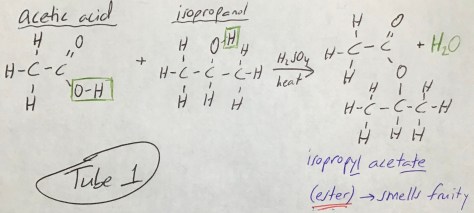
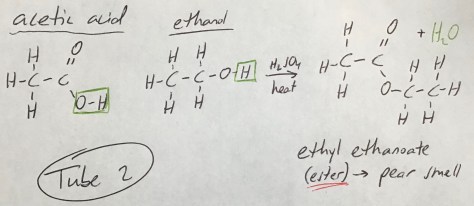
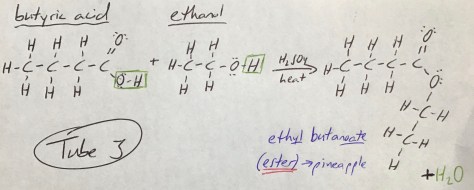
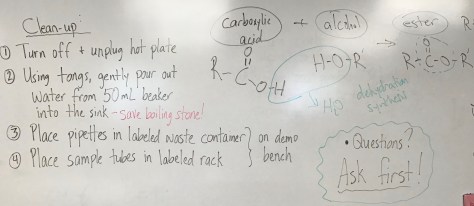
For our final lesson of Chapter 6, students were tasked with analyzing the ester synthesis lab from yesterday. The Lesson 35 Student Worksheet guides students through the analysis process.
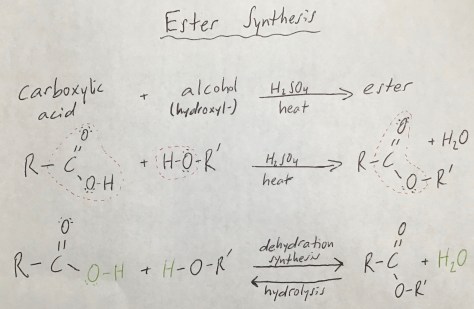
Notes from class:
Keep Learning!
Wondering why the O and H from the carboxylic acid partner up with the H from the alcohol to form water during the ester synthesis reaction? The answer is far from simple! Check out the chemistry involved in Fischer Esterification, courtesy of the University of Calgary department of Chemistry.
Homework:
Read Lesson 35 in the textbook. Login via hs.saplinglearning.com and enter your username and password.
Write notes for Lesson 35 and work through the practice problems at the end of Lesson 35.
Please ask questions about anything from Lesson 35 you do not yet fully understand.
Monday, December 2, 2019 (HS-LS2-4): We will begin class with a reminder that we are collecting student-researched data contained within the Survival and Reproductive Strategies of (insert selected species here) in Yellowstone National Park project students worked on last week. Select data will be entered into the Yellowstone Biomass Survey Students were instructed to complete this work before the beginning of class today, but with insufficient data collected thus far, the deadline will be extended to the end of class today. Students will instead work through the Food Chain Gizmo to ensure sufficient access to learning about that concept.
If all students contribute the required animal and plant biomass data to the Yellowstone Biomass Survey by the end of class today, we will move forward tomorrow constructing and analyzing a trophic pyramid of Yellowstone Park.
Note: The Yellowstone Virtual Road Trip will be graded this weekend. Refer to the checklist provided on November 26 to ensure all work is completed. Ask Mr. Swart if you are unsure about any required pieces of work.
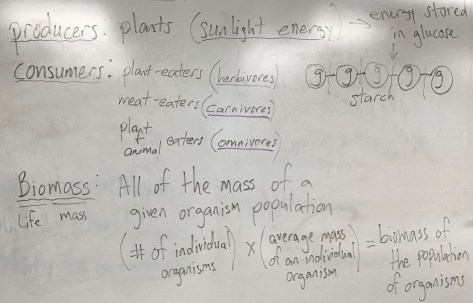
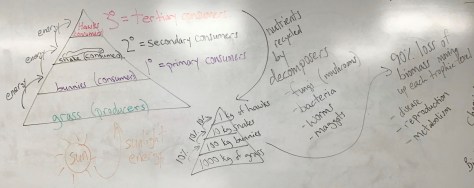
Tuesday, December 3, 2019 (HS-LS2-4): We will begin class with some interactive class notes. Students will revisit the vocabulary of producers and consumers from yesterday’s Gizmo, and we will add the vocabulary terms of primary, secondary, and tertiary consumers, as well as decomposers. We will review the movement of energy in a food web, and discuss how organisms use (and lose) energy. Finally, we will discuss the concept of biomass and apply the 90% rule to the trophic levels as introduced in yesterday’s Gizmo. After completing our notes, students will work through the Forest Ecosystem Gizmo.
Notes from class:
Wednesday, December 4, 2019 (HS-LS2-3, HS-LS2-5): Now that students better understand the predator-prey relationships (energy cycling), students will work in small groups to create posters representing biogeochemical cycling. For the project, students will create a poster to model the water, carbon, nitrogen, phosphorus, and sulfur cycles on a poster of Yellowstone National Park. For our work today, students will have time to complete the Food Web and Ecosystem Gizmos from Monday and Tuesday, and then they will receive the Nutrient Cycling POGIL worksheet packet that will provide them with additional information about the process of carbon (C), water (H and O), nitrogen (N), and phosphorus (P) cycling.
Due Friday:
Yellowstone Virtual Road Trip (refer to checklist) – share Google Doc with Mr. Swart (david.swart@g.highlineschools.org)
Food Web Gizmo
Ecosystem Gizmo
Nutrient Cycling POGIL (individual assignments)
Due next Thursday: Biogeochemical Cycling Poster (group project)
Sketch and label the major must-see attractions and geographically distinct regions of the park
Draw and label the carbon (C), water (H and O), nitrogen (N), phosphorus (P), and sulfur (S) cycles within the park
The poster should be nicely organized, easy to understand, and colorful! Due date: next Thursday (December 12) by the end of class.
Note 1: While not included in the POGIL, sulfur is often included as a component of the biogeochemical cycle, frequently abbreviated as the CHNOPS cycle. Including the sulfur cycle will earn group members bonus points.
Note 2: As with the Unit 1 Ocean Acidification project, students are expected to work productively and equally within their groups. On Tuesday, students will fill out the Individual Contribution Multiplier worksheet to to explain how each team member contributed. The multiplier will affect individual student grades on the team project, so students must communicate early and often regarding expectations for each other.
Helpful Resources:
One Strange Rock: Nitrogen Cycle
Crash Course: Carbon and Water Cycles
Crash Course: Nitrogen and Phosphorus Cycles
Bozeman Science: Biogeochemical Cycles (includes the Sulfur Cycle)
The Carbon Cycle – a NASA Earth Observatory website with data about global carbon cycling in the land, air, and sea with actual numbers that need to be added to the student posters.
Water Cycle – USGS website providing a robust review of hydrologic (water) cycle vocabulary, a presentation of the cycle itself, and data students will need to add the actual amount of water stored in various locations on Earth.
Texas A&M University has a website with pages devoted to explaining the Nitrogen Cycle. Additional in-depth information about the Nitrogen Cycle is available on the Nature Education Knowledge Project website.
Phosphorus Cycle – information about the cycle and a nice graphic from the Shmoop University website.
Sulfur Cycle – a presentation provided by The Environmental Literacy Council
Monday, November 25, 2019: With the short holiday week, students who needed time to work on the Yellowstone Virtual Road Trip work from last week had the opportunity to do so; students who were caught up watched The Lost Worlds of Planet Earth from Season 1 of Cosmos.
Tuesday, November 26, 2019: Class began with a self-assessment with regard to work completed for the Yellowstone Virtual Road Trip project. Students evaluated their work via a checklist, turned in the checklist for assignment credit, and then received back the checklist in order to complete missing work. Students who needed time to work had the opportunity to do so; students who were caught up watched The World Set Free from Season 1 of Cosmos.
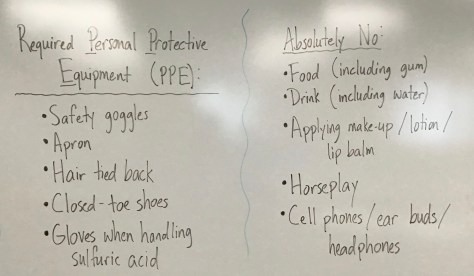
Lesson 34 Lab: Our work today is to conduce the Ester Synthesis Lab. Class will begin with a class discussion of the experiment, with emphasis placed on lab safety. For the lab, students will use the Lesson 34 Student Worksheet to guide them through the lab.
We began class with students watching the video below (except for 5th period which lost half of the class due to Pep Assembly prep):
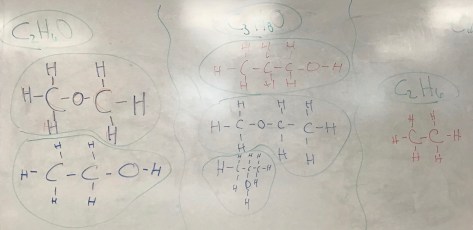
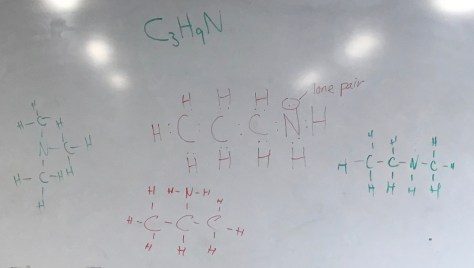
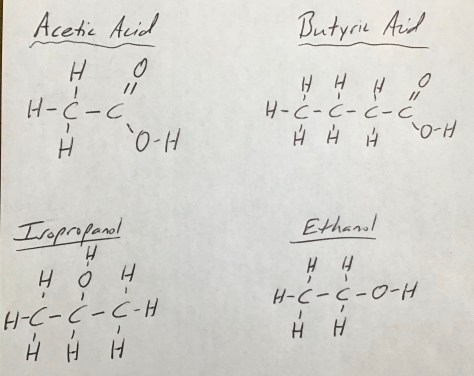
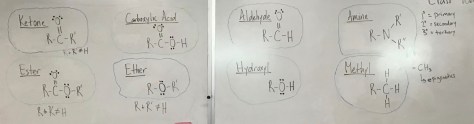
After the video, students copied the notes from the whiteboard pictured below to their notebooks. (Although we did not use it today, the Lesson 33 PowerPoint is provided here as a learning resource.)
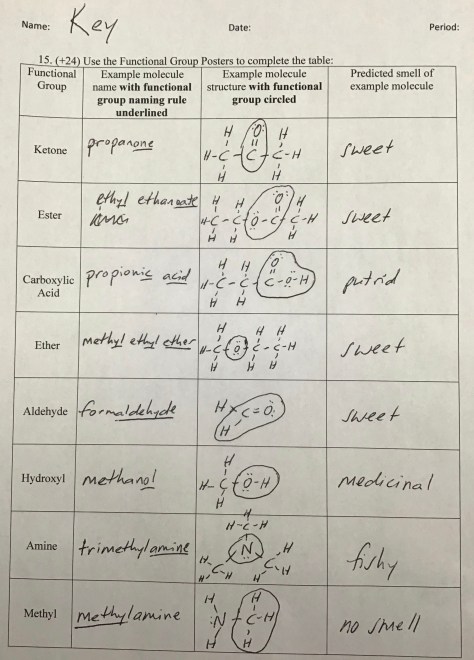
Students then gathered into Functional Group project teams and began working on the Functional Group Project. Students will have the full class period tomorrow and then may also work on Monday and Tuesday if needed while students who are finished are treated to Hunting the Elements. The posters will be utilized by the class during the Chapter 6 test.
Homework:
Read Lesson 33 in the textbook. Login via hs.saplinglearning.com and enter your username and password.
Write notes for Lesson 33 and work through the practice problems at the end of Lesson 33.
Please ask questions about anything from Lesson 33 you do not yet fully understand.



 Science with Swart
You must be logged in to post a comment.