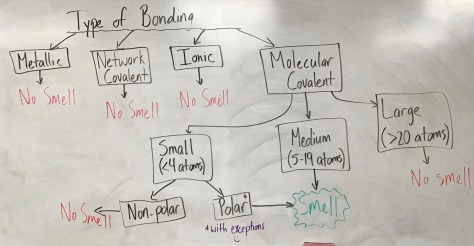
Chapter 8 concluded with the Lesson 46 PowerPoint and Lesson 46 Worksheet. Lesson 46 brought together the various concepts needed to understand how molecules with certain properties can be detected by our noses, with our brain recognizing those molecules as having a specific smell. The entry task (ChemCatalyst) asks students to model why perfume molecules can be smelled from across a room, but paper cannot (both placed near a sunny window).
Students also received a copy of the Chapter 8 Study Guide to use in preparation for the quiz on Tuesday. Work through the quiz questions on your own, then compare your answers to the key.
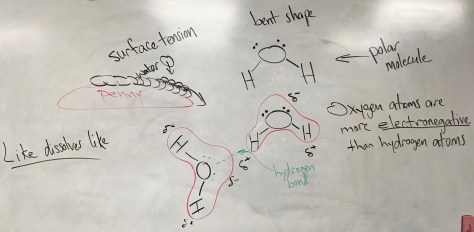
Notes from class (January 10):
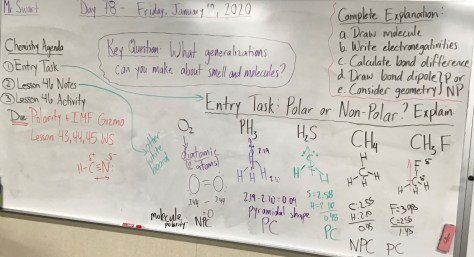
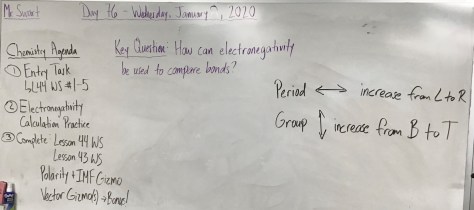
Notes from class (January 13):
Keep Learning!
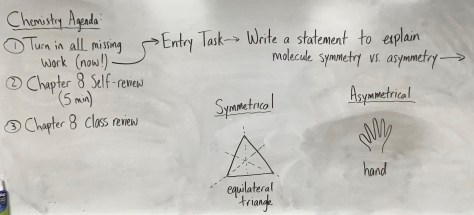
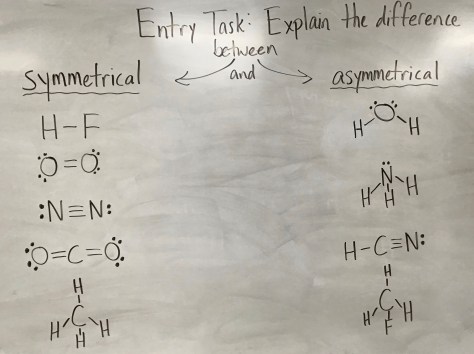
Wondering how to determine whether a molecule is symmetrical or asymmetrical? Work through the slide deck from Dr. Fred Omega Garces and focus in on slide 15. Look familiar? Students received a copy of this flow chart in class today.
Homework:
Read Lesson 46 in the textbook. Login via the Sapling website and enter your username and password.
Write notes for Lesson 46 and work through the practice problems at the end of Lesson 46
Please ask questions about anything from Lesson 46 you do not yet fully understand.
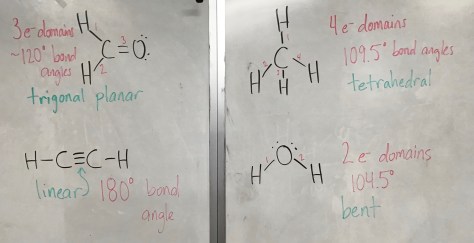
We continued our study of polarity, this time exploring how the polarity of molecules might impact our ability to smell the molecule. Through the Lesson 45 PowerPoint, students learned that polar molecules are more likely to be detected by the nose as something with a scent although there are still polar molecules (like water) that do not smell. We also visualized several molecules using a Java-based Molecule Polarity PhET simulation to give students a better sense of the concepts of electron density, bond dipoles, and molecule dipoles. Emphasis was placed on the connection between bond electronegativity and overall molecule geometry. During student work time, students cut out the molecules in the molecules handout and used the molecules to complete the Lesson 45 Worksheet.
Homework:
Read Lesson 45 in the textbook. Login via the Sapling website and enter your username and password.
Write notes for Lesson 45 and work through the practice problems at the end of Lesson 45
Please ask questions about anything from Lesson 45 you do not yet fully understand.
After learning about the concepts of electronegativity and polarity in yesterday’s lesson, students learned that scientist Linus Pauling assigned electronegativity values to individual atoms as a measure of how strongly an atom attracts electrons (click here for a deeper dive into how he calculated electronegativity). Although not used in class, the Lesson 44 PowerPoint is provided here as a resource and includes a copy of the periodic table with electronegativity values for each element. It also explains the difference in electronegativity between covalent bonds (0.5 and less), polar covalent bonds (between 0.5-2.1), and ionic bonds (greater than 2.1).
Students who finish the work early had time to complete yesterday’s Lesson 43 worksheet and Monday’s Polarity and Intermolecular Forces Gizmo. Students who are fully caught up have the opportunity to investigate vectors and may earn bonus credit for completing one or both vector-related Gizmos.
Notes from class:
Keep Learning!
Want more information about dipoles from yesterday’s lesson? Read about how dipole moments are calculated.
Monday, January 6, 2020 (HS-LS2-7, HS-ETS1-3): Welcome to the first week of school in 2020! We have a lot to accomplish, so our work today is broken down into three steps:
Step 1: Take the Continent Survey – this will inform (but does not guarantee!) group placement for our work tomorrow.
Step 2: Join Mr. Swart’s Newsela classroom. After joining the classroom, students are instructed to read the article titled, “Earth’s Systems: What is a biome?” and highlight key ideas in the article using the highlighting feature in Newsela.
Tuesday, January 7, 2020 (HS-LS2-7, HS-ETS1-3): We will extend our learning of biomes from yesterday with the Ted Ed video below (Why is biodiversity so important?):
After a brief discussion about the video, students will read the Newsela article titled, “What is biodiversity?” and and highlight key ideas in the article using the highlighting feature in Newsela..
After reading the article and completing the notes, students will learn of their continent team assignment by checking their student Gmail account. Based on data from the continent survey yesterday, students were placed into one of five different continent teams:
The first team assignment is for each team member to read the articles about the Physical Geography and Human Geography of their continent through the Newsela classroom.
After reading the articles, team members will cross-reference the content from the article with the HHMI BiomeViewer and decide as a team which biome to move forward with the research project.
Wednesday, January 8, 2020 (HS-LS2-7, HS-ETS1-3): Student groups have the class period to work on yesterday’s work.
Thursday, January 9, 2020 (HS-LS2-7, HS-ETS1-3): With the Newsela website down during class today, students had two options: complete the BiomeViewer work from Monday (required) or, if finished with the BiomeViewer work, to watch the Popped Secret video below and complete the accompanying student handout.
Friday, January 10, 2020 (HS-LS2-7, HS-ETS1-3): Today is the final day of class time for students to complete the individual work for the Continent Biome project. Students have the class period to complete the work. Any additional time should be used to complete the BiomeViewer Student Worksheet activity from Monday or the Popped Secret bonus handout from yesterday.
The BiomeViewer worksheet is due today for full credit. Late work will receive 60% max credit. The Popped Secret handout is due next Friday for bonus.
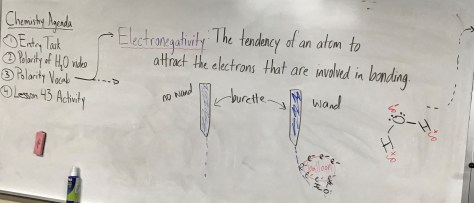
After completing the entry task on slide 3 of the Lesson 43 PowerPoint, we visualized the concept of a “charged wand” and it’s effect on polar molecules using a balloon, electrons gently extracted from the hair of a student volunteer, and a burette filled with water. Students observed water flowing straight through the burette at the beginning of the demonstration, and then saw how water was attracted to the “charged wand” when the balloon was placed close to the stream of water. Students were challenged to explain the observation using their understanding from our work yesterday (models drawn in the class notes below). Next, we watched the Bozeman Science video below about the polarity of water molecules to review, extend, and apply the learning from yesterday to real-world scenarios:
We then talked through the definitions of electronegativity and dipole, relating both concepts back to molecules of water and carbon dioxide (see class notes below). Finally, students received copies of the Lesson 43 Worksheet and accompanying cartoon to work through.
Notes from class:
Keep Learning!
Looking for more challenge? When drawn as vectors, dipole arrows allow scientists to calculate the magnitude and direction of the overall dipole of a molecule. Using vector addition, dipole arrows explain why water is polar while carbon dioxide is non-polar. Brush up on vectors and vector addition using the Gizmo simulations. Ask for one or both copies of the Gizmo handouts and grow your brain!
Homework:
Read Lesson 43 in the textbook. Login via the Sapling website and enter your username and password.
Write notes for Lesson 43 and work through the practice problems at the end of Lesson 43
Please ask questions about anything from Lesson 43 you do not yet fully understand.
Thursday, December 19: We ended 2019 with an introduction to Lesson 42: Attraction Between Molecules. For our entry task, students watched the Crash Course video below:
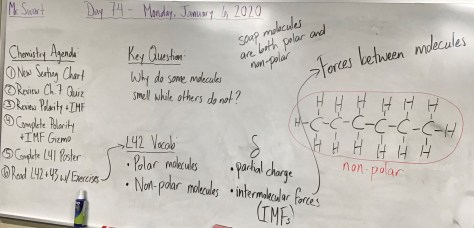
Monday, January 6: We began the year with a new student-selected seating chart. While students arranged themselves, they received back the Chapter 7 quiz from December 18. We then reviewed the quiz with students sharing out answers. Next, we reviewed the concept of polarity and intermolecular forces (class notes shown below). Finally, students had the remainder of the class period to complete the Gizmo, complete the Lesson 41 molecule poster project, and to read lessons 42 and 43 in the textbook and answer the lesson exercises.
Homework:
Read Lesson 42 in the textbook. Login via the Sapling website and enter your username and password.
Write notes for Lesson 42 and work through the practice problems at the end of Lesson 42
Please ask questions about anything from Lesson 42 you do not yet fully understand.
Students who are completely caught up should take the opportunity to review our work thus far in Unit 2, analyze their biogeochemical cycling posters (using the grading rubric), discuss ideas, and ask questions.
Tuesday, December 17, 2019: In preparation for the mid-unit 2 quiz tomorrow, we will review our work from unit 2, culminating with an analysis of the biogeochemical cycling posters.
Wednesday, December 18, 2019: Mid-Unit 2 Quiz
Thursday, December 19, 2019 (NGSS on pages 10-12): King County EcoConnections Biospheres workshop hosted by Jennifer Scales
For our final lesson of Chapter 7, we began with the TED-Ed video below to review the process of how we smell:
The Lesson 41 PowerPoint includes the key vocabulary concept of receptor site theory, where students learn the importance of molecule shape in determining recognition by receptor molecules involved in sensing smell.
Work for today (+10 assignment category bonus points for finished poster, due Monday, January 6, 2020):
Research the molecule responsible for your favorite smell. Example: limonene is the compound that gives orange peels their smell (CompoundChem has a huge list of aroma chemistry infographics)
Research whether the olfactory receptor is known for the molecule. A list of smell molecules and their olfactory receptors is located at OlfactionDB. For limonene, the olfactory receptors are coded for by the genes Olfr56 (mouse) and OR2V1 (human).
Make a poster (8.5″ x 11″ paper)! Your poster should include:
the name of the molecule
the structure
the smell
the name of the olfactory receptor (if known)
Keep Learning!
Homework:
Read Lesson 41 in the textbook. Login via hs.saplinglearning.com and enter your username and password.
Write notes for Lesson 41 and work through the practice problems at the end of Lesson 41
Please ask questions about anything from Lesson 41 you do not yet fully understand.
For Lesson 40, students worked in small groups to organize a set of 24 cards containing compounds with different shapes and functional groups. The Lesson 40 PowerPoint includes a nice graphic organizer for studying the relationship between molecule name and functional group. The Lesson 40 Worksheet and Card Sort are available for download.
Homework:
Read Lesson 40 in the textbook. Login via hs.saplinglearning.com and enter your username and password.
Write notes for Lesson 40 and work through the practice problems at the end of Lesson 40.
Please ask questions about anything from Lesson 40 you do not yet fully understand.
After completing the quiz, read and follow the steps below:
Read Lesson 39 in the textbook (pages 200-202). Use a paper copy of the text or try logging in to the digital textbook (instructions at the bottom of this post).
Write the definition for Space-Filling Model in your Chapter 7 Notes. The definition is in the glossary (page G-20).
Write a short summary of what you think are the most important things to remember from what you read in Lesson 39.
Use MolView, a free molecular modeling software program available online, to search for the molecules shown in Lesson 39. To begin, type methyl octanoate into the search bar to see the structure.
Rotate the ball-and-stick model around by clicking and dragging the molecule.
Use the Models > Representations menu and select the van der Waals Spheres option. How does the ball-and-stick model compare with the van der Waals Spheres model?
Repeat the process with the other molecules shown in Lesson 39.
Research the name of the molecule responsible for your own favorite smell. Can you find it in MolView?
Homework:
Read Lesson 39 in the textbook. Login via hs.saplinglearning.com and enter your username and password.
Write notes for Lesson 39 and work through the practice problems at the end of Lesson 39.
Please ask questions about anything from Lesson 39 you do not yet fully understand.



 Science with Swart
You must be logged in to post a comment.