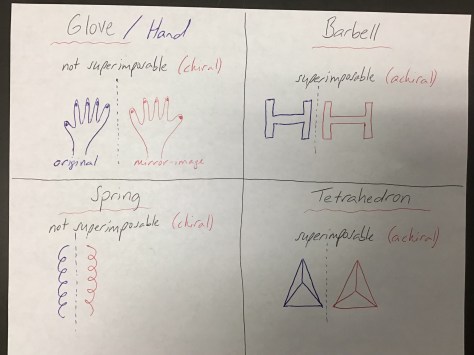
Mirror-Image Isomers

We began with the Lesson 47 PowerPoint ChemCatalyst to help get students thinking about mirror images.  We then watched a short video about chirality (below):

Students then received the Lesson 47 Worksheet, working in pairs to model the compounds using the class set of molecular modeling kits.  The worksheet concluded with students hypothesizing whether L-carvone will smell like D-carvone, and then testing their hypothesis.

Class Notes
Keep Learning!

Want more?  Check out the blog post Perhaps looking-glass milk isn’t good to drink for an overview of Lewis Carroll, looking-glass milk, and L- and D-carvone.  Want more?  Joanna Shawn Brigid O’Leary from Rice University published an even more extensive investigation of how Lewis Carroll (author of Alice in Wonderland and Through the Looking Glass) weaved biochemistry into his fiction.  Her paper (available as a PDF), WHERE ‘THINGS GO THE OTHER WAY’: THE STEREOCHEMISTRY OF LEWIS CARROLL’S LOOKING-GLASS WORLD is well worth the read.  Perhaps it will even inspire students to read the book before the movie is released in theaters on May 27!

Homework:

  • Read Lesson 47 in the textbook.  Login via hs.saplinglearning.com and enter your username and password:
    • Username: wahps****s-####### (**** = first 4 letters of your last name and ####### = student number).  Remember to include the dash between s and #.
    • Password: S-####### (the S must be capitalized)
  • Write notes for Lesson 47 on the Chapter 9 Notes handout.
  • Work through the practice problems at the end of Lesson 47.
  • Please ask questions about anything from Lesson 47 you do not yet fully understand.
Phase, Size, Polarity, and Smell

Entry Task

Chapter 8 concluded with the Lesson 46 PowerPoint and Lesson 46 Worksheet.  Lesson 46 brought together the various concepts needed to understand how molecules with certain properties can be detected by our noses, with our brain recognizing those molecules as having a specific smell.  The ChemCatalyst asks students to model why perfume molecules can be smelled from across a room, but paper cannot (both placed near a sunny window).

Homework:

  • Read Lesson 46 in the textbook.  Login via hs.saplinglearning.com and enter your username and password:
    • Username: wahps****s-####### (**** = first 4 letters of your last name and ####### = student number).  Remember to include the dash between s and #.
    • Password: S-####### (the S must be capitalized)
  • Write notes for Lesson 46 on the Chapter 8 Notes handout.
  • Work through the practice problems at the end of Lesson 46.
  • Please ask questions about anything from Lesson 46 you do not yet fully understand.

Polar Molecules and Smell

Entry Task

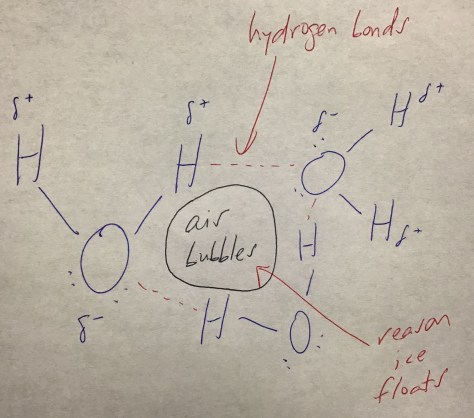
We continued our study of polarity, this time exploring how the polarity of molecules might impact our ability to smell the molecule.  Through the Lesson 45 PowerPoint, students learned that polar molecules are more likely to be detected by the nose as something with a scent although there are still polar molecules (like water) that do not smell.  Students worked in pairs to cut out the molecules in the molecules handout and used the molecules to complete the Lesson 45 Worksheet.

Class Notes:

img_0172

Homework:

  • Read Lesson 45 in the textbook.  Login via hs.saplinglearning.com and enter your username and password:
    • Username: wahps****s-####### (**** = first 4 letters of your last name and ####### = student number).  Remember to include the dash between s and #.
    • Password: S-####### (the S must be capitalized)
  • Write notes for Lesson 45 on the Chapter 8 Notes handout.
  • Work through the practice problems at the end of Lesson 45.
  • Please ask questions about anything from Lesson 45 you do not yet fully understand.

Electronegativity Scale

Entry Task

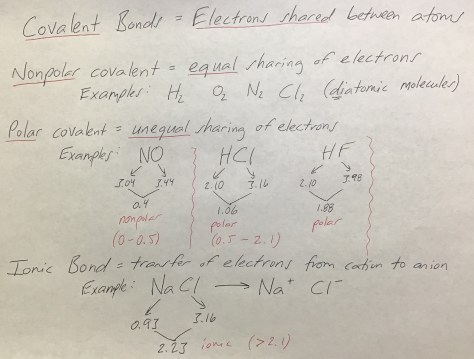
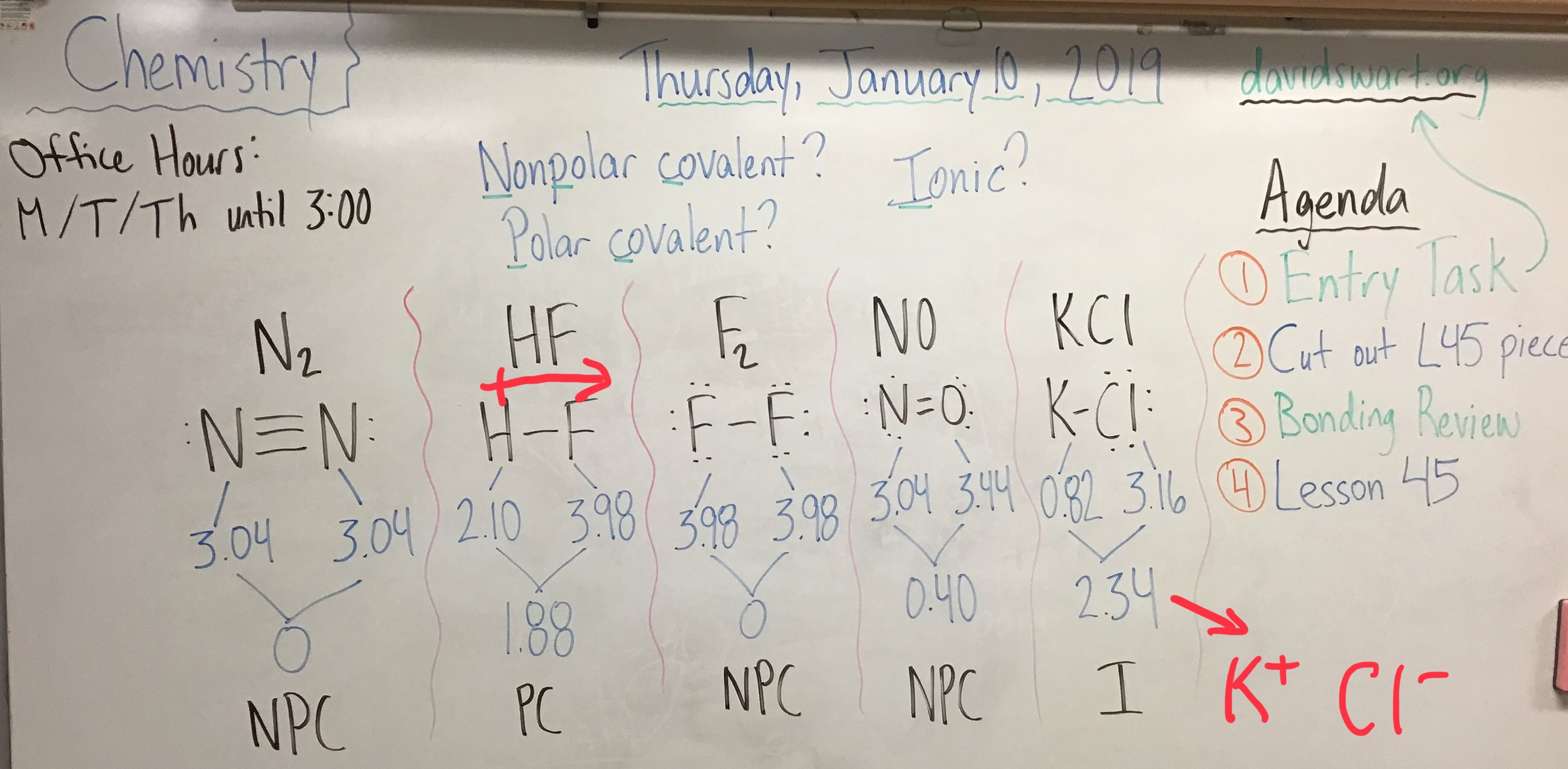
After learning about the concepts of electronegativity and polarity in yesterday’s lesson, students learned how scientist Linus Pauling assigned electronegativity values to individual atoms as a measure of how strongly an atom attracts electrons.  The Lesson 44 PowerPoint includes a copy of the periodic table with electronegativity values for each element.  It also explains the difference in electronegativity between covalent bonds (0.5 and less), polar covalent bonds (between 0.5-2.1), and ionic bonds (greater than 2.1).  The Lesson 44 Worksheet provides students with the opportunity to calculate the electronegativity difference between two atoms in a molecule and to use that information to determine the type of bond that is present between the two atoms.

Class Notes:

img_0171

Molecule Polarity Simulation:

https://phet.colorado.edu/sims/html/molecule-polarity/latest/molecule-polarity_en.html

Homework:

  • Read Lesson 44 in the textbook.  Login via hs.saplinglearning.com and enter your username and password:
    • Username: wahps****s-####### (**** = first 4 letters of your last name and ####### = student number).  Remember to include the dash between s and #.
    • Password: S-####### (the S must be capitalized)
  • Write notes for Lesson 44 on the Chapter 8 Notes handout.
  • Work through the practice problems at the end of Lesson 44.
  • Please ask questions about anything from Lesson 44 you do not yet fully understand.

Electronegativity and Polarity

Entry Task

After completing the entry task, we reviewed the results of the Graphing Practice entry tasks from the week before Winter Break.  Next, we transitioned to Lesson 43 by first watching the Crash Course chemistry video about polar and non-polar molecules:

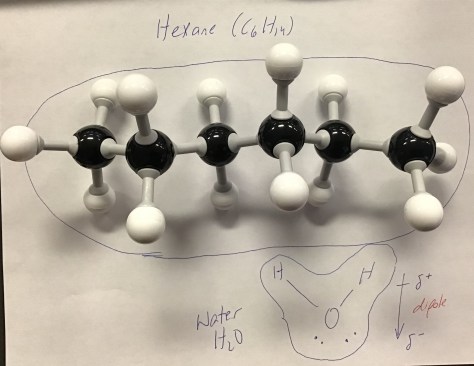
Following along with the polar bear theme, students received copies of the Lesson 43 Worksheet and accompanying cartoon.  After reading through the cartoon and working through the worksheet, we briefly worked through parts of the Lesson 43 PowerPoint and students received a copy of the periodic table that includes the electronegativity values for each element.

Notes from class:

img_0169

img_0168

Homework:

  • Read Lesson 43 in the textbook.  Login via hs.saplinglearning.com and enter your username and password:
    • Username: wahps****s-####### (**** = first 4 letters of your last name and ####### = student number).  Remember to include the dash between s and #.
    • Password: S-####### (the S must be capitalized)
  • Write notes for Lesson 43 on the Chapter 8 Notes handout.
  • Work through the practice problems at the end of Lesson 43.
  • Please ask questions about anything from Lesson 43 you do not yet fully understand.

Attractions between Molecules

Entry Task

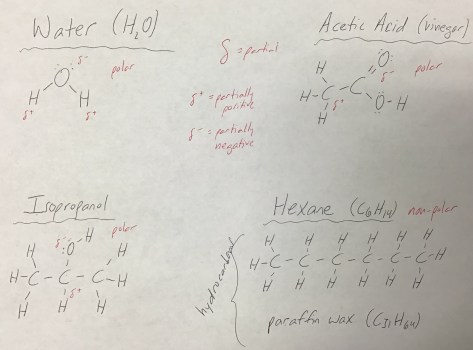
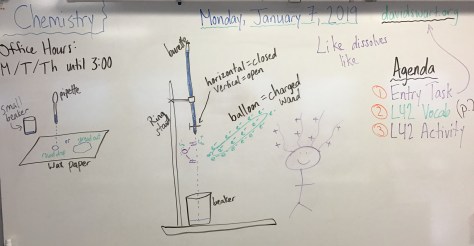
We kicked off 2019 with Lesson 42: Attraction between molecules.  Students received the Lesson 42 Worksheet and then we briefly reviewed functional groups and the concept of polarity.  The lab calls for students to observe the characteristics of water, acetic acid, isopropanol, and hexane (molecular structures are shown below):

img_0166

Notes from the whiteboard depicting the lab setup are shown below:

img_0167

Homework:

  • Read Lesson 42 in the textbook.  Login via hs.saplinglearning.com and enter your username and password:
    • Username: wahps****s-####### (**** = first 4 letters of your last name and ####### = student number).  Remember to include the dash between s and #.
    • Password: S-####### (the S must be capitalized)
  • Write notes for Lesson 42 on the Chapter 8 Notes handout.
  • Work through the practice problems at the end of Lesson 42.
  • Please ask questions about anything from Lesson 42 you do not yet fully understand.