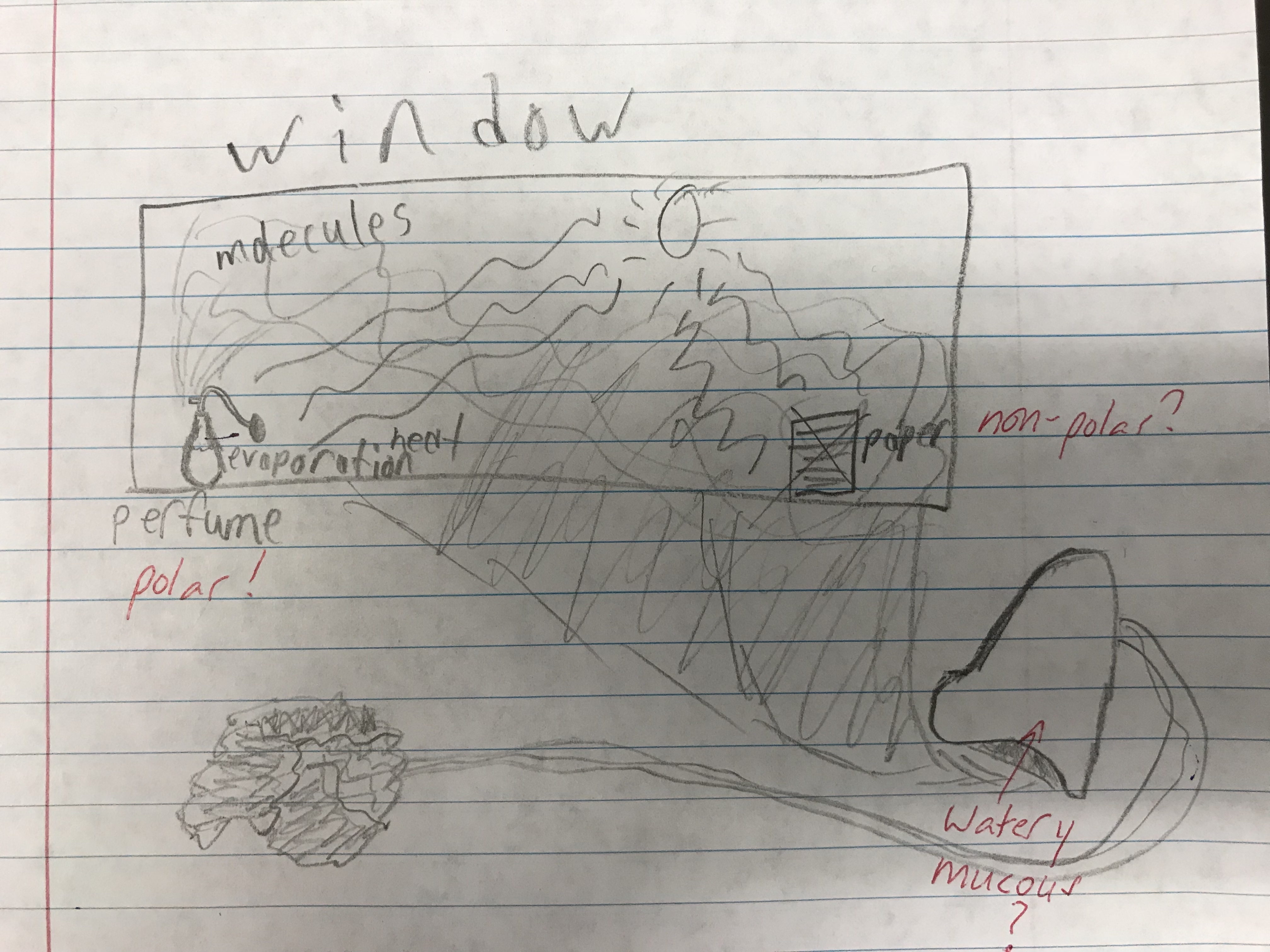
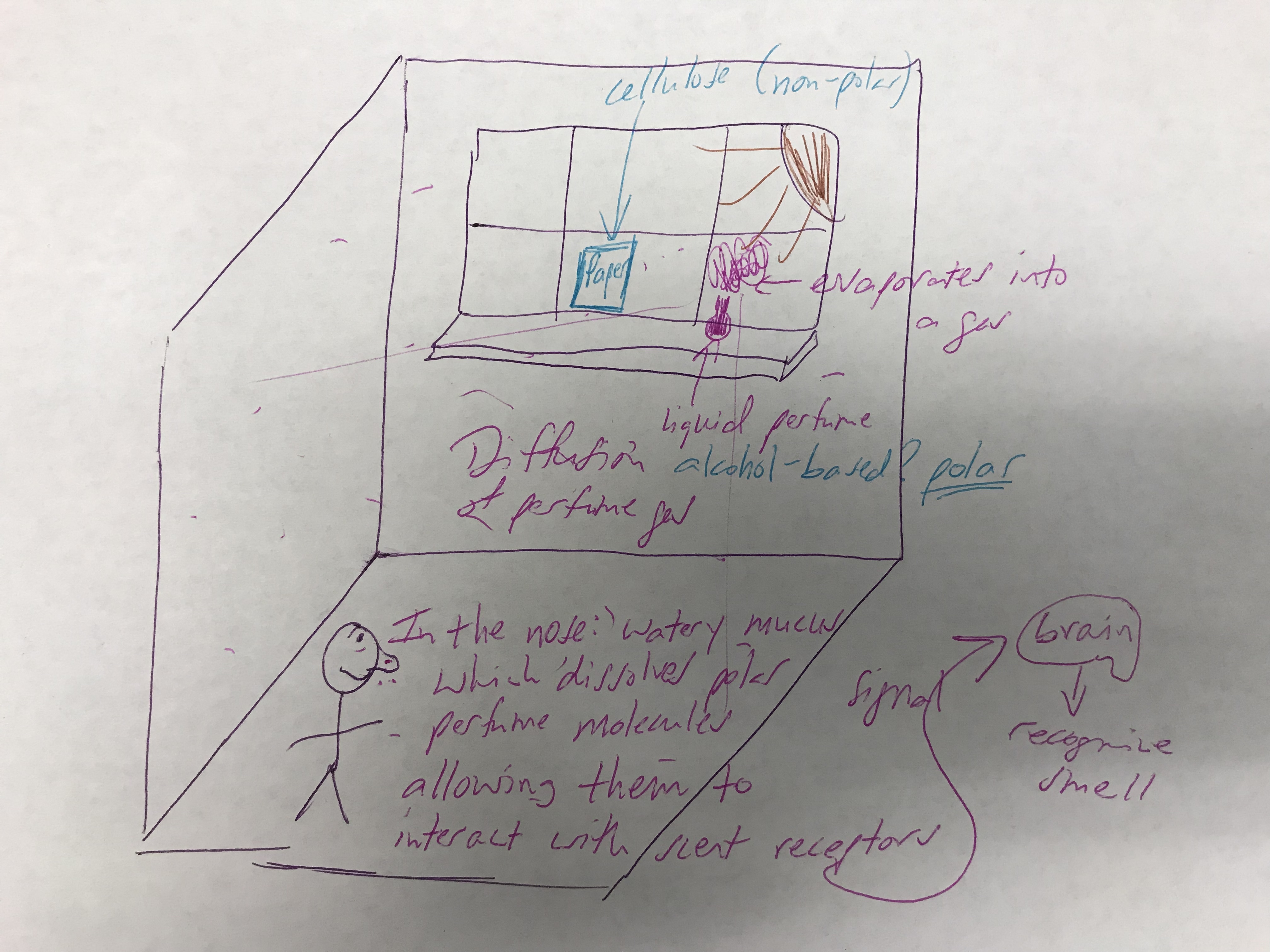
Chapter 8 concluded with the Lesson 46 PowerPoint and Lesson 46 Worksheet. Lesson 46 brought together the various concepts needed to understand how molecules with certain properties can be detected by our noses, with our brain recognizing those molecules as having a specific smell. The ChemCatalyst asks students to model why perfume molecules can be smelled from across a room, but paper cannot (both placed near a sunny window). Examples of the explanation (students and teacher versions) are provided below:
Student explanation of why we can smell perfume but not paper left in a sunny window.Teacher-drawn explanation using student-generated ideas
After the lesson, students received the Chapter 8 Quiz Study Guide in preparation for the review tomorrow and the Chapter 7/8 quiz scheduled for next Tuesday.
In preparation for the Central Dogma Quiz tomorrow, students received the Unit 4 Review worksheet to help them study and remember what we have learned about during the unit and where those resources can be located on the class website.
We continued our study of polarity, this time exploring how the polarity of molecules might impact our ability to smell the molecule. Through the Lesson 45 PowerPoint, students learned that polar molecules are more likely to be detected by the nose as something with a scent although there are still polar molecules (like water) that do not smell. Students worked in pairs to cut out the molecules in the molecules handout and used the molecules to complete the Lesson 45 Worksheet. Students who would like to explore the polarity of molecules further are encouraged to visit the University of Colorado’s PhET molecule polarity simulation (or just click below).
After learning about the concepts of electronegativity and polarity in yesterday’s lesson, students learned how scientist Linus Pauling assigned electronegativity values to individual atoms as a measure of how strongly an atom attracts electrons.
The Lesson 44 PowerPoint includes a copy of the periodic table with electronegativity values for each element. It also explains the difference in electronegativity between covalent bonds (0.5 and less), polar covalent bonds (between 0.5-2.1), and ionic bonds (greater than 2.1). The Lesson 44 Worksheet provides students with the opportunity to calculate the electronegativity difference between two atoms in a molecule and to use that information to determine the type of bond that is present between the two atoms. For homework, students are assigned questions 1-5 (odds).
Students were curious about new elements in the periodic table, so below is an article for the curious to learn more about the predicted “Island of Stability” and the theoretical upper limit in atomic number for the periodic table:
We began class with students receiving copies of their progress reports and a copy of the Lesson 43 Worksheet and accompanying cartoon. After reading through the cartoon, we briefly worked through parts of the Lesson 43 PowerPoint and students received a copy of the periodic table that includes the electronegativity values for each element.
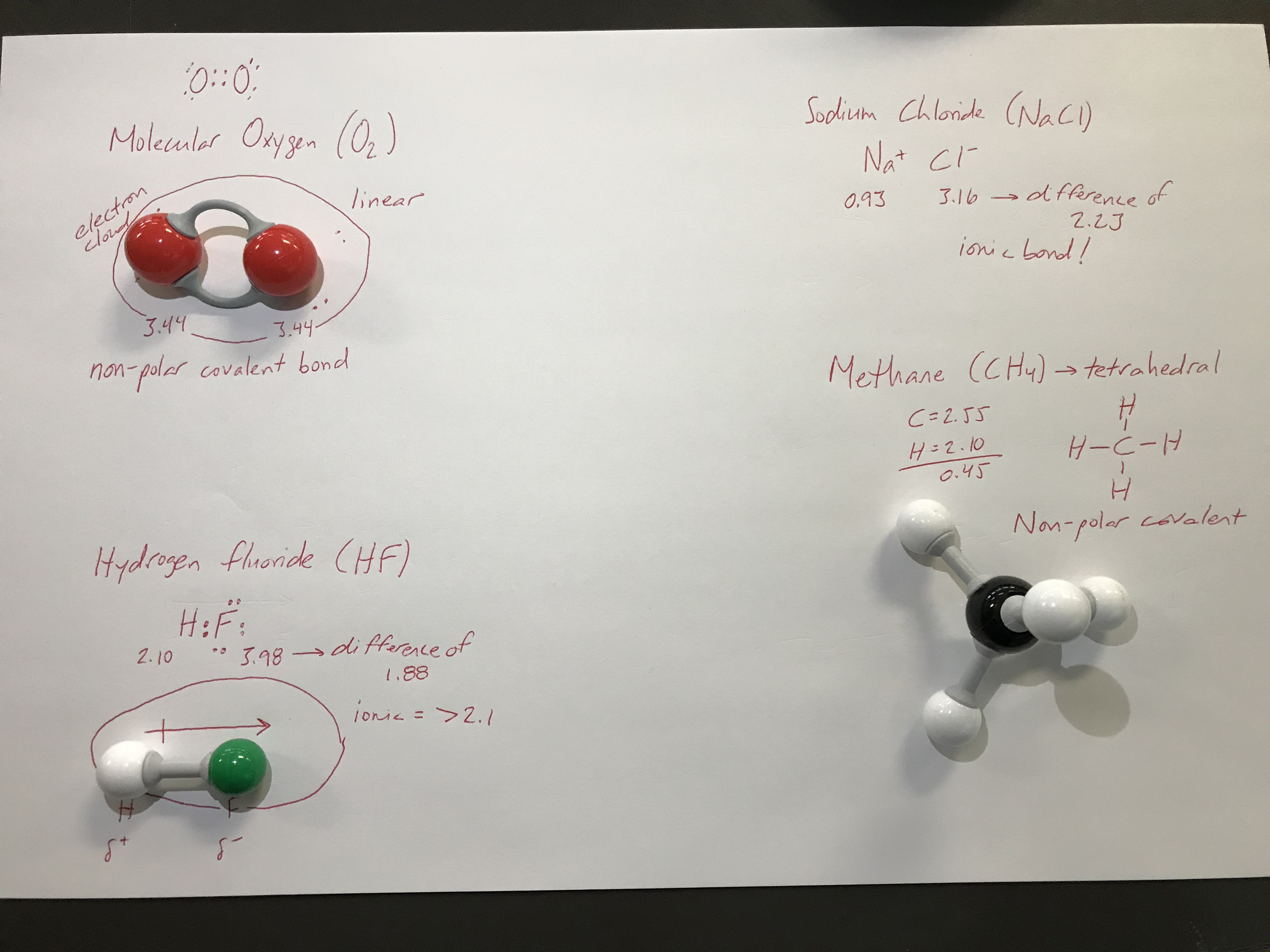
We then investigated four different molecules and discussed the connection between molecule geometry, atomic composition, and how to calculate the difference in electronegativity between two atoms. Students learned that non-polar covalent bonds have a difference in electronegativity of 0.5 or less. An electronegativity difference greater than 2.1 results in an ionic bond. Values between 0.5-2.1 result in polar covalent bonds.
For more on dipole moment, check out the Khan Academy video below:
For homework, students are assigned questions 1-4 on page 226.
As we enter our final week of Unit 4, students received a progress report, their graded quiz from Friday, and a copy of the Strawberry DNA Extraction Lab Checklist.
Students with a D or F we told that in order to qualify for an in-progress (IP) grade at the end of the semester, they need to take their progress report home, explain it to their parent/guardian, craft a plan to pass biology, and then bring the progress report back signed and with a written plan.
We briefly reviewed the quiz and most students achieved a perfect score, solving the RNA and amino acid sequences perfectly. Because there were two versions of the exam, with table partners receiving different copies, it was immediately evident if any copying occurred. Students were again reminded about the importance of academic honesty, and students who copied received a score of zero.
Next, we reviewed the lab checklist and then watched the video below to provide students with the academic learning required to explain the role of soap, salt, and isopropyl alcohol in the lab.
Finally, students who completed the New Genetics assignment were allowed to use class computers to begin writing their lab reports. Students who have not yet completed the assignment had class time to do that work. Students were reminded that the lab report is due Thursday and we have an exam Friday.
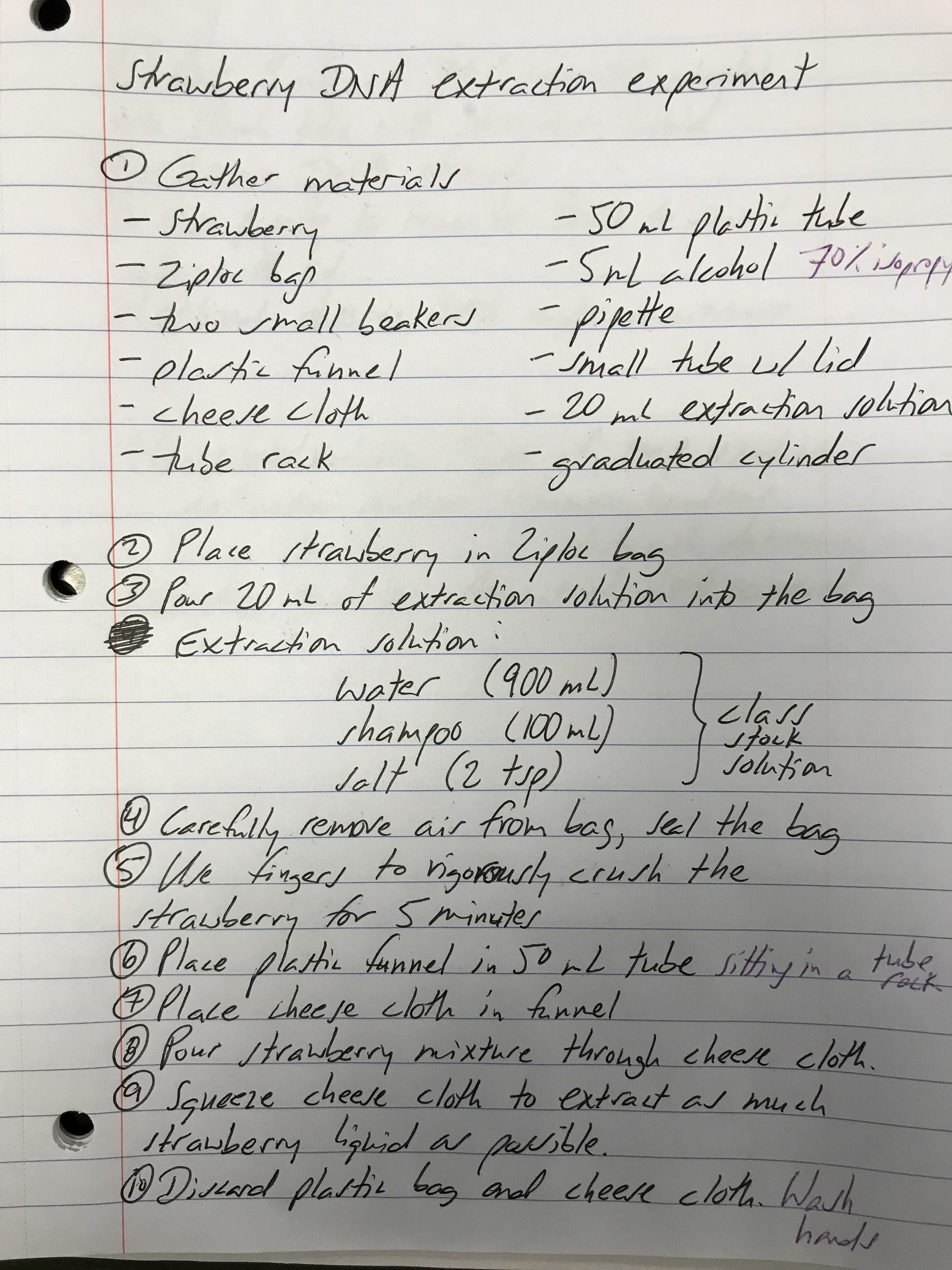
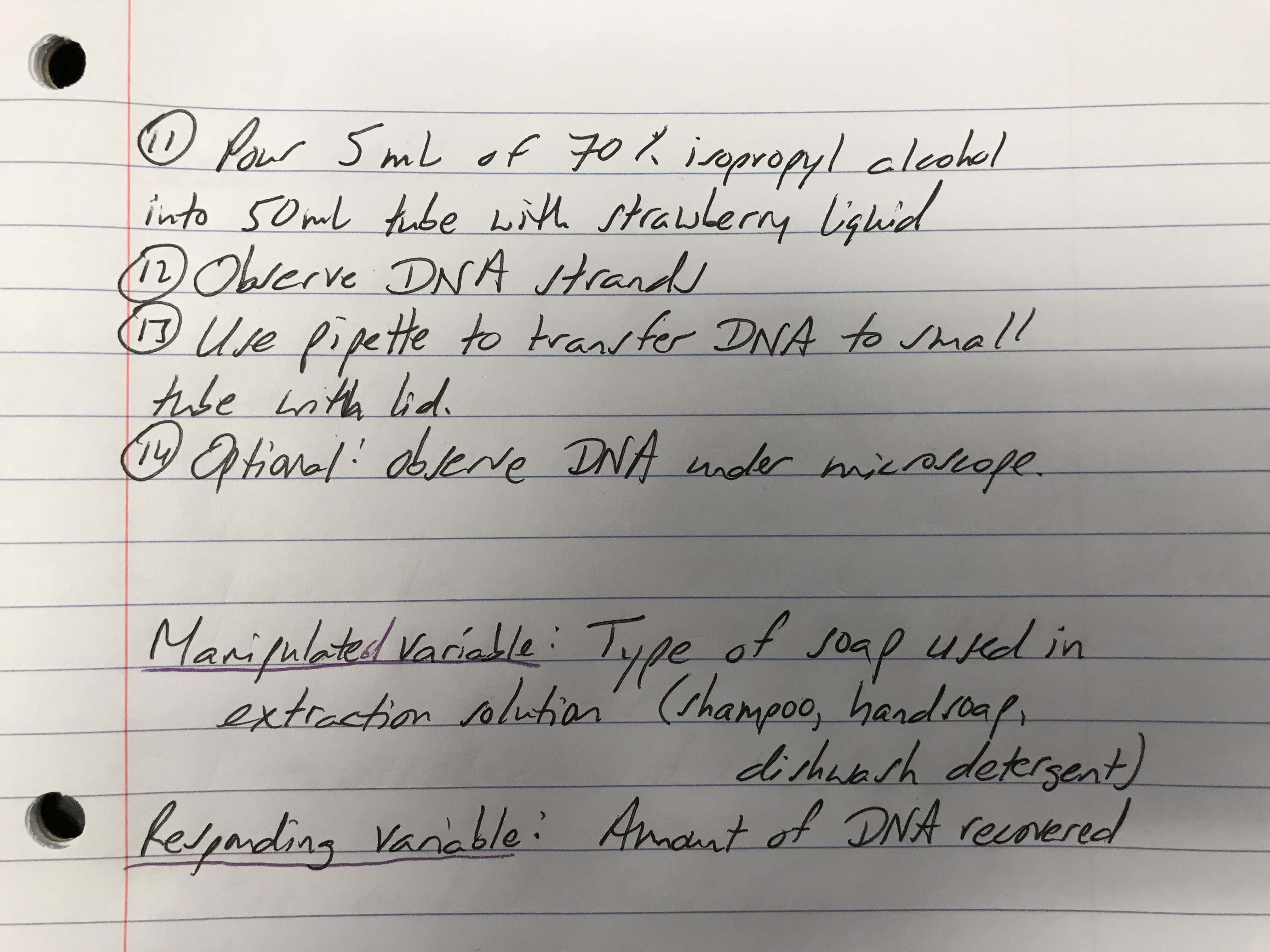
In our continued study of Central Dogma, we set our sites on extracting DNA from strawberries. To prepare for the lab, students watched two videos explaining the DNA extraction procedure (both produced by the North Carolina Community Colleges group NCBioNetwork.org). The first video, produced 5 years ago, provides students with a straight-forward approach to extracting DNA. Students watched the video and wrote down as many details as they could.
After watching the video, we assembled one class procedure “crowd-sourced” from the all of the student notes.
At the end of the second video, students learned that human DNA varies by only 0.1% from person to person. For the final segment of class, students watched a thought-provoking video about a scientist who has combined a variety of tools and technologies to turn DNA from hair into portraits using 3-D printing.
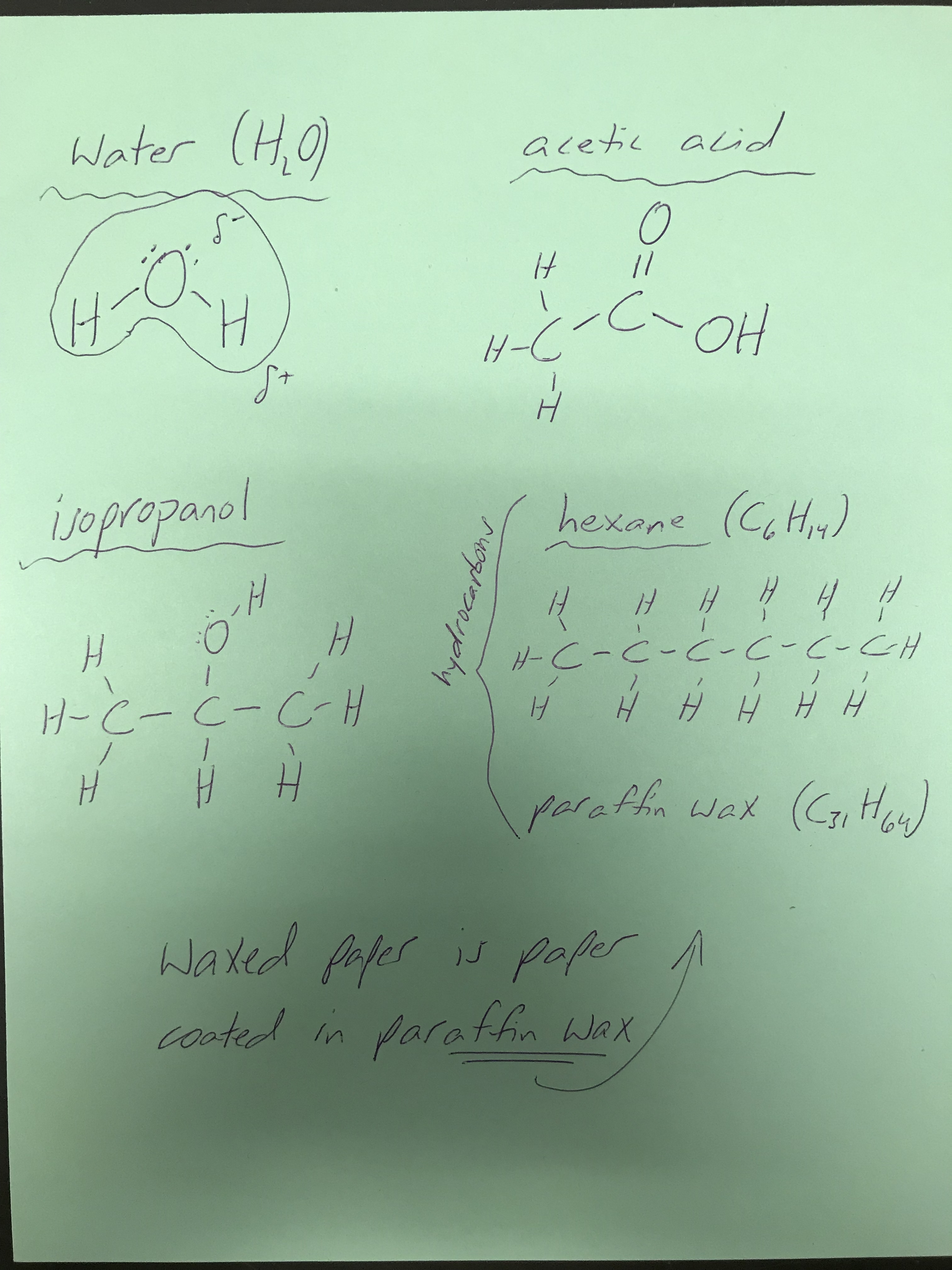
We kicked off 2018 with Lesson 42: Attraction between molecules. Students received the Lesson 42 worksheet and then we briefly reviewed functional groups and the concept of polarity. The lab calls for students to observe the characteristics of water, acetic acid, isopropanol, and hexane (molecular structures are shown below):
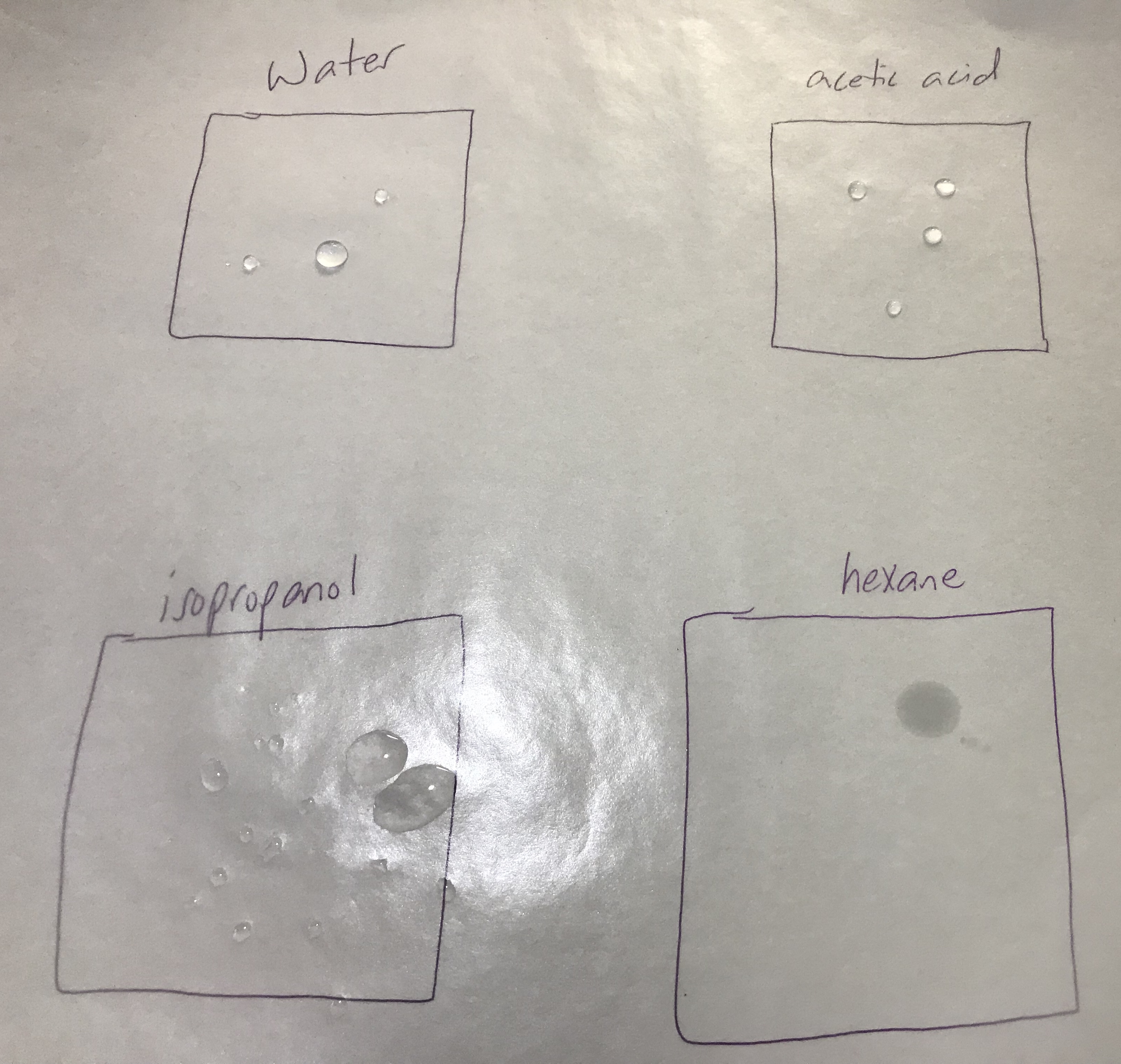
Students were tasked with writing a detailed procedure in advance of the lab tomorrow. At the end of class, we tested the response of the four test liquids when dripped onto a piece of wax paper:
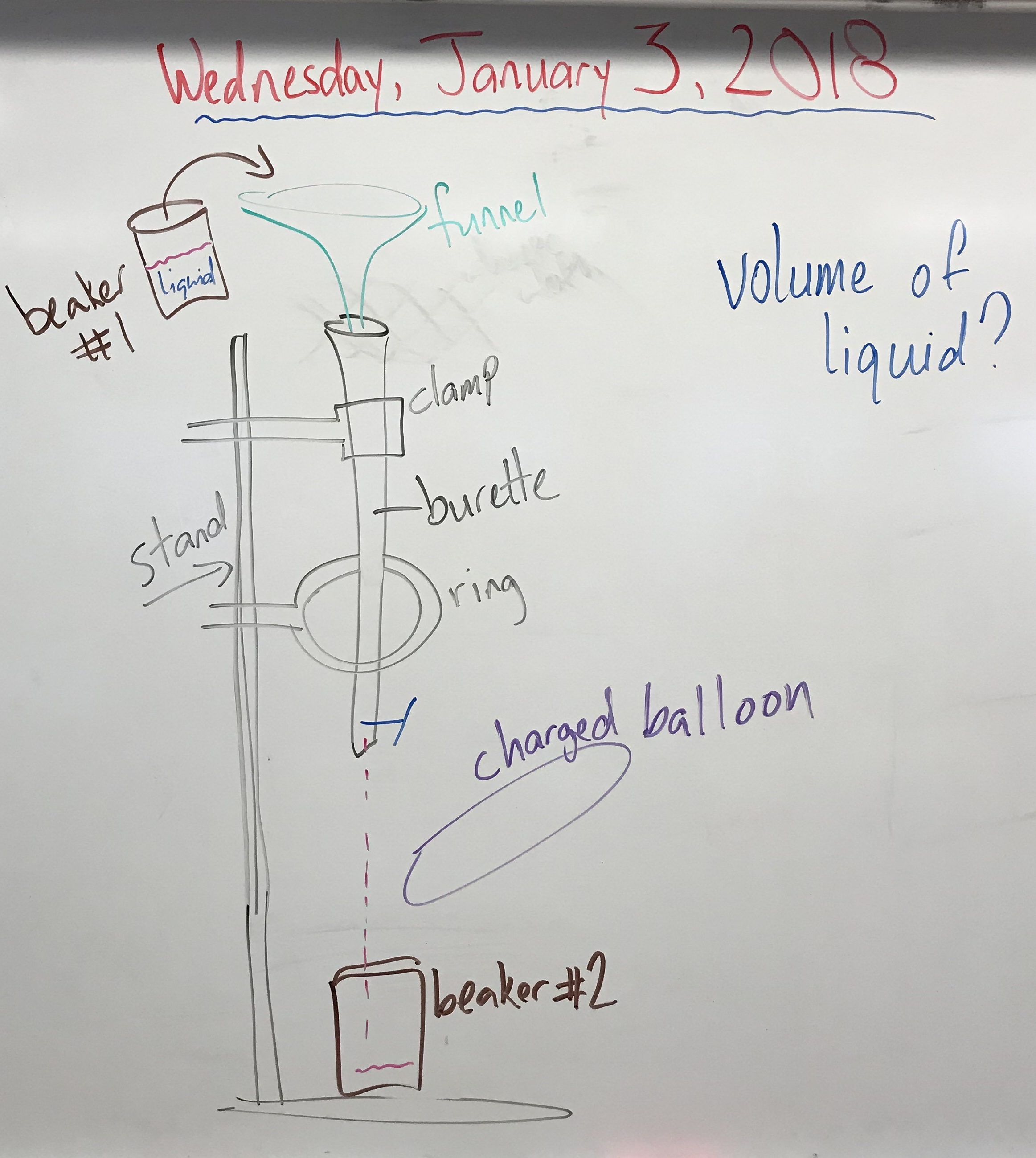
For the lab, there were four stations set up around the classroom containing all of the necessary equipment and materials to conduct the lab. Students also could use the drawing on the white board (below) to aid in their lab setup. Students had to follow their written procedures, which meant revising them a needed to actually complete the lab. Results were summarized at the end of class (water, acetic acid, and isopropanol were all attracted to the charged balloon, while hexane was not). Students realized that the acetic acid we used (36% acetic acid) contained water, as did the isopropanol (70%). To determine whether the water in both solutions might be responsible for the attraction observed, we tested glacial acetic acid (100% acetic acid) at the end of class and found it to be highly attracted to the balloon.
Students will have the final two days of the week to write lab reports (one per group). For the lab report (due Friday, 1/5):
Introduction
Procedure
Results
Discussion
Include explanation of charged balloon results
Include explanation of waxed paper results
On Thursday, to provide students with some foundational knowledge of polarity (helpful for making sense of the lab, and a concept we will encounter very soon in the textbook), we watched the Crash Course video below:








 Science with Swart
You must be logged in to post a comment.