Weather: Thermometers

We jumped into the short week with a lab designed to help students understand the relationship between temperature and pressure.  The Lesson 52 Worksheet has two parts, and we conducted the lab for part 2.  We adjusted the lab procedure as follows:

  1. Bring 200 mL of water to 80 degrees Celsius, measuring temperature with a digital thermometer.
  2. Invert a 10 mL graduated cylinder and place in the heated water for 3 minutes.
  3. Quickly and carefully move the graduated cylinder from the heated water into 100 mL of room temperature water (colored blue with 2 drops of food coloring) and quickly add ice to chill the water.
  4. Record observations throughout the experiment.

Several groups had difficulty observing the intended outcome, so I conducted a quick demonstration toward the end of class and we discussed why the results occurred.  The picture below shows cold water entering the graduated cylinder and rising above the water line.IMG_0547
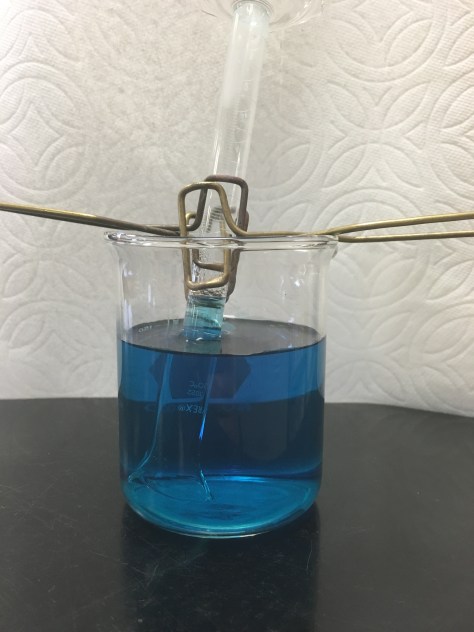
Students successfully reasoned that at the beginning of the experiment, the graduated cylinder contains room temperature air.  When placed in the heated water, the steam (evaporated water molecules) displace the room temperature air in the graduated cylinder, as evidenced by the bubbles observed leaving the graduated cylinder.  When the steam-filled graduated cylinder was transferred to the cold water, the decrease in temperature caused the steam to condense back into liquid form, and the volume of space occupied by the liquid water decreased.  As a result, cold water was drawn into the graduated cylinder.  The concepts of pressure and vacuum were introduced by students looking to explain further, and those concepts will be introduced in upcoming lessons.  For reference, the Lesson 52 PowerPoint is attached.  For homework, students should complete textbook questions 5-9 or take notes on the lesson.
Central Dogma: Strawberry DNA Lab Results

With the short class period, we briefly reviewed the science behind the strawberry DNA extraction solution by watching a segment of the video below (beginning at about the 3:00 mark):

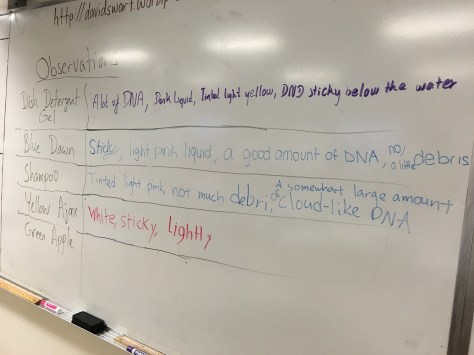
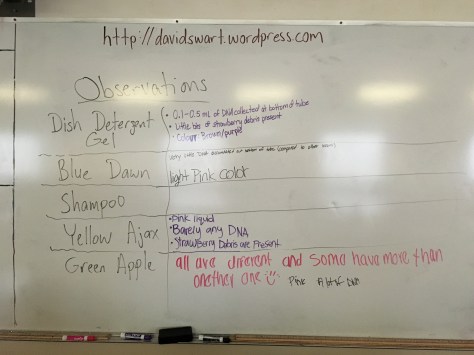
Students then located their DNA samples from yesterday.  Although our microcentrifuge stopped working toward the end of 3rd period, students had the opportunity to observe their samples and use laboratory-grade micropipettes to transfer a small volume of their DNA samples to glass slides.  The samples were visualized using our class digital microscope connected to the projector for all to see.  Students in 2nd and 3rd period were able to compare findings after centrifuging their samples, while students in 4th and 5th periods had more time to prepare and observe samples under the microscope.  Notes from the whiteboard, as well as a selection of microscope pictures (some potentially showing several DNA strand clusters and others showing cellular debris with some possible DNA strand clusters), are shown below:

File_000
Second Period Observations
File_001
Third Period Observations


Weather: Kelvin Scale

Because of the altered class schedule yesterday and the short class period today, we skipped Lesson 52 and moved ahead to Lesson 53.  We will return to Lesson 52, which involves a lab where students make rudimentary thermometers, when we return from the 4-day holiday break on Wednesday (2/17).  Today, class began with a short SciShow video about the Kelvin Scale:

After the video, students worked through the Lesson 53 Worksheet.  The Lesson 53 PowerPoint is available for review by clicking here.  For homework, students should complete textbook questions 6, 9, 11, and 12 or take notes on the lesson.

Central Dogma: Strawberry DNA Extraction Lab

With the Curriculum Fair resulting in shortened class periods, students worked incredibly efficiently in small groups to extract DNA from strawberries.  We modified the procedure written the day before such that groups of 4 students worked together to prepare 500 mL of extraction solution using one of the 5 available liquid soap products (450 mL water + 50 mL soap + 1 tsp salt).  Each student then extracted DNA from their strawberry and saved an aliquot of the extracted DNA in an Eppendorf tube labeled with the student’s initials which will be used in class tomorrow for further study and analysis.

Central Dogma: Strawberry DNA Lab Prep

In our continued study of Central Dogma, we set our sites on extracting DNA from strawberries.  To prepare for the lab, students watched two videos explaining the DNA extraction procedure (both produced by the North Carolina Community Colleges group NCBioNetwork.org).  The first video, produced 5 years ago, provides students with a straight-forward approach to extracting DNA.  Students watched the video and wrote down as many details as they could.

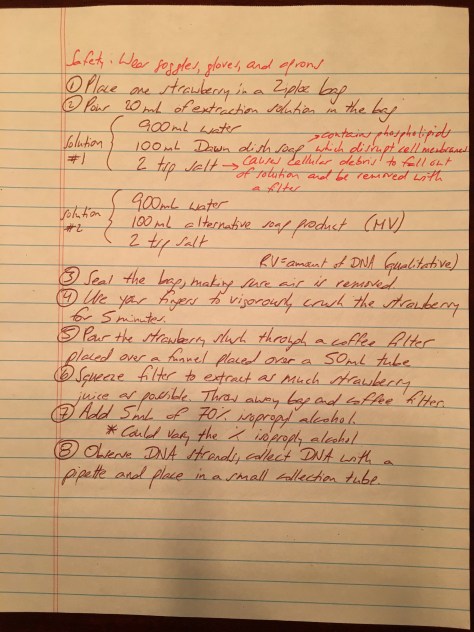
After watching the video, we assembled one class procedure “crowd-sourced” from the all of the student notes. Missing from the original video are some of the details explaining how the reagents in the extraction solution actually work. NCBioNetwork recently reduced a newer version of the video, complete with dramatic effects and a really awful script. Because the content in the newer video added to student understanding, we elected to watch and then updated the class procedure after.

IMG_0540

At the end of the second video, students learned that human DNA varies by only 0.1% from person to person.  For the final segment of class, students watched a thought-provoking video about a scientist who has combined a variety of tools and technologies to turn DNA from hair into portraits using 3-D printing.

Weather: Measuring Liquids

A huge thank you to Mr. Frank for overseeing a lab while I was away on a WABS professional development field trip to Renton Technical College.  Students worked in small groups to complete the lab outlined in the Lesson 50 Worksheet.  For future reference, students may also review the Lesson 50 PowerPoint slides that accompany the textbook reading.  For homework, students were assigned textbook questions 5-7 from the end of Lesson 50 (or notes on the reading).

Central Dogma: The New Genetics – Chapter 1

With Mr. Frank substituting, students read chapter 1 of The New Genetics.  They were tasked with defining the vocabulary terms (the words in bold) and then answering the questions at the end of the chapter.  Students were instructed to turn in their work at the end of the class period.  Students who actively engaged in the assignment will receive participation credit, and students will have additional time in a future class period to complete the assignment as it will almost certainly take longer than the class period. For students with Internet access outside of school, the book is available to read online through the NIH’s National Institute of General Medical Sciences website.  Paper copies are available through the NIGMS website as well – for free!

Central Dogma: Molecular Bonds

We spent the first part of the class period learning about the properties of water.  Students reviewed the vocabulary of molecule and atom (as in, a molecule of water consists of two atoms of hydrogen and one atom of oxygen).  We discussed the difference between covalent bonds and hydrogen bonds, with students learning about electronegativity and partial positive and partial negative charges.  We then applied that learning to the study of DNA, with students learning how the DNA bases adenine and thymine align via hydrogen bonding, and similarly with guanine and cytosine.  Students then worked in pairs to build an A, T, C, or G molecule, and then found another group with the complementary base to visualize the hydrogen bonding sites.  Students then drew out their molecule pairs, labeling the vocabulary terms of molecule, atom, covalent bond, and hydrogen bond.  Pictures from the whiteboard are shown below.  Students wishing to review the structures can see the nucleotide pairs and hydrogen bonds by clicking here.

Weather: Weather Science

We launched Unit 3 with an overview of how to make sense of the various types of weather maps used to predict weather.  The Lesson 49 PowerPointLesson 49 Worksheet, and the Weather Variables handout are available for download.  For more information about the jet stream, check out the short video below:

For weather forecast data, visit the University of Washington Atmospheric Sciences Virtual Map Room.  Lesson 49 textbook questions 1, 2, and 6 were assigned as homework.  To help connect the concepts of temperature, volume, and pressure, we also watched Kevin Delaney performing on Jimmy Fallon: