Mitosis: Modeling mitosis

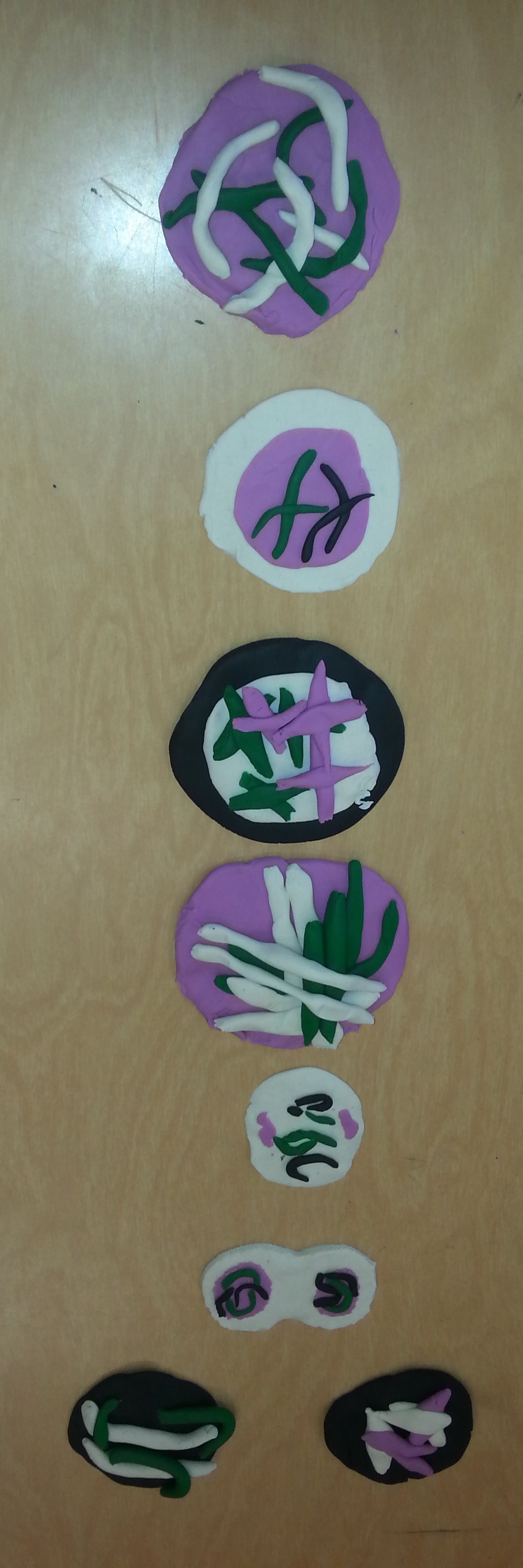
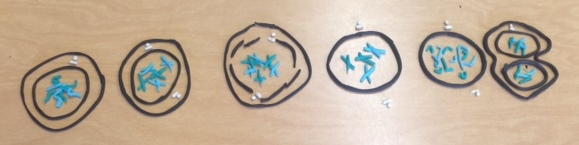
After assembling into project groups of 3-4 students, groups were tasked with modeling the process of mitosis using Play-Doh.  Students documented their work by taking pictures (extra credit for stop-motion video) and emailing them for posting on the class website.  The modeling activity served to help the team bond and identify team member strengths.  After modeling mitosis, students set their sites on the Mitosis Project worksheet.  Teams were tasked with researching the 12 available project options, picking their top 4 project selections, and then explaining why they should get their top pick (in the event of multiple groups picking the same topic).  Tomorrow, groups will receive their project assignments and begin working on the project.  Student work examples from the mitosis project are shown below:
IMG_5905

IMG_1480

Mitosis

Mitosis: Introduction to mitosis – Day 2

We kicked off the class period with an engaging science video from Late Night with Jimmy Fallon:

We then launched in to a continuation of Friday’s introduction to mitosis (click here for the slides).  Students reviewed their notes from the reading to discuss the entry task.  Next, students learned some key vocabulary terms for understanding and discussing mitosis.  Finally, we ended class with a Crash Course video about mitosis:

Students interested in learning more about the molecular biology of mitosis should check out this TED Talk from Drew Berry:

Mitosis: Introduction to mitosis – day 1

Today we launched into the study of mitosis by reading the first several pages of chapter 4 (Cellular Reproduction: Multiplication By Division) of Inside the Cell.   With the short class periods today, students were tasked with reading pages 46-51 and answering the following questions in their lab notebooks:

  1. Explain the purpose of mitosis.
  2. Which cells undergo mitosis?
  3. Describe the phases of mitosis in detail (words and drawings).
  4. Explain what happens when cells divide uncontrollably.  List the known causes of uncontrolled cell division.

This unit is focused specifically on NGSS Standard HS-LS1-4Use a model to illustrate the role of cellular division (mitosis) and differentiation in producing and maintaining complex organisms.  Students have previously been assessed on their understanding of how cellular expression of specific gene products (proteins) can result in unique cell types, and groups of unique cell types can form tissues.  Students learned about body structure and organization during Unit 3, including the organization of cells into tissues and organs.  In this mini-unit, students will be able to clearly connect the process of mitosis (cell division) with tissue organization and organism development.

Mitosis: Biology EOC practice exam

Students had the entire class period today to take a Biology EOC practice exam.  Please review yesterday’s post for additional details. Students received 50 points for demonstrating solid and sustained effort throughout the exam.  The following information was displayed on the overhead throughout the class period:

  1. This is a practice exam
  2. Treat it exactly like the real exam:
    1. No talking
    2. No other resources (notes, phone, people, etc)
    3. Be respectful of all others in the room
  3. Do your best
  4. You receive credit for solid and sustained effort
  5. Finish early?
    1. Complete Chromosome Presentation
    2. Extra credit reading under back window

Mitosis: Jeopardy! game – review of units 1-5

Before we begin our next unit (mitosis), we took a step back to review how far we’ve come during our first five units of biology this year.  To review, we played a PowerPoint version of Jeopardy!  It was a lot of fun watching students work in small groups to arrive at their responses to the questions.  The game template was provided to me by another teacher and may be used and/or modified as desired by any interested users.

Tomorrow, students will be taking a practice biology end-of-course exam designed to introduce them to the rigor of a full exam but within the time constraints of a class period.  The real exam does not have the same time constraints.  Students will not be able to use any other resources while taking the practice exam.  They will receive participation credit for taking the exam, not for how well they do.  In fact, students will identify themselves by student number, an identifier that provides anonymity during the scoring phase of the exam.  While some level of test anxiety is inevitable, I want to emphasize that this exam is solely for practice and self-assessment purposes.  Students should come away with a deeper understanding of their current level of knowledge about biology, gaps in knowledge, appreciation for EOC test structure, and a plan to fill knowledge gaps.  Please get a good night’s sleep, eat breakfast, bring a snack if needed, and come prepared and focused.  We will score the exams on Wednesday and then launch the mitosis unit on Thursday.

Central Dogma: Chromosome Project – Reflection

Due to our aging technology infrastructure, many students were unable to complete their chromosome projects on Wednesday.  With all science teachers together at a district-wide meeting, the substitute will provide students with the following work options:

In order of priority:

  1. Complete the Chromosome Project and email it to me (the PowerPoint and Activity Logs).
  2. Complete and turn in Chromosome Project reflection worksheet (copies on table under blackboard).
  3. Complete and turn in Unit 4 exam and Unit 5 quiz revisions.
  4. Check grades in Illuminate, identify missing assignments, locate missing assignments on the class website, print the work, complete it, and turn it in.
  5. Complete extra credit reading.

Central Dogma: Chromosome Project – Day 4

Today is the fourth and final day of working in the computer lab on the Chromosome Project.  Please download and complete the Day 4 Activity Log.  Students who complete the project before the end of the class period should share their expertise with classmates who would benefit from some additional help.  Remember, the purpose of this project is for each student to identify one disease caused by one gene on one chromosome.  Students are gaining a vast array of skills, including:

  • Using NCBI to research chromosomes, genes, and proteins;
  • Effective using the Internet searches research human diseases or conditions caused by inappropriate gene expression;
  • Applying project management skills to break down a large project into smaller units (the daily activity logs);
  • Working with Microsoft Word and PowerPoint to document and share learning;
  • Self-sufficiency by visiting the class website daily, and then reading and following complex written instructions;
  • Teamwork by sharing learning strategies with classmates working through similar learning challenges.

I am very proud of the work I have seen students accomplish over three short days.  Students have been presented with a variety of scheduling challenges, and several have also dealt with technological challenges.  I am impressed with the perseverance of my students and look forward to seeing their finished projects.

**Update: Because of the continued technology challenges, the final PowerPoint project is now worth 50 points, with additional credit awarded for presentations (+10 extra credit) and group participation (+10 extra credit) during presentations.  The reflection assignment (+10) was separately graded as well.