
With multiple students scheduled to take both the Algebra and Geometry EOC exams tomorrow and Wednesday, followed by the Biology EOC on Thursday, today was the final day available for a whole-class content review. We used the class period to play a special biology edition of Jeopardy! Students partnered with one or two other students and they worked together as a group to answer questions using white boards. With only 45 seconds to answer each question, students had to draw primarily from content they have already mastered. Several of the questions came directly from previous Biology EOC practice exams, with the intent to prepare students as well as possible for what they will experience on Thursday (although they will not have notes available to consult during the exam).
Category Archives: Uncategorized
EOC Review: Review of Units 1 and 2
To help prepare students for the Biology End of Course exam, students received two different practice worksheets. By treating the cell organelle matching worksheet (page 1) as a quiz (no talking, no cell phones, no collaboration), students were able to self-assess their preparedness for that section of the EOC. After about 15 minutes of private think time, we reviewed the answers as a class. Students were then tasked with answering the cellular respiration and photosynthesis questions on the back of page 3 of the worksheets. Again, we reviewed the answers as a class after some quiet work time (pictured below). Finally, we concluded with 15 EOC-style questions (13 multiple choice and 2 short answer) that reinforced the organelle practice. Students were then encouraged to review the organelles at home, and blank note cards were offered to students who want to make flash cards as a review tool.

Evolution: Creating Phylogenetic Trees from DNA Sequences
For today’s lesson, visit the HHMI Creating Phylogenetic Trees from DNA Sequences and work through the Click and Learn activity in order to complete the worksheet packet.
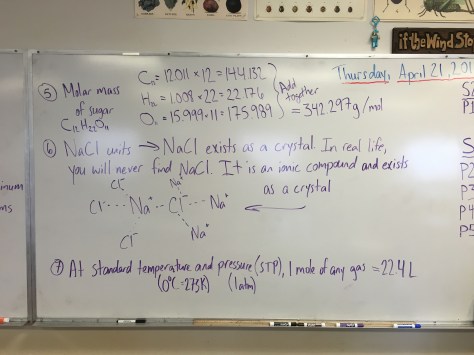
Toxins: Molar Mass
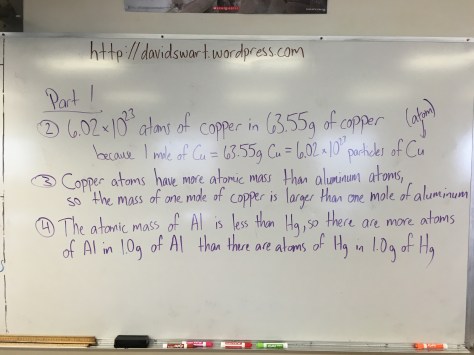
Today’s work began with the ChemCatalyst from the Lesson 77 PowerPoint. Students considered the question for a few minutes and were once again reminded how abstract the idea of the mole really is. To help bring the concept of the mole to life, students worked through the Lesson 77 Worksheet. The worksheet consisted of two parts, with Part 1 asking students to work through some of the math behind calculating molar mass. Then in Part 2, students participated in a lab activity where they were able to actually measure out and visualize what one mole of various materials look like. Students worked with water, table salt, aluminum, nickel, and iron. For homework, students were assigned textbook questions 5-7.
Answers for Part 1 are shown below:
Toxins: Conservation of Mass
We kicked off 4th quarter with Lesson 71 – a review of the Law of Conservation of Mass. We briefly reviewed the Lesson 71 PowerPoint and then students had the remainder of the class period to work in groups to complete the lab described on the Lesson 71 Worksheet.
Variation and Inheritance: Introduction to Meiosis
We launched Unit 4 with an introduction to the concept of meiosis. We began with a Crash Course video about heredity (below) and then followed that with a reading assignment. Students completed the reading from Chapter 4 of Inside the Cell (pages 52-59), answering the “Got It?” questions on page 59 in their lab notebooks.
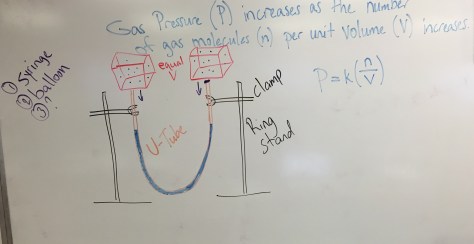
Weather: Pressure and Number Density
Happy Pi Day! We began class with a SciShow video about Pi (below) and students received an additional 20 minutes to finish the Chapter 11 quiz from Friday. We then moved into Lesson 63, the first lesson of Chapter 12. Students received copies of the Lesson 63 Worksheet, a companion handout with information connecting air pressure and temperature, and a calendar detailing lessons, assignments, and tests through the end of March. Students are also welcome to review the Lesson 63 PowerPoint. A picture of the white board with notes about the lab are also provided below.
Mitosis: Mitosis Project
Today students launched in to the Mitosis Project. The project outline can be viewed here. Below are some resources for groups as they begin conducting research on their topic:
- Mitochondrial replication
- Chloroplast replication
- Binary fission in bacteria
- Muscle growth and repair
- Epigenetics and regulation of gene expression
- Homeobox genes in embryogenesis
- Limb regeneration in newts and salamanders
- C. elegans cell fate mapping
- Cancer and metastasis
- The effect of smoking on lung cells
- The effect of alcohol on liver cells
- Retrovirus infection
Additional information for each project topic can be found on the Mitosis Project Resources page. Remember to cite sources using APA format – Citation Machine can help simplify the process.
Central Dogma: Chromosome Project
Update: March 2
Today marks the final day of class time for working on this portion of the Chromosome Project. After our entry task, students who have completed the project will be offered the opportunity to present their work to the class for feedback. For those who finish early, please complete The New Genetics reading assignment (Chapter 1) from February 9. When that assignment is complete, the next reading assignment is Chapter 4 from Inside the Cell (define vocabulary words in bold and answer the questions at the end of the chapter). Notes from the entry task are shown below:


Update: March 1
A complete presentation will have the following sections:
- Information connecting Chromosome, DNA, Gene, Protein, and Trait (Disease/Condition)
- Information about Disease/Condition
- Researcher = Your Name
- Research connection between Gene and Disease/Condition
- How is the disease/condition inherited? Are the genetics known?
- Update references in APA format
Use the Citation Machine website to help you cite your sources using APA format. Sources need to be referenced on the last slide of the Google Slides document you are working on.
Original Post: February 25
Welcome to the Chromosome Project! Yesterday you had the opportunity to research one or more genes known to be involved in a genetic disease or condition of interest to you. You then located the gene on a particular chromosome.
Now your work begins! Your mission today is to learn as much as you can about the gene you identified yesterday. Record your findings in the Daily Log located in Google Classroom.
To research your gene, visit the NCBI Human Genome Resources page and enter your gene name into the “Find a Gene” box on the left panel. Be sure to select “homo sapiens” in the pull-down box. When the search completes, click on your gene name (typically the first gene on the list) and browse through the entry. There is a ton of information provided! The length of the gene can be found by hovering your mouse over the top green line under the “genomic regions, transcripts, and products” and looking for the number after the word “length.” The length of the amino acid sequence can be found by clicking on the word “protein” on the right hand side of the page under Related Information. Browse the entries for the full-length protein and note the number of amino acids in the protein. The full-length protein can be challenging to find: look for an entry that does not include words like truncated, isoform, predicted, synthetic construct, or unnamed protein product.
Another great website to visit to learn more about specific genes is GeneCards.org. Just type your gene name into the “Explore a Gene” search box and appreciate the power of the Internet! NCBI PubMed contains a huge database of scientific papers – search for your gene and see what articles are out there.
You can use all of this information to edit the Chromosome Project Template Slides also located in Google Classroom. If time permits, continue researching the disease/condition you selected. Your goal is to learn what you can about what the disease/condition is and how it is inherited.
Welcome to research! Use your time well and challenge yourself to learn new things!
Weather: Chapter 10 Quiz
In preparation for the Chapter 10 Quiz, students worked together as a class to answer the Chapter 10 practice questions at the end of the chapter. Pictures of their work written on the whiteboards are shown below:


Students may use one page of notes for the quiz. After the quiz, students will prepare for tomorrow’s activity (they will have a substitute teacher) by writing a procedure for how to measure the interior volume of our classroom, taking into account the volume occupied by fixed structures.
 Science with Swart
You must be logged in to post a comment.