We took a quiz designed to reinforce student learning about the processes involved in evolution. After, students had the opportunity to complete any late work or watch the video below:

We took a quiz designed to reinforce student learning about the processes involved in evolution. After, students had the opportunity to complete any late work or watch the video below:
We have entered the Math EOC testing period (Geometry today, Algebra tomorrow). Students attend periods 1-3 today and 4-6 tomorrow afternoon, following the SBAC testing bell schedule.
Today, students watched the HHMI Biointeractive video titled Evolving Bodies, Evolving Switches (watch below). The video explains how the stickleback fish has evolved and adapted to its environment, and shows how scientists are using genetics to further understanding of evolution as well as developmental biology. After watching the video, students completed a worksheet to reinforce and extend their learning.
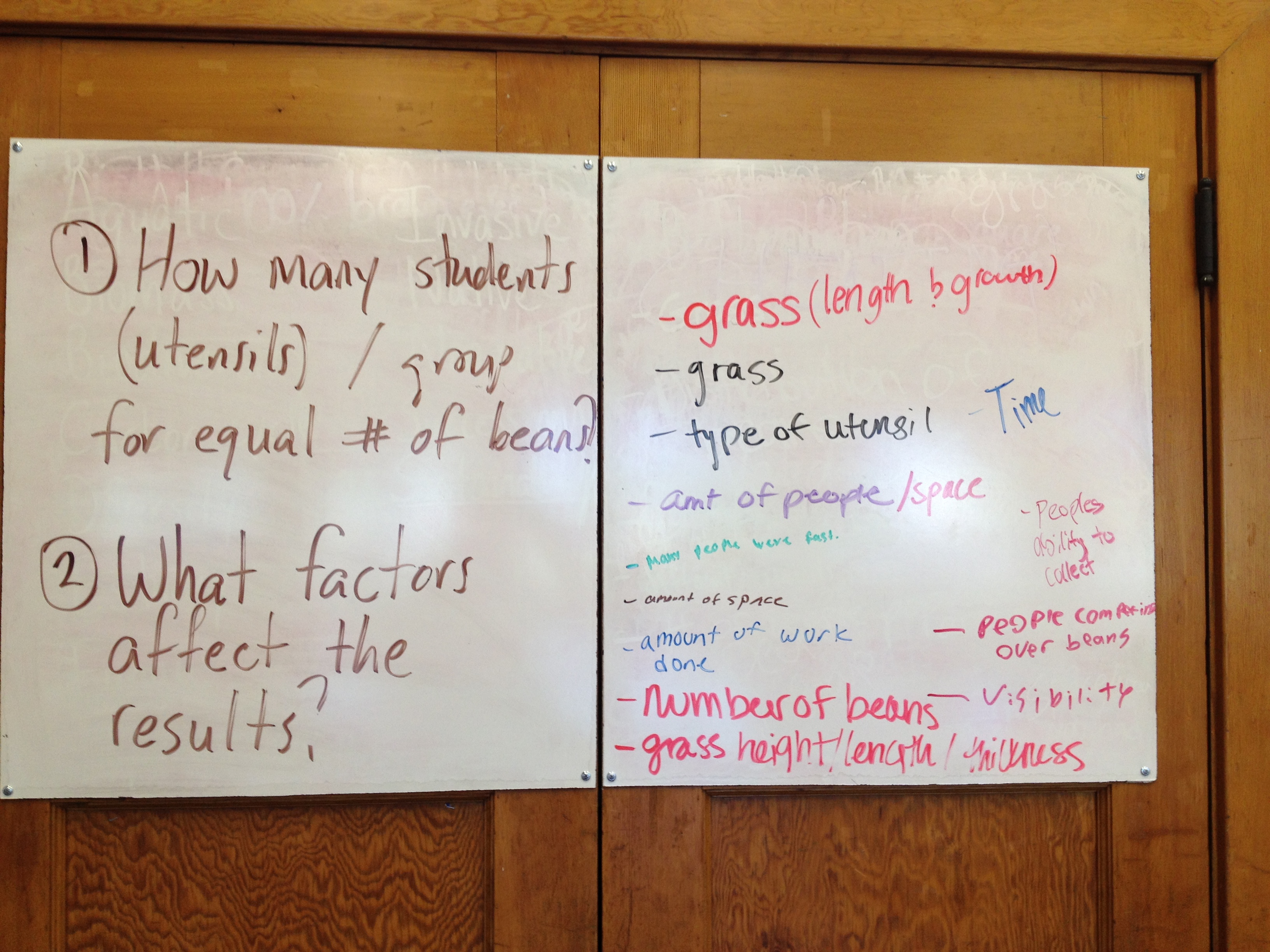
Taking advantage of the beautiful weather, we spent the first half of class outside today playing an evolution bean game. The class was divided into thirds, with one-third of students receiving a plastic fork, spoon, or knife. All students received a plastic cup. The cup served as the “mouth” and the eating utensil was the “hand”. One bag of 1000 pinto beans was scattered in a section of the front lawn, and students had to move the beans from the ground to the cup using only the utensil. After two minutes, the students gathered in their utensil groups and counted the total number of beans collected. We repeated the activity again, changing the number of students with each utensil and collecting additional data. We then went back into the classroom and analyzed our results. Students calculated the average number of beans obtained by each group member, the average number of beans available to each group, and how many students it would take with each utensil to obtain the average number of beans available to each group. Students then thought about the factors that affected the class results, sharing their ideas on the white board (below). Finally, students were challenged to improve the game, writing ideas for how to evolve the bean game and make it even more engaging for all students.
With many my students off-site today taking the AP History exam, students in class had time to complete The Beak of the Finch worksheet from yesterday, catch up on late work, review how to write EOC-style conclusion statements, and study from the biology EOC review booklet students received last Friday.
After some great discussion around evolution, pseudogenes, and the reactivation of the gene encoding teeth in chickens, we started off the lesson with a TED Talk from Jack Horner: Building a dinosaur from a chicken. Students engaged in a spirited debate about the ethical considerations around tinkering with genetics. We then transitioned to the HHMI Biointeractive video: The Beak of the Finch. Students received a copy of the student quiz to work on in class and to either take home and complete as homework (for students taking the AP History exam tomorrow) or to complete in class tomorrow.
Today we made the connections between DNA mutations and evolution. Students took notes from PowerPoint slides and then watched an HHMI Biointeractive video titled “The Birth and Death of Genes” and completed some multiple choice questions on a worksheet.
As an introduction to our final unit this year, we watched Cosmos, Episode 2: Some of the Things That Molecules Do. Students responded to worksheet questions while they watched, and the worksheet is due tomorrow at the beginning of class for full credit. Late work will now be accepted for 65% credit. The entire Cosmos series is available streaming on Netflix, and Netflix offers a one month free trial for students who do not currently subscribe.
Reminder: Biology EOC review sessions will be held tomorrow (5/12), Thursday (5/14), and the following Tuesday (5/19) in my room after school from 2:20-3:30. Students are also encouraged to continue working through the EOC study guide that went home with them on Friday.
After a brief review of genetics yesterday, today we are studying evolution. Here are resources that will be helpful during the day:
How many human cells are in the human body? 37.2 trillion! Read more here.
There are 10 times more bacterial cells in your body than human cells! Read more here.
HHMI Biointeractive: Creating phylogenetic trees from DNA sequences
In lesson 9, our first lesson of the week, we circled back to osmosis, a concept students learned about early in the school year. We connected the theme of “Water Follows Salt” with the reality that cell membranes contain pores and channels that regulate the flow of everything across the cell membrane. We discussed the vocabulary of osmosis in the context of blood, recognizing that blood cells in plasma (isotonic) behave much differently than blood cells in water (hypotonic) or in saltwater (hypertonic). We then thought about how salmon might be able to transition from freshwater to saltwater during their life cycle. By connecting pore protein expression (via the Central Dogma) with evolution, students now have the foundation necessary to explain how salmon can hatch from an egg fertilized in a freshwater stream, migrate through the brackish waters of an estuary out into the Puget Sound, travel for years in the salty Pacific Ocean, and eventually find their way back to the steam from which they were born to complete their life cycle. We wrapped up with a video about ice cave exploration, in which the concept of extremophiles was presented. Students then transitioned to Work Time where they read an article and answered questions about extremophiles.
To better understand how DNA mutation drives evolution, students worked through the HHMI’s BioInteractive lesson titled Creating Phylogenetic Trees from DNA Sequences. Students completed the accompanying PDF worksheet prepared by HHMI.
The Evolution mini-lesson concludes on Friday. Students will have all day in class on Friday to read up to four articles and respond to questions about the articles. Students must read the first two articles (1- Carsonella ruddii and 2- Dogs First Domesticated in Europe) and thoroughly answer the questions to earn a grade of Developing (equivalent to a C). Students who read and answer the questions from the third article (3- And the Genomes Keep Shrinking with questions) will earn a grade of Proficient (equivalent to a B). To earn a grade of Advanced, students must read the fourth article (4- Vitamin C Evolution) and write a one paragraph summary explaining what they learned, what confused them, what they want to learn more about, and how they would obtain the information they want to learn.
Many students elected to take the reading packet in advance in order to complete the reading on Friday. However, students do have the option of completing the reading over Spring Break and returning the completed work on Monday, April 14.
 Science with Swart
You must be logged in to post a comment.