Category Archives: Evolution

Lactase Persistence Case Study

Our study of evolution turns to an investigation of the enzyme lactase, which converts lactose (a sugar found in milk) into the sugars glucose and galactose.  While lactase is found in the digestive system of infants, many adults no longer express the enzyme and thus suffer from lactose intolerance.  However, there are populations of people in the world who continue to express lactase as adults.  Such people are called lactase persistent.  People who no longer produce lactase are called lactase nonpersistent (or more commonly, lactose intolerant).  Today and tomorrow, students will investigate which populations of people around the world have developed lactase persistence, and they will analyze data and use their analysis to write a conclusion based on the Cultural-Historical Hypothesis.  We will make use of a set of materials collected from a much larger body of work published by BSCS.  We will also use the Complete Map of Test Results to complement the mapping work students will do using data from 70 different test subjects.

Note: the conclusion writing assignment is due Monday, March 5.

We will begin the lesson by watching the HHMI video Got Lactase? The Co-Evolution of Genes and Culture provided below:

Mutation and Selection Gizmo

After an abbreviated end to last week during which a late-start (snow) and two all-school activities conspired to limit our classroom time, we decided to start the class period with Jack Horner’s entertaining TED Talk in which he describes his research connecting dinosaurs and chickens.

After the video, we briefly discussed how scientists study embryology, the fossil record, atavisms, and behavior to add to our understanding of evolution.  Students were then released to work with a partner on the Mutation and Selection Gizmo.  Students were instructed to work at least through Activity A of the handout today in preparation for our work tomorrow.

Writing to Explain

What a week!  With 12 minute class periods yesterday and only 35 minutes today, we made the most of our time by completing and discussing the Cosmos video and then students were tasked with a “writing to explain” assignment where they compared and contrasted artificial and natural selection.  Most importantly, the assignment asked students to explain using evidence from the video.  The assignment is due Monday.

As we continue in our study of biology this school year, students will continue to practice the skill of explaining using evidence, with the expectation that students will draw on a variety of sources and learn to differentiate between credible and less-than-credible scientific resources.

Introduction to Evolution / Cosmos Video

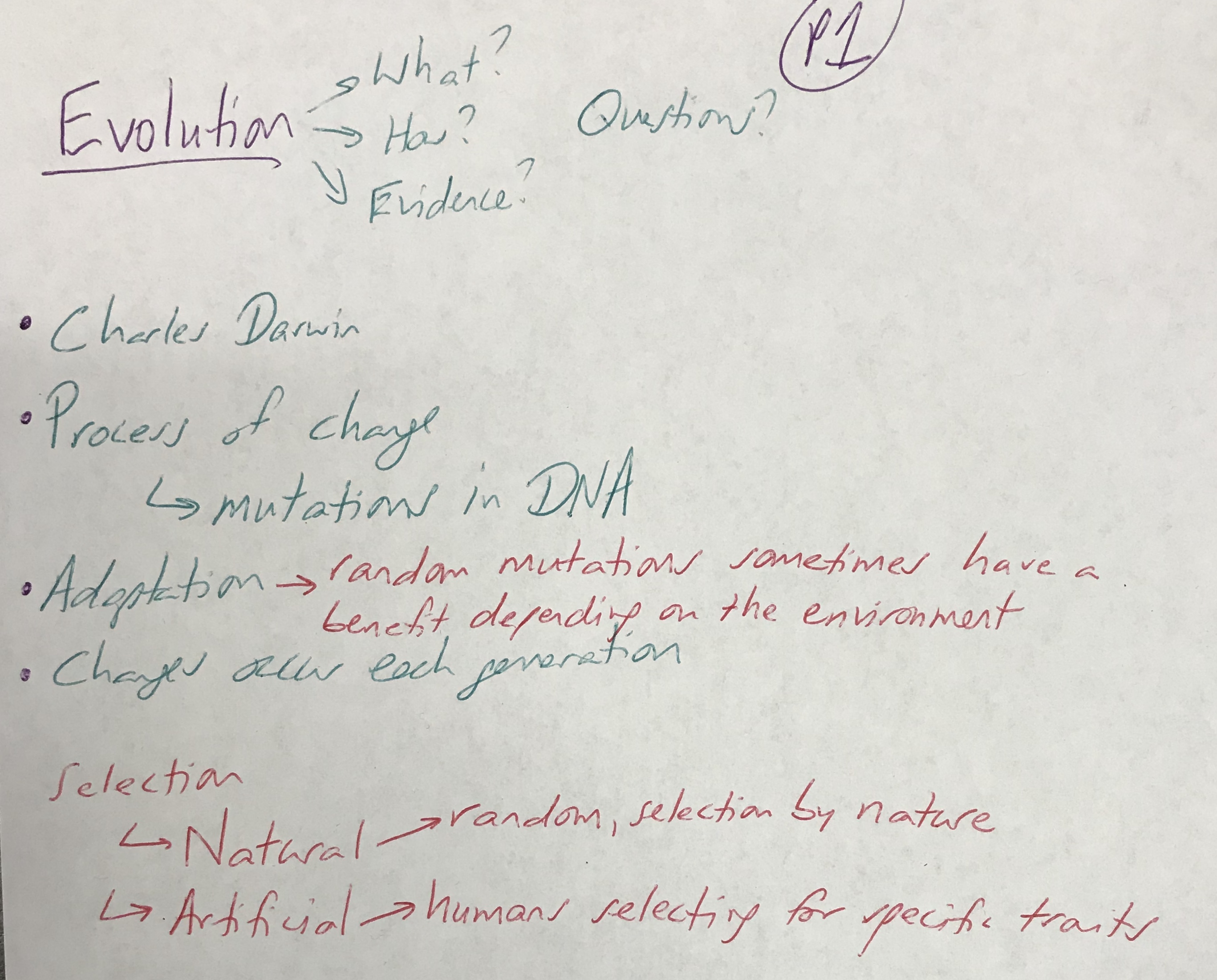
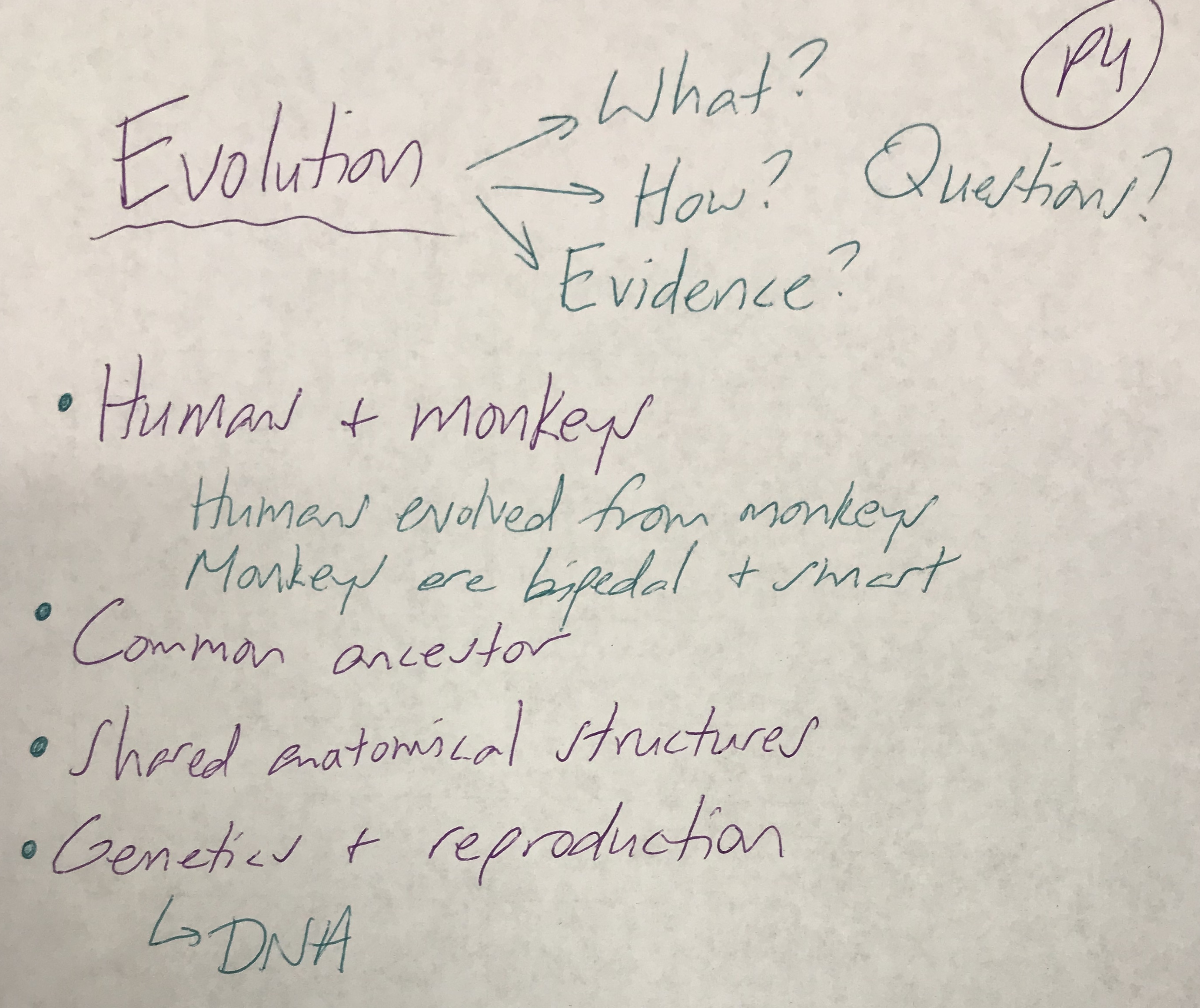
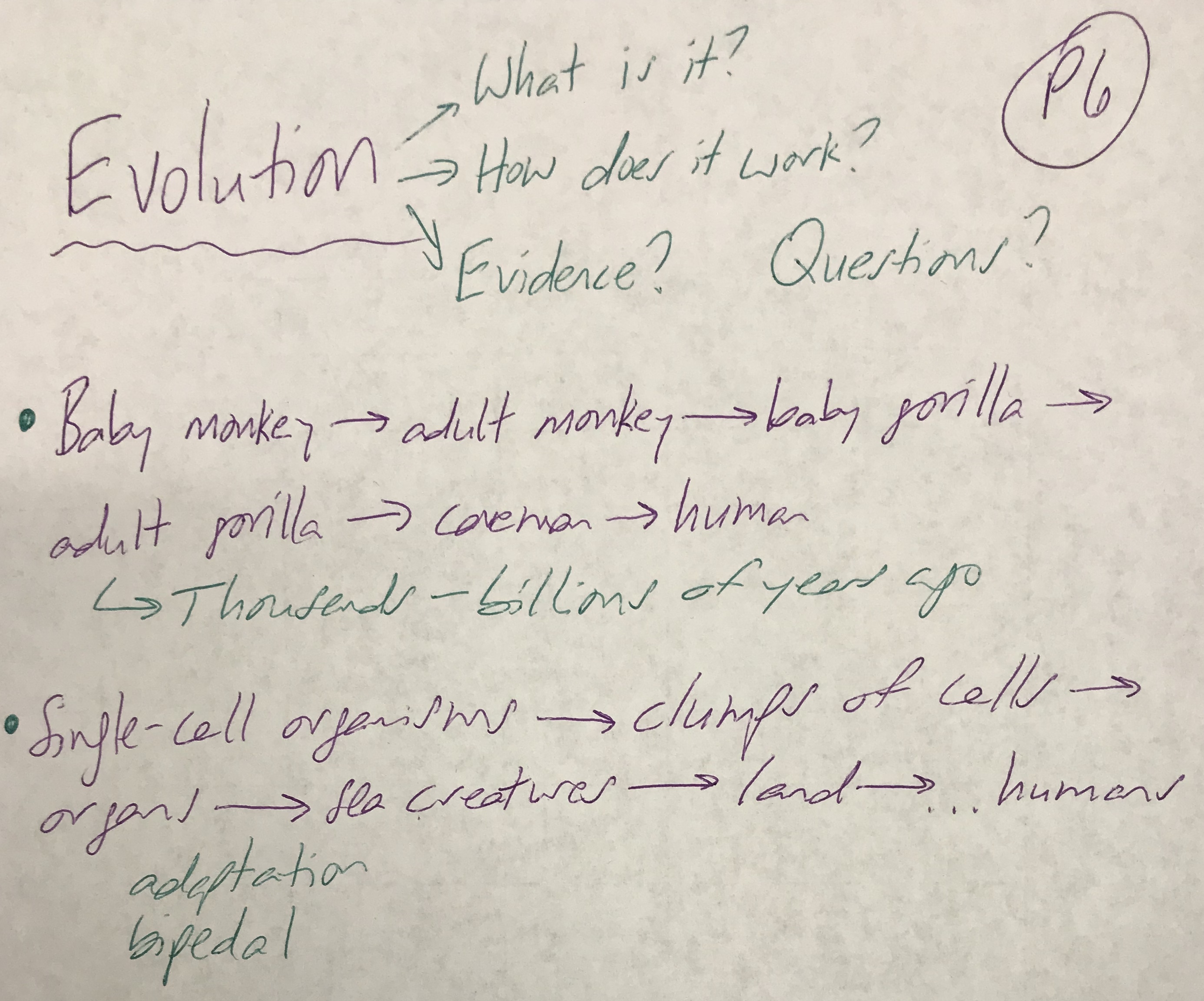
We began Unit 6 with a brief class discussion about what students know (or think they know) about evolution.  All student ideas were recorded and served as an entry point into the second episode of Cosmos from the 2014 series hosted by Dr. Neil deGrasse Tyson.  Student initial ideas are shared below.  We watched the first 30 minutes of the video today, pausing periodically to answer questions on the handout students received and which will be turned in after we complete the video tomorrow.  Students learned today during the episode (titled “Some of the Things That Molecules Do”):

  • dogs and wolves share a common ancestor (artificial selection);
  • polar bears and brown bears share a common ancestor (natural selection);
  • how random DNA mutations can occasionally produce desirable traits depending on the environment in which the organism with the mutation lives;
  • how all life on Earth is connected via DNA to a common ancestor (using the Tree of Life analogy);
  • how the evolution of sight can be traced all the way back to bacteria
1st period initial ideas
4th period initial ideas
6th period initial ideas

EOC Review: Evolution Review – Your Inner Monkey

We concluded our Biology End of Course review by watching the PBS video Your Inner Monkey.  The video does a nice job of bringing together the key concepts from our units on evolution and central dogma.  Tomorrow, students will sit for the EOC.

All three episodes of the movie series are listed below:

  1. Your Inner Fish
  2. Your Inner Reptile
  3. Your Inner Monkey


Evolution: Infectious Organisms Project Comic Work

For the final phase of the Infectious Organisms project, it is time to put together what you have learned into something easily shared with others.  A comic strip is one way to share information both with words and images.  Using the information contained in your organism-specific article summary worksheets, and carefully reviewing the project rubric to be sure you have the necessary information, it is time to create your comic strip.  Your work must be original – you may refer to existing comic strips for inspiration only.  We have different sized paper available: large poster paper, 8.5″ x 14″ long printer paper, and 8.5″ x 11″ standard printer paper.  Use the paper that works best for you and your project.  Include as many panels as you need to tell your story.  Be creative!

Students have been quite successful using comic creator websites like  MakeBeliefsComix.com, Pixton.com, and StoryBoardThat.com so if the thought of drawing your own comic is overwhelming, try using an online resource to help you with the artwork so you can focus on the content.  There are several other comic creator websites on the Internet, so find one that works best for you.

Comics are due at the beginning of class on Wednesday.  All comics must be ready to share in paper form, so if you create a comic online, be sure to print it!  On Wednesday, you will get to see everyone else’s work and they will see yours, so use your class time well to make a comic strip you are proud of.

Evolution: Infectious Organisms Project Research

First, a couple of brief housekeeping items.  Google Classroom once again proved to be too cumbersome to use as a classroom tool, so all documents pertaining to the Infectious Organisms Project will be stored here on the class website.  Additionally, rather than have one long running project post, I have decided to write separate posts for smaller chunks of work to help students locate information quickly and easily.

Onward!  At the beginning of class, students will find out which infectious organism they have been assigned to research.  The vast majority of students elected to work individually, so I have made the decision that while students may collaborate, they will need to turn in their own individual project.  Students will have today (Wednesday, May 3) and tomorrow (Thursday, May 4) to deeply research their organism.  Learn as much as you can!  Read, watch videos, talk with each other to share resources, and let me know if you are struggling to find information or are unsure if the resources you are using are scientifically credible.  By Friday, each student must complete two more Article Summary Worksheets for the two best articles found for their assigned organism.

Due at the beginning of class on Friday, May 5:

  • Article Summary Worksheet completed for the Biological Warfare Case Study (assigned yesterday) – read through all 12 slides!
  • Answers to the four questions found on slide 1 of the above case study
  • Two additional completed Article Summary Worksheets (see sentence in bold red text above)

Also from yesterday, here is a link to the project rubric.

A few resources to help with your research:

Ready to start working on your comic strip?  The rubric provides a list of content to include in the comic strip.  A successful comic strip will be easy to read, have pictures that help explain what is happening, and it should take the complicated information you read about and craft it into a form that is easy to understand but is also informative.  The topics are pretty intense, and comics often have some humor in them, so if you can lighten the mood in an appropriate way using a bit of humor, your reader will appreciate it!

For students excited to draw their comic strip by hand, we have poster paper (go big!) and 8.5″ x 14″ printer paper along with pens, colored pencils, and crayons.  Prefer to go digital?  A Google search for “comic strip creator” will provide several website options.  Find the one you like best and get to work!

Evolution: Co-evolution Case Study

Having learned key vocabulary concepts about co-evolution and symbiosis, and with images of parasites fresh in our minds, we will now transition to the Infectious Organism Comic Strip Project.  Students will read through both the Infection Comic Strip Grading Rubric document, as well as the List of Infectious Organisms.  Students will select their preferred infectious organisms and submit their preference to the teacher for placement into groups.

To complete the day, students should visit the UC Berkeley Understanding Evolution website and read through the Coevolution and Case Study of Coevolution pages, then read through and take detailed notes from the Biological warfare and the coevolutionary arms race case study.  For the biological warfare case study, your notes should include complete answers to the questions on the first slide (also listed below).  Students should also complete the Science Article Summary Worksheet for the case study.

  • What is coevolution?
  • How do living and non-living environments shape organisms through natural selection?
  • How do evolutionary trade-offs restrict adaptation?
  • How can we use the methods of science to answer questions about the natural world?

Evolution: Zombie Parasites

After a thorough examination of the process of evolution, it is time to apply our learning!  We will begin with a PowerPoint to briefly discuss the concept of infectious organisms, with an emphasis on thinking about how the co-evolution of organisms has resulted in complex relationships between organisms.  Students will define the vocabulary terms of host, bacteria, virus, parasite, and infection.  Next, we will watch a National Geographic video about zombie parasites.  The presenter, Anand Varma, applies his expertise in photography to the study of parasites.  Mr. Varma travels the world collecting specimen for study, and his ability to apply biological concepts to his work, think creatively, and drive to overcome failure make him and his work truly remarkable.

Evolution: Evolving Bodies, Evolving Switches

Today, students watched the HHMI Biointeractive video titled Evolving Bodies, Evolving Switches (watch below).  The video explains how the stickleback fish has evolved and adapted to its environment, and shows how scientists are using genetics to further understanding of evolution as well as developmental biology.  After watching the video, students completed a worksheet to reinforce and extend their learning.