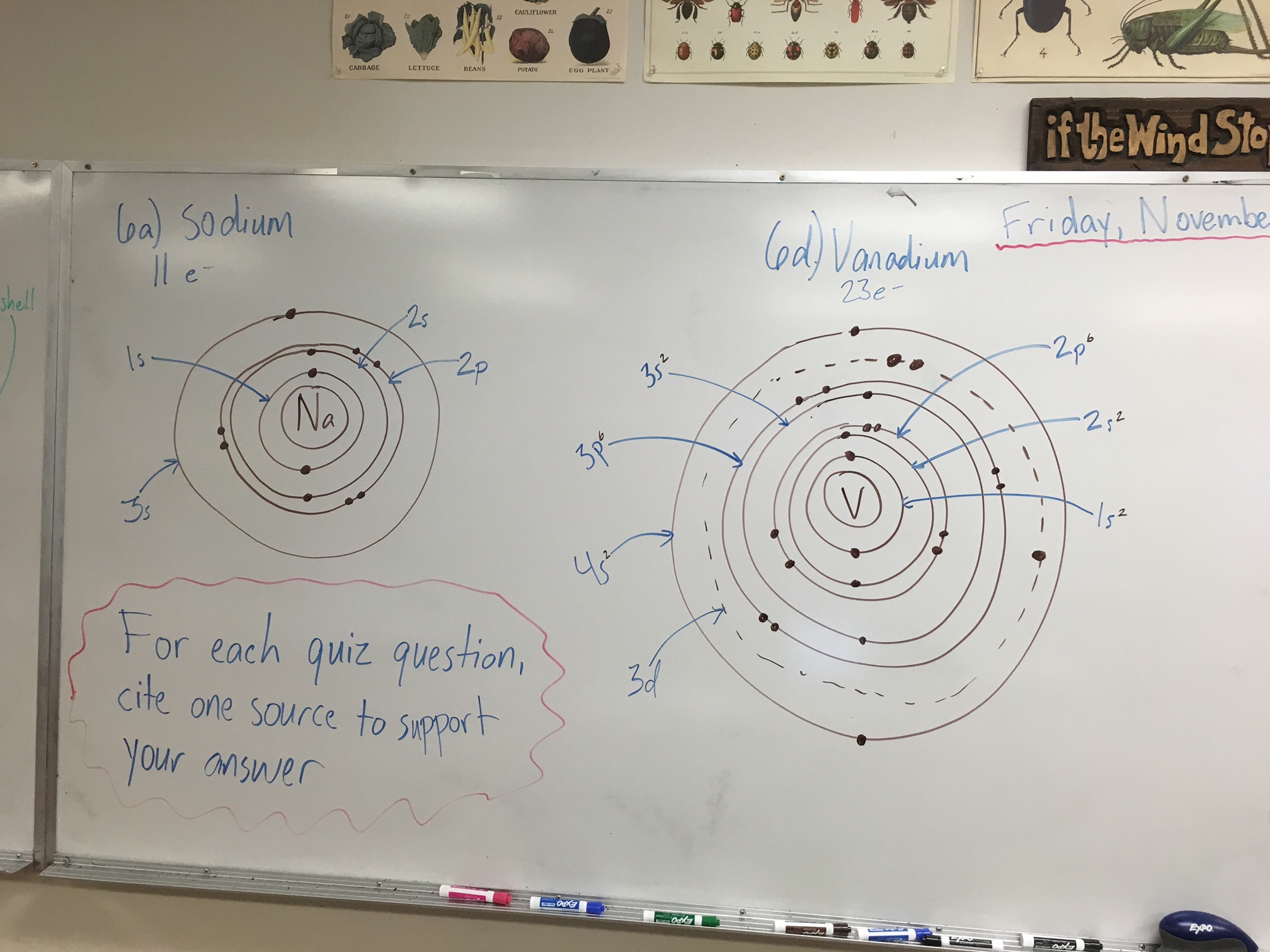
We completed our review of subshells from Lesson 24 (answers to textbook questions 6a and 6d are pictured below) and then students received the Chapter 4 Quiz as a take-home assignment. As part of the quiz, students must cite one piece of evidence from class (textbook, notes, videos, etc) to support their answer. The quiz is due Monday.
Note for November 12: Students, please scroll down for additional resources/instruction!
Our learning about electrons culminated today with Lesson 24, in which students understanding of electron shells was expanded to include the concept of subshells. We worked through the first 10 slides of the Lesson 24 PowerPoint, and students also received a copy of the Lesson 24 Worksheet. Students used the last part of class to read through Lesson 24 in the textbook and begin working on the worksheet.
To help students build a better foundation as they learn the challenging concept of electron subshells, students are encouraged to watch the Crash Course chemistry video below:
Want more? There is a follow-up Crash Course video (#25) that picks up where this one left off and takes the content to a whole new shell (sorry, chemistry humor):
Note: No school on Wednesday, November 11 (Veteran’s Day)
Additional content for Thursday, November 12 is being posted in advance to serve as reference material for interested students:
There are two handouts on the front table – one is a new copy of the Periodic Table that includes electron configurations. The other is an outline of the Period Table with electron subshell blocks. Feel free to take one of each to use as a study tool. By now, everyone should have read through Lesson 24 in the textbook. To supplement your learning, I have drawn out an electron subshell filling tool on the left white board (pictured below). By following the orange arrows while moving own the rows, you can see that the electrons fill subshells in a specific way. Remember, the s orbital only has room for 2 electrons, the p orbital has room for 6, the d orbital holds up to 10 electrons, and the f orbital has room for 14 electrons. Following the arrows, you can see that subshell 1s fills first, followed by 2s, 2p, 3s, 3p, 4s, 3d, 4p, 5s, 4d and so on. The number written in superscript to the right of the subshell indicates how many electrons are in that particular subshell. The electron configurations for hydrogen, helium, and carbon are written and drawn out on the left white board.
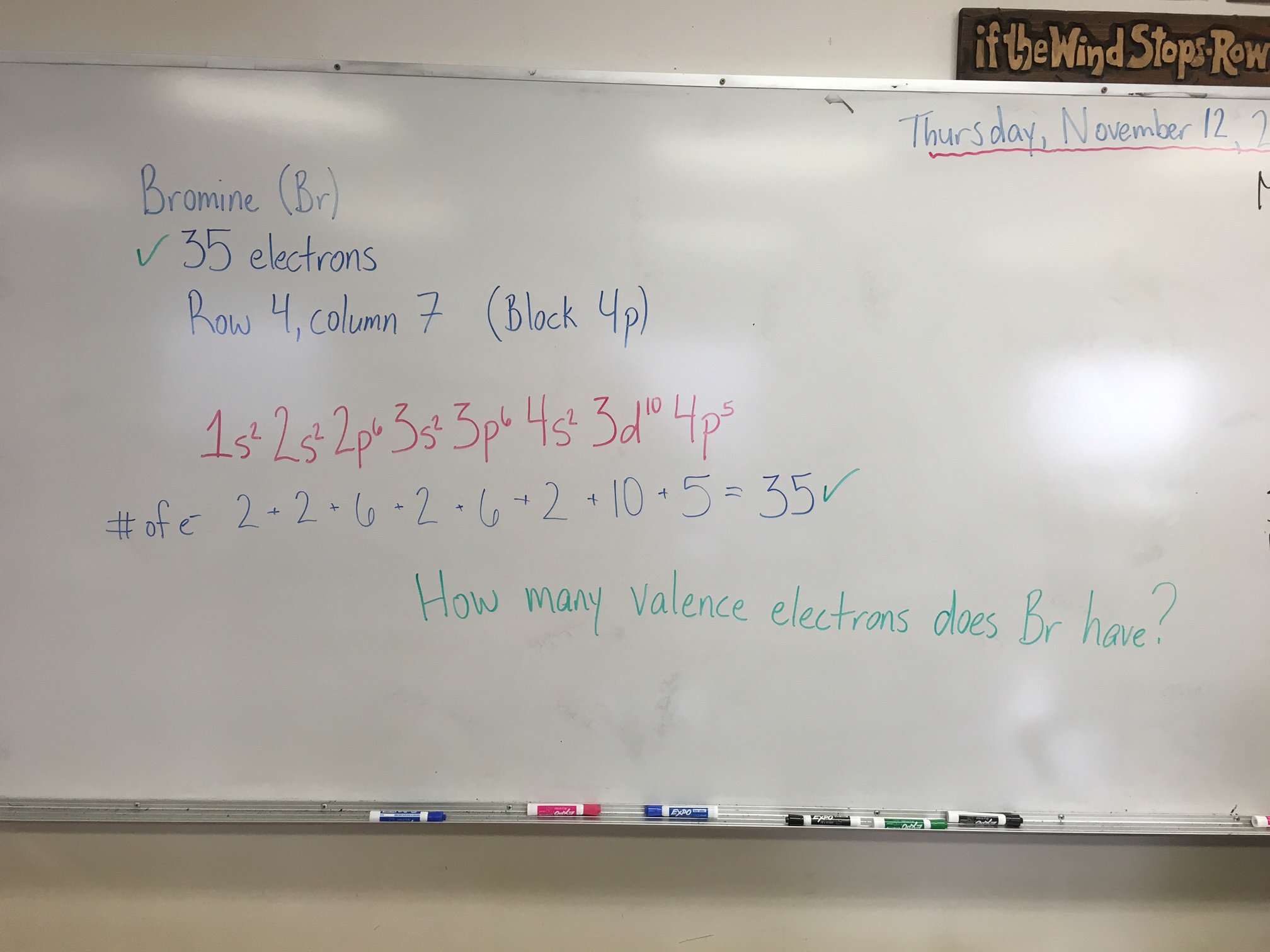
The electron configuration for bromine is written out on the right white board (above), along with the question: how many valence electrons does bromine have? You should be able to determine by looking at the Periodic Table that bromine (Br, element number 35) has 7 valence electrons. The question to consider is: how might the electron configuration be used to determine that? The video below will explain that, and will provide you with several practice questions (and answers – pause the video and work through a few of the problems!):
Students looking for a deeper dive into the content, including the advanced concept of electron spin (not something you will be tested on, but I know many of you are bound for college chemistry…), are encouraged to watch the Bozeman Science video below:
We will review Chapter 4 on Friday in preparation for the Chapter 4 Quiz on Monday.
With chemistry teachers from across our school district meeting all day yesterday, students had the opportunity to review Lessons 20-23 and to begin working on Lesson 24 if time permitted. Special thanks to our substitute, Mr. Stark, who ensured the day went smoothly.
We began class by continuing the learning from Lesson 22. We created polyatomic ionic compounds using the Card Masters game deck. We also briefly reviewed the Lesson 22 PowerPoint slide deck, focusing on key vocabulary terms. With the end of the quarter approaching, students are not required to complete the Lesson 22 worksheet but are welcome to work through it as a study tool. For the final segment of class, students received the Lesson 23.1 worksheet. Lesson 23 revolves around a lab activity where students make paint. We will use the short class period tomorrow to make blue paint and review the Lesson 23 PowerPoint and selected worksheet responses.
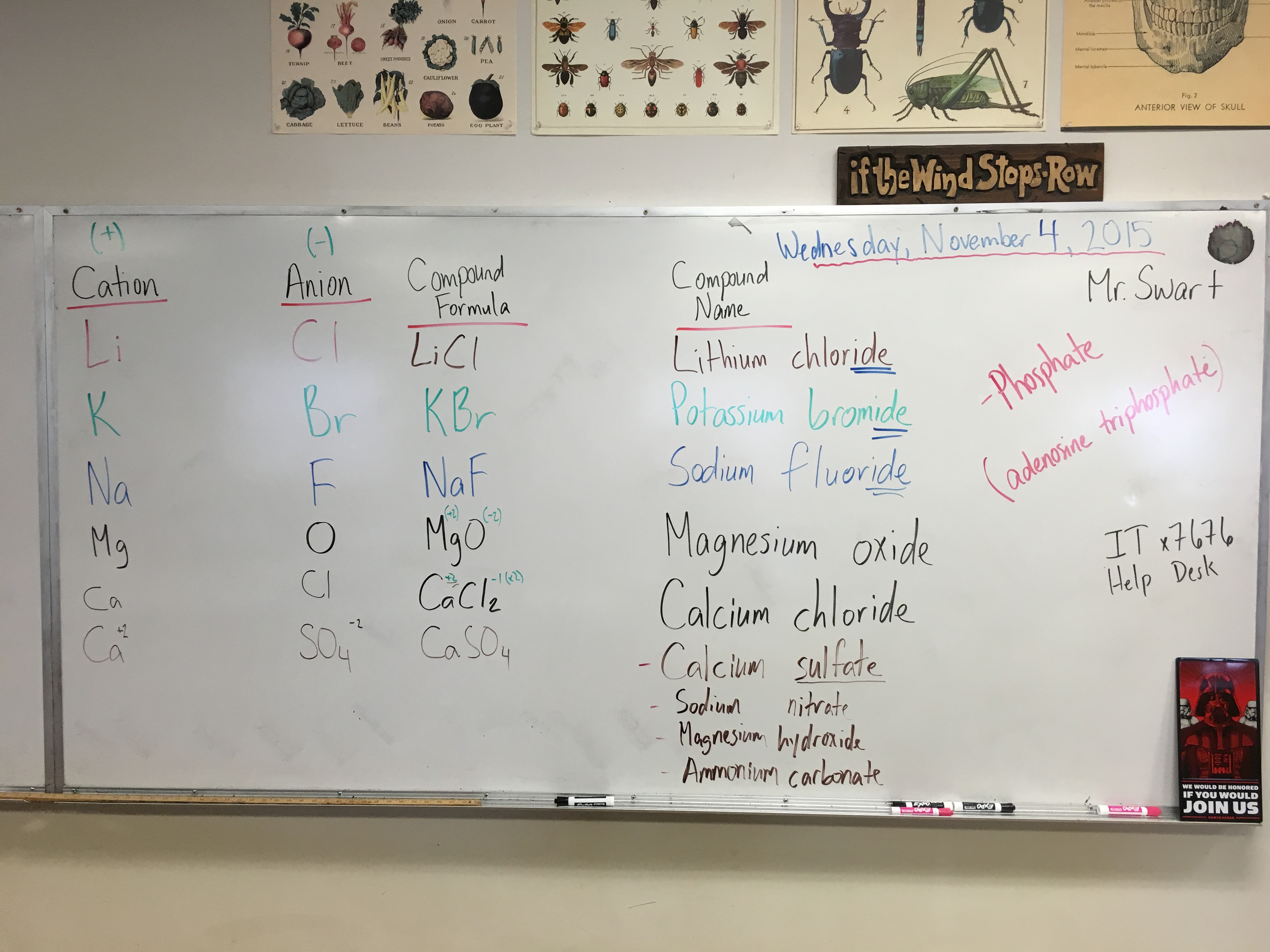
We elected to skip the Lesson 21 game and instead focused on answering student questions and continuing the work of learning how to name ionic compounds. We transitioned to Lesson 22, introducing the concept of polyatomic ionic compounds. Students were introduced to some of the more common polyatomic anions and cations, with a list of some of the compounds discussed pictured below:
We worked through student questions about Lesson 20 for the first part of class, with several of the questions guiding students through the learning the textbook intended to introduce through the Salty Eights game in Lesson 21. Rather than play the game, students instead used the last part of class to begin working with molecular modeling kits (something they will be introduced to later in the textbook). Although we did not use it today, the Lesson 21 PowerPoint is available for download. We will work through portions of the Lesson 21 worksheet tomorrow, playing the game at the beginning of class.
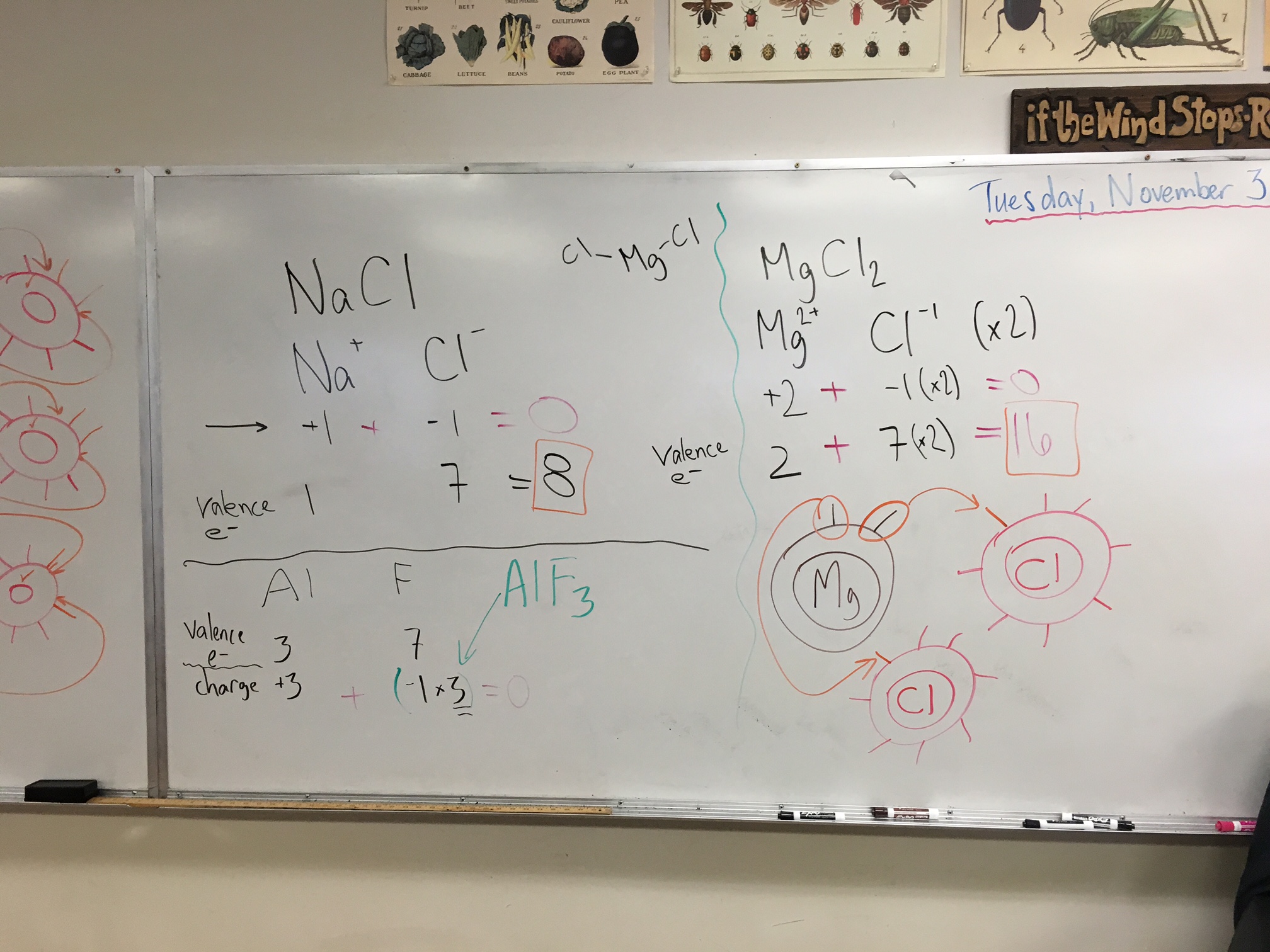
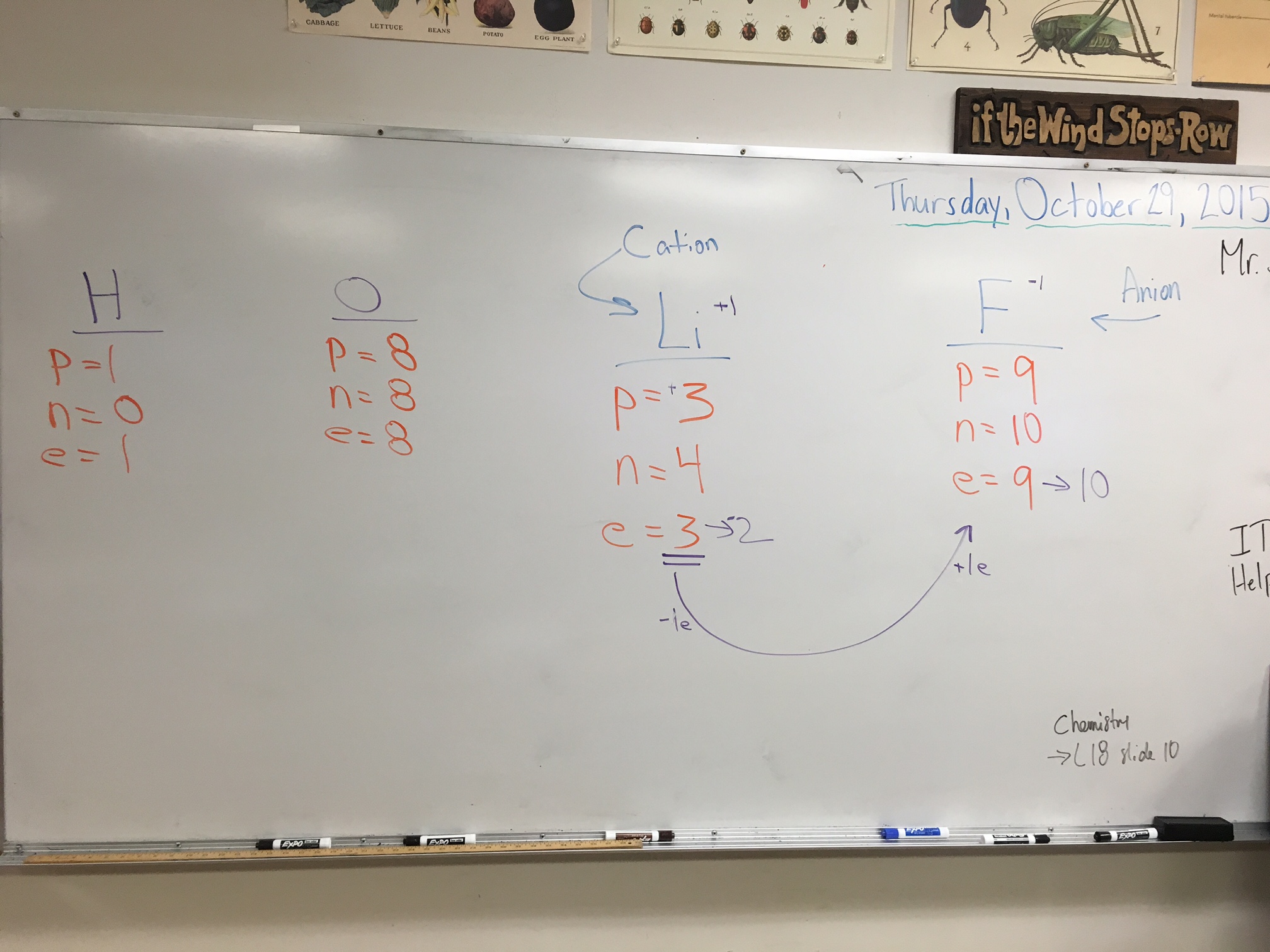
We began the class period by discussing questions students had about Lessons 17-19. The whiteboard work is shown below:
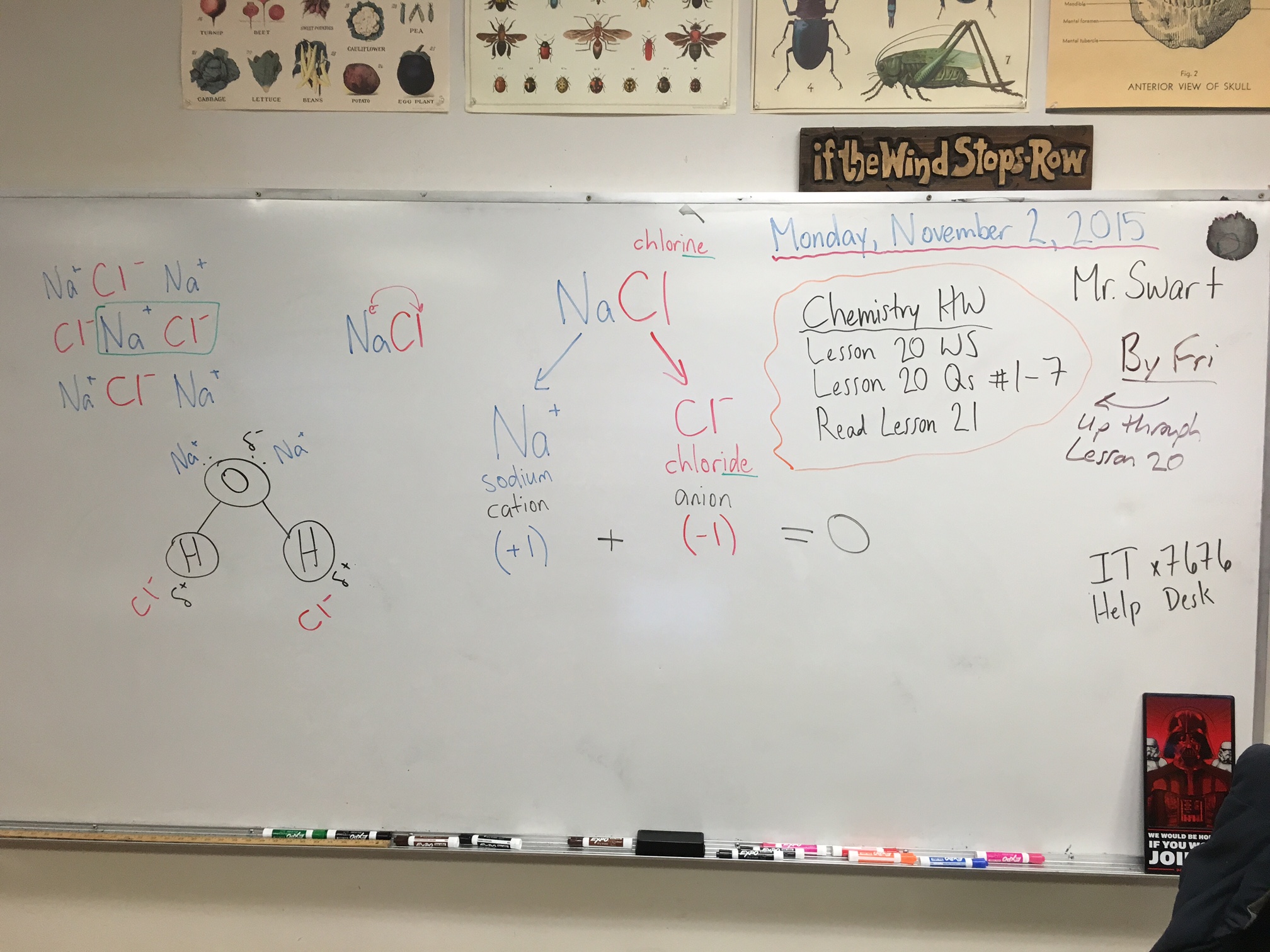
We extended our learning about ions to the study of ionic compounds, reviewing the Lesson 20 PowerPoint which included the vocabulary terms of cation and anion and learning about how different numbers of anions and cations combine by following the Rule of Zero Charge. Students worked on the Lesson 20 Worksheet and for homework should complete Lesson 20 textbook questions #1-7 and read Lesson 21 in the textbook.
We spent the short Friday class period catching up on work from the first three lessons of Chapter 4 (Lessons 17-19). As a reminder, the assignments from this week are as follows:
Lesson 17: Worksheet and textbook Qs #1–2
Lesson 18: Worksheet and textbook Qs #3-10
Lesson 19: Worksheet and textbook Qs #2-16 (evens)
Looking to dig deeper into the Periodic Table? Check out the Dynamic Periodic Table website and explore the rich collection of data for all of the elements in the table.
Students should read Lesson 20 this weekend to prepare for class on Monday. Also, the quarter ends on Friday, November 6, so students should make every effort to catch up on missing work to ensure their quarter grade accurately reflects their current mastery of course content.
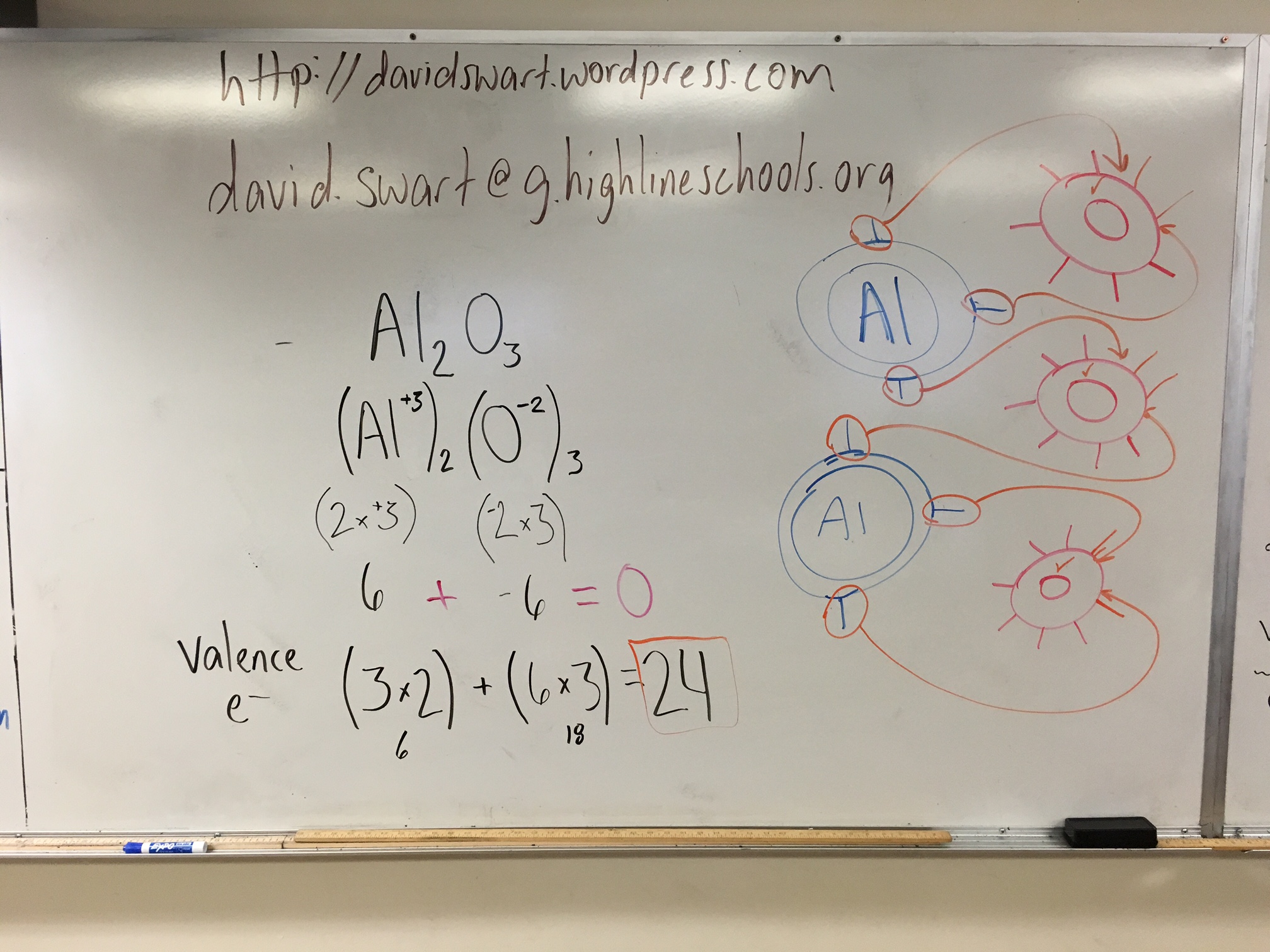
Our learning about electrons continued with the Lesson 19 PowerPoint introducing students to the concept of ions. Students received the Noble Gas Envy handout and we walked through the example on the whiteboard. The discussion prompted a student question about how two atoms of hydrogen bind with an oxygen atom to form a water molecule which was also captured on the whiteboard (pictured below). For classwork, students received the Lesson 19 Worksheet and the Ion Cards Game Cards that accompanies it. For homework, students should complete the Lesson 19 textbook questions #2-16 (evens only).
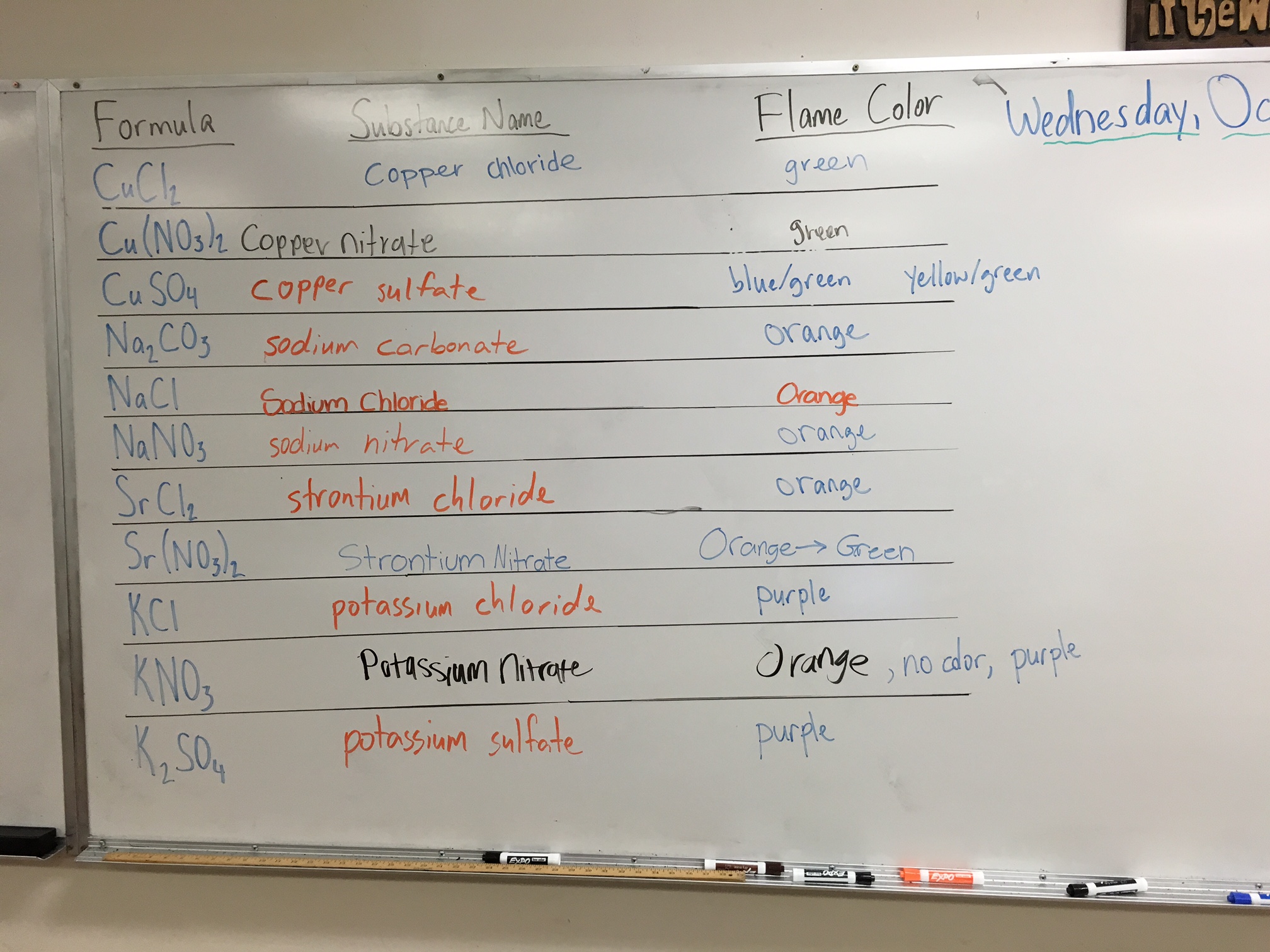
We began the class period by creating a table of the data from yesterday’s Flame Test lab, which students then used to complete the Lesson 17 Worksheet.
We also reviewed the Lesson 17 PowerPoint before transitioning to Lesson 18. There are several hand-outs for Lesson 18, including the Lesson 18 Worksheet, the Lesson 18 Shell Model, the Table of Electron Shells, and the Table of Valence and Core Electrons. We reviewed the Lesson 18 PowerPoint through slide 9 and will complete the remaining slides tomorrow. For homework, in addition to completing the Lesson 18 worksheet, students should work through questions #3-10 at the end of Lesson 18 in the textbook and then read through Lesson 19 in the textbook.


 Science with Swart
You must be logged in to post a comment.