
Category Archives: Chemistry

Attractions between Molecules

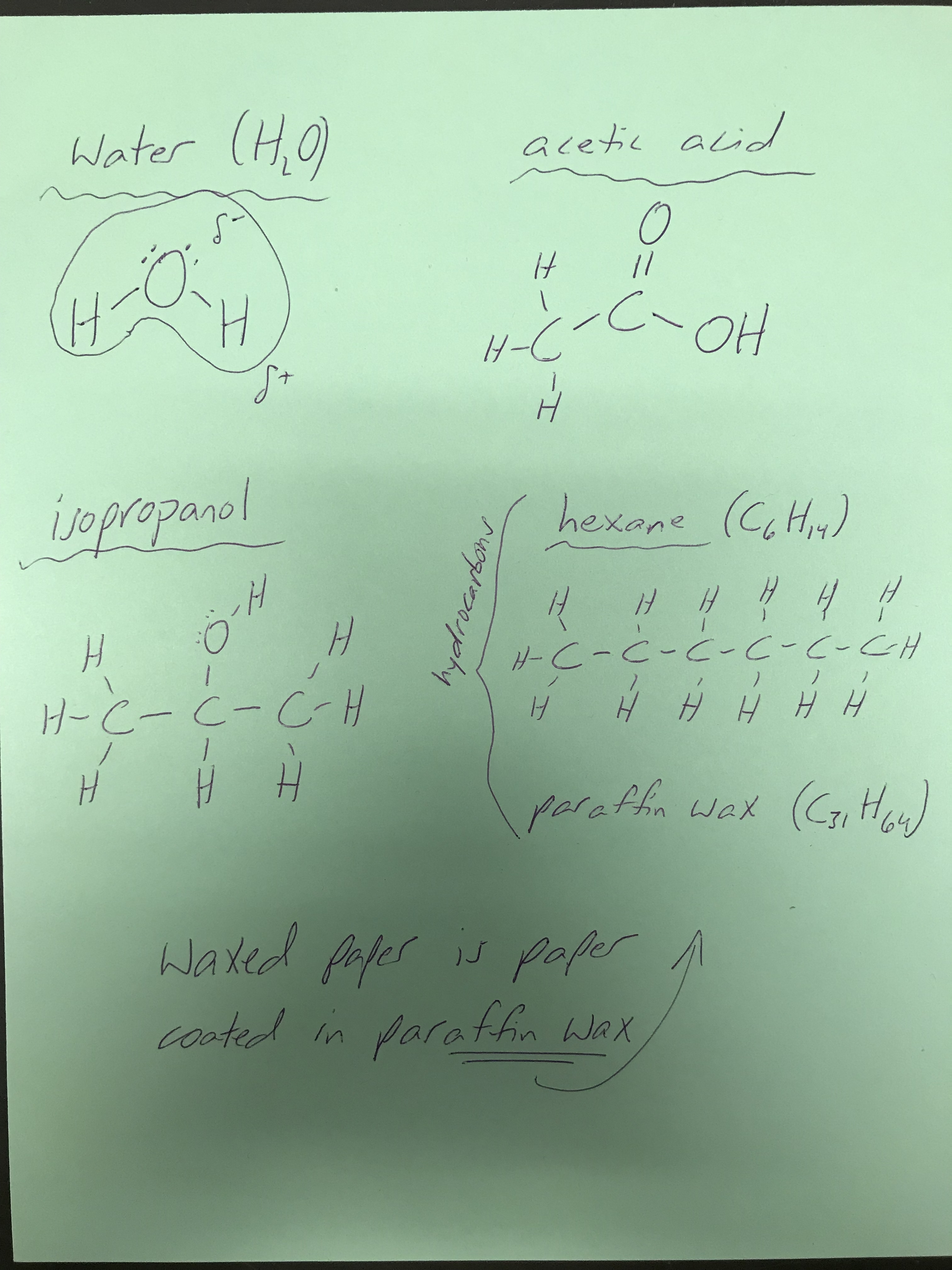
We kicked off 2018 with Lesson 42: Attraction between molecules.  Students received the Lesson 42 worksheet and then we briefly reviewed functional groups and the concept of polarity.  The lab calls for students to observe the characteristics of water, acetic acid, isopropanol, and hexane (molecular structures are shown below):
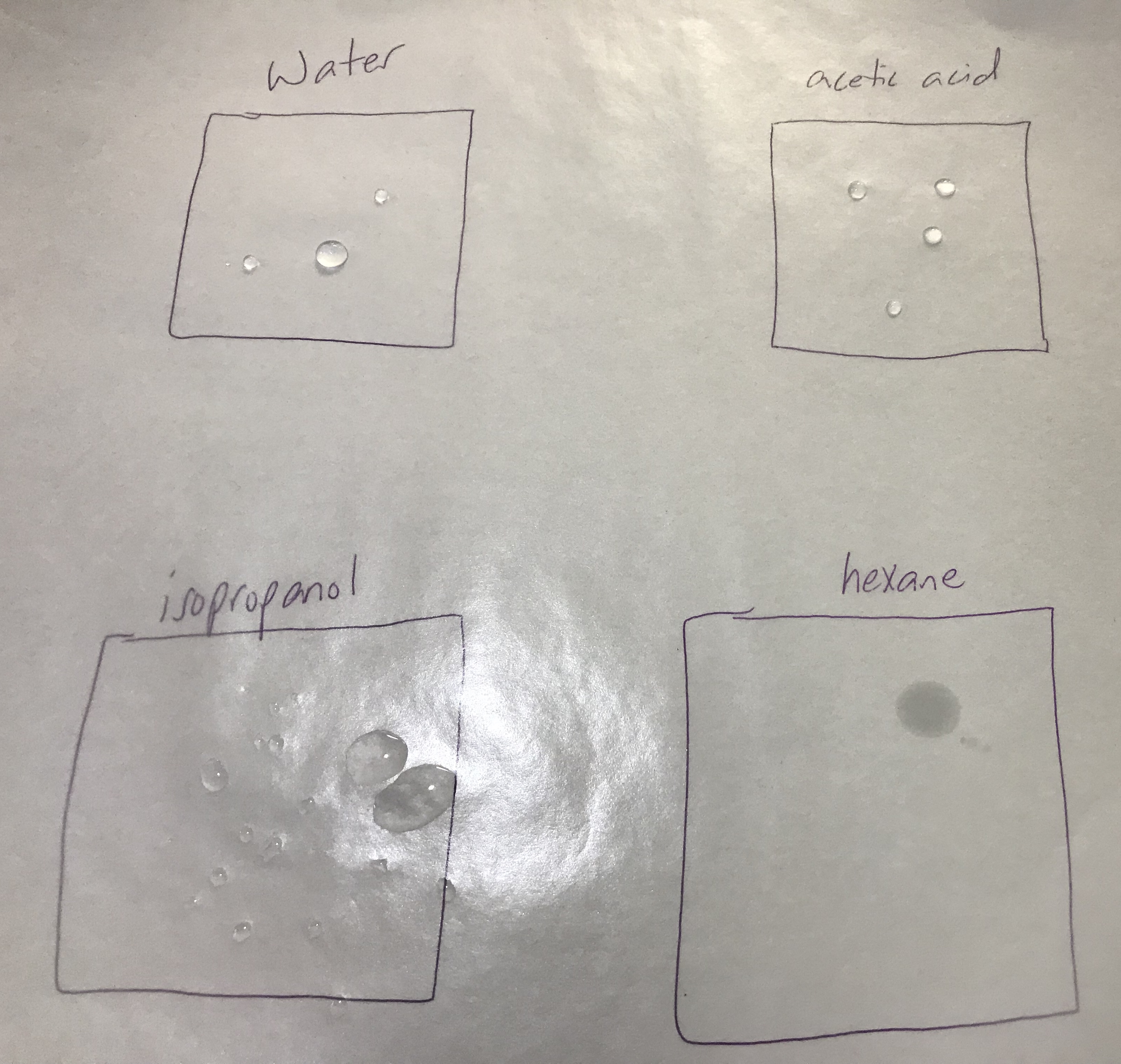
Students were tasked with writing a detailed procedure in advance of the lab tomorrow.  At the end of class, we tested the response of the four test liquids when dripped onto a piece of wax paper:
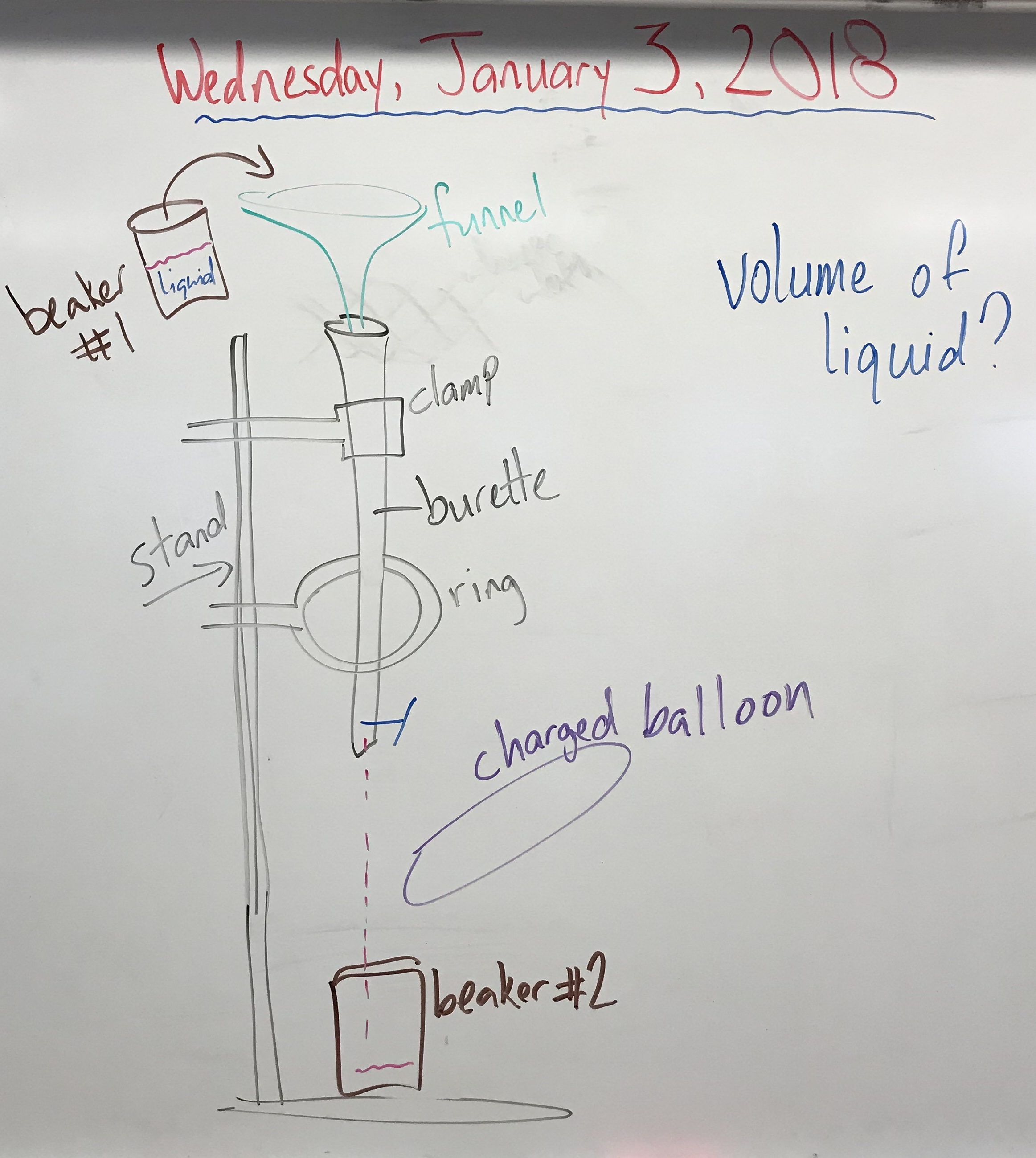
For the lab, there were four stations set up around the classroom containing all of the necessary equipment and materials to conduct the lab.  Students also could use the drawing on the white board (below) to aid in their lab setup.  Students had to follow their written procedures, which meant revising them a needed to actually complete the lab.  Results were summarized at the end of class (water, acetic acid, and isopropanol were all attracted to the charged balloon, while hexane was not).  Students realized that the acetic acid we used (36% acetic acid) contained water, as did the isopropanol (70%).  To determine whether the water in both solutions might be responsible for the attraction observed, we tested glacial acetic acid (100% acetic acid) at the end of class and found it to be highly attracted to the balloon.
Students will have the final two days of the week to write lab reports (one per group).  For the lab report (due Friday, 1/5):

  • Introduction
  • Procedure
  • Results
  • Discussion
    • Include explanation of charged balloon results
    • Include explanation of waxed paper results

On Thursday, to provide students with some foundational knowledge of polarity (helpful for making sense of the lab, and a concept we will encounter very soon in the textbook), we watched the Crash Course video below:

Receptor Site Theory

For our final day of school before Winter Break, we learned the content of Lesson 41 through Episode 6 of Neil deGrasse Tyson’s version of Cosmos.  In addition to briefly explaining receptor-site theory, the episode also explains, indirectly, why water isn’t wet (electron repulsion).  Students should complete Lesson 41 textbook problems 1-8 over the break (p. 211).

Electron Domains

We breezed through Lesson 37 with a demonstration connecting molecular formula and shape.  Students learned:

  • noble gases (single atoms) are visualized as points
  • molecules consisting of two atoms (i.e. hydrogen fluoride) are linear
  • molecules consisting of three atoms can be bent (H2O) or linear (CO2)
  • molecules consisting of four atoms, like ammonia (NH3) are called pyramidal
  • molecules consisting of five atoms, like methane (CH4) are called tetrahedral

For homework, students were assigned Lesson 37 textbook problems 5-9 on page 195.

We spent the remainder of the class period delving into the science required to successfully answer the question: Is water wet?

Functional Group Poster – Days 2-3

Prior to beginning our second day of work on the Functional Group Poster Project, we discussed the Ester Synthesis Lab scheduled for tomorrow.  Students received the lab handout and were instructed to read it completely and answer the pre-lab assignment questions as homework.

Next, we discussed the concept of “R groups” to help students better understand how to complete the poster project.  We first watched the video posted to the previous lesson (also below) and then worked through a PowerPoint slide deck.  Students had the remainder of the class period to work on their posters.

Octet Rule

We continued our study of Lewis Dot Structures by investigating the Octet Rule through the lens of double and triple bonds.  Students applied the HONC 1234 rule with their understanding of valence electrons (octet = eight electrons) to build molecules that share one or more bonds.  We worked through the Lesson 32 PowerPoint and then students used the Lewis Dot puzzle pieces from Lesson 31 to work through the Lesson 32 worksheet.  Some students elected to use molecular modeling kits to further their understanding of the geometry of how atoms bond.

Lewis Dot Symbols

We extended our learning of the HONC 1234 rule from yesterday by re-introducing the concept of Lewis Dot Symbols and Structures.  The Lesson 31 PowerPoint includes key vocabulary, and we reviewed Lewis Dot Symbols and how they assemble to create Lewis Dot Structures in our class notes:

Students had the remainder of the class period to work in groups of four on the  Lesson 31 Worksheet using the Lewis Dot Puzzle Pieces.  For homework, students were assigned textbook questions 3-6.