Category Archives: Chemistry

Mystery Solutions

We began class today with the entry task from the Lesson 83 PowerPoint.  The student-driven solution is provided below:

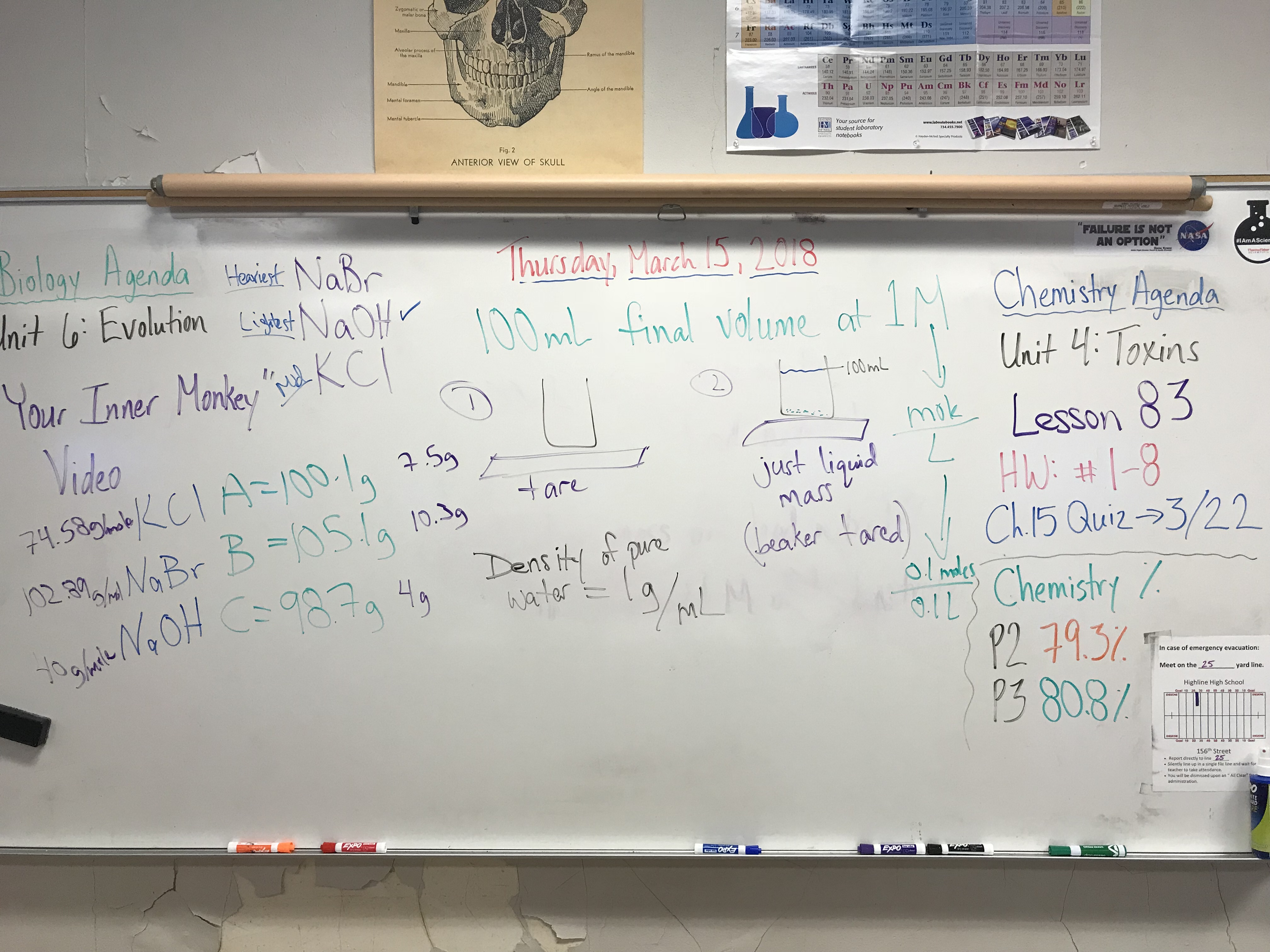
For the remainder of class, students worked through the Lesson 83 Worksheet.  We began with Part A, in which students were tasked with determining which mystery solution matched with one of three chemical formulas.  The mystery solutions each had a different mass, but all three were known to be 100 mL and 1.0 M solutions.  Notes from the white board are provided below.  For homework, students were assigned problems #1-8 from Lesson 83 in the textbook.  Also, students were provided with a printed copy of the Chapter 15 Study Guide and were told about the revised schedule for next week (Chapter 15 quiz on Thursday).
Preparing Solutions

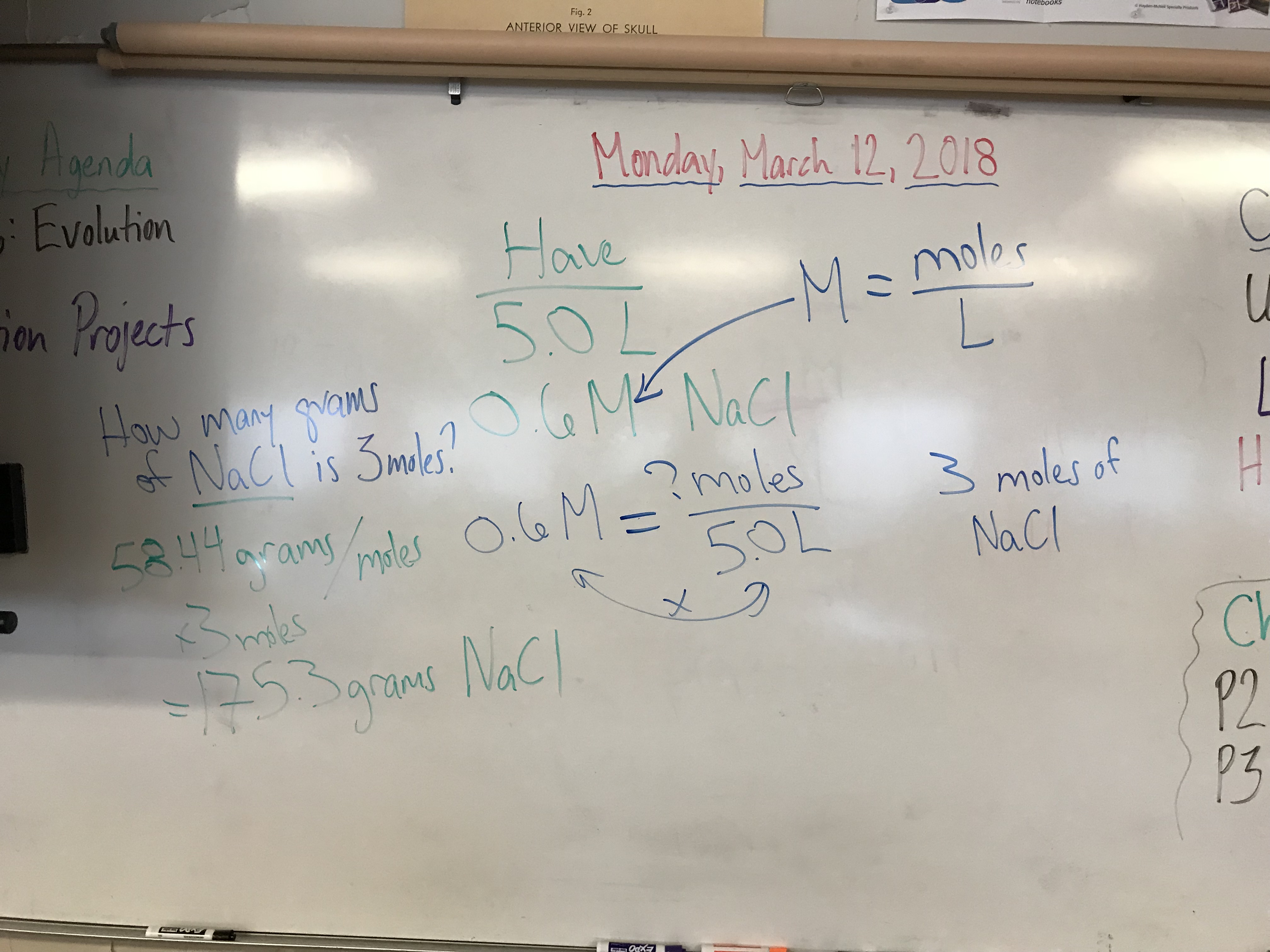
We took advantage of the gap in AP testing to work through Lesson 82.  The Lesson 82 Worksheet called for students to work in groups to prepare salt solutions and then we measured the specific gravity of each solution using a hydrometer.  Our class results are provided below:

Period 2 Results:

Want 500 mL total volume (water = solvent)
Group grams of salt Specific Gravity Volume (L) moles of salt M
0 0 1.000 0.5 0.00 0.00
7 2.9 1.004 0.5 0.05 0.10
1 8.75 1.012 0.5 0.15 0.30
2 11.7 1.014 0.5 0.20 0.40
5 17.5 1.026 0.5 0.30 0.60
6 23.4 1.034 0.5 0.40 0.80
3 29.25 1.042 0.5 0.50 1.00
4 35.05 1.048 0.5 0.60 1.20
8 43.85 1.052 0.5 0.75 1.50

Period 3 Results:

Want 500 mL total volume (water = solvent)
Group grams of salt Specific Gravity Volume (L) moles of salt M
0 0 1.000 0.5 0.00 0.00
7 2.9 1.002 0.5 0.05 0.10
1 8.75 1.010 0.5 0.15 0.30
2 11.7 1.014 0.5 0.20 0.40
5 17.5 1.024 0.5 0.30 0.60
6 23.4 1.030 0.5 0.40 0.80
3 29.25 1.042 0.5 0.50 1.00
4 35.05 1.050 0.5 0.60 1.20
8 43.85 1.062 0.5 0.75 1.50

For reference, the Lesson 82 PowerPoint is available for download.

Additionally, students are encouraged to practice observing the relationship between moles, volume, and molarity using the University of Colorado Molarity PhET simulation below:

https://phet.colorado.edu/sims/html/molarity/latest/molarity_en.html

Molecular Views

Our work today involved thinking about solutions from a molecular perspective.  Students briefly reviewed yesterday’s Gummy Bear portion of the lab via the ChemCatalyst on slide 3 of the Lesson 81 PowerPoint.  Students then received the Lesson 81 Worksheet and the Particle Views Handout.  The handout was used in Part 1 of the worksheet.  For Part 2, students did the mental work of thinking through how to prepare solutions with different volumes and molarities.  They then observed the outcome of preparing those solutions.  The lesson helped illustrate the connection between molarity (M), particle density, and the number of moles (particle number) in a solution.  Pictures from the white board are shown below.

Solution Concentration

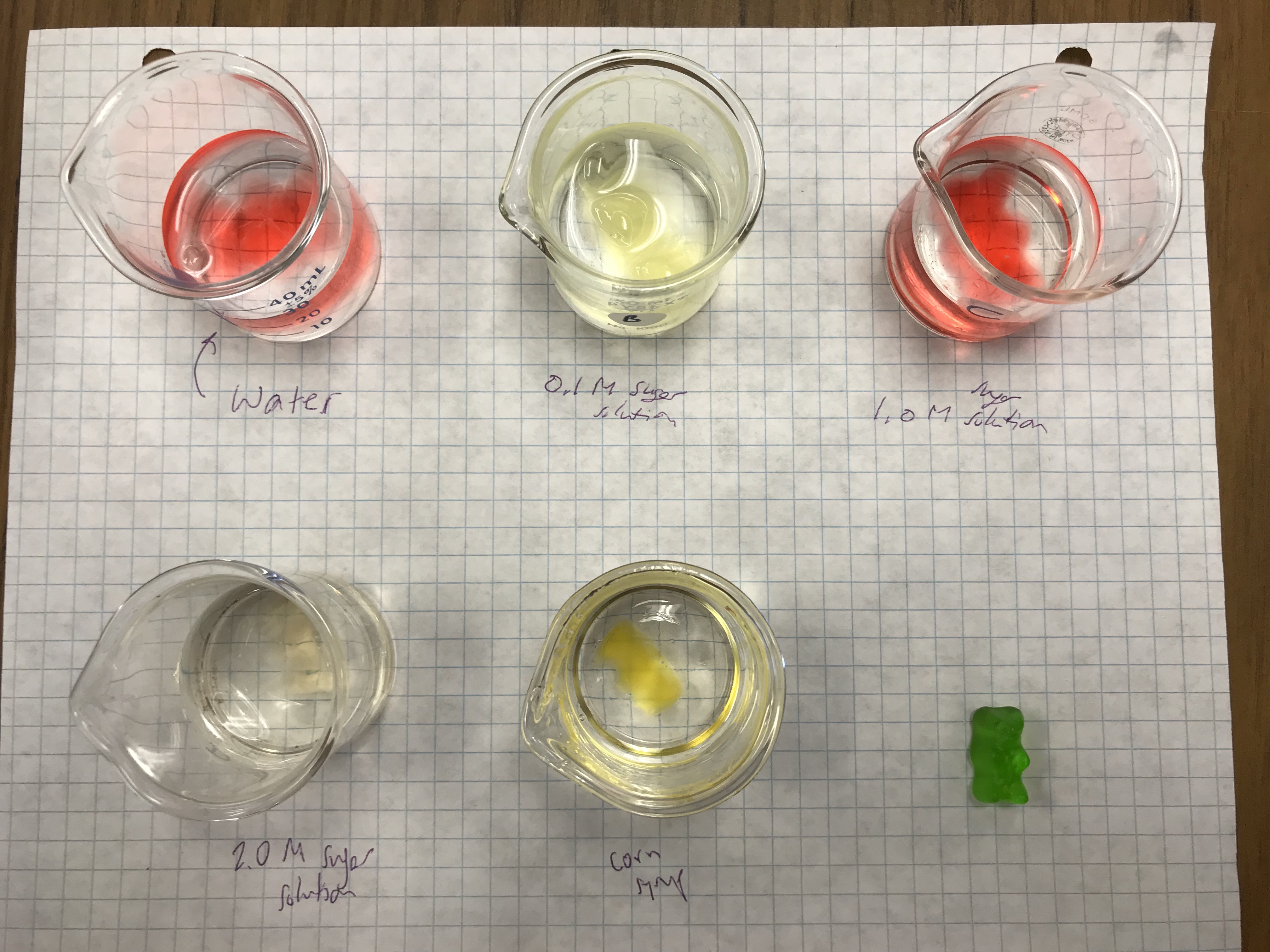
We began Lesson 80 with an entry task (included in the Lesson 80 PowerPoint) in which students were asked to consider the fate of gummy bears placed into solutions containing increasing amounts of sugar.  The resulting discussion allowed us to revisit the concept of osmosis and to model what might be happening in the gummy bears (shown after soaking in solution overnight).

After recording some additional lesson-related vocabulary (solute, solvent, concentration, and molarity), students received the Lesson 80 worksheet and used the remainder of class time to acquire the data and begin filling in the table on the bottom of the front page.  With SAT tomorrow for juniors, we will complete the Lesson 80 Worksheet on Thursday.  Students in class tomorrow will have time to work through the assigned problems from the textbook, problems 1-10.

Comparing Amounts

Yesterday we were introduced to the concept that 6.02 x 10^23 particles of something is equivalent to a unit called the mole.  For more about how this number, called Avagadro’s number.  Student’s wishing to learn more about how that number was calculated are encouraged to read the Scientific American article How was Avagadro’s Number Determined?  The mole is one of the basic units of measurement in science – part of the International System of Units (SI units).  To learn more about SI units, including an update on how the kilogram as about to be redefined, check out the Nature article titled New Definitions of Scientific Units are on the Horizon.  As a brief refresher of the mole (and explicitly connecting the value of the mole to Avagadro’s number), we watched the Crash Course video below (at 0.75 speed) from about time stamps 5:30 to 8:00.

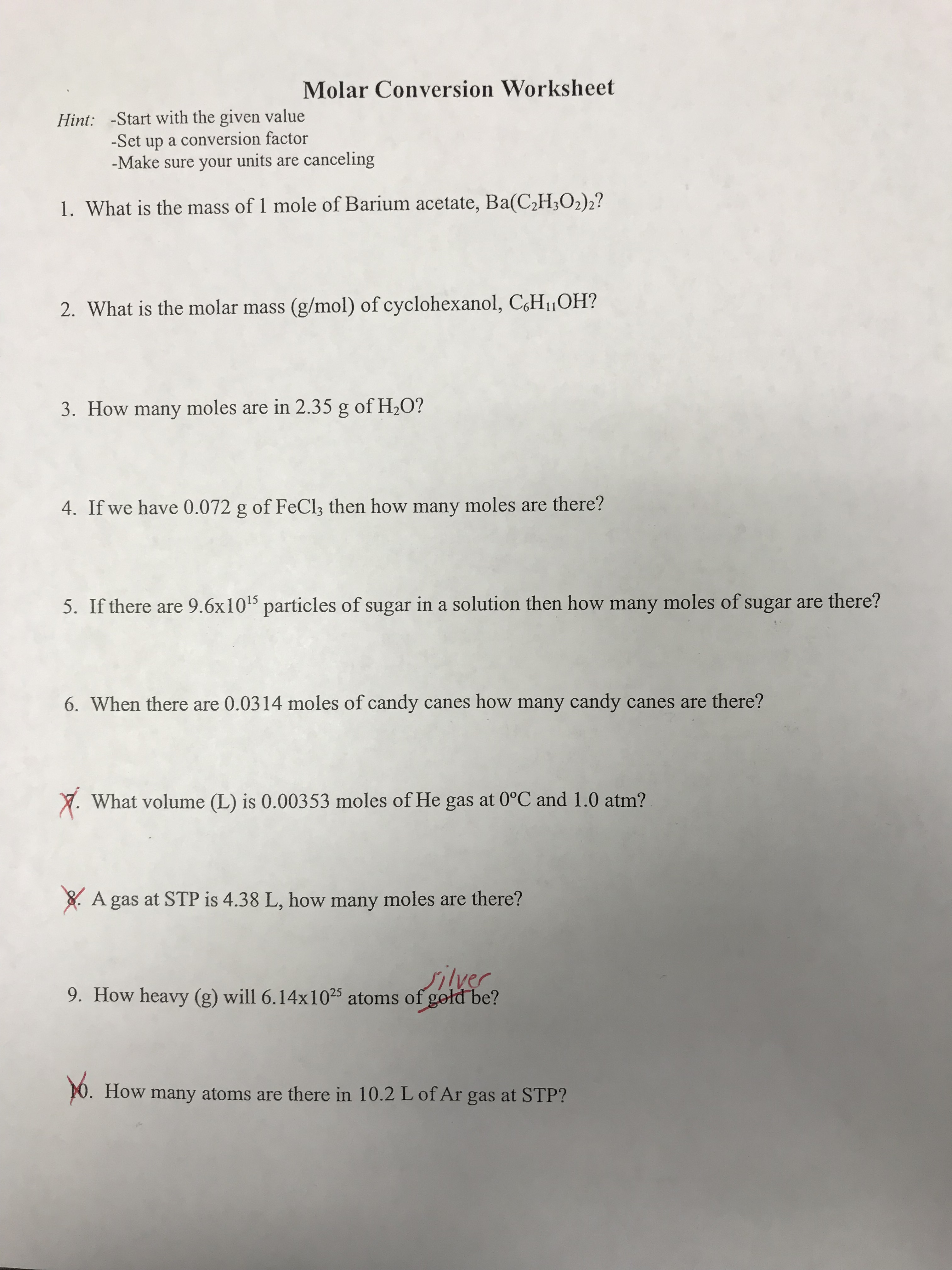
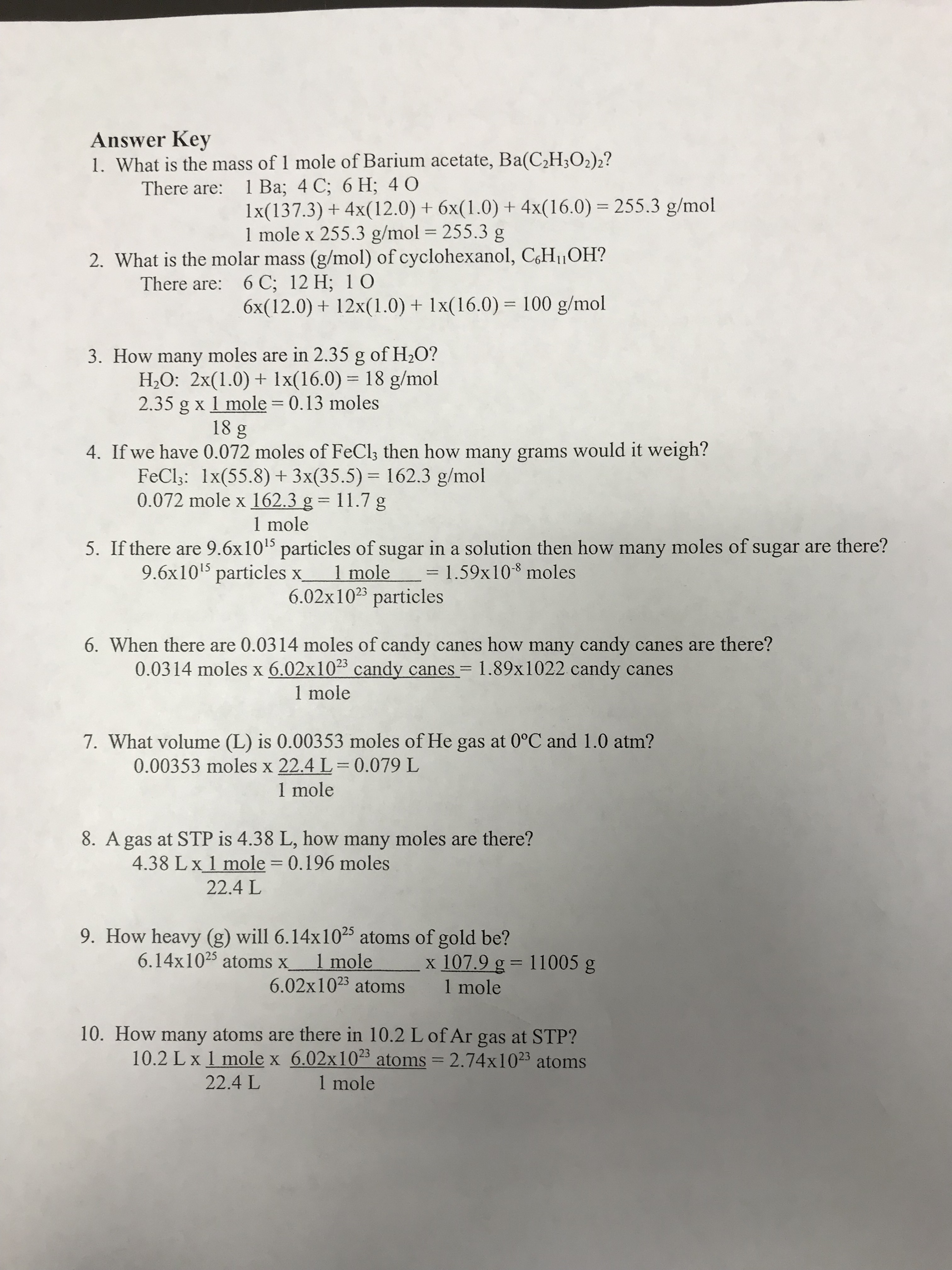
After the video, we worked through some example problems from yesterday’s molar conversion worksheet and also from the Chapter 13/14 study guide.  The remaining 15 minutes of class were used to work through the Lesson 79 PowerPoint in which we ultimately compared the toxicities of regular and diet soda, containing fructose and aspartame, respectively.  We will work through the Lesson 79 Worksheet tomorrow as part of our review of Chapters 13 and 14.

Counting by Weighing

Our work today involved a Counting By Weighing activity.  Students recorded the mass of a small number of objects to then estimate the mass of a much larger number of objects.  The activity was designed to help students begin to make sense of the mole, a unit of chemistry that represents 6.02 x 10^23 of any given object.  In chemistry, we use the mole as a way to measure the number of atoms or molecules.  Students also received a copy of the Chapter 13/14 Study Guide as a tool to begin preparing for the quiz next Thursday.

Toxicity

In the first lesson of Chapter 14, students were introduced to the concept of LD50 (the dose of a compound that is lethal to 50% of the population).  As our entry task, students considered the following:

Which substance do you think is most toxic to you –

  1. Alcohol (ethanol, C2H6O)
  2. Aspirin (salicylic acid, C7H8O3)
  3. Arsenic (III) oxide (As2O3)

Explain your thinking

We then identified the LD50 values for all three substances using the Lethal Doses Handout.  We discussed the meaning of LD50 (the lethal dose at which 50% of rats die after exposure to a given amount of a substance, often expressed in mg/kg) and students were shown a Material Safety Data Sheet (MSDS) for water (toxic at >90 mL/kg), providing students with evidence that all substances are toxic at high enough levels.

Students then received the Lesson 74 Worksheet to work on during class time and they were assigned Lesson 74 textbook questions 1-5.

Unit Conversion

As we transition from Chapter 13 to Chapter 14, we took a brief detour to review dimensional analysis and the metric system.  To prepare for “the mole” – a unit new to most chemistry students, we began class with the worksheet “How Many Whoozles?” Students were challenged to complete the first two problems, with a few students completing all of them.  The answer key for problems 1-5 is shown below:

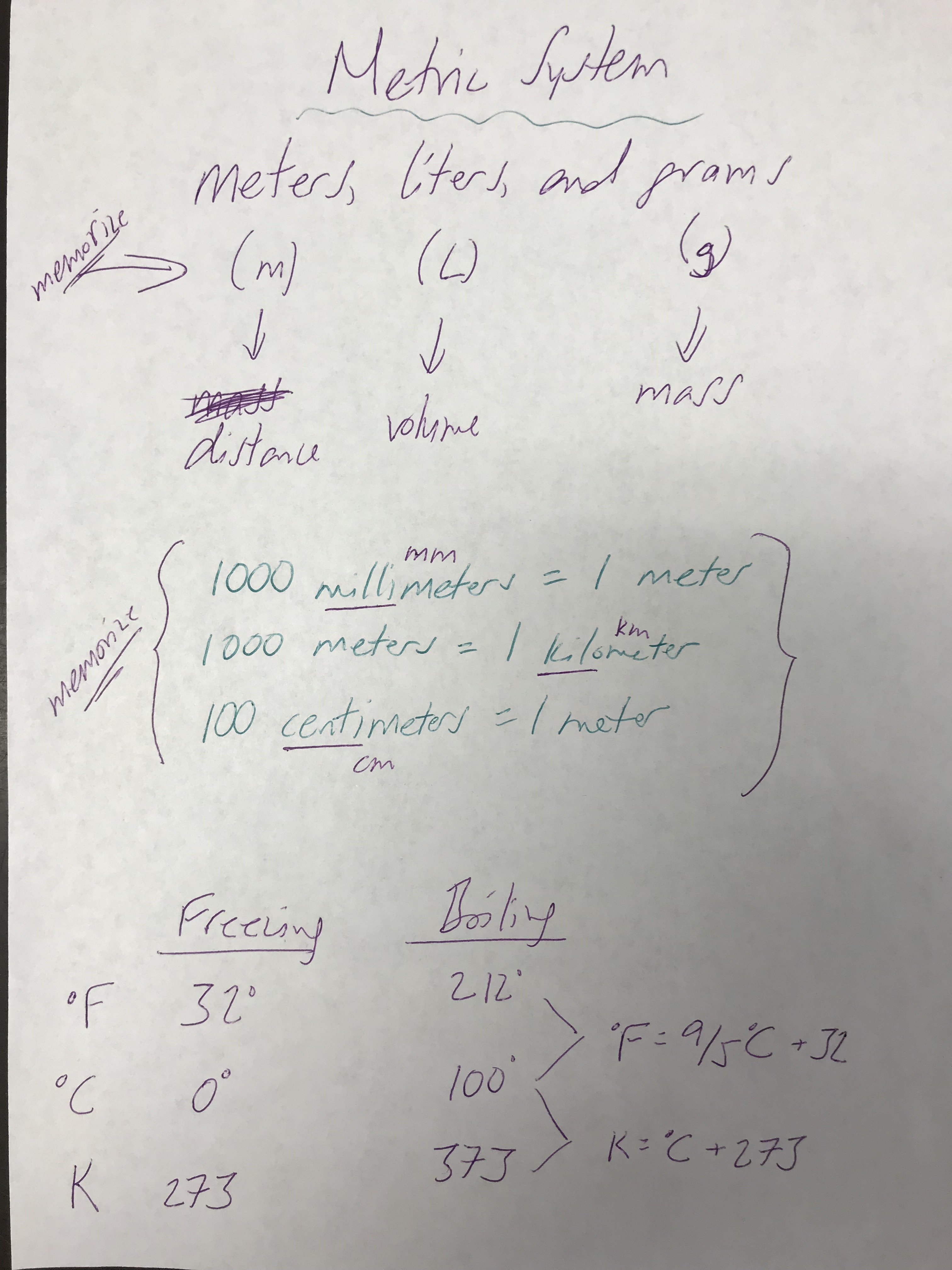
Next, we transitioned to a review of the metric system, focusing on the base units of meters, liters, and grams.  We followed that up with the classic video aptly titled, “Meters, Liters, and Grams.”

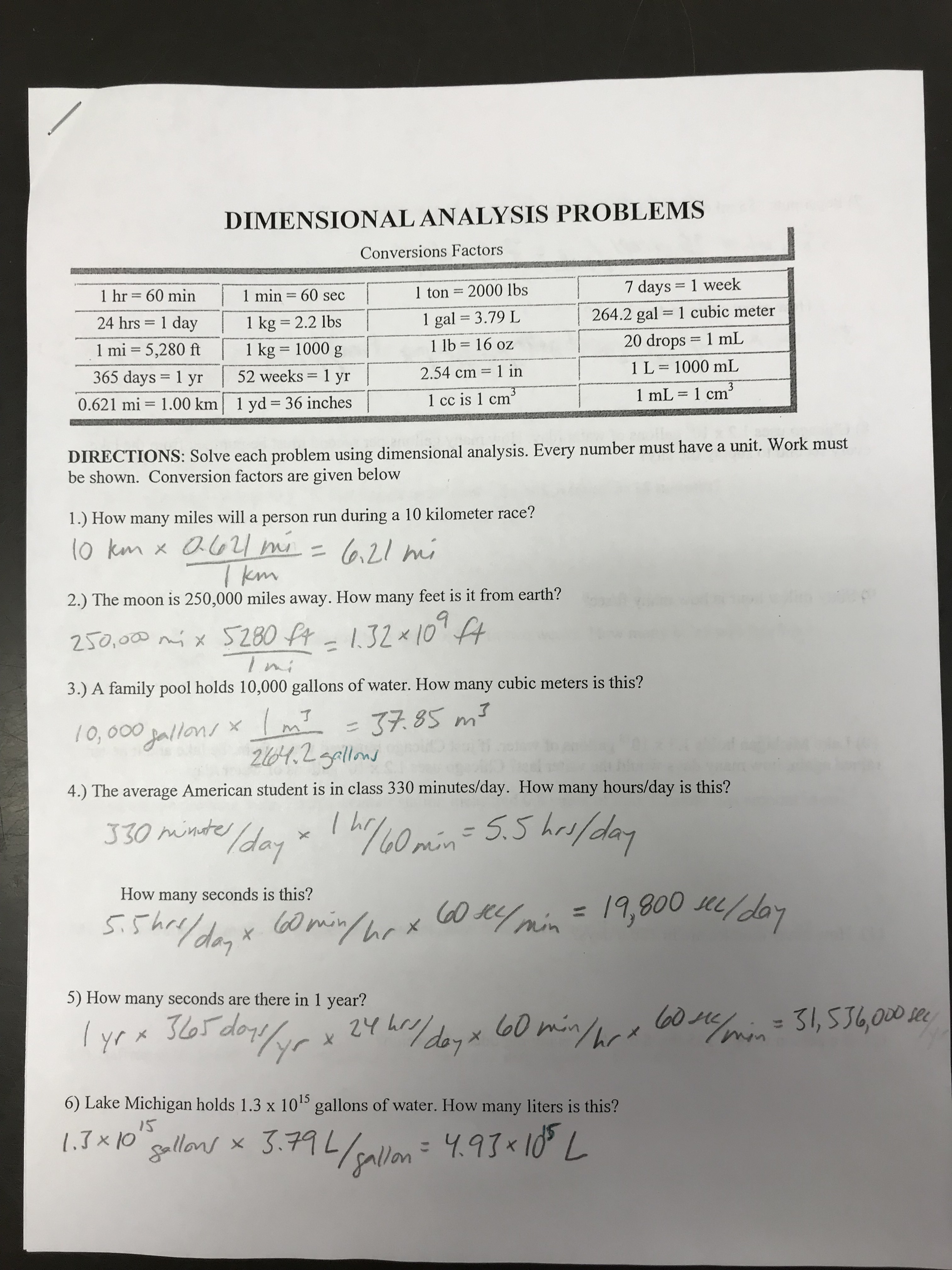
For the remainder of class, students solved Dimensional Analysis practice problems on a worksheet.  Students may turn in one completed page (one page = front and back) for homework credit.  Turning in both completed pages will earn the student a bonus point for homework.  We worked through the first six problems together as a class: