Category Archives: Chemistry

Workspace Calculations

Welcome to chemistry class!  When most students think of chemistry class, they think of something they’ve seen on TV or in the movies: specifically potions and explosions.  Our first piece of work this year is intended to drive home the point that we take lab safety incredibly seriously – there will be no potions or explosions in our lab space.  However, accidents are far more likely to occur in lab spaces that are overcrowded, and our work will be to determine where our lab space falls on the scale of safe to unsafe as determined by the number of students in the class and the square footage available to each student.

The assignment consists of two parts.  Part 1 involves an activity where students work together to sketch the lab, take measurements of the space, and calculate the square footage per student. An example of a floor plan drawn by one group of students is shown below.

Lab Floor Plan

This same group of students measured the interior walls of the classroom to be 307″ x 544″ (25.6′ x 45.3′) for a gross square footage of approximately 1160 sq ft.  After subtracting out the square footage of the immovable structures in the room, the net square footage was found to be 726 square feet.  The net square footage represents all of the available floor space in the classroom for all students to move safely about during a lab.  To calculate the square footage available for each student, one must divide the net square footage by how many students are in the class:

  • Period 2: 726 square feet / 26 students = 28 square feet per student
  • Period 3: 726 square feet / 27 students = 27 square feet per student
  • Period 4: 726 square feet / 26 students = 28 square feet per student
  • Period 5: 726 square feet / 21 students = 35 square feet per student
  • Period 6: 726 square feet / 28 students = 26 square feet per student

For Part 2, students will locate and describe the use of lab safety equipment, then write up their findings from Part 1 in the context of the article Overcrowding in the Instructional Space written by the NSTA Safety Advisory Board.  Ultimately, we will come away with a student-driven list of recommendations to ensure safety in our lab given the constraints (things we are unable to change).  Students who complete the assignment early (due Monday) will make lab safety posters which will be posted around the lab space.

Before the end of class on Friday, students will receive two copies each of the class syllabus and the student safety contract (all signed by student and guardian, one copy of each turned in to the teacher by next Friday, September 14, and the other kept in the student’s chemistry folder), and a copy of the letter home to families of chemistry students.

Gay-Lussac’s Law

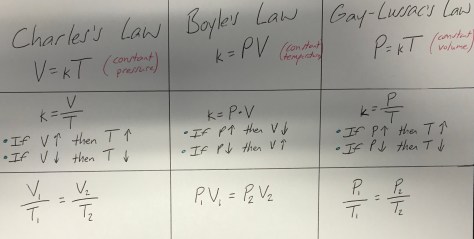
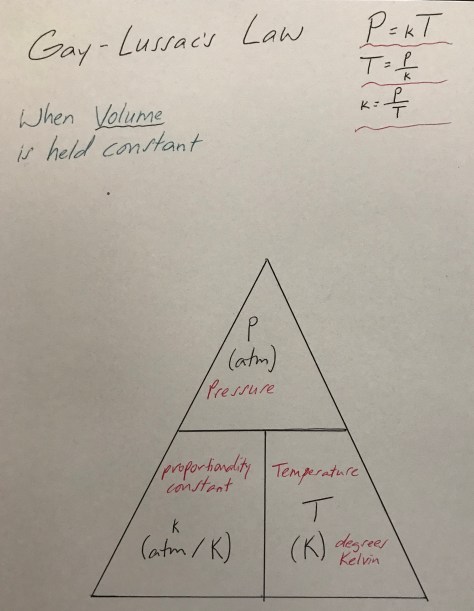
For lesson 59, we learned about Gay-Lussac’s Law (P=kT), the third gas law needed to connect pressure, volume, and temperature.  Gay-Lussac’s Law helps explain the egg-in-a-bottle trick, where boiled water displaces the air inside a bottle, and as the water condenses, an egg placed over the bottle will be pulled inside because of the change in pressure inside the bottle.

For students who missed the demonstration in class today, see the video below:

The Lesson 59 worksheet and Lesson 59 PowerPoint are available for download.  By the end of class tomorrow, students should be able to explain the outcome of the experiment below using Gay-Lussac’s Law:

Boyle’s Law

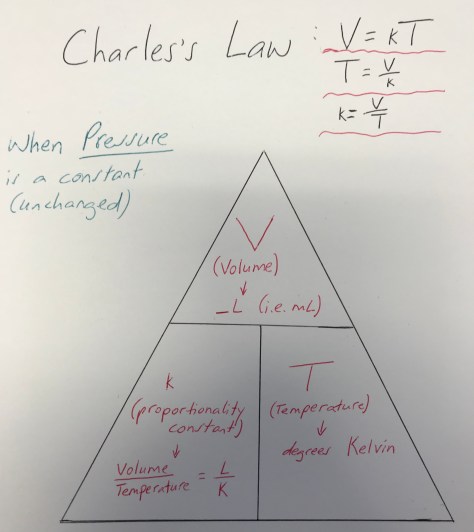
Before we began our study of Boyle’s Law, we reviewed Charles’s Law of Ideal Gases:

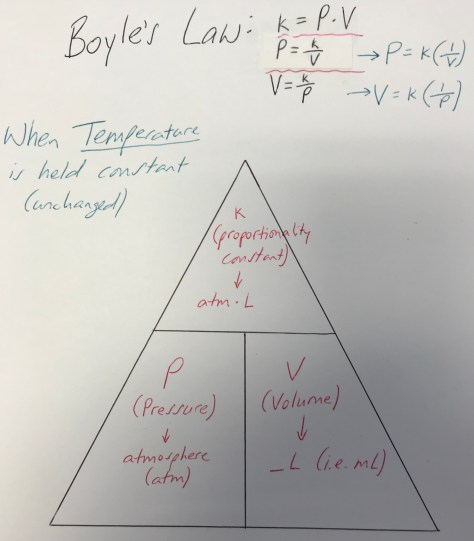
Continuing with our study of pressure and volume, students learned about Boyle’s Law in Lesson 58.  Class began with a Sci Guys video about Boyle’s Law:

After the video, students took down a few notes from the whiteboard (below) and then worked through the Lesson 58 Worksheet.  For reference, students are also encouraged to review the Lesson 58 PowerPoint.

Charles’s Law
Boyle’s Law
Whiteboard notes for the Lesson 58 lab


Air Pressure

Lots of demonstrations today!  We will conduct as many demonstrations as time and resources permit.  Students are encouraged to watch the videos below to make additional observations and to help explain what is happening in each of the demonstrations.  Students will write observations and draw pictures of air molecules to visualize pressure using the space provided on the Lesson 57 Worksheet.  The Lesson 57 PowerPoint includes the definition of pressure.

Balloon in a bottle:

Soft drink can:

Submerged cup:

Air pressure mat:

Cup and card:

Balloon in a vacuum:

Marshmallows:

Egg in a bottle:

Extend Your Learning!

Ever wonder why is space a vacuum?  Great question!  Read the cleverly titled article Why is space a vacuum? and find out!

Gas Density

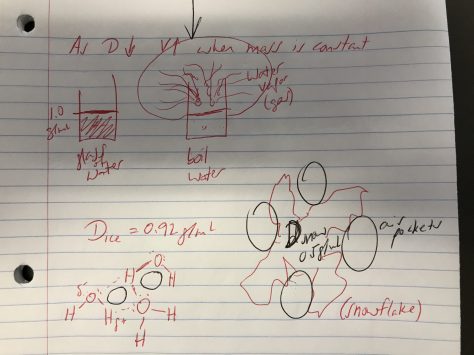
For the first lesson of Chapter 11, students worked with dry ice and watched a couple of teacher demonstrations involving dry ice.  To begin class, students quickly assembled into groups of 2-3 and transferred a small amount of dry ice into a deflated plastic bag which they sealed closed.  Students recorded the mass of the dry ice added to the bag, then measured the volume of the bag after the dry ice finished sublimating in order to calculate the density of carbon dioxide gas.

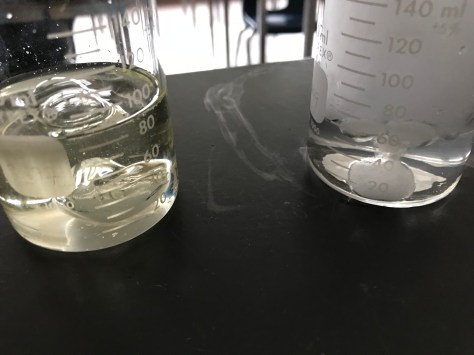
While waiting for the dry ice to sublimate, students hypothesized about what they might observe when water ice and dry ice were heated on a hot plate, and also what would happen when water and dry ice were added to liquid water or vegetable oil (pictured below).

Dry ice in vegetable oil (left) and water (right)

Students then observed the outcomes and recorded their observations on the Lesson 56 Worksheet.  Students also recorded the definitions of sublimation and evaporation, both of which are included in the Lesson 56 PowerPoint.  For homework, students were assigned problems 1-10 from Lesson 56 in the textbook.

Note: For students who missed class due to testing today, please watch the videos below as a substitute for participating in the lab.

Density, Temperature, and Fronts

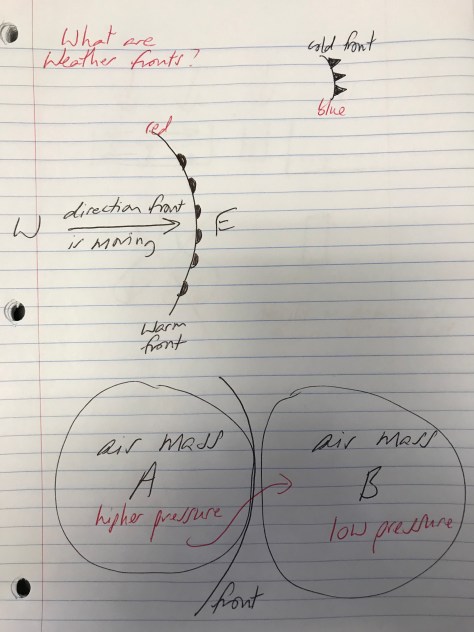
In the final lesson of Chapter 10, students focused their learning of temperature and volume back on the concept of weather as it relates to warm and cold fronts and the formation of clouds.  We worked through the ChemCatalyst in the Lesson 55 PowerPoint and then watched a clip of Kenvin Delaney, Jimmy Fallon, and Lucy Liu experiment with matter of different densities:

Students then worked through the Lesson 55 Worksheet which calls for them to reference the Weather Variables worksheet from Lesson 49.  For homework, students were assigned textbook questions 1-6.

Charles’s Law

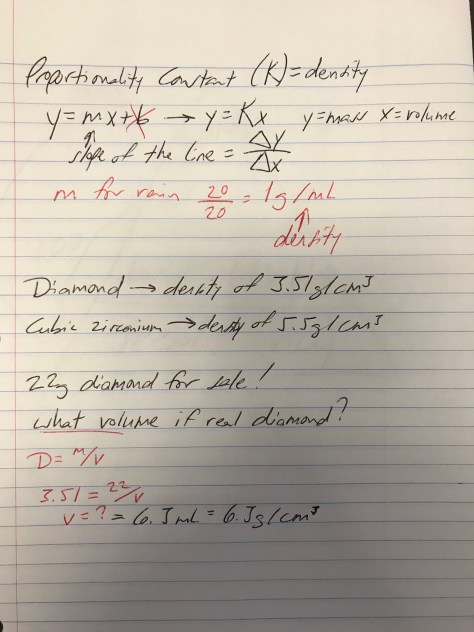
We formally connected observations about the relationship between temperature and volume by introducing Charles’s Law.  The Lesson 54 PowerPoint includes the definition of Charles’s Law (V=kT), extending the concept of the proportionality constant, k, to gases.  The constant is unique to each gas, and serves to connect temperature and volume.  We worked through the ChemCatalyst and watched a few minutes of a YouTube video showing a lava lamp in action:

We sketched out a before/during/after model of how a lava lamp works and the white board notes are shown below.

Students then practiced working through Charles’s Law by completing the Lesson 54 Worksheet.  For homework, students were assigned textbook questions 1-7.


Thermometers

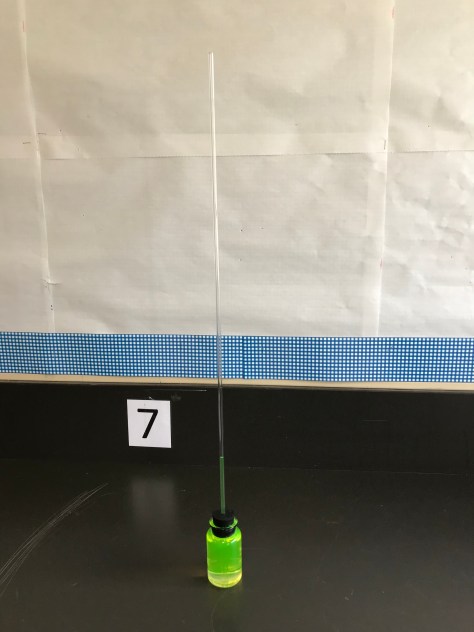
For Lesson 52, students conducted the DIY Thermometers Lab.  For homework, students were assigned textbook problems #1-9.  A picture of the liquid (antifreeze) thermometer setup is shown below:

Note: Tomorrow over half of each chemistry class will be attending the Shakespeare play, so students attending class will have time to complete homework.

Kelvin Scale

With so many students out of class on a field trip on Friday, we switched the order of Lesson 52 and moved ahead to Lesson 53.  We will return to Lesson 52 tomorrow after students have the opportunity to read through the lab and complete the pre-lab. Today, class began with a short SciShow video about the Kelvin Scale:

After the video, students worked through the Lesson 53 Worksheet.  The worksheet refers to a simulation which can be accessed here: Gas Properties (PhET simulation which requires Java).  The Lesson 53 PowerPoint is available for review by clicking here.  For homework, students should complete textbook questions 1-7.  Notes from class are provided below:

Lesson 49-51 Homework Review

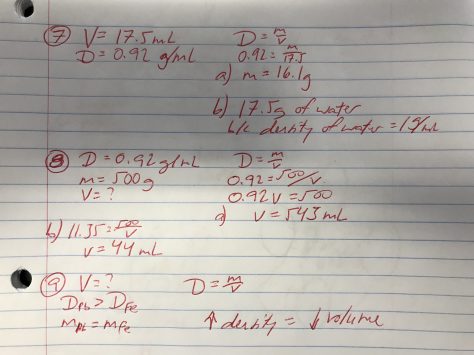
In preparation for the mini-quiz tomorrow on Lessons 49-51, students had time to review the answer key for those assignments (click the hyperlinked questions in the List of Homework for Unit 3 page).  Students had the remainder of the class period to study and ask questions about lesson content and specific homework questions.  Final reminder: Turning in completed homework by the start of class Friday is required in order to take the mini-quiz.

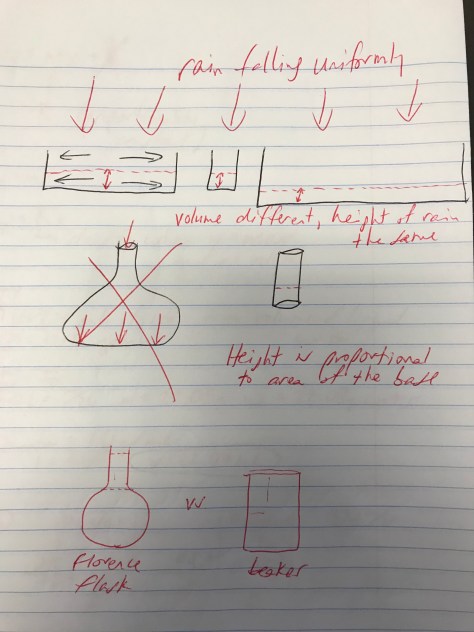
Notes are pictured below: