Category Archives: Chemistry

Structural Formulas

We continued our work from yesterday, beginning with the Lesson 29 PowerPoint.  After preparing for the lesson, students worked through the Lesson 29 worksheet which included another “wafting” activity in which three additional scents were provided for students to smell and connect with molecular formulas.  Students learned that two molecules can have the same molecular formula but smell very differently.  One compound smelled like rum extract, while an isomer of that compound smells like stinky cheese.  The compounds are isomers because they have the same chemical formula but different structural formula.  The activity further enabled students to make connections between compound names, molecular formulas, structural formulas, and smell.

List of samples and songs:

Homework:

  • Read Lesson 29 in the textbook.  Login via hs.saplinglearning.com and enter your username and password.
  • Write notes for Lesson 29 and work through the practice problems at the end of Lesson 29.
  • Please ask questions about anything from Lesson 29 you do not yet fully understand.
Molecular Formulas

For our first lesson of Unit 2, students were asked to respond to the following entry task (written in their notebooks):

  • What do you think is happening when you smell something?
  • Why do you think we have a sense of smell?

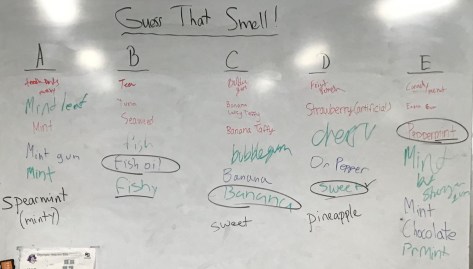
The first question directly tested student recall of the content learned yesterday.  Students will review, revise, and expand on their understanding of what happens when they smell something throughout the unit.  After a class share-out of why students think we have a sense of smell, we worked through the Lesson 28 PowerPoint and then students all participated in an activity (guided by the  Lesson 28 Worksheet) where they smelled five different scents and then compared their observations as a class. To reinforce yesterday’s lesson in which students learned about the connection between smell, emotion, and memory, students listened to snippets of songs while smelling each of the compounds.  We will revisit the songs and smells later in the unit to see whether music had an effect on student retention of smell identities.  After completing the individual smell test, students shared their individual thinking about the identity of each smell to reach a group consensus which they then wrote on the whiteboard (example shown below).  Once each group shared their thinking, the identity of each compound and the class of smell (minty, sweet, or fishy) was revealed.

IMG_0614

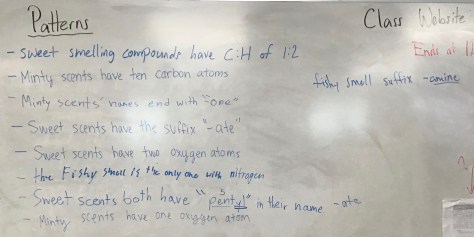
Based on the class results, students made connections between molecular formulas, chemical names, and scents (fishy, minty, or sweet).  Each student group contributed a pattern observed from Table 2 of the Lesson 28 Worksheet and an example from one class is shown below:

IMG_0613

List of samples and songs:

Homework:

  • Read Lesson 28 in the textbook.  Login via hs.saplinglearning.com and enter your username and password.
  • Write notes for Lesson 28 and work through the practice problems at the end of Lesson 28.
  • Please ask questions about anything from Lesson 28 you do not yet fully understand.
Deeper, Deeper, Deeper Still

To kick off our new chemistry unit focusing on organic chemistry (covalent bonds with an emphasis on carbon-containing molecules) and smell, we watched episode 6 of Cosmos.  The most relevant segment of the video occurs between minutes 13 and 17, where Dr. Tyson explains how molecules are detected by our brain, resulting in the formation of memory associated with smell.  Students completed the Unit 2 Initial Model handout (half-sheet) and turned that in as evidence of learning and engagement.  We will revisit and add to the model of smell throughout the unit.

Electroplating Lab Report

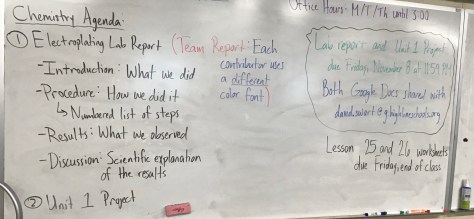
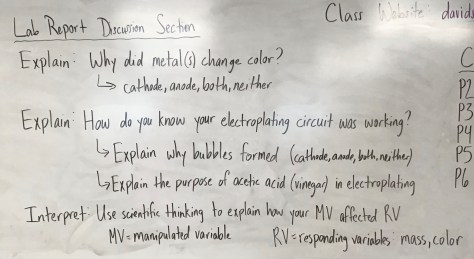
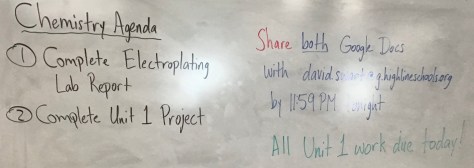
To conclude our electroplating lab, students will collaborate with their lab team to write a team lab report (shared with the teacher as a Google Doc).  Each student should use a different color font and team members should work together to determine how to equally divide the work.  The lab report is due Friday evening at 11:59 PM for full credit.  Late lab reports will receive a maximum score of 60%.

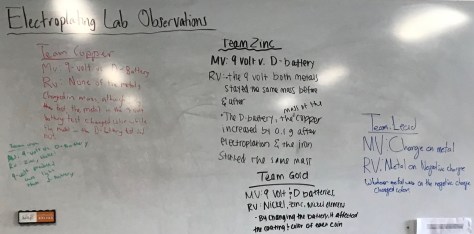
Electroplating Results By Class Period:

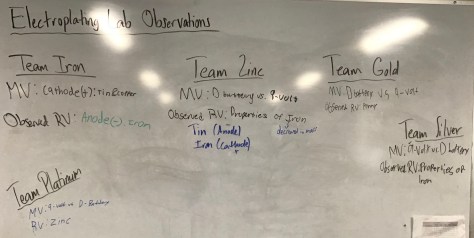
IMG_0605
Period 2 Electroplating Lab Observations
IMG_0606
Period 3 Electroplating Lab Observations

Friday: Final Model for Electroplating Lab

IMG_0609

IMG_0610

Electroplating Metals

For our final lesson of Unit 1, the concept of electroplating metals was introduced by watching a short video featuring a garage-style setup with a guy who uses a spork and pickle juice to electroplate a part of his cart project:

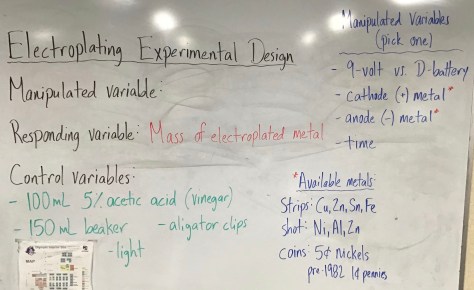
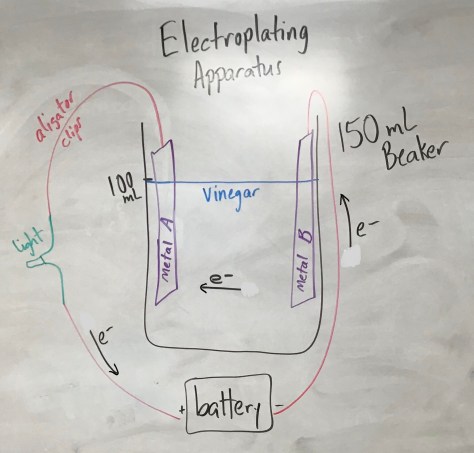
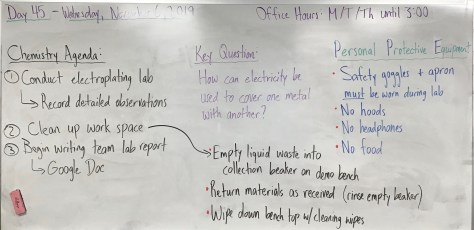
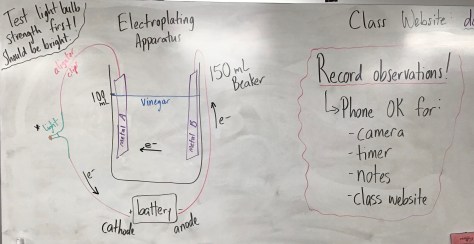
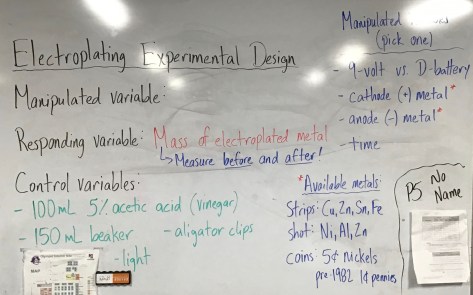
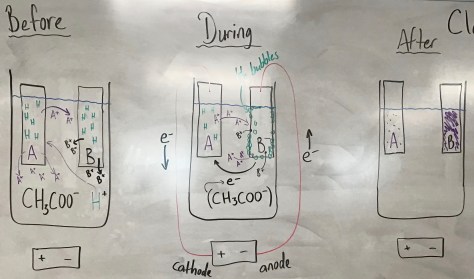
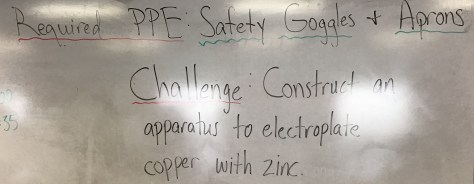
After the video, we discussed how to set up an electroplating apparatus (pictured below) and also discussed safety concerns and required personal protective equipment to be worn during the lab tomorrow (goggles and lab apron required, hair tied back, closed-toe shoes).  Students then worked with their table team to design an electroplating experiment and write up a procedure to follow tomorrow.

IMG_0598


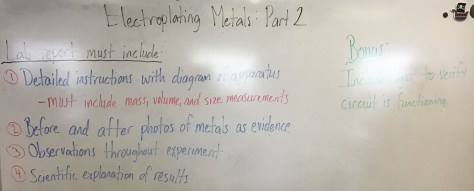
For the Wednesday lab, students must carefully document all aspects of their work in preparation for writing a lab report.  Students who finish early may begin writing the lab report.

IMG_0600

IMG_0602

Bonding

The Lesson 26 PowerPoint will introduce students to the four models of chemical bonding.  Students will also receive a handout of the models with additional information.  After the PowerPoint, students will work in pairs to organize the Substance Cards and record their learning on the Lesson 26 worksheet.

Homework for this evening:

  • Read Lessons 26 and 27 in the textbook.
  • Work through the homework problems at the end of Lessons 26 and 27 and write notes for Lessons 26 and 27.
  • Come to class tomorrow prepared to ask questions about anything from Lesson 26 you do not yet fully understand.
Classifying Substances

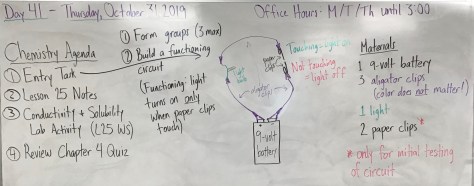
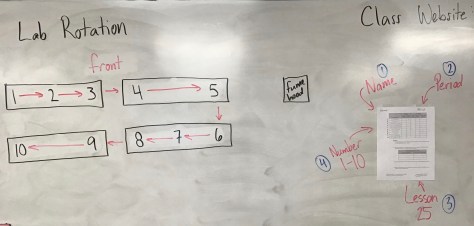
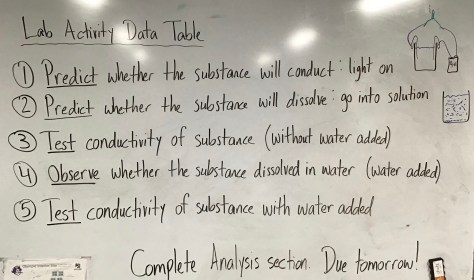
We enter the final chapter in Unit 1 with the Lesson 25 PowerPoint, introducing students to the concept of classifying substances based on properties of matter like conductivity and solubility.  After slide 6 in the PowerPoint, students will receive the Lesson 25 Worksheet and then work in groups of 4 students to test the conductivity and solubility of the substances listed on the worksheet.  By the end of class, students will compile all of the data from the lab into the table on page 2 of the worksheet.

Notes from class:

IMG_0592

IMG_0593

IMG_0594

Homework for this evening:

  • Read Lesson 25 in the textbook.
  • Work through the homework problems at the end of Lesson 25 and write notes for Lesson 25.
  • Come to class tomorrow prepared to ask questions about anything from Lesson 25 you do not yet fully understand.
Electron Configurations

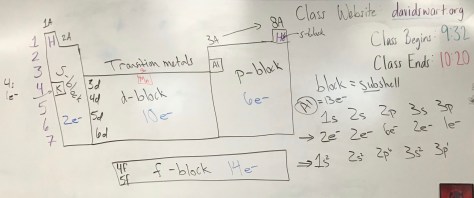
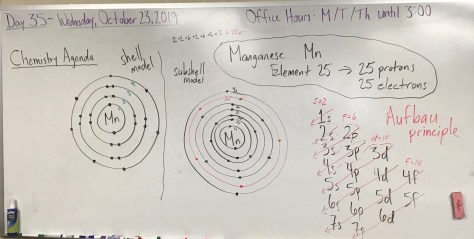
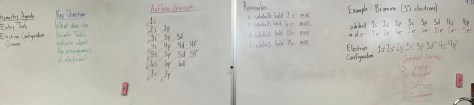
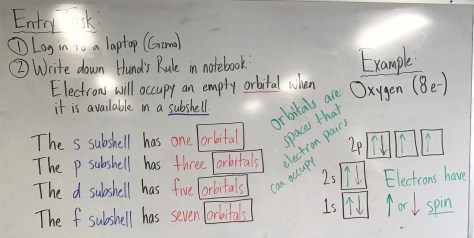
For our final lesson of Chapter 4, students took notes about the concept of sub-shells and then worked through the Lesson 24 Worksheet.

Notes from class:

Students are encouraged to watch the Crash Course chemistry video below as optional homework.


For Thursday’s lesson, students will gain additional practice with electron configurations via the Electron Configuration Gizmo.

Additional notes from class:

IMG_0580

IMG_0581

Keep Learning!

Extend your learning with additional videos focusing on electron orbitals and electron configurations.

Homework for this evening:

  • Read Lesson 24 in the textbook.  Login via hs.saplinglearning.com and enter your username and password.
  • Work through the homework problems at the end of Lesson 24.  Take notes.
  • Come to class tomorrow prepared to ask questions about anything from Lesson 24 you do not yet fully understand.
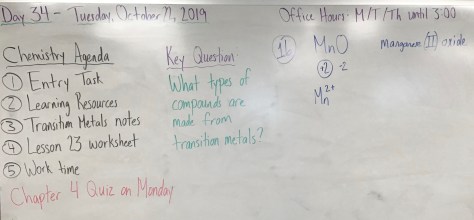
Transition Metal Chemistry

Today we learned about how to name compounds that involve transition metals.  To help launch the lesson, students watched a video by Tyler DeWitt titled Transition Metals in Ionic Formulas:

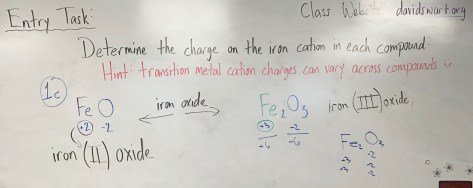
After watching the video, we practiced writing ionic formulas with transition metals via the Lesson 23.1 worksheet.

Notes from class:

IMG_0576

IMG_0577

Extend your learning!

Students are encouraged to review lesson content by watching the videos below:

Real-world application:

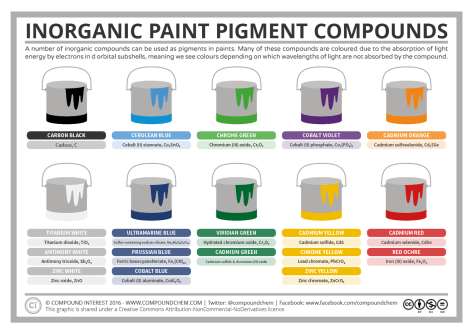
Click on the image below to learn more about how transition metals are used in the process of coloring paint.

Chemistry-of-Inorganic-Paint-Pigment-Compounds

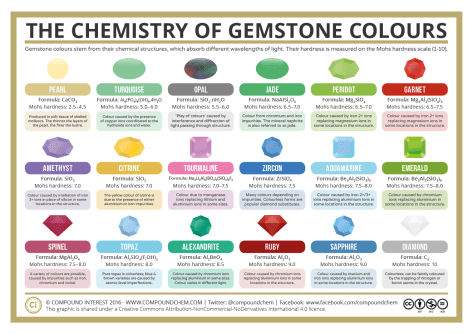
Next, click on the image below to learn how transition metals impact the color of gemstones:

The-Chemistry-of-Gemstone-Colours-2016

What do you notice about the two different images?  How can different transition metals turn different materials (paint and gemstones) similar colors?  How do similar chemical formulas result in different colors?  To help answer this, consider the difference between paint and gemstones: you light observes light reflected by both substances.  Does light interact with paint and gemstones differently?