Category Archives: Biology

Week 8

Monday, October 21 (HS-LS1-3): Our work this week is to apply our learning of homeostasis to the cellular level.  The primary focus of the lesson today was to provide students with the vocabulary to explain the concepts of osmosis and transport of water across the membrane via the membrane protein channel aquaporin.

To begin class, students will be introduced to the Egg Lab.  Each student will receive a chicken egg, and they must measure and record the volume of their egg using water displacement.  For this first day of the Egg Lab, students will then place the egg in a container with vinegar to begin the process of dissolving the shell.

Students will begin class by watching the Amoeba Sisters: Cell Transport video (below).

After the video, students will complete a worksheet that goes along with the Amoeba Sisters video.


Tuesday, October 22 (HS-LS1-3): To begin class, students will attend to their egg (Day 2).  Their job today is simply to replace the vinegar without harming their egg.  The fresh vinegar will continue to dissolve the egg shell over the next two days

Next, we will work through the Membrane Functions PowerPoint slide deck.  Students should commit the vocabulary terms to memory.  The aquaporin claymation video included in the slide deck is also provided below for easy access:


Wednesday, October 23 (HS-LS1-3): Next, we will finish working through the Slide Deck from yesterday and then students will apply their learning about osmosis by working through the Osmosis Gizmo on the Explore Learning website.

Any remaining time may be used to complete the Mitosis and Cancer BioInteractive from last week.

Keep Learning! Students who would like a more in-depth review of cell membranes and transport are encouraged to watch the Crash Course video below outside of class:


Thursday, October 24 (HS-LS1-3): For day 4 of the Egg Lab, students will work with their lab table groups to complete the following:

  1. Gently rinse each egg to remove any last parts of the shell.
  2. Gently dry each egg.
  3. Measure the volume of each egg separately using water displacement.
  4. Each student in the group should record the volume of each egg in their lab notebook.  For example, a group of four students will each have four egg volume recordings in each student’s lab notebook.
  5. Rinse out the cup and dry it with a paper towel, and return the egg to the cup.  Label the cup with the student’s name.
  6. Carefully cover the egg with one of the following:
    • Vinegar (egg #1)
    • Corn syrup (egg #2)
    • Distilled water (egg #3)
    • Bonus liquid (egg #4)
  7. Label the cup with the liquid used and then cover the cup with plastic.
  8. Record any additional observations about the egg during the class period.
  9. Return the cup to the fume hood for further observation tomorrow.

For the remainder of the class period, students should work hard to complete any missing biology assignments.  We have an exam next Thursday, so students who are caught up on work should begin assembling a page of notes to use on the exam.


Friday, October 25 (HS-LS1-3): The egg lab concluded with students receiving the following instructions:

  1. Gently rinse and dry egg
  2. Measure and record the final volume using water displacement
  3. Discard the egg and cup

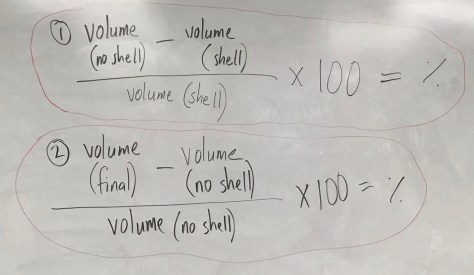
After discarding the eggs, cleaning up the lab station, and washing their hands (as they have been doing each day of the lab), students were tasked with working with their lab group to calculate the change in volume:

  • from Day 1 (Monday, volume of eggs with shell) to Day 4 (Thursday, volume of eggs without shell)
  • from Day 4 to Day 5 (volume of eggs after soaking overnight in various liquids)

A positive change means the egg gained volume.  A negative change means the egg lost volume.  Students reported out their data as a class (shown below), and then we discussed the movement of water across the membrane of eggs placed in various solutions (final picture below).
IMG_0584

IMG_0585

Week 7

Monday, October 14, 2019 (HS-LS1-4): Mid-unit 1 quizzes are due at the beginning of class for full credit.  Late quizzes will receive a maximum score of 60%.

Having learned about DNA last week, it is time to focus on the process of cell division.  Mitosis, or somatic cell division, involves the division of one cell into two after all of the components of the original cell (including the DNA!) divide into two sets.  We began by watching a Crash Course video about mitosis:

After the video, students were assigned to read pages 46-51 of chapter 4 (Cellular Reproduction: Multiplication By Division) of Inside the Cell.   Students then answered the following questions in their lab notebooks:

  1. Explain the purpose of mitosis.
  2. Which cells undergo mitosis?
  3. Describe the phases of mitosis in detail (words and/or drawings).
  4. Explain what happens when cells divide uncontrollably.  List the known causes of uncontrolled cell division.

Tuesday, October 15, 2019: Class began with a brief discussion of questions 1 and 2 from yesterday’s reading assignment.  After the discussion, students had the remainder of the class period to complete the reading and questions, and then to work in teams to create a time-laps video of mitosis modeled with Play-Doh.


Wednesday, October 16, 2019: PSAT


Thursday, October 17, 2019: As we continue our study of mitosis, students will invest the next two days researching what happens when cells divide uncontrollably.  Students will use The Eukaryotic Cell Cycle and Cancer Interactive tool from HHMI BioInteractive to explore how errors in DNA copying during mitosis can lead to cancer.

Students may choose between the overview worksheet (beginner) and the in-depth worksheet (advanced).


Friday, October 18, 2019: Students have the short Friday class period to complete The Eukaryotic Cell Cycle and Cancer worksheet activity from yesterday.  Students who finish early should extend their understanding of cancer treatments by watching the Ted-Ed video below about biohacking cells to fight cancer.  After watching the video, students may earn up to +5 bonus for writing a summary of how scientists are creating CAR-T cells to upgrade the human immune system to fight cancer.

Need a break from the study of cancer?  Learn about the amazing process of regeneration in planaria!  After watching the video below, students may earn +5 bonus for writing a summary of the RNAi experiments (blocking the activity of beta-catenin and APC) in planaria.

Week 6

Monday, October 7: Students will write up a lab report of last Friday’s strawberry DNA extraction lab report.  The lab report will include the following components:

  • Student name
  • Lab report title
  • Introduction (explain the purpose of the lab)
  • Procedure (numbered list of steps someone could follow to recreate the experiment you are reporting on)
  • Results (observations from the lab)
  • Conclusion (what was learned, three areas of improvement, and explanation of the “next” experiment)

Tuesday, October 8: Students repeated the strawberry DNA extraction experiment from last Friday, testing the experimental question “Which type of soap is better at extracting strawberry DNA?”  Students conducted the extraction twice, using extraction solution prepared with either Dawn dish soap (orange) or Suave shampoo (blue).  Students took pictures of their results to include in their revised lab report.

Notes from class today:


Wednesday, October 9: To begin class, students shared out the results from their lab yesterday.  We then made connections between procedure steps, extraction solution components, cell structure, and DNA precipitation.  Students had the remainder of the class period to update their lab reports and to bulk up the Introduction and Conclusion sections of the lab report by incorporating what was learned today.


Thursday, October 10: For our final day of class this week, students had the opportunity to complete their lab reports (due today) or begin the take-home quiz (due Monday).


Friday, October 11: No School / For homework over the long weekend, students will complete the mid-unit take-home quiz.

Week 5

Monday, September 30 (HS-LS1-1): Our week began with a brief class discussion in which students shared out what they know (or think they know) already about DNA.  Students then received a worksheet with questions that were answered by watching The Double Helix video.

After sharing out answers from the video, students received a guided worksheet and instructions for how to complete the first half of the first page.  We will continue the work tomorrow.


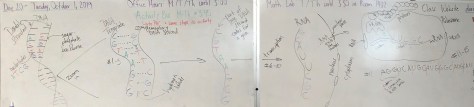
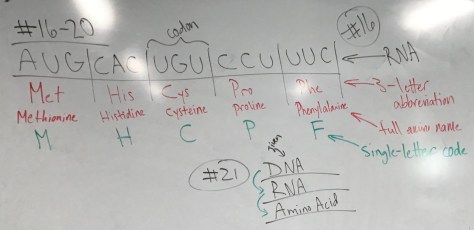
Tuesday, October 1 (HS-LS1-1): Today we launched into an investigation of Central Dogma.  Students learned how DNA codes for RNA which codes for protein, with everyone drawing out the notes shown below.  We drew out the processes of transcription and translation, using the guided worksheet from yesterday to help students understand what happens at each step of the process.  We will continue our exploration of Central Dogma and complete the worksheet packet tomorrow.

Notes from class:

IMG_0536

IMG_0537


Wednesday, October 2 (HS-LS1-1): We completed our tour of Central Dogma with students working through the final page of the guided worksheet from yesterday.  Drawings and the worksheets were both turned in for credit.

Next, we learned about the information contained in DNA.  We watched a thought-provoking video about a scientist who has combined a variety of tools and technologies to turn DNA from hair into portraits using 3-D printing and concluded class with a discussion about how the technology will impact people in the near future.


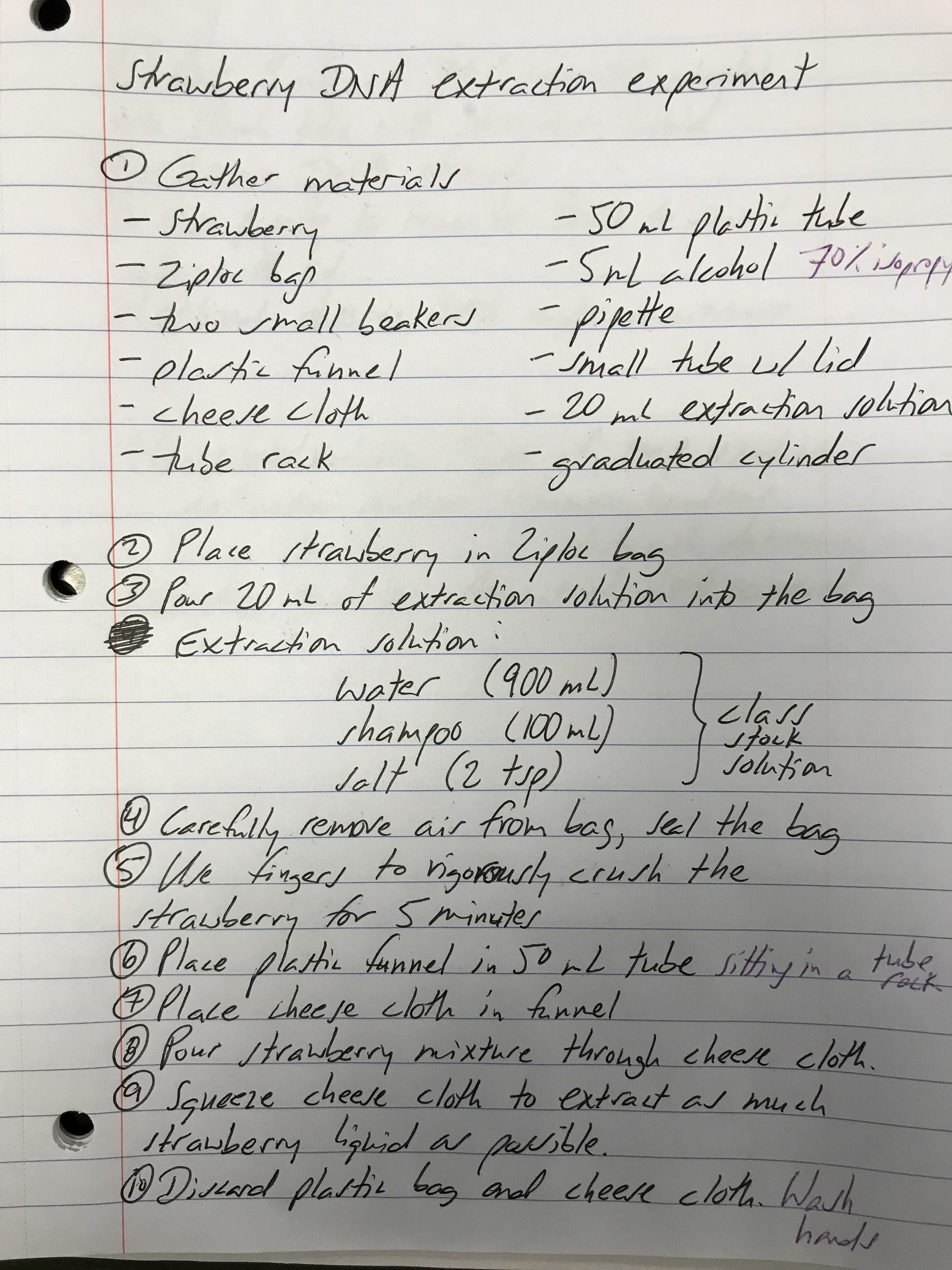
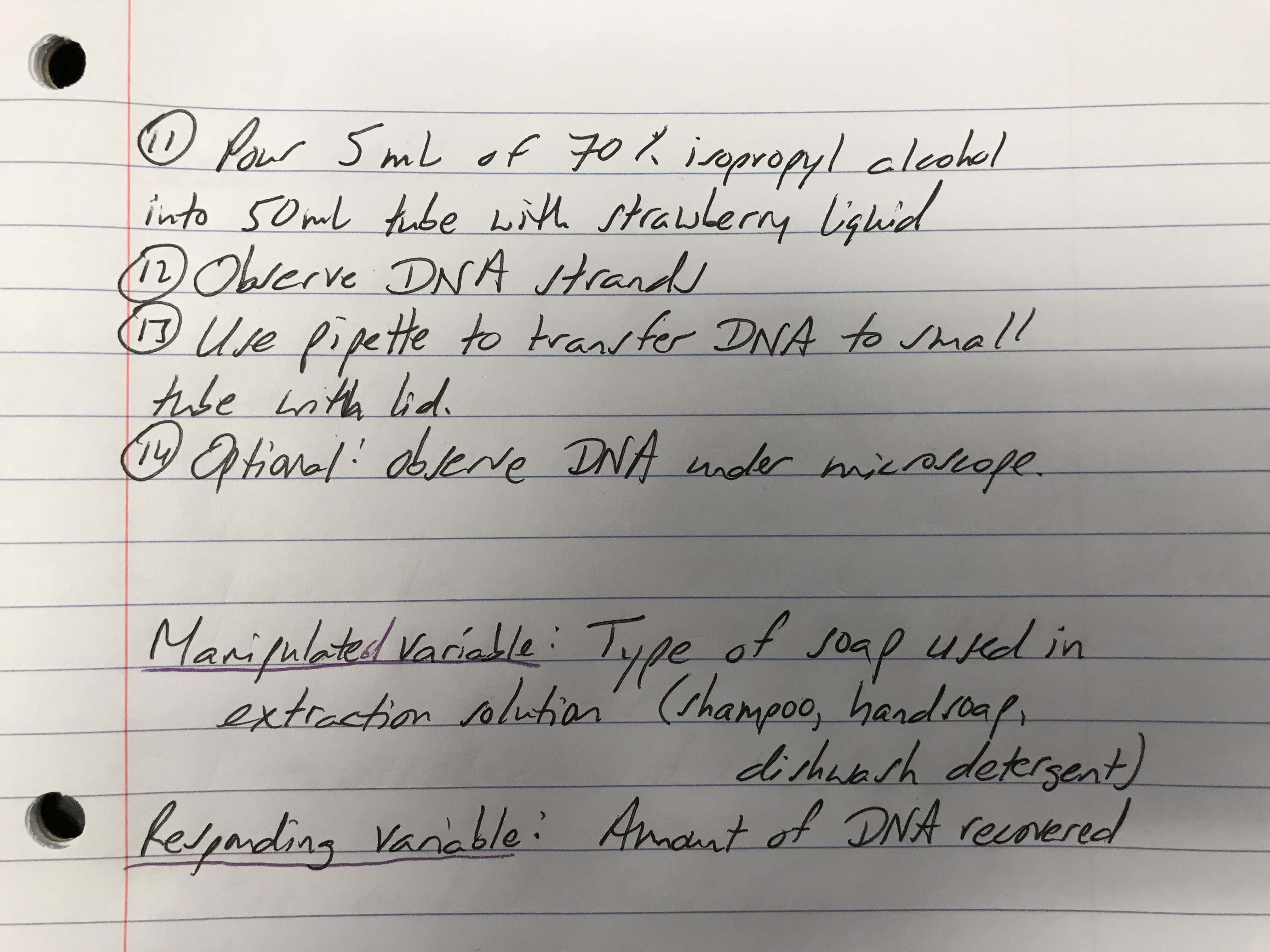
Thursday, October 3 (HS-LS1-1): In our continued study of Central Dogma, we set our sights on extracting DNA from strawberries.  To prepare for the lab, students watched a video explaining the DNA extraction procedure (produced by the North Carolina Community Colleges group NCBioNetwork.org).  Students watched the video and wrote down as many details as they could.

After watching the video, we assembled one class procedure “crowd-sourced” from the all of the student notes.


Students had the remainder of the class period to type up their notes as the Procedure section of a lab report.


Friday, October 4 (HS-LS1-1): Students will conduct the strawberry DNA extraction lab.  All materials, procedure steps, and results must be documented in their lab notebooks which will be checked and graded for accuracy and completion.

Week 4

Monday, September 23 (HS-LS1-5): We will begin the week with The Digestive System video by Mr. Anderson at Bozeman Science to review this important area of study.

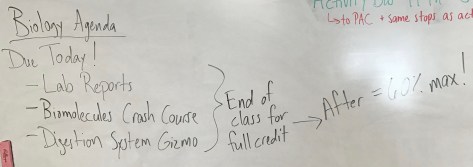
After the video, students will have the remainder of class to complete the Digestive System Gizmo activity packet from last week.

Homework:

Watch the Biological Molecules Crash Course video (below) and complete the associated worksheet.


Tuesday, September 24 and Wednesday, September 25: Half of the 9th grade class is scheduled to visit Camp Waskowitz, so students who are in biology class today will have the class period to begin writing a lab report detailing the corn seed germination and corn plant growth experiment.

The lab report must include:

  • Student name
  • Lab report title
  • Introduction (explain the purpose of the lab)
  • Procedure (numbered list of steps someone could follow to recreate the experiment you are reporting on)
  • Results (observations from the lab, including how many seeds were germination, how many days it took for germination to happen for each seed, and daily plant growth)
  • Conclusion (what was learned, three areas of improvement, and explanation of the “next” experiment)

Thursday, September 26: Students have the entire class period to complete the plant experiment lab report.  Students who finish the lab report early will begin constructing molecular models for the photosynthesis and cellular respiration activity tomorrow.


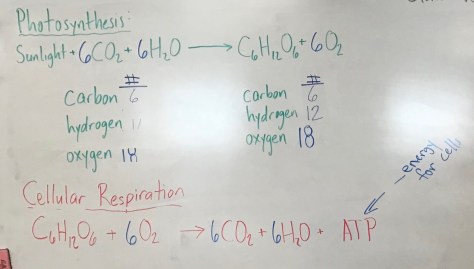
Friday, September 27 (HS-LS1-5, HS-LS1-7): For our short Friday class period, students will use molecular modeling kits to build the molecules involved in both photosynthesis and cellular respiration.  Students will learn how to balance both equations and will understand the concept of energy stored in the bonds of molecules.

Notes from class:

IMG_0525

IMG_0526

Week 3

Week 3: September 16-20

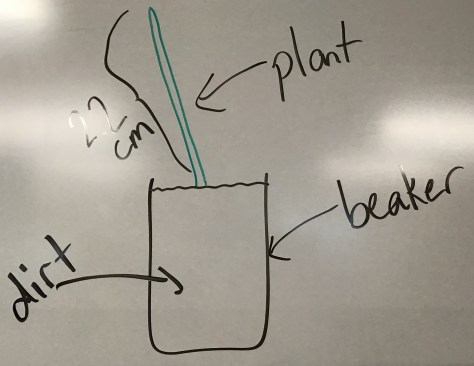
Monday, September 16 (LS1-2): After making and recording corn seed observations, students plant seeds in soil in preparation for the next phase of our experiment.

IMG_0498

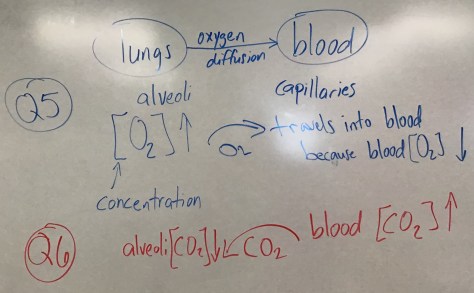
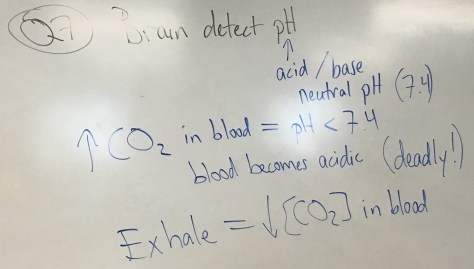
Next, students will discuss the analysis questions from last Friday’s assignment.  In The Breath of Life reading, students learned how the respiratory system of humans enables gas exchange, with the lungs inhaling oxygen and exhaling carbon dioxide.  The gas exchange occurs within the alveoli, thin-walled sacs inside the lungs.  The reading introduced the concept of feedback systems, focusing on the special nerve cells in the cardiovascular and nervous systems that can sense changes in pH.  As carbon dioxide builds up, the blood becomes more acidic, and the lungs are forced to exhale to rid the body of carbon dioxide which then brings the pH back to normal levels.

IMG_0497

IMG_0496

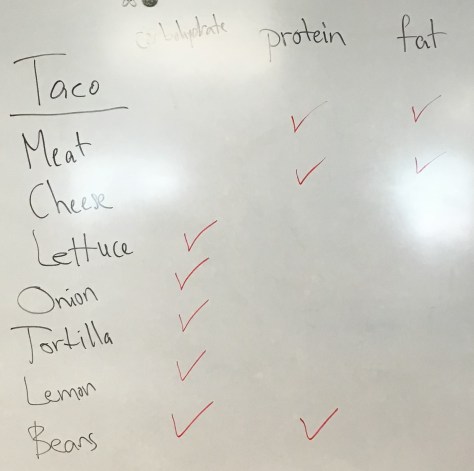
For the last few minutes of class, we made a list of some of the ingredients found in tacos, and then categorized those food items as carbohydrates, proteins, or fats.  We will dig into this work much more deeply tomorrow.

IMG_0499


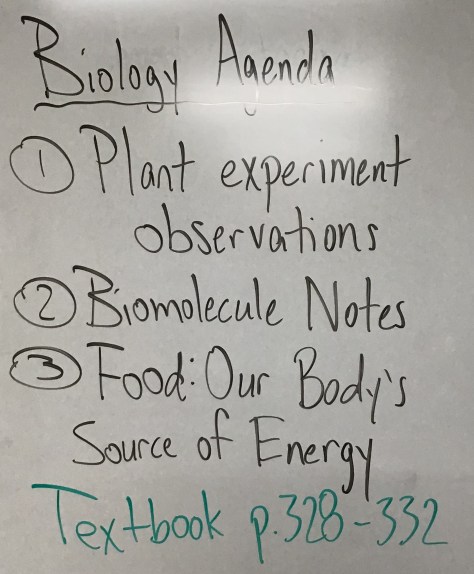
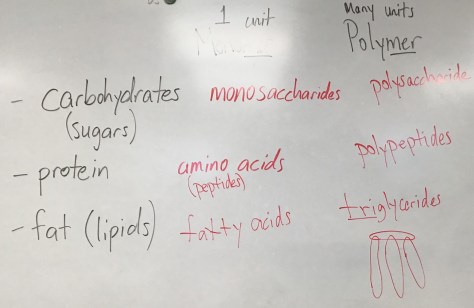
Tuesday, September 17 (LS1-2):  After making and recording corn plant observations, students actively took notes and shared their understanding of biomolecules.  Glucose is a simple sugar and the key ingredient in cellular respiration, the process organisms use to generate vast amounts of ATP energy.  Sugars are one type of biomolecule.  Our work today was to learn about three major classes of biomolecules: proteins, fats (lipids), and sugars (carbohydrates).  We reviewed the monomers and polymers of each, and then students read pages 328-332 in our textbook and completed the associated worksheet.  The assigned reading is titled Food: Our Body’s Source of Energy and Structural Materials.  Now that students understand the link between photosynthesis (chemical potential energy stored in glucose), cellular respiration (glucose metabolized to transfer the energy in glucose to ATP), and the larger connection with the respiratory and cardiovascular systems, it is time to learn more about how the digestive system makes use of the variety of foods available to us.  It is time to think beyond glucose.

Notes from class:

IMG_0505

IMG_0503

IMG_0504


Wednesday, September 18 (LS1-2): After making and recording corn plant observations, we reviewed the reading from yesterday and focused in on an important group of enzymes responsible for digestion in the human digestive system.  For the remainder of class, students worked with a partner on the Digestive System Gizmo activity packet.


Thursday, September 19 (LS1-2): After making and recording corn plant observations for the final time, students will work with a partner to complete the Digestive System Gizmo activity packet.


Friday, September 20: Students had the entire short Friday class period to work on the Digestive System Gizmo activity packet.  Students were instructed to complete, at a minimum, through Activity B as homework before class on Monday.


Keep Learning!

Watch The Digestive System video by Mr. Anderson at Bozeman Science to learn more about this important area of study!

Week 2

Week 2: September 9-13

Monday, September 9: Signed copies of the safety contract and syllabus are due today.

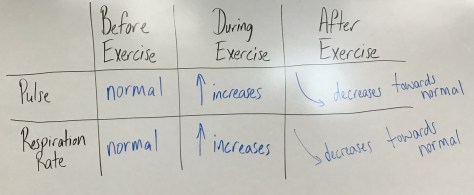
For class today, we will revisit our work last week on homeostasis.  We will discuss the concepts of positive and negative feedback as they relate to humans, and extend our thinking to plants. (Reminder – please enter heart rate and respiration data on the Google Form so we can analyze the class data tomorrow.)  We began our work with students sharing what they know about the connection between exercise, pulse rate, and respiration rate.  We extended the discussion to include photosynthesis and cellular respiration, connecting all of the ideas together through feedback loops and the hormone epinephrine (also known as adrenaline).  Class notes are shown below.

file-7

file1-4

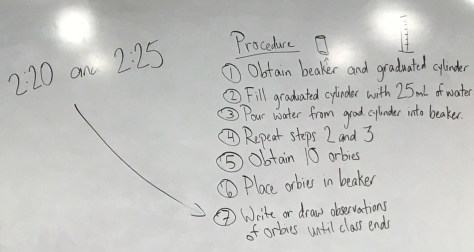
Our work this week is to further our understanding of how organisms interact with their environment.  For our first experiment of the school year, students will explore variables involved with seed germination and plant growth.  We will determine which variables promote plant growth (positive feedback) and which inhibit plan growth (negative feedback).  Our work today is to begin the process of seed germination by first hydrating Orbeez.  The procedure we followed is shown below:

file2-3


Tuesday, September 10 (HS-LS1-3):

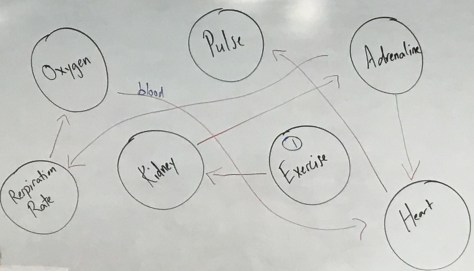
Class began with an entry task in which students were tasked with constructing a network diagram using 7 vocabulary terms learned so far this year.  After making initial attempts, students worked with their lab table group to optimize their network.  The first team finished drew their network diagram on the white board (pictured below) and the class analyzed it.  Students learned to look for the node with only arrows leaving to determine where to start, and they learned that the arrows point from one term toward the next term in the sequence.

file-9

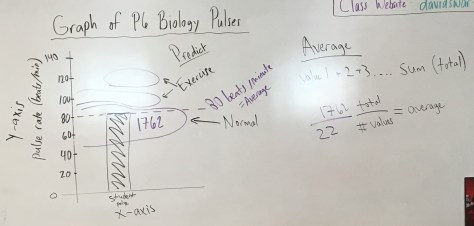
While students were busy drawing network diagrams, Nurse Jessica visited and offered to use a pulsometer for students to obtain accurate pulse readings.  We used the anonymous student data to construct a graph and then calculated the average pulse rate (beats per minute) of all of the students in the class.

file1-6

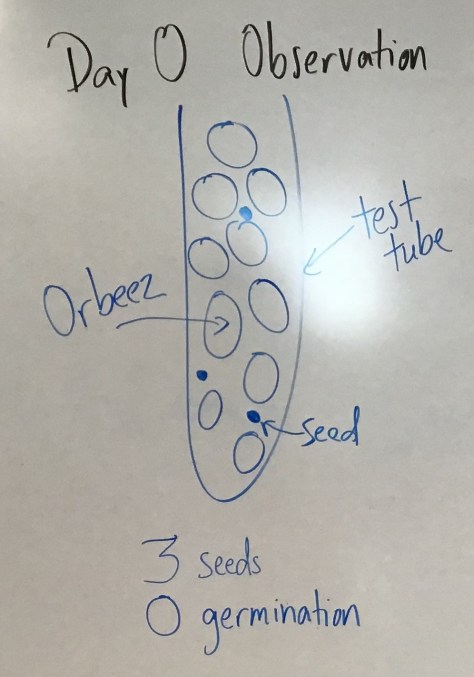
Finally, we returned to our Orbeez hydration activity from yesterday.  Students recorded observations of their Orbeez after one day (24 hours) hydrating in water.  Students then rinsed their Orbeez and placed 10 Orbeez in a labeled test tube along with some corn seeds.  Students selected up to 10 seeds to add to their test tube.  Students drew and labeled their initial (Day 0) observations in their notebooks.  Over the next few weeks, students will make daily observations of their corn seeds.

file2-4


Wednesday, September 11: At the beginning of class, students recorded observations of their corn seeds “planted” in Orbeez.

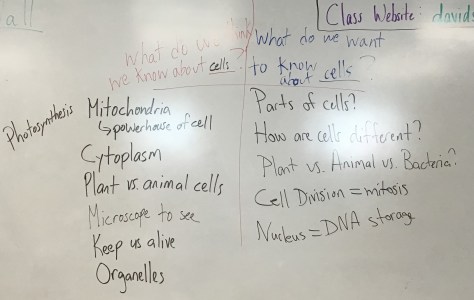
Next, we constructed a student-generated list of what students know, think they know, or want to know about cells:

IMG_0475

Next, we will watch the Harvard BioVisions video Inner Life of a Cell, which presents a realistic animation of how cells move:

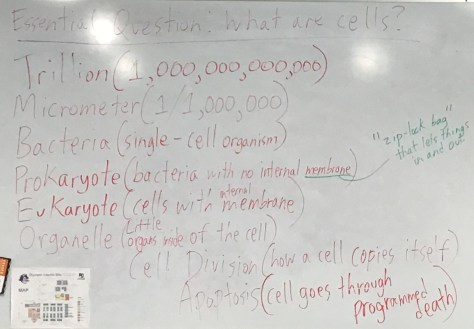
After the video, Mr. Peterson guided students through new vocabulary words that they will encounter in an article to be read after working with Mr. P.

IMG_0476

The article, titled Facts About Cells, comes from Newsela.  Students will have the option to select one of four different versions of the article, each geared toward a different reading level.  Students will select the version most appropriate for them and then complete the quiz questions at the end of the article.  For students looking for an advanced level text, students may instead read through page 13 of Chapter 1 of Inside the Cell.  The “Got It” questions on page 19 are due tomorrow by the end of class instead of the “quiz” questions from the Newsela article.


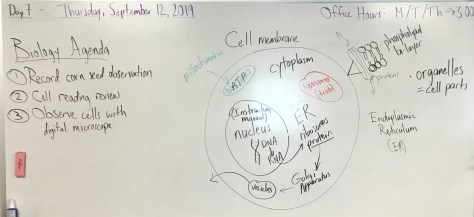
Thursday, September 12 (HS-LS1-2): After making and recording corn seed observations, we discussed the articles from yesterday.  Students gathered into groups based on their chosen text levels and discussed the “quiz” questions at the end of the articles.  We used the reading as a basis to construct a model of a cell, with aspects of the model representing a network diagram.  We finished by revisiting photosynthesis and cellular respiration, connecting the mitochondria organelle from our model with ATP from cellular respiration.

Notes from class:

IMG_0483

IMG_0484


Friday, September 13 (HS-LS1-2):  After making and recording corn seed observations, students will review the types of cells as a class.  When finished, students will read The Breath of Life on pages 236-239 of the BSCS Biology textbook and complete the analysis questions (due Monday).  We will discuss the analysis questions on Monday.


Keep Learning!

Want to learn more about body systems and the specialized cells, tissues, and organs they contain? Review the body systems with Anatomy and Physiology videos from Crash Course!


Week 1

Week 1: September 4-6

Wednesday, September 4: Networking 

To kick off the school year, students will meet the teacher, learn about our classroom, and then complete the Ten Facts About Me survey.  The information they share will help introduce the students to each other and the teacher.  Students will share information about themselves with each other, constructing a network diagram during the process.  The survey and network diagram will be turned in at the end of class.


Thursday, September 5: Human Homeostasis (HS-LS1-3)

Computers are an invaluable tool for modern-day biologists.  We will rely on computer technology frequently this school year as a means to acquire and share knowledge.  For this lesson, students will work with their assigned partner to create free accounts at ExploreLearning.com.  We will periodically utilize the simulations (called Gizmos) on the website.  After both partners have successfully created accounts, students will work together with the assignment of completing Activity A of the Human Homeostasis Gizmo worksheet.  Note: students faced a number of challenges today while working on the Gizmo (too few functioning computers and several student gmail accounts locked) so the Gizmo will not be counted as an assignment.


Friday, September 6: Human Homeostasis (HS-LS1-3)

When class begins, students will review important vocabulary concepts from yesterday’s work with Mr. Peterson.  Next, students will be introduced to our class experiment.  Students will monitor their heart rate and respiration rate (one minute each) on at least three separate occasions today (Friday), tomorrow (Saturday), and Sunday.  Each day, students should record resting rates, rates after light activity, and rates after exercising.  Students will record each data point on this Google Form and we will analyze the class set of data next week.  Finally, students received copies of the class syllabus and safety contract.  Students will read and return both copies on Monday, signed by both the student and a parent or guardian.


Keep Learning!

For students interested in pushing their learning beyond the content learned in class, we can look to the Next Generation Science Standards (NGSS) for High School Life Science (HS-LS) for the standards we are investigating and look for assessment boundaries.  The assessment boundary for HS-LS1-3 states: Assessment does not include the cellular processes involved in the feedback mechanism.  This means the WCAS exam students take at the end of their 11th grade year (based on understanding of the NGSS) will include questions that approach the assessment boundary but do not include content at that boundary.  Therefore, students looking to learn at an advanced level should explore content at or beyond the assessment boundary!  The Keep Learning! section located at the end of each week’s post is a great place to get started.  For this week, check out the videos below focusing on  Homeostasis and Negative/Positive Feedback:

Biome Research

Our goal for this week is for students to work together in their groups to conduct a deep-dive into their assigned biome and human-caused environmental disaster.  Students must share the work load equally, documenting their efforts in a shared team Google Doc.  Groups are expected to work together to identify scientifically credible resources and to document those resources in their Google Doc.  By Friday, everyone in the group should be able to:

  • Clearly describe the biome when it is healthy (long-term climate and major vegetation).
    • Is the weather the same year-round?  Describe in detail.
    • Are there seasons in your biome?  Describe in detail.
    • Where does your biome exist on a map?  Does your biome exist in multiple places around the world?
    • How are the organisms living in the region where your assigned disaster occurred similar or different to other parts of the world with the same biome?
  • Draw the major ecosystem(s) present within the biome as a food web (complete with nodes, edges, and properly drawn arrows indicating energy flow).
    • If your biome exists in multiple places on Earth, include food webs for each site.
  • Explain what humans did to cause the environmental disaster within the biome.
    • Specificity matters – include as many details as possible about the cause of the disaster.
    • Conduct a root cause analysis: keep asking “why” and dig as deeply as you can!
  • Clearly describe the biome when it is in crisis (as a result of the environmental disaster)
  • Explain how humans have attempted to correct the problem that led to the environmental crisis (what worked, what did not work)
  • Note: If your group finishes conducting research before Friday, craft your research into a research report.  Follow standard conventions for spelling, punctuation, and grammar.  Write in complete sentences.  Proof-read and edit!  Work as a team to construct a report you can be proud of submitting.

Your project team will be assigned a biome.  Your team may choose from the options provided, or propose a different topic (must be discussed with Mr. Swart before moving on).  If multiple groups in the same class period are assigned the same biome, teams must select different project options. Teams are expected to identify additional resources beyond those provided below and incorporate those resources into their research.

Selected Project Team Resources:

Ocean Biome

Desert Biome

Forest Biome

Arctic / Tundra Biome

Rainforest (including Jungle) Biome

Wetland (including Swamp) Biome

Mountain Biome


Ecological Challenges Presentations

Students presented their work from yesterday, with each student limited to a single minute of time to present their slide to the class describing the biome they researched and a man-made ecological disaster that occurred in that biome.  The audience was tasked with making a list in their notebooks that included the name of the presenter, the biome, and the disaster.  At the end of the presentations, students selected the top three biomes they want to continue researching.  Students will be strategically placed into groups designed to honor their interests and group identities will be revealed Monday.