Category Archives: Biology

Punnett Squares (one trait)

To reinforce concepts introduced in the video yesterday but not covered in the reading assignment, we spent today learning and applying the vocabulary of inheritance.  We dusted off the cobwebs from student memories from middle school, reviewing the vocabulary words of:

  • genotype: the genetic makeup of an organism
  • phenotype: the physical appearance of an organism
  • allele: one of two or more forms that a gene could take
  • dominant allele: an allele that is always expressed when it is present (usually represented by a capital letter)
  • recessive allele: an allele that is not expressed when the dominant allele is present (usually represented by a lower case letter)
  • homozygous: having two alleles that are the same
  • heterozygous: having two alleles that are different
  • probability: the likelihood of an even

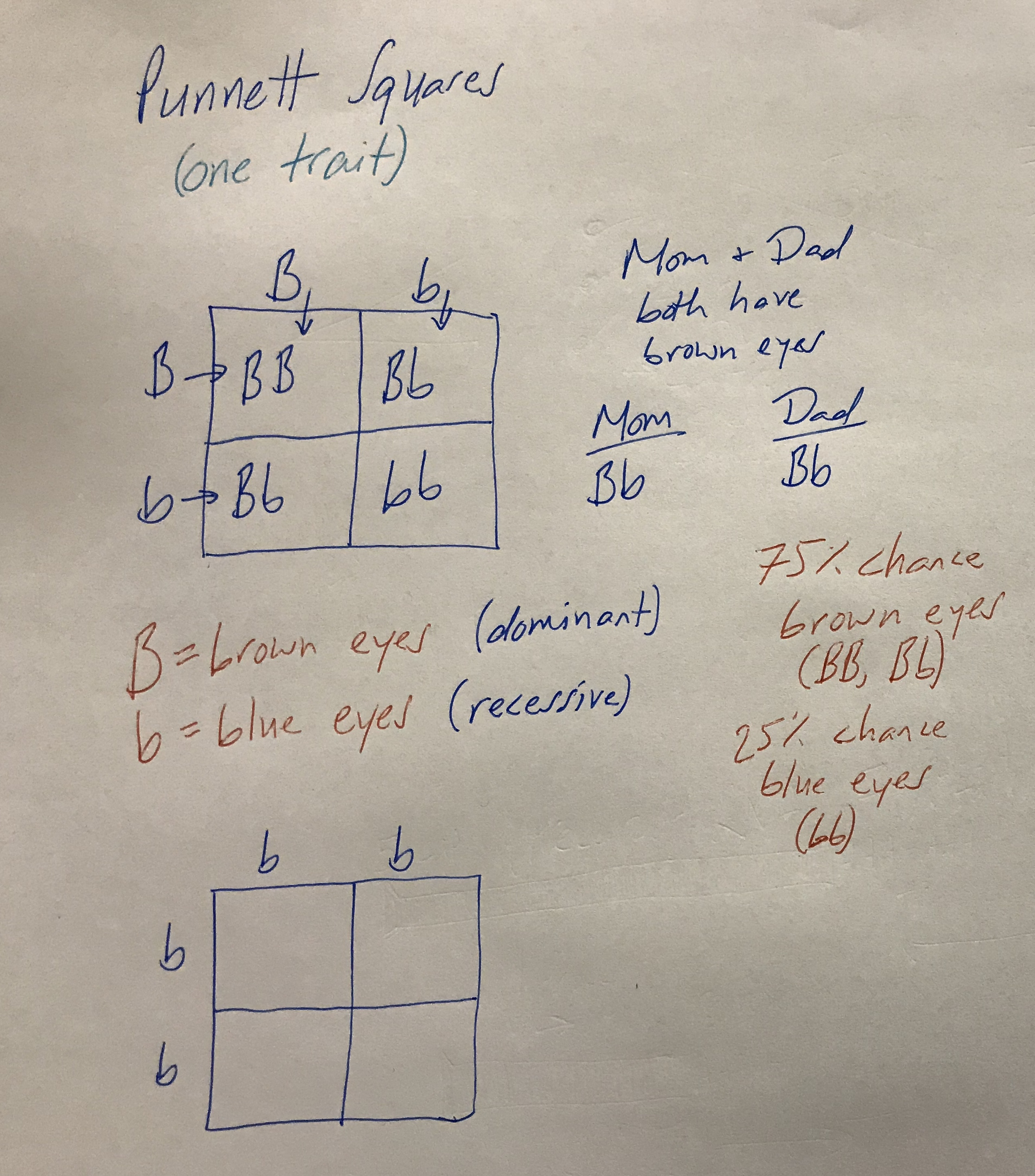
We then applied the vocabulary to an example Punnett Square about eye color inheritance patterns.  Students were provided with the following set of notes to reinforce concepts learned yesterday and provide context for our work today:
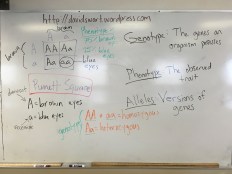
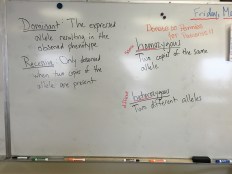
We then applied these concepts to a Single-Trait Punnett Square Gizmo in which students worked together in pairs to complete a work packet which included a review and application of the vocabulary learned thus far.

Students looking for additional practice are invited to complete the Punnett Square worksheet.
Structure and Function of Genes

For day one of our two-day lesson on the structure and function of genes, students were tasked with modeling the four types of DNA mutations described in yesterday’s case study on cystic fibrosis.  Students were given a wild-type DNA sequence and then had to solve the RNA and resulting amino acid sequences (see Structure and Function of Genes – Day 1 Power Point).  After a review of the types of mutations, students then introduced each type of mutation into the DNA sequence, solving both the RNA and amino acid sequences and connecting the vocabulary with the actual process of mutating DNA in specific ways to effect a specific outcome on the amino acid sequence.

Update: January 19

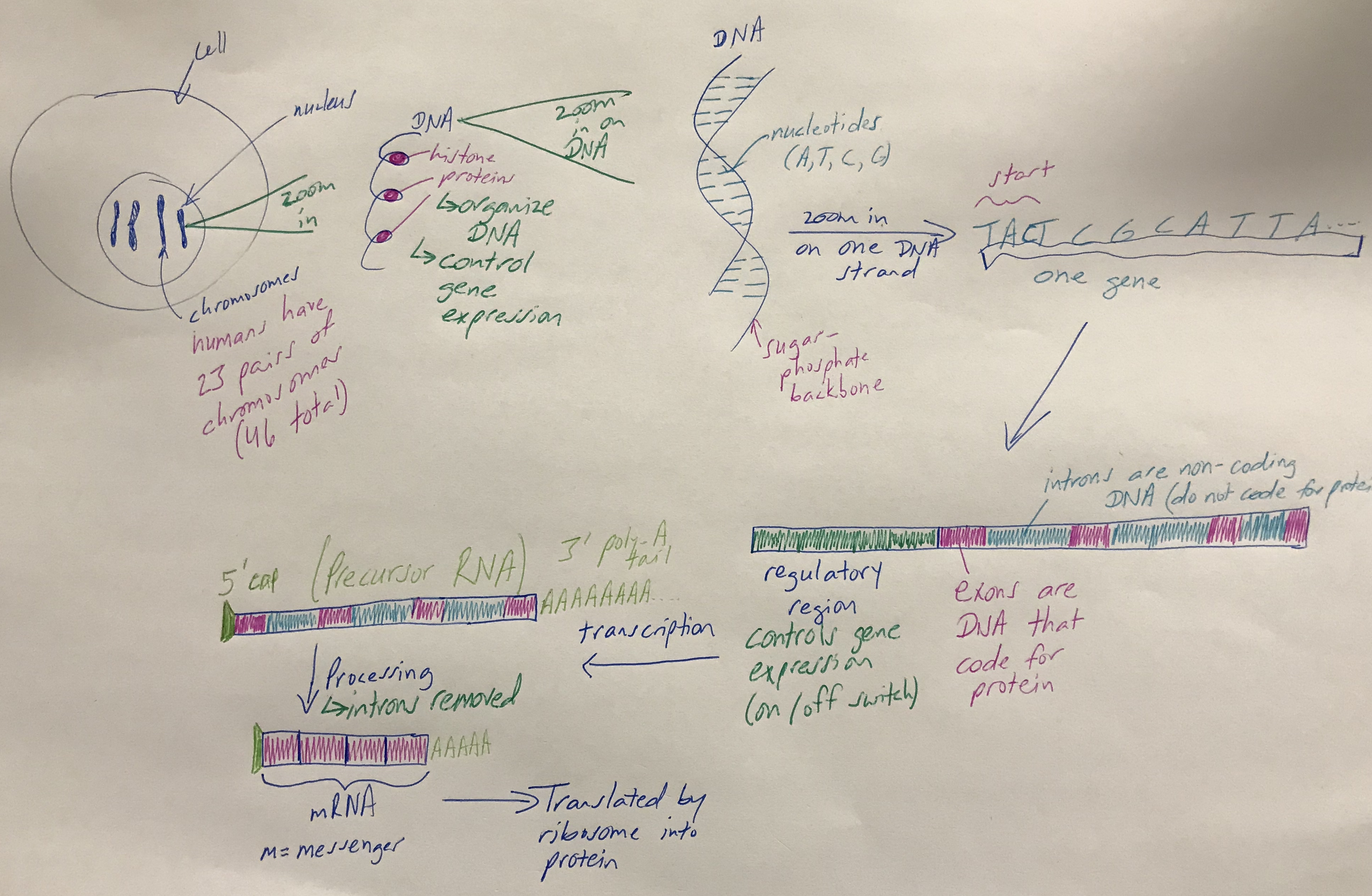
For day 2 of this lesson, we took notes on the structure of genes, including a review of how chromosomes are found in the nucleus of cells, how chromosomes consist of DNA coiled around histone proteins, and how genes consist of regulatory regions, exons, and introns.  At the end of the lesson, we previewed single-trait Punnett Squares to prime students for next week.

Structure and Function of Genes
Punnett Square Preview

Case Study of Cystic Fibrosis

In today’s lesson, we used a case study about cystic fibrosis as the mechanism to:

  • review the stop codon;
  • connect the concepts of protein structure and function;
  • review how R groups differentiate amino acids;
  • review how R group interactions result in protein folding;
  • discuss “structure equals function”;
  • bring a human face to a genetic disease;
  • and help students recall the mechanism of genetic inheritance.

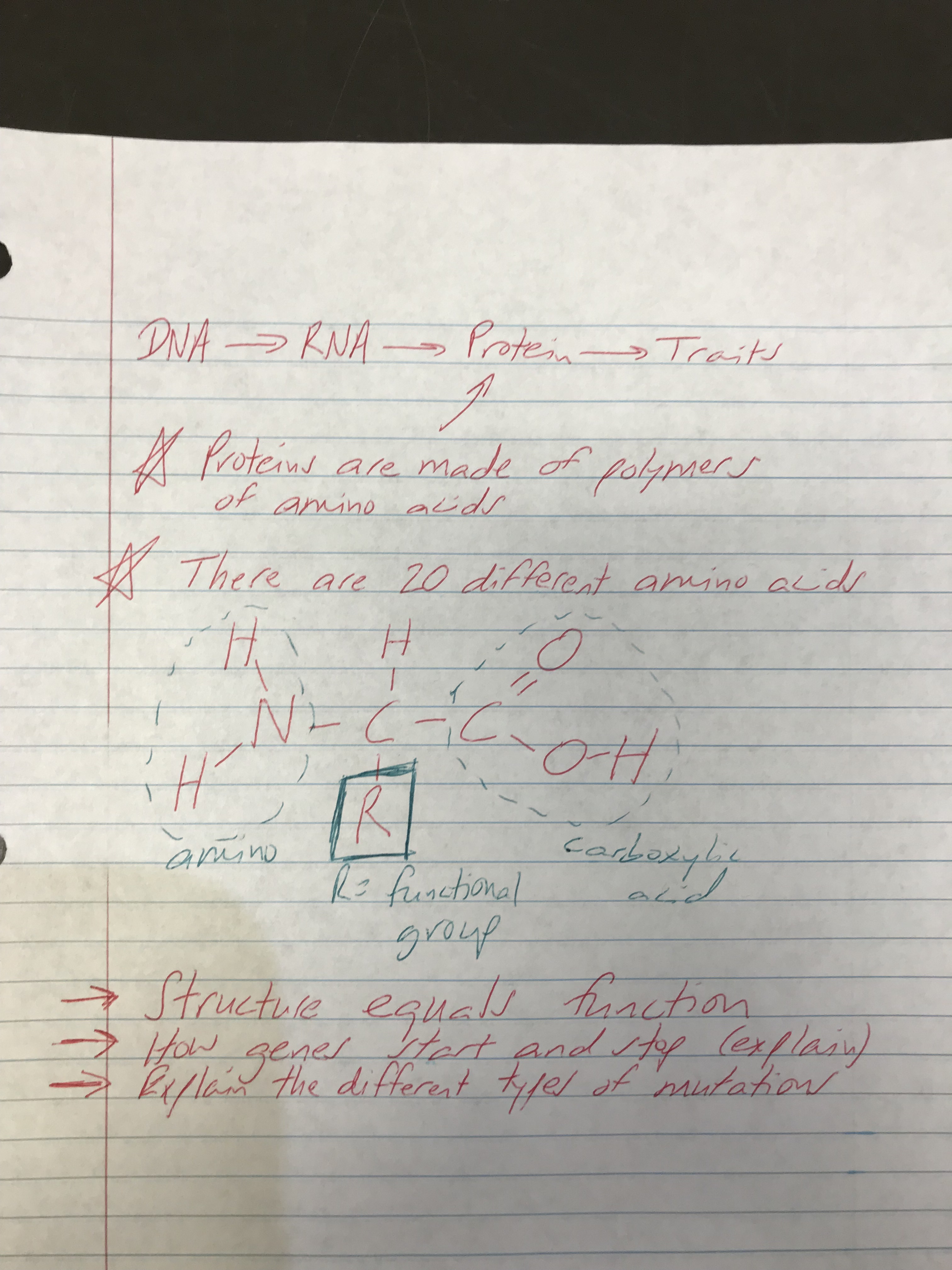
For the entry task, students were challenged to consider how genes begin and end.  We discussed how mRNA sequences always begin with AUG (which codes for methionine, and amino acid which may also occur elsewhere in a protein).  Students were then reminded of the three “stop codons” and we reviewed how those work to release a protein from the ribosome.  We reviewed the structure of amino acids, focusing on the 20 different R groups and how those R groups each have different properties.  The interactions between R groups determine protein shape, and shape determines protein function.  When the sequence changes, the shape changes, thus changing the function of a protein.  We then moved into the cystic fibrosis case study, first watching the video below and then working through the lesson PowerPoint.

Class concluded with a few additional notes, pictured below:

Nature vs Nurture

Unit 5 was introduced with the following entry task:

In your lab notebook, list at least 5 traits that best describe who you are.

After responding to the entry task, students were assembled into groups of 2-3 students and together they debated whether a list of traits provided on a worksheet are inherited via nature, nurture, or both.  We came back together as a class so students could share their thinking and hear each others ideas.

Class concluded with the following assignment, due tomorrow:

Using your list of traits from the entry task, write an explanation about which of your traits are nature, which are nurture, and which are both.  Explain your thinking!

Strawberry DNA Lab Report

As we enter our final week of Unit 4, students received a progress report, their graded quiz from Friday, and a copy of the Strawberry DNA Extraction Lab Checklist.

Students with a D or F we told that in order to qualify for an in-progress (IP) grade at the end of the semester, they need to take their progress report home, explain it to their parent/guardian, craft a plan to pass biology, and then bring the progress report back signed and with a written plan.

We briefly reviewed the quiz and most students achieved a perfect score, solving the RNA and amino acid sequences perfectly.  Because there were two versions of the exam, with table partners receiving different copies, it was immediately evident if any copying occurred.  Students were again reminded about the importance of academic honesty, and students who copied received a score of zero.

Next, we reviewed the lab checklist and then watched the video below to provide students with the academic learning required to explain the role of soap, salt, and isopropyl alcohol in the lab.

Finally, students who completed the New Genetics assignment were allowed to use class computers to begin writing their lab reports.  Students who have not yet completed the assignment had class time to do that work.  Students were reminded that the lab report is due Thursday and we have an exam Friday.

Strawberry DNA Extraction Lab

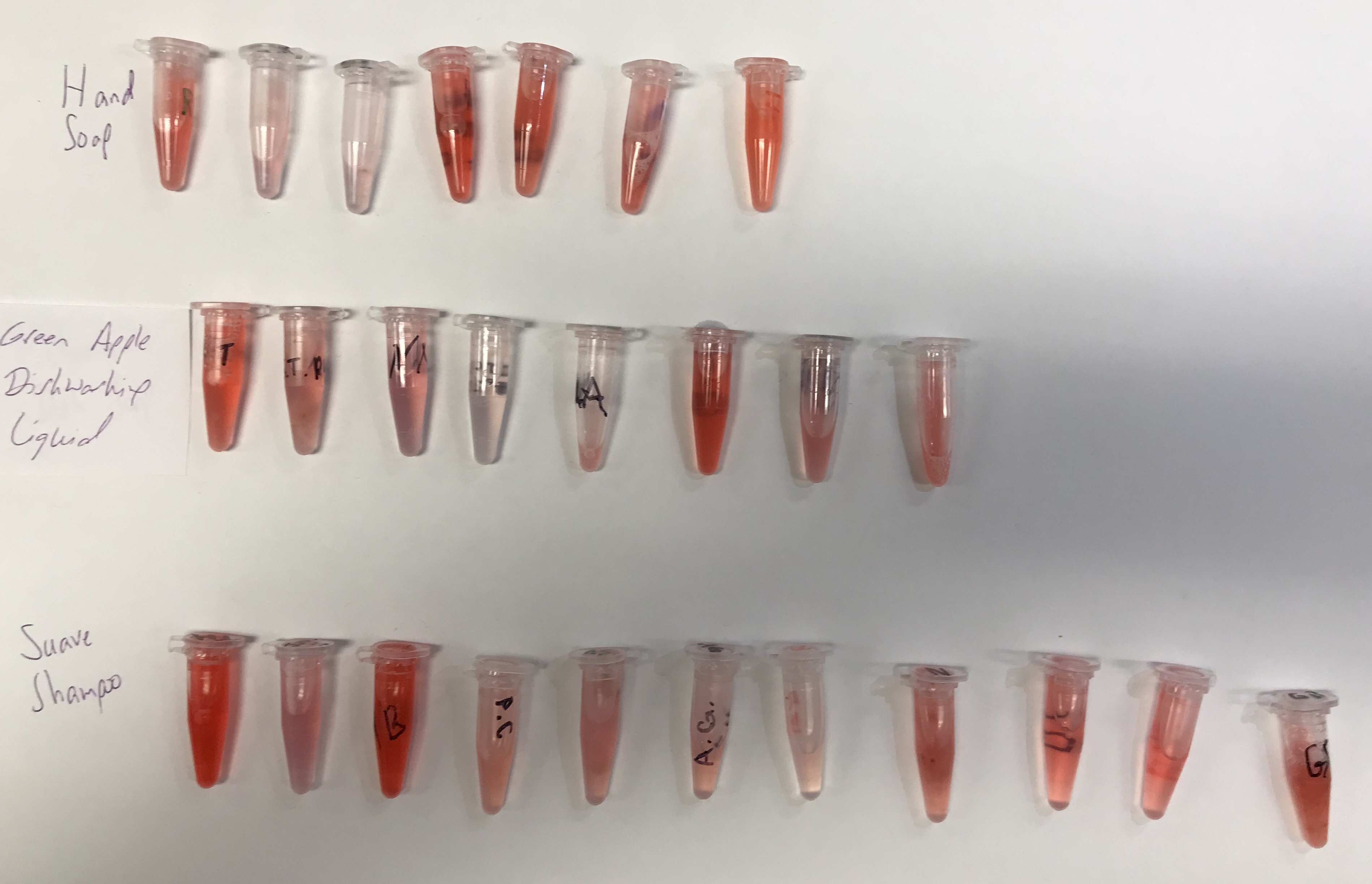
Class sets of extracted DNA grouped by the type of soap used in the extraction solution:

Period 1 DNA Results
Period 4 DNA Results
Period 6 DNA Results

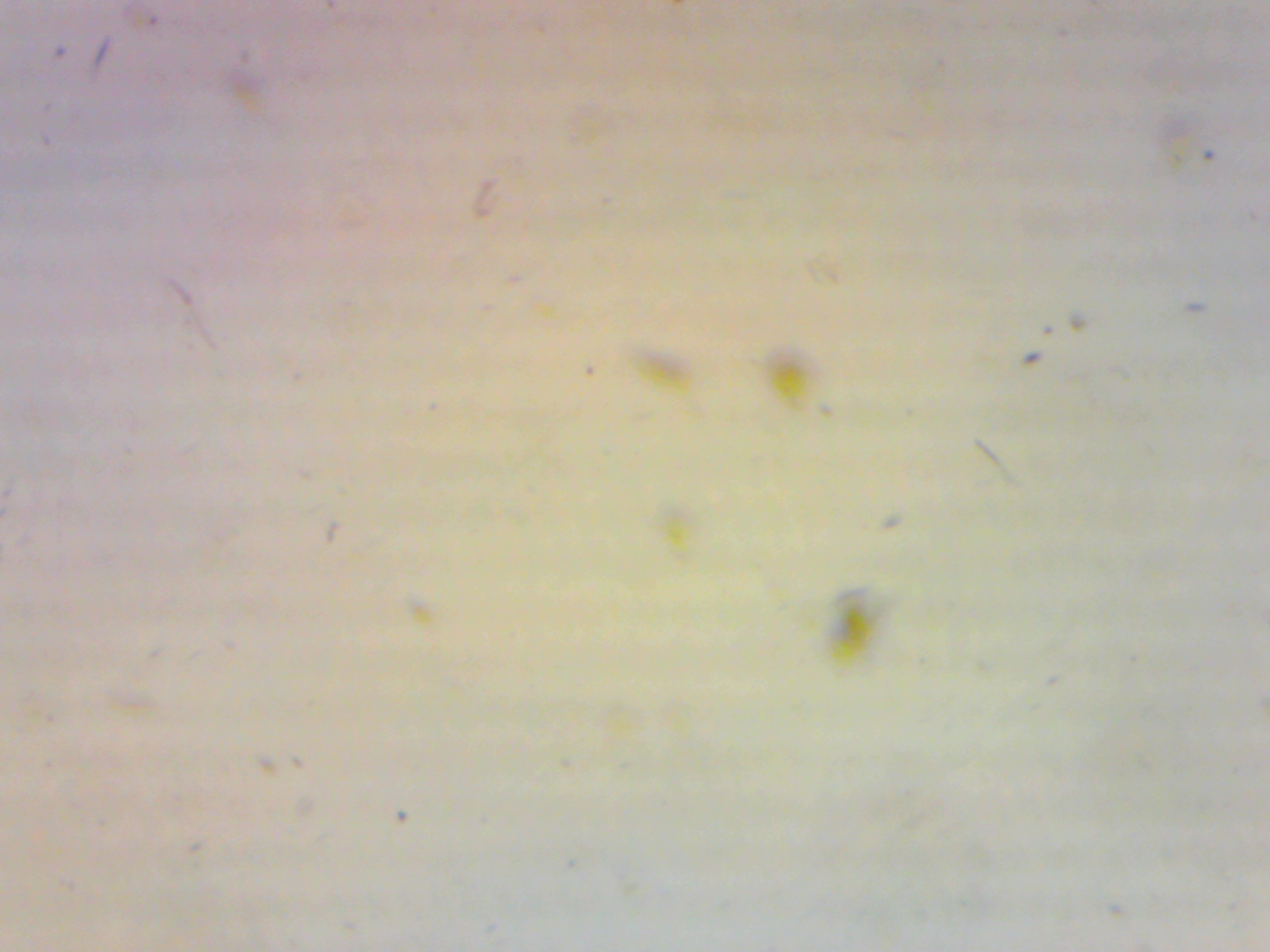
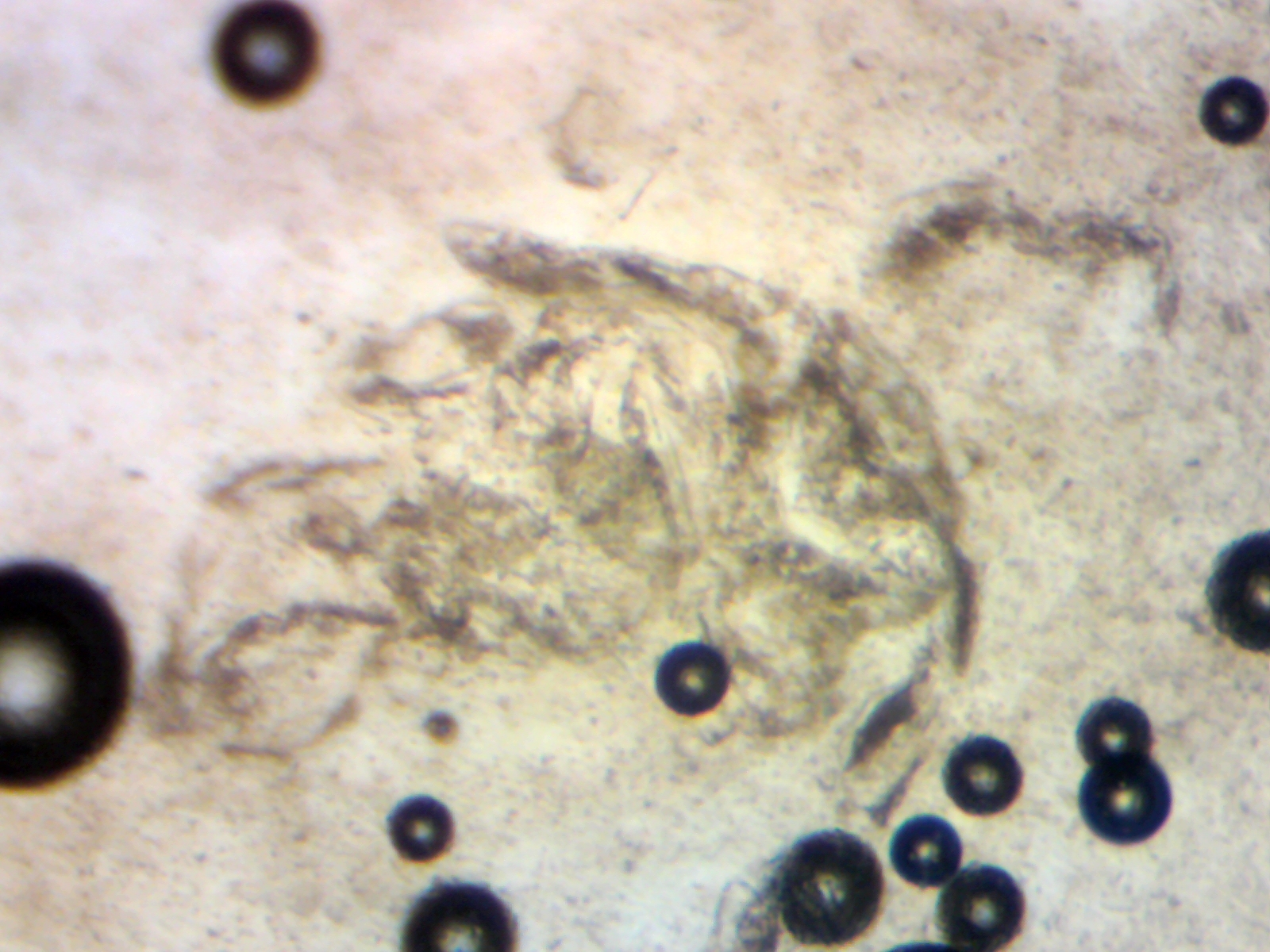
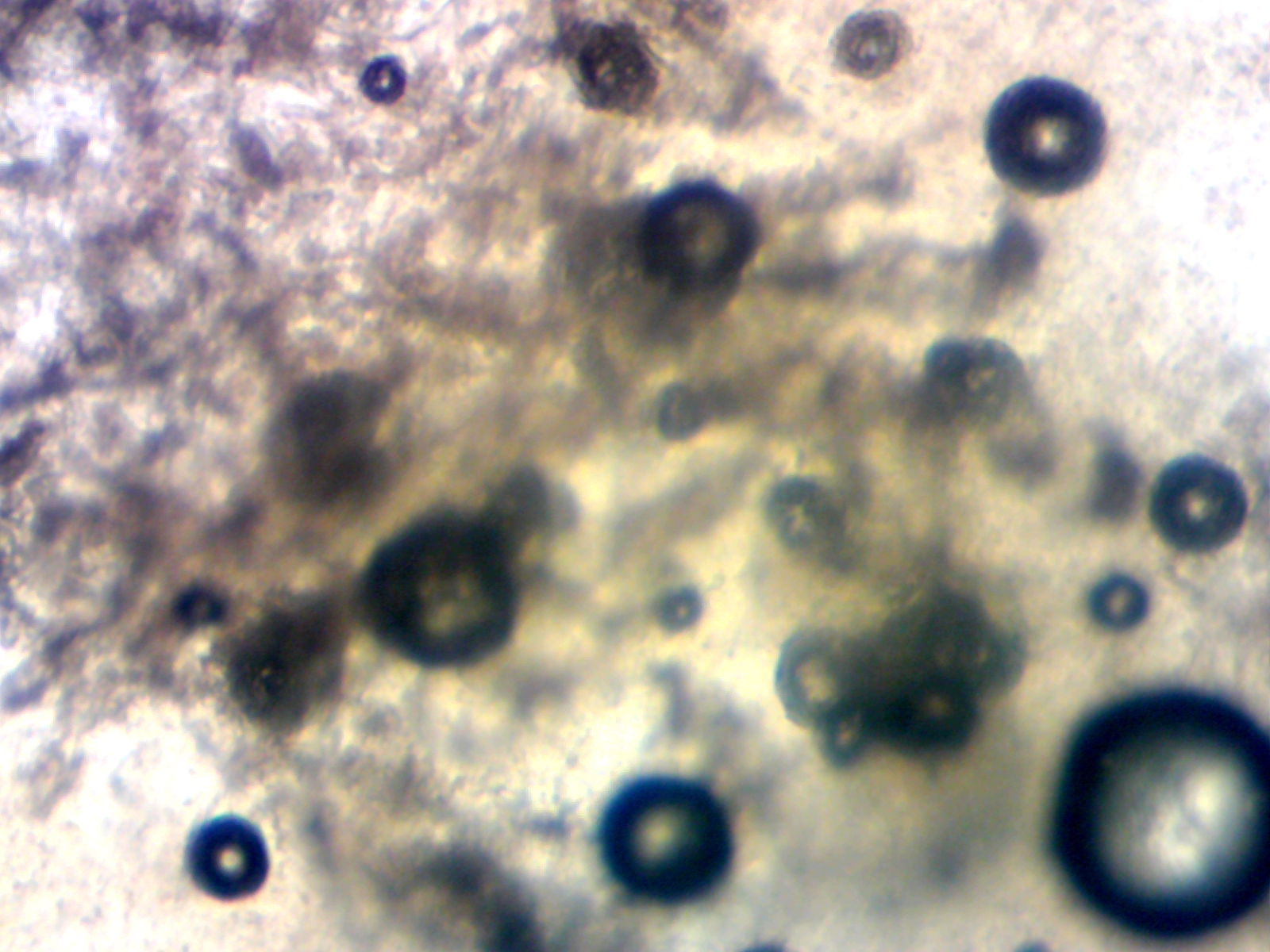
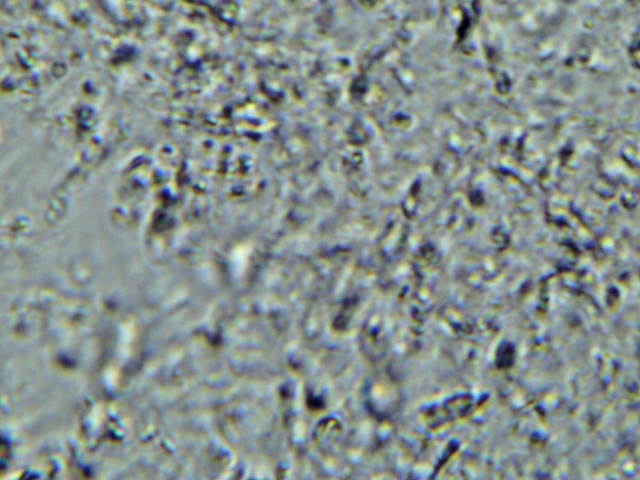
Student-acquired pictures of DNA samples under the microscope:

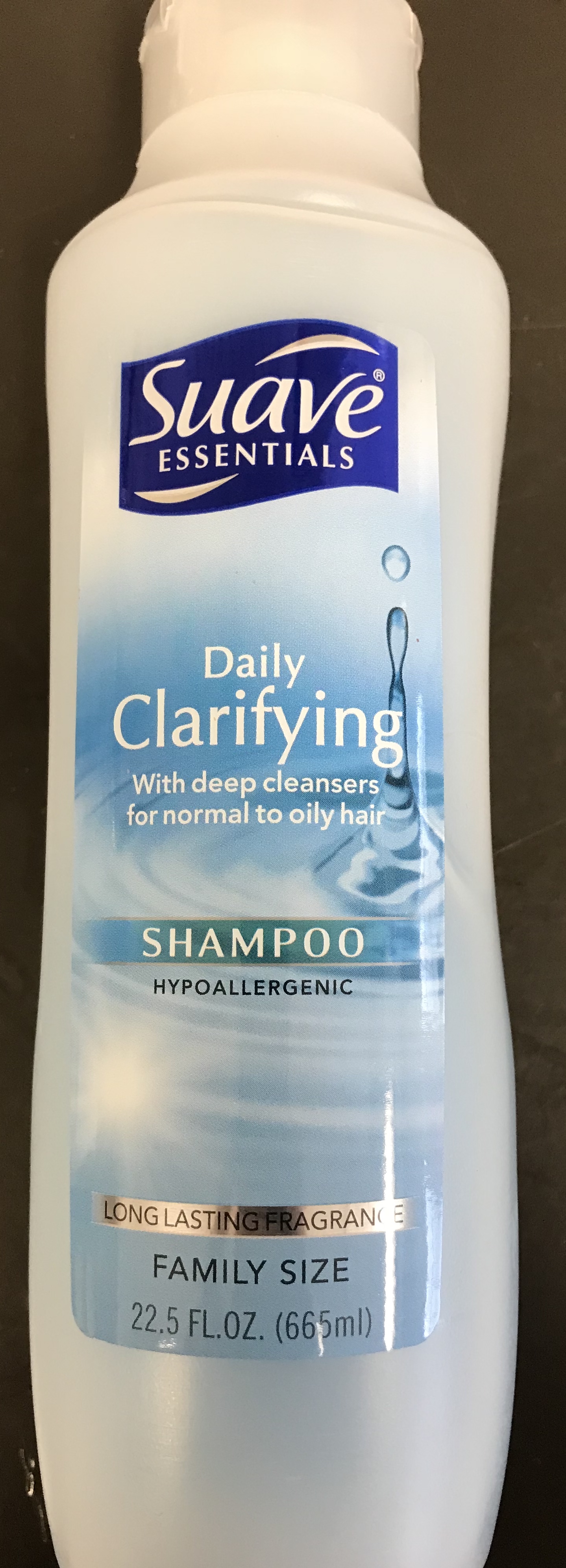
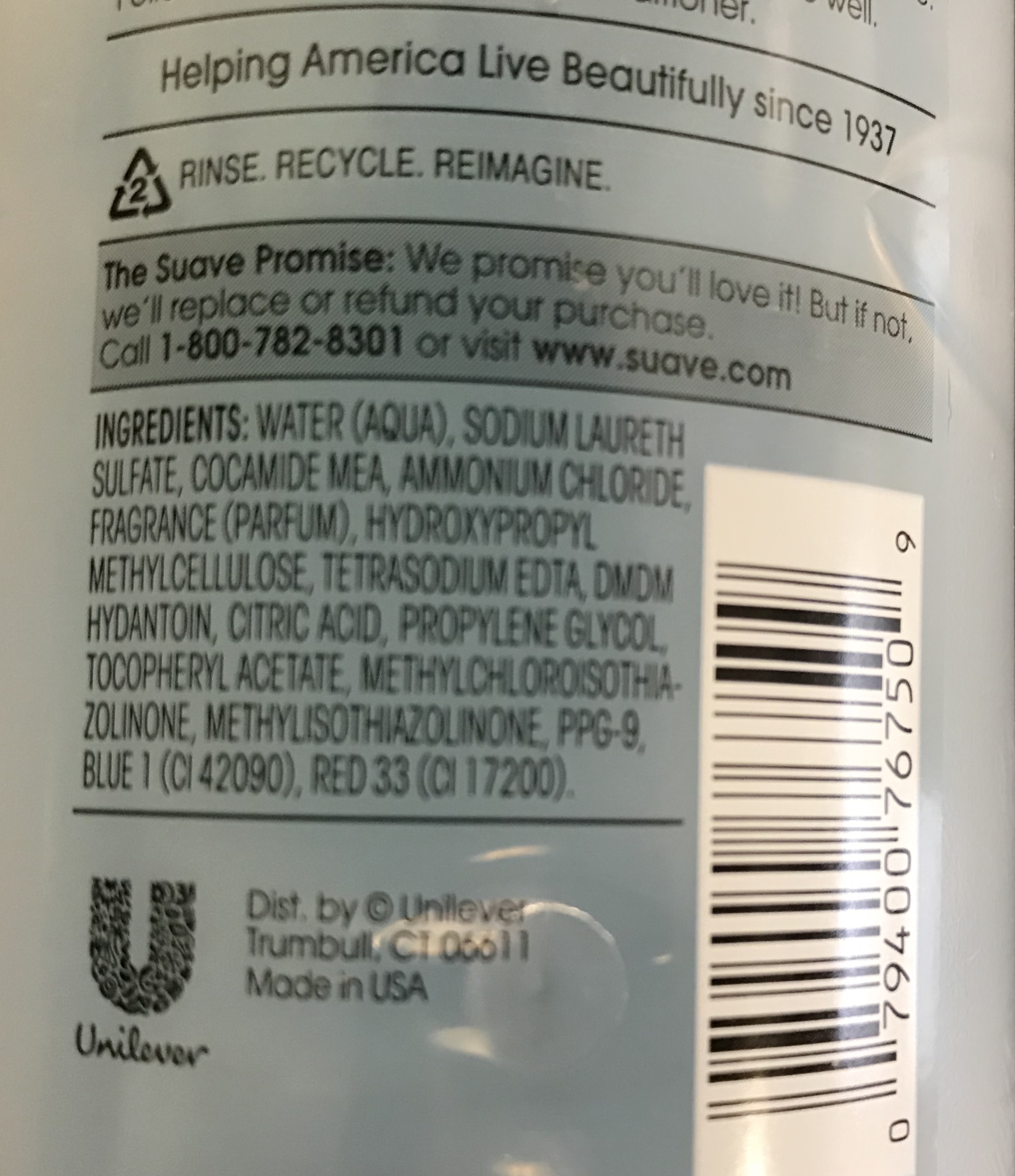
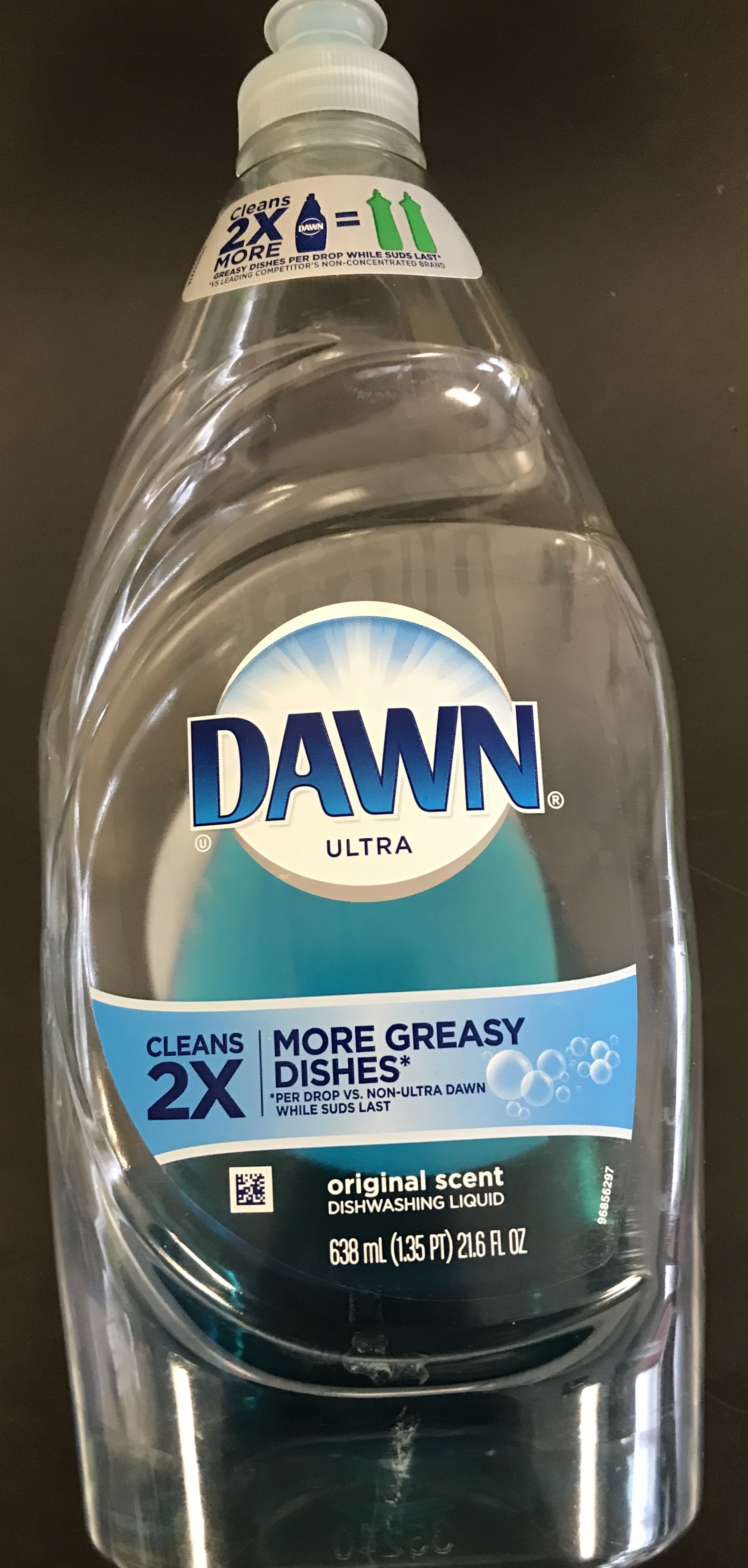
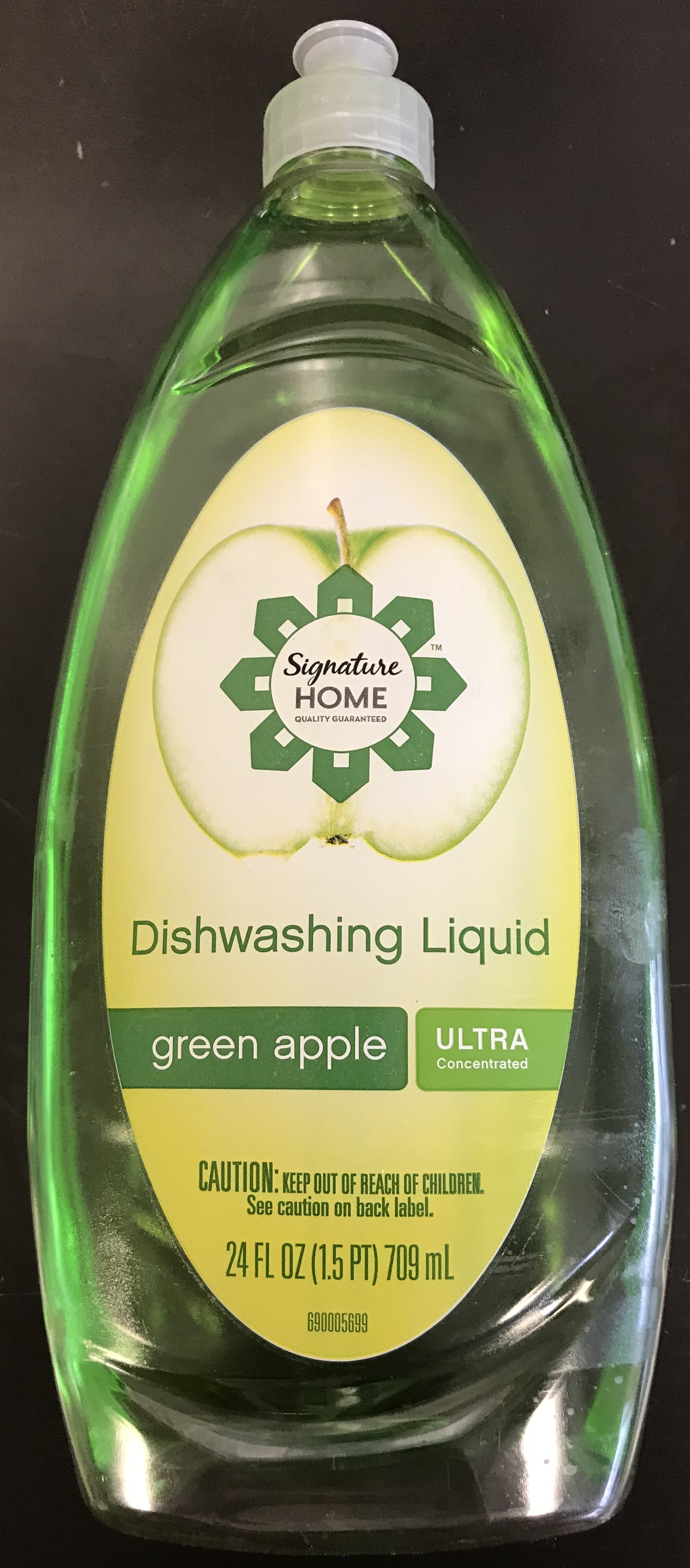
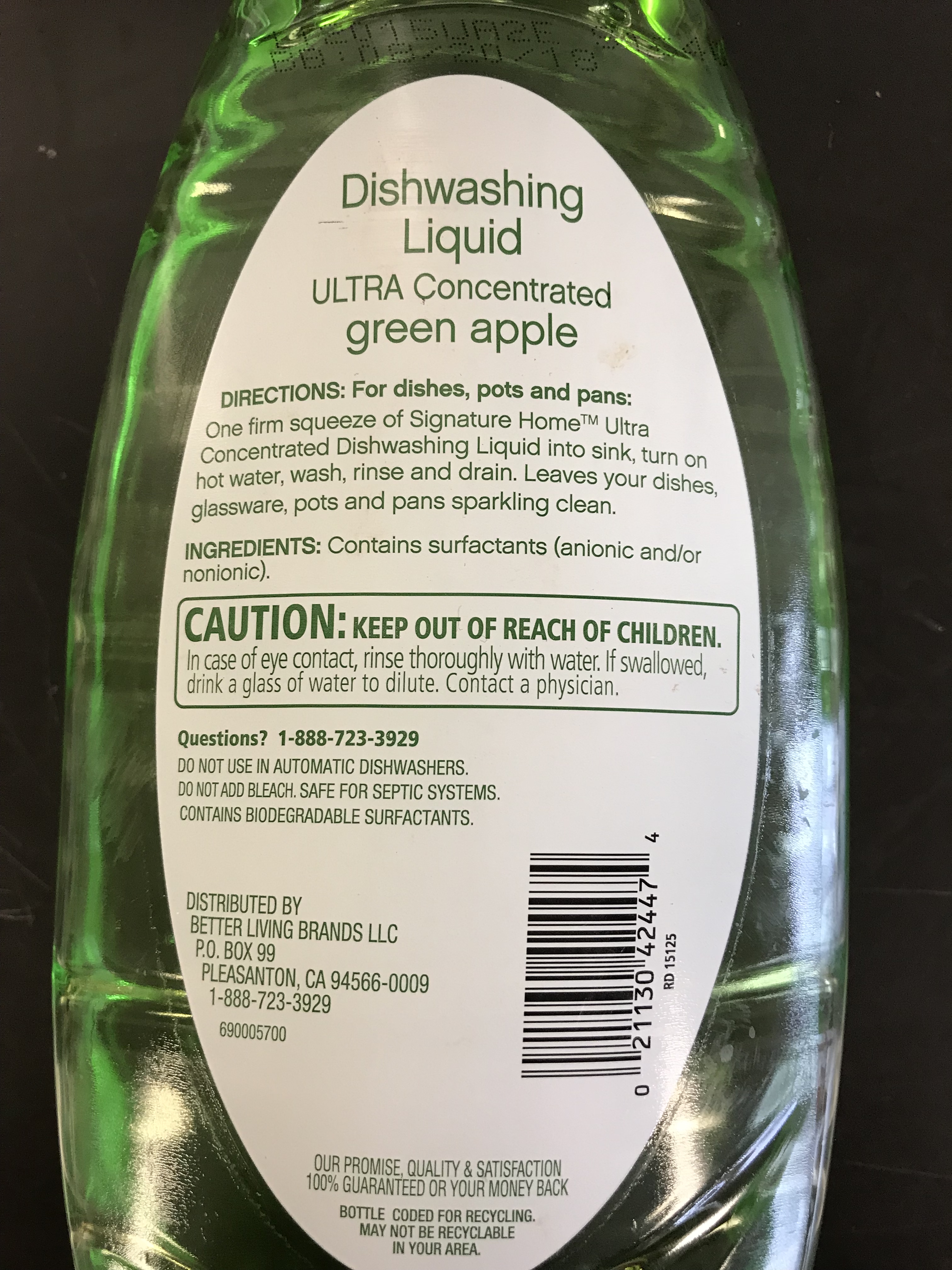
Labels for the different soaps used in the extraction solutions:

Shampoo
Shampoo Back
Dawn Dish Soap
Dawn Dish Soap Back
Green Apple Dish Soap
Green Apple Dish Soap Back
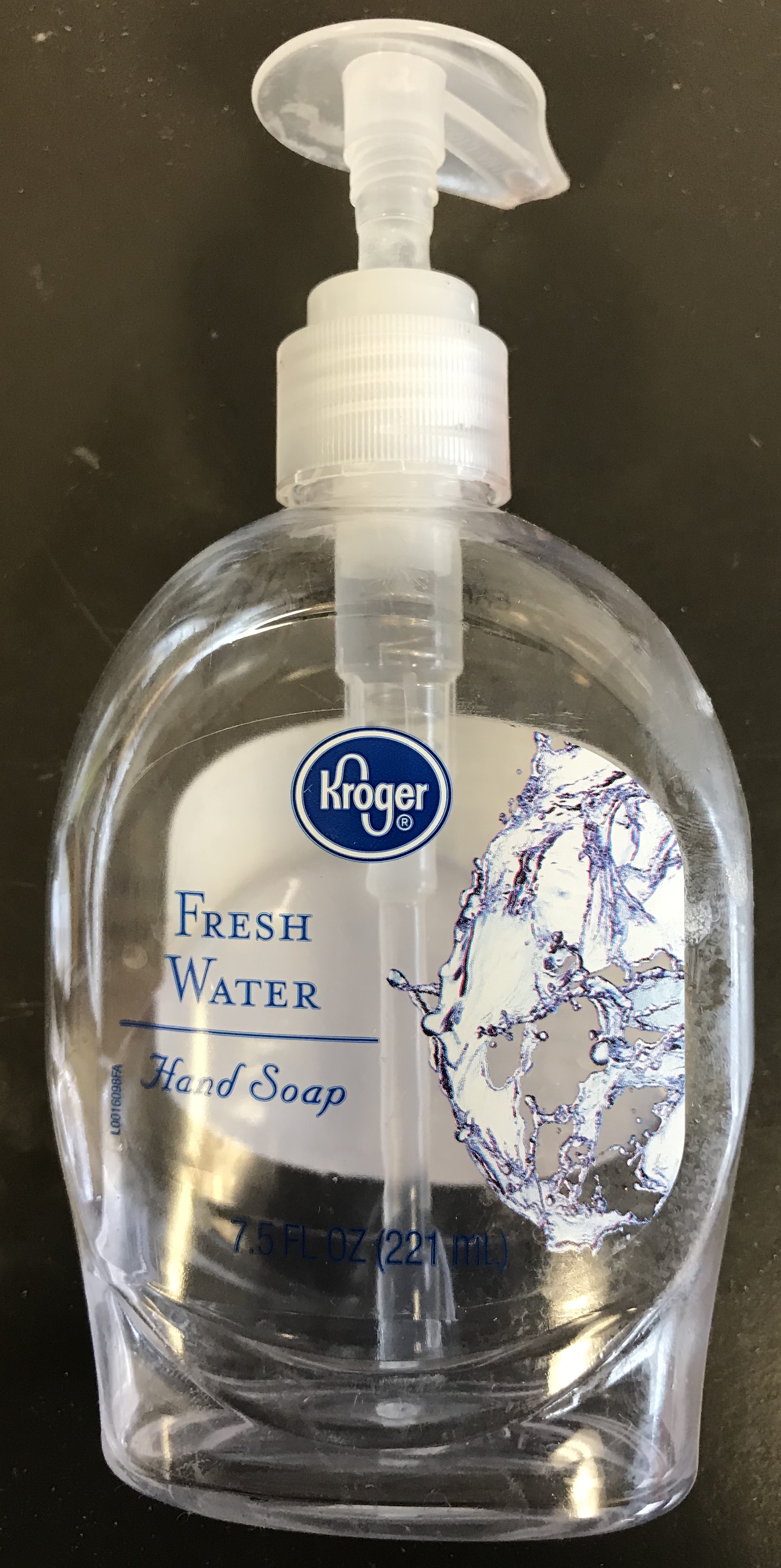
Hand Soap
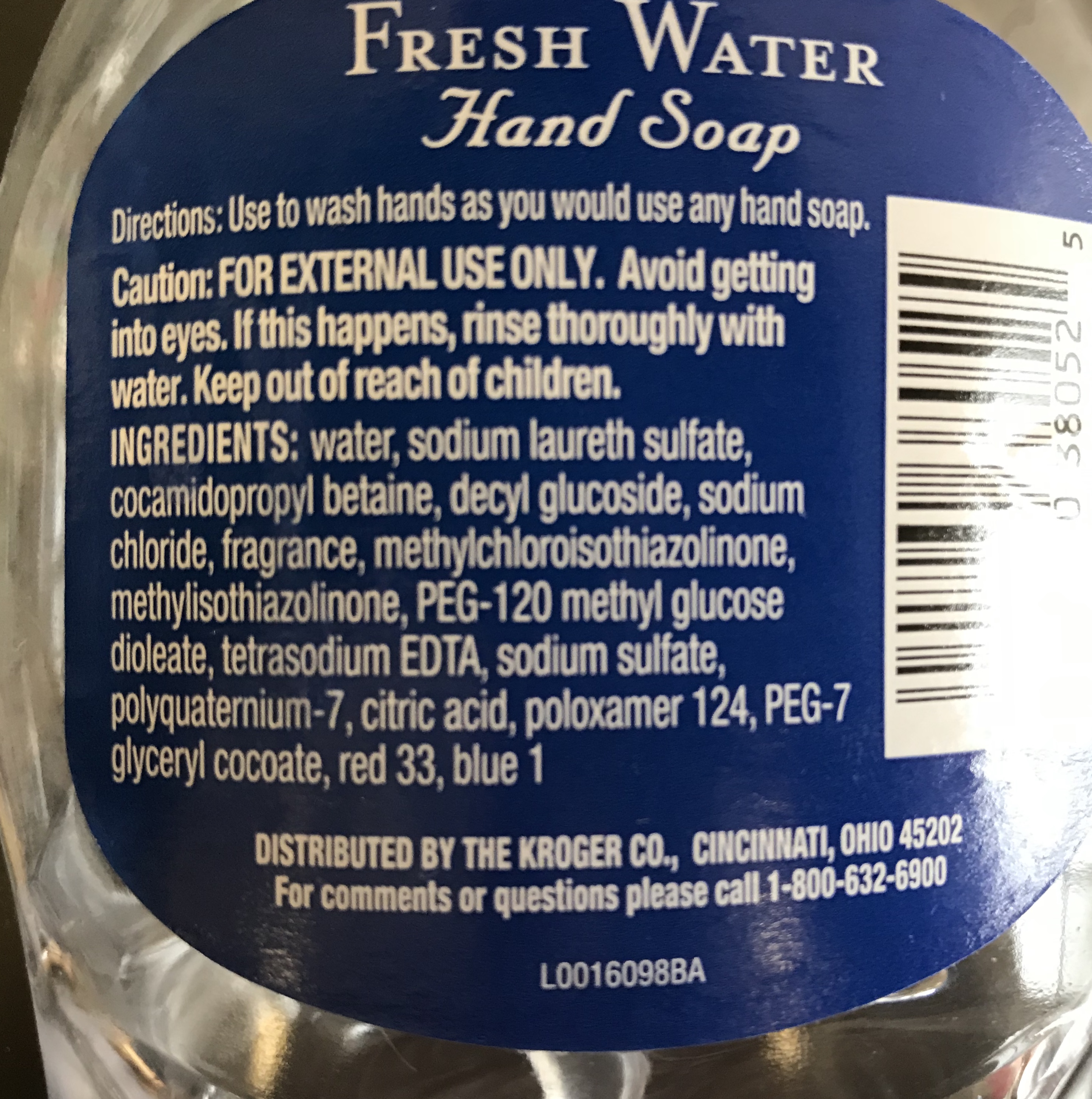
Hand Soap Back

Strawberry DNA Lab Prep

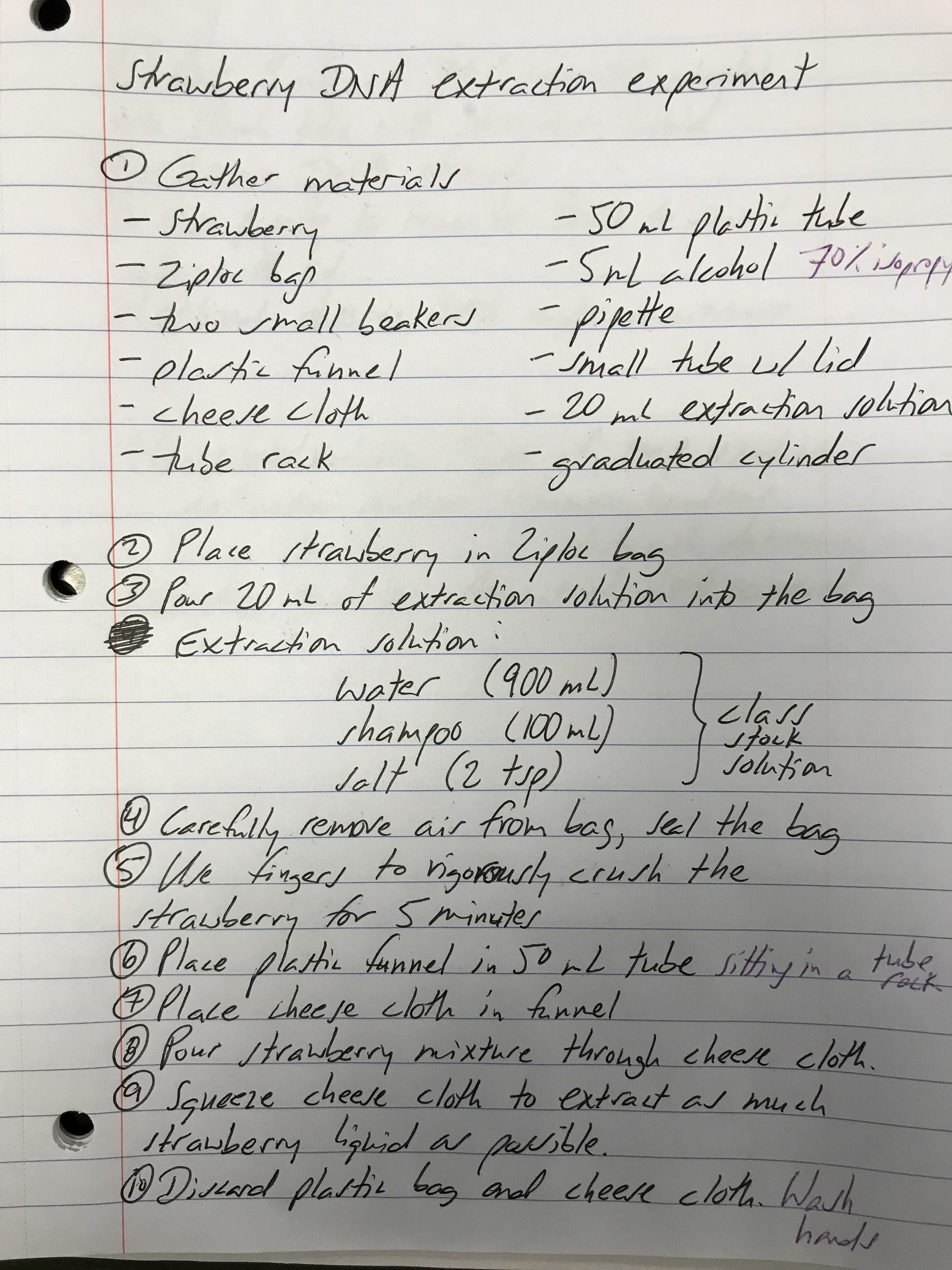
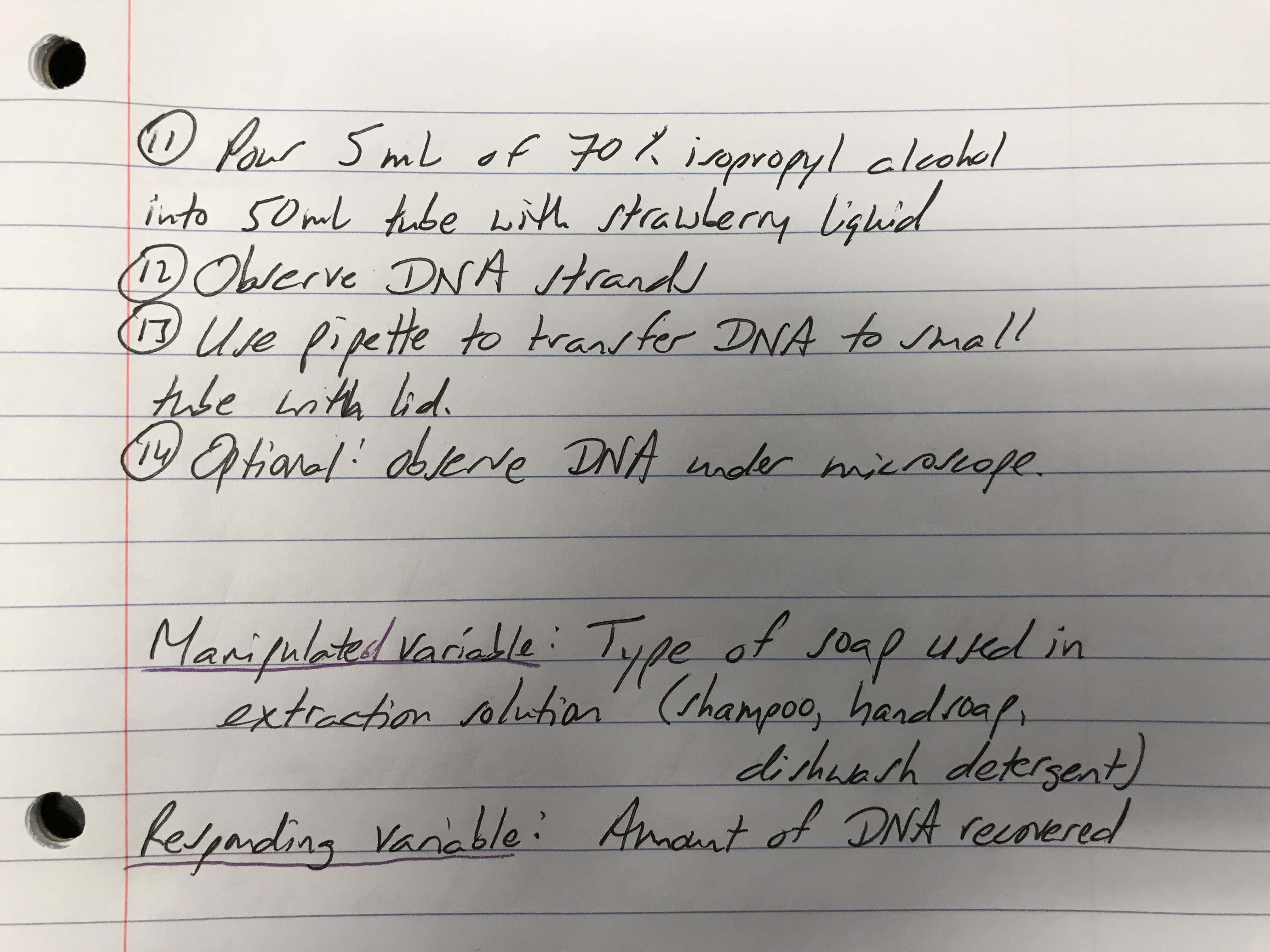
In our continued study of Central Dogma, we set our sites on extracting DNA from strawberries.  To prepare for the lab, students watched two videos explaining the DNA extraction procedure (both produced by the North Carolina Community Colleges group NCBioNetwork.org).  The first video, produced 5 years ago, provides students with a straight-forward approach to extracting DNA.  Students watched the video and wrote down as many details as they could.

After watching the video, we assembled one class procedure “crowd-sourced” from the all of the student notes.

At the end of the second video, students learned that human DNA varies by only 0.1% from person to person.  For the final segment of class, students watched a thought-provoking video about a scientist who has combined a variety of tools and technologies to turn DNA from hair into portraits using 3-D printing.

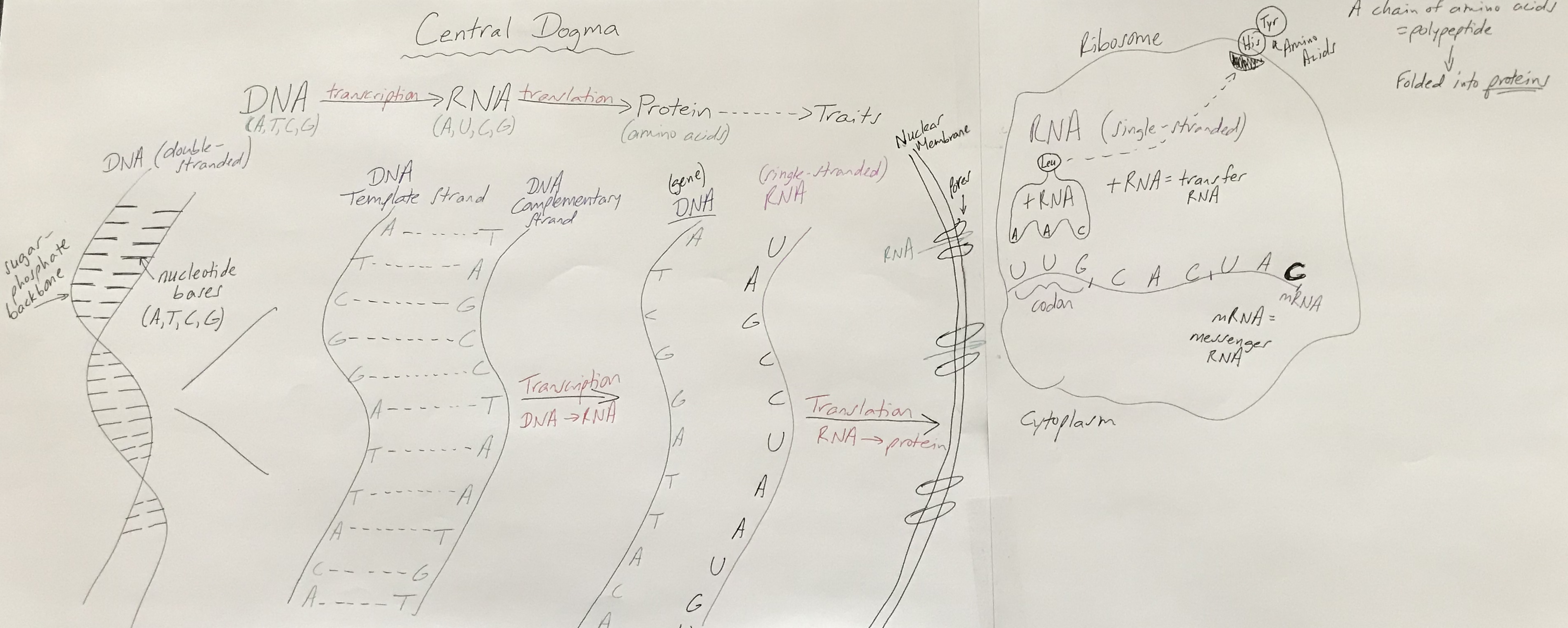
Central Dogma

After wrapping up the discussion from the previous day’s lesson about The Double Helix, we launched into an investigation of the process of Central Dogma.  Students learned how DNA codes for RNA which codes for protein, with everyone drawing out the notes shown below.  We drew out the processes of transcription and translation, using a guided worksheet approach to help students understand what happens at each step of the process.  We worked through worksheet question 15 (identifying codons) and will continue our exploration of Central Dogma and complete the worksheet packet tomorrow.

Click to enlarge

Update: 12/13/17

We completed drawing our model of Central Dogma and then students had the remainder of the class period to work through the worksheet from yesterday.  Drawings were collected (students will receive credit for their work) and the worksheet is due by Friday for credit.  Below is an updated picture of our model:

Click to enlarge