
After reaching out to stakeholders yesterday, many student groups were excited to report their stakeholder had replied back! Energized by the connection, students embraced the task of researching and then using their understanding of science to propose a solution to reduce the effect and frequency of harmful algal blooms on the Puget Sound ecosystem. To help guide their research efforts, students were encouraged to review the Know and Need to Know lists they assembled last week when we kicked off the Problem Based Learning task (see October 15th post). Today, students also learned that they will have a few additional days of computer-based research time, and they began thinking about how they will represent their individual projects to their stakeholders on Tuesday, November 3.
All posts by David Swart
Matter, Atomic Structure, and Bonding: Formation of Elements
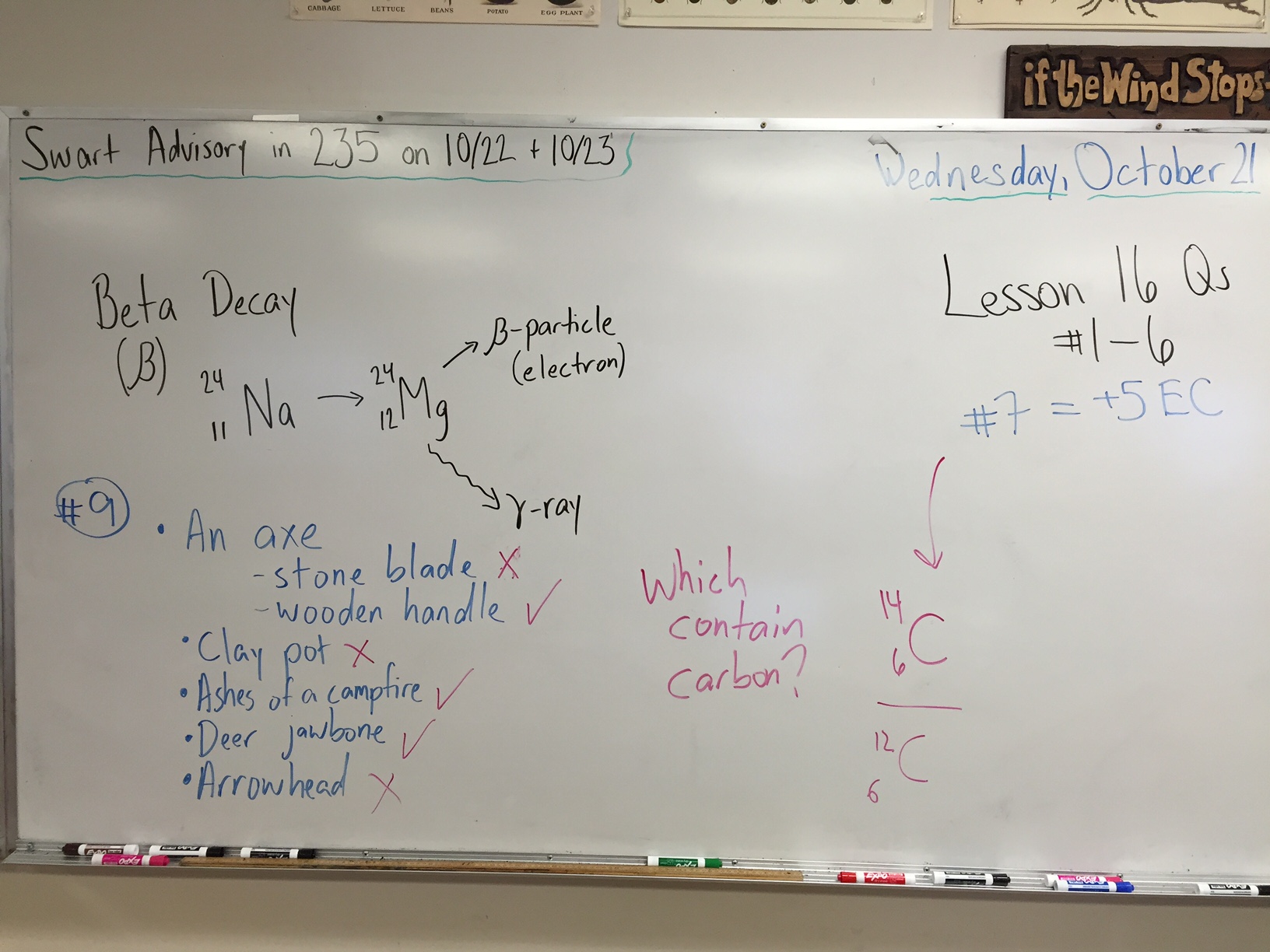
Before introducing the final lesson in Chapter 3 explains how elements are formed (through alpha and beta decay (fission) of through fusion), we reviewed student questions about Lesson 15 (pictured below):
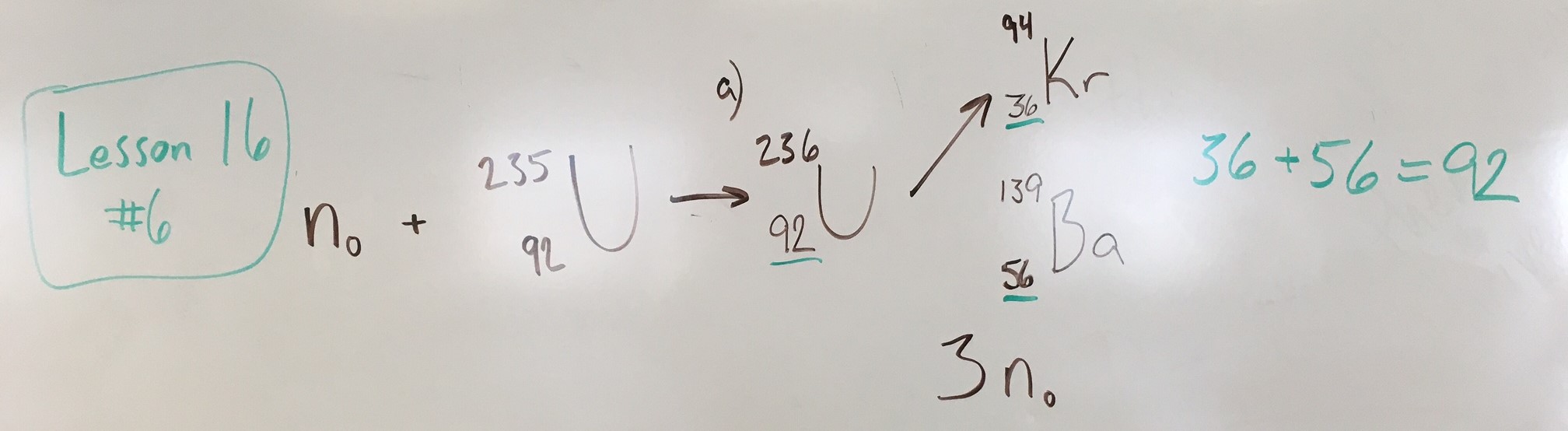
For Lesson 16, we looked through the PowerPoint and then students used the last 20 minutes of class to work on the Lesson 16 Worksheet. Students should also complete questions 1-6 from the textbook.
Cells & Homeostasis: PBL Research – Day 2
For our second day of project work, student groups were tasked with identifying a primary stakeholder and then actually drafting an email to the stakeholder. The pictures below show the instructions provided to students in identifying an appropriate primary stakeholder and in crafting the email to the stakeholder. Students reached out to a wide variety of stakeholders throughout the day, including local marine scientists, restaurant owners, community groups interested in the environment, local government officials, and elementary school teachers. Student groups were then tasked with coming up with at least three different project ideas which both meet the goal of the mission and meet the needs and interests of the primary stakeholder. Students continued to document their collaborative work in the shared Google Doc.

Cells & Homeostasis: PBL Research – Day 1
Today marked the beginning of our project team work investigating the problem of reducing the frequency of harmful algal blooms (HABs) in Puget Sound. Students used their responses from the Seahurst Park pre-assessment worksheet from last Thursday to assemble into groups (questions 4 and 5). Student groups then worked together to create a single shared Google Doc per group, with each student working in the group having their own Chromebook for simultaneous editing. We concluded with groups creating a list of stakeholders and then selecting one to be the audience for their presentation.
At the start of class, I pointed out the HS-LS2-7 code written at the top of the pre-assessment. Students learned about the Next Generation Science Standards and were also reminded of the Washington State high school credit requirements for upcoming graduation classes.
Matter, Atomic Structure, and Bonding: Nuclear Reactions
We continued our exploration of how the nucleus of an atom can change by launching into Lesson 15. The lesson revolves around the Nuclear Quest board game where students learn how new elements are created. Before launching into the game, students elected to review the Lesson 15 PowerPoint in order to better understand the key concepts and vocabulary from the textbook reading they were assigned over the weekend. Students then had time to cut out the various game pieces (the board, the three sheets of nuclear quest cards, the two sheets of radiation cards) and look over the game instructions as preparation for playing the game and completing the Lesson 15 worksheet tomorrow. For homework Tuesday, students should complete the Lesson 15 worksheet, Lesson 15 textbook questions (#4-12), and read Lesson 16 in the textbook.
For more information on radioactive decay, visit the Bodner Group’s website out of Purdue University. Additional video tutorials for chemistry topics of study are available for free on Khan Academy (along with a vast range of other subjects). Can’t get enough of the Periodic Table? Enjoyed watching Theodore Gray on the Hunting the Elements video (he was the guy with the huge wooden periodic table who also reacted sodium and chloride to salt popcorn) – visit his interactive Periodic Table website to further explore the elements and see how they are used in the real world.
Matter, Atomic Structure, and Bonding: Writing to Explain Prompt 1
To support our school’s goal of improving the ability of students to use writing to explain, the science department gave the first of three “writing to explain” science prompts this school year. This first writing prompt serves as a baseline, with the next two prompts designed to assess growth in student ability to use writing to explain science. Although students had the entire class period to respond to the prompt, students who finished early had the remainder of the class period to complete unfinished work.
Cells & Homeostasis: Cell Membrane Function Assessment
To support our school’s goal of improving the ability of students to use writing to explain, the science department gave the first of three “writing to explain” science prompts this school year. This first writing prompt serves as a baseline, with the next two prompts designed to assess growth in student ability to use writing to explain science. Although students had the entire class period to respond to the prompt, students who finished early had the remainder of the class period to complete unfinished work.
Cells & Homeostasis: Intro to Seahurst Park PBL
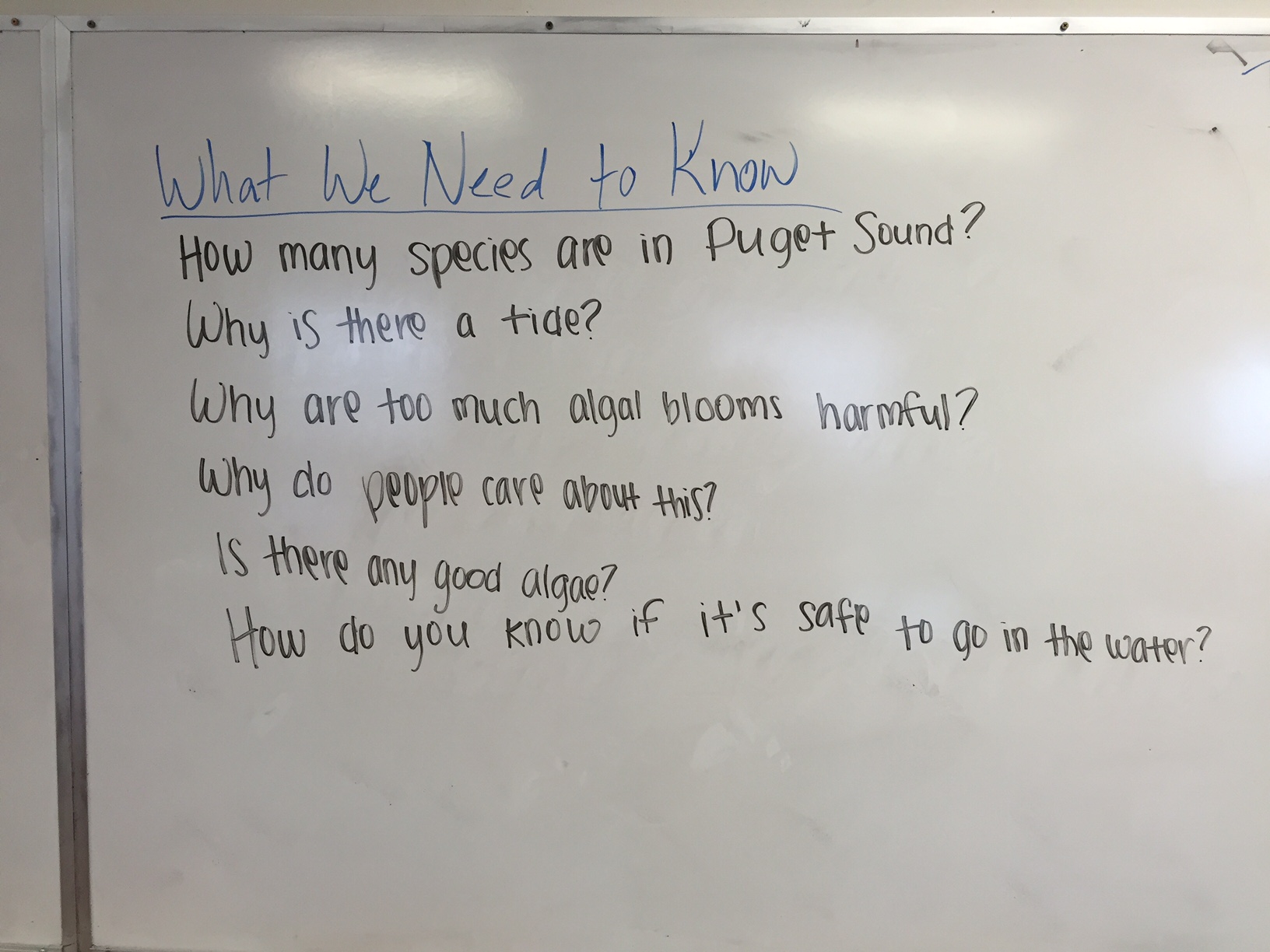
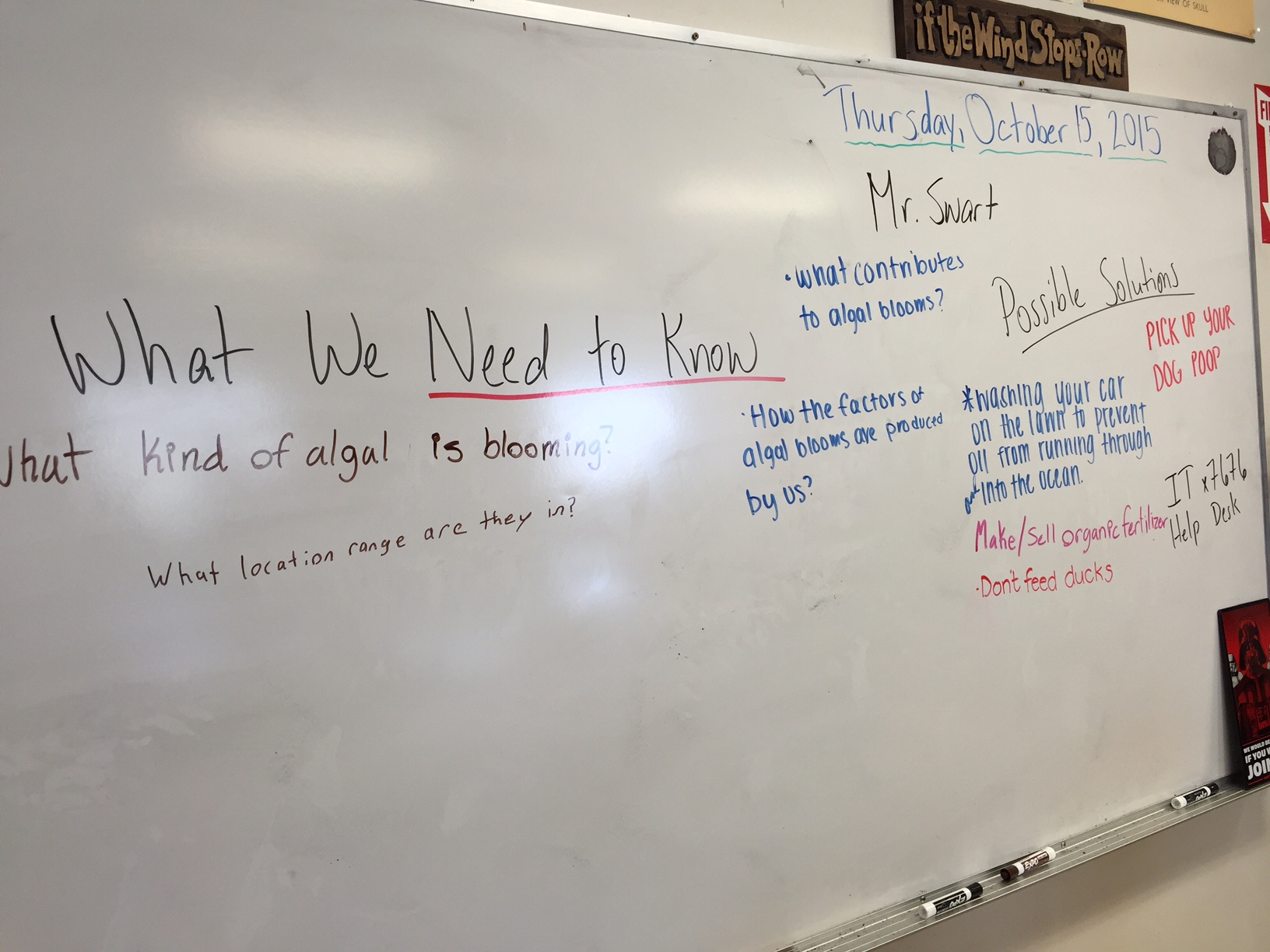
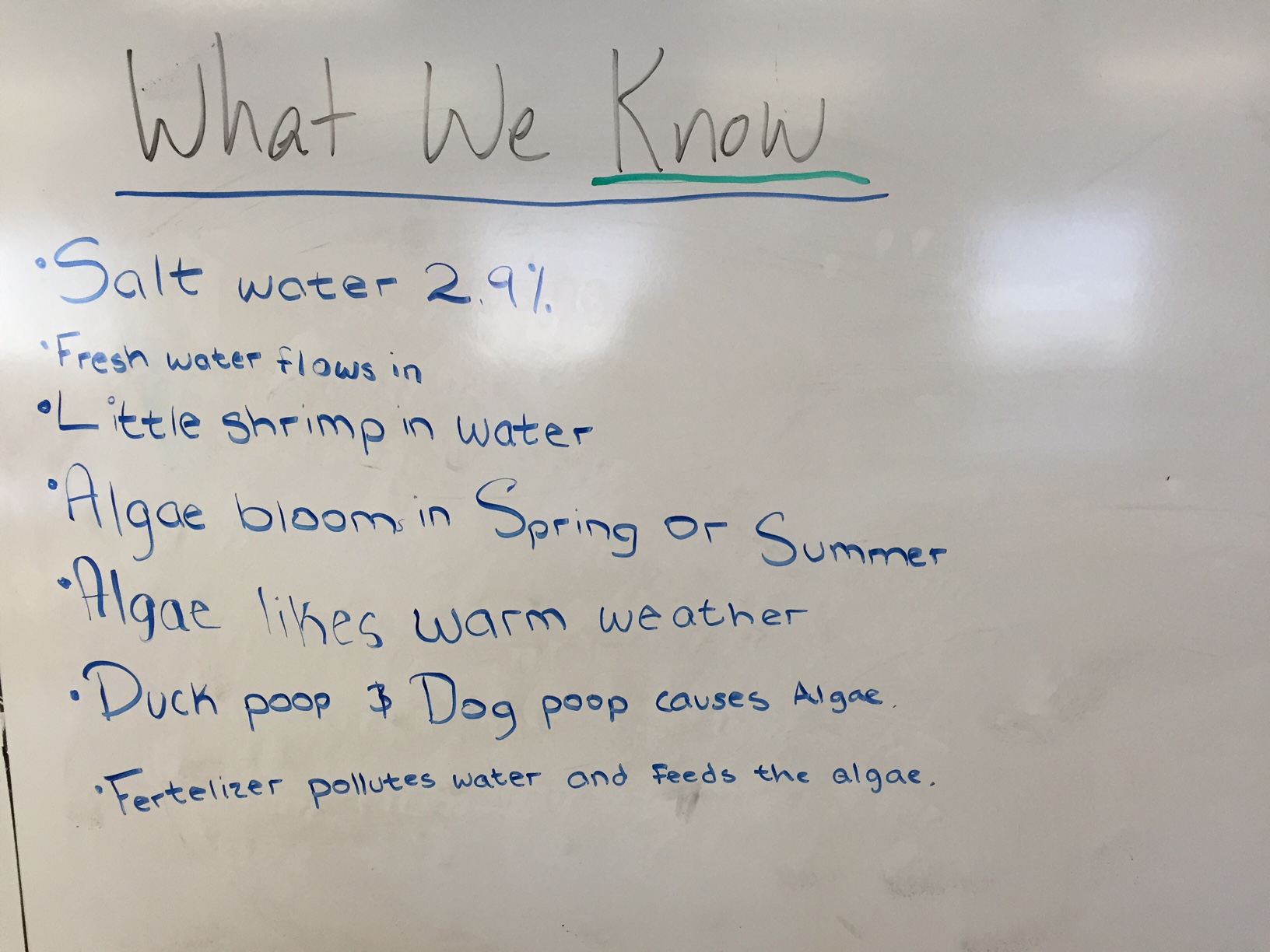
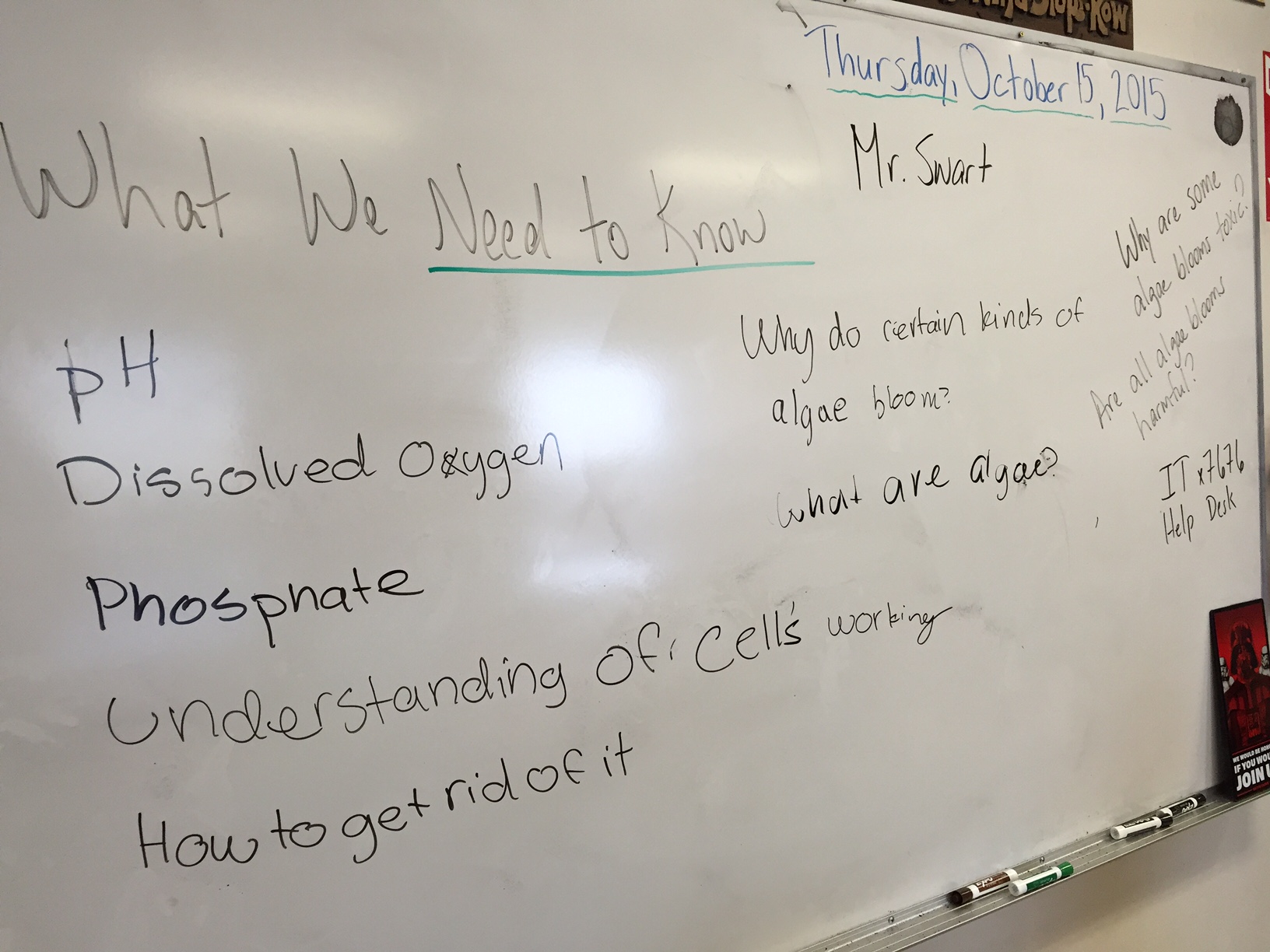
We began class with a pre-assessment of student prior knowledge of the learning targets encompassed by the final segment of our unit on cells and homeostasis. Next we launched the Seahurst Park PBL (problem-based learning) with a PowerPoint depicting a scenario familiar to students now that they have recently visited Seahurst Park and learned about harmful algal blooms locally in Puget Sound, as well as on a much larger scale off the West Coast (from Tuesday’s reading assignment). We concluded the class period with students taking the lead in creating the Know/Need to Know chart on the white boards at the front of the classroom. Student work is shown below, grouped by class period (click to enlarge).



Cells & Homeostasis: West Coast Toxic Algal Bloom
Many thanks to Mr. Stark for filling in as my substitute today. I spent the day in Shoreline for professional development as part of my Washington Alliance for Better Schools (WABS) STEM teacher externship program. In class today, students were scheduled to share their field trip experience with Mr. Stark, after which they were to receive an article to read along with a worksheet with questions about the reading and the field trip. This past June, the Seattle Times published the article Toxic algae bloom might be largest ever (or download the PDF), providing students with background content for the final phase of our unit. The worksheet of questions about the reading can be downloaded here.
Cells & Homeostasis: Seahurst Park Field Trip
Today was the big Seahurst Park field trip. Over 100 students and 12 adult chaperones traveled by bus down to the park where we met our hosts from the Environmental Science Center (ESC). ESC staff guided groups of students through six stations, with students spending a half-hour per station.
Watersheds (with Joanna): Students used a physical model of a city to learn how buildings, vehicles, pets, and other sources all contribute to the accumulation of pollution in Puget Sound. Students each shared one way they would personally help reduce their own impact on the environment.
 Water Quality Testing (with Jennifer): Students first read a brief article highlighting why harmful algae blooms occur (below). Students then measured a variety of factors related to water quality by sampling water sources from around the park. Students worked in groups, with each rotation measuring one of the following: dissolved oxygen, phosphate, nitrate, pH, and turbitidy. Students compiled the data into mini lab reports, sharing out their findings with each other and then analyzing it through graphing and writing a brief conclusion.
Plankton Tow (with Kelly): Students collected samples of Puget Sound plankton using a plankton tow. Samples were collected into cups for analysis during the Plankton Lab.

 Plankton Lab (with Jarett): Before using the microscopes to see the plankton in their Plankton Tow samples, students watched two brief videos to help them better understand the scale and consequences of harmful algae blooms (HABs). The first video, “Toxic algae blooms contaminate U.S. drinking water,” explains the impact of HABs on marine life, the fishing industry, and consumers. The second video, “Toxic Algae Bloom Causing Seizures in Sea Lions,” shows the neurotoxic effect of the algae toxin domoic acid on a sea lion found on the Washington coast. Students then viewed their own plankton under a microscope. Identification cards created by the Washington Sea Grant were used to identify species of plankton observed by students. Specifically, the Marine Zooplankton of Puget Sound card and the Marine Phytoplankton of Puget Sound card (pictured below) were provided.
Recycling (with Megan): Students learned all about how various types of common household waste can be separated into recycling, food waste, and garbage. The CleanScapes Recology community education program emphasized the importance of properly disposing of the various types of waste, with a focus on the types of waste often generated by teenagers.
Bioaccumulation Game (with Brendan): Poker chips, bags, arm bands, a few bright orange vests, and an energetic group of students was all it took to bring to life the concept of bioaccumulation. The game began with more than half the students (representing small fish preyed upon by salmon) scrambling around for 30 seconds to fill bags with poker chips (plankton) that had been scattered around in the grass. Next, the salmon were released, represented by students wearing bright green arm bands. When a “salmon” touched a smaller fish, the smaller fish gave the salmon their poker chips, representing a transfer of energy. After another 30 seconds, the orca entered the game (two students wearing bright orange vests) and devoured most of the salmon who then turned over their poker chips to the orca. When the game ended, the two orca had most of the poker chips. Students were then pushed to consider what might happen to the orca if a biotoxin were present in the environment and was being consumed by species lower toward the base of the food chain.
This was such a fantastic opportunity for students to visit a beautiful local park, interact with the talented and dedicated ESC staff, and spend the day bonding with peers and staff from our school, our district central office, and our community. There are an enormous number of people to thank for making today a success, and my students will be recognizing all of the behind-the-scenes people in the coming days.
Looking ahead, we will use our experience today as the basis for the final part of our first unit. As students make sense of what they learned and begin to take ownership of their own power to protect our local environment, they will be challenged to publicly share their learning. Stay tuned!
 Science with Swart
You must be logged in to post a comment.