In their assigned homework reading of Lesson 7 of the textbook, students learned about chemical changes, and the lesson references the penny lab as an example (originally from lesson 2 in the textbook, we will conduct the penny lab next week). For our abbreviated Friday class period, students were introduced to the concept of Conservation of Mass via the Copper Cycle.
Because the Copper Cycle experiment involves steps that must be conducted in a fume hood, we opted to watch a video (below), with students taking observations on their Copper Cycle handout. For reference, students also received a copy of the Copper Cycle experimental procedure.
For homework, students were assigned Lesson 7 textbook questions 1, 5, and 6 (page 30). In addition, students should read Lesson 8 prior to class on Monday.
In our abbreviated Friday class period, students had the opportunity to check out a biology textbook to take home and use as a study guide. For the remaining time in class, we continued our study of bioethics by taking notes on the Principles of Bioethics and then applying that learning to the bioethical problem of vaccination. Students learned about a measles outbreak in the United States back in early 2015 by watching the video below. After, they filled out the Focus on the Principles worksheet with the ethical question of “Should healthy people choose not to be vaccinated?”
We launched our first official chemistry lesson today by learning about chemical names and symbols. Students took notes from a PowerPoint slide deck which condensed the learning from Lesson 6 in the textbook. They then had the remainder of the class period to make observations about 18 test tubes containing various chemical elements and compounds and filling in the table in their “mystery vials” handout. For homework, students were assigned the task of completing the handout, skimming lesson 6, and reading lesson 7 in their textbook.
We launched our mini bioethics unit with an entry task that asked students to recall the definition of biology (the study of life) and to commit to memory the meaning of the prefix “bio-” (life). Students then took notes about values, morals, ethics, and bioethics and applied their new understanding of ethics to identify the two ethical questions contained in a list of nine different questions. Students may download the class notes by clicking here. We concluded the lesson with the Pandemic Flu! exercise, in which students were tasked with considering who would and would not receive a life-saving vaccine during a hypothetical pandemic flu outbreak. For homework, students were assigned to write a paragraph about an imaginary scenario where two values conflict and a decision must be made.
Our first week included an introduction from the teacher (Wednesday) and students meeting each other and constructing a social network based on their own experiences interacting with biology away from school (Thursday). Today students will have some quiet time to reflect on who they are and who they want to become, sharing this with me in the form of an About Me writing assignment.
In addition, freshmen students were reminded to turn in their Waskowitz field trip forms in order to participate in all of the activities on Monday. Chemistry students will have a substitute on Monday while I am away on the field trip.
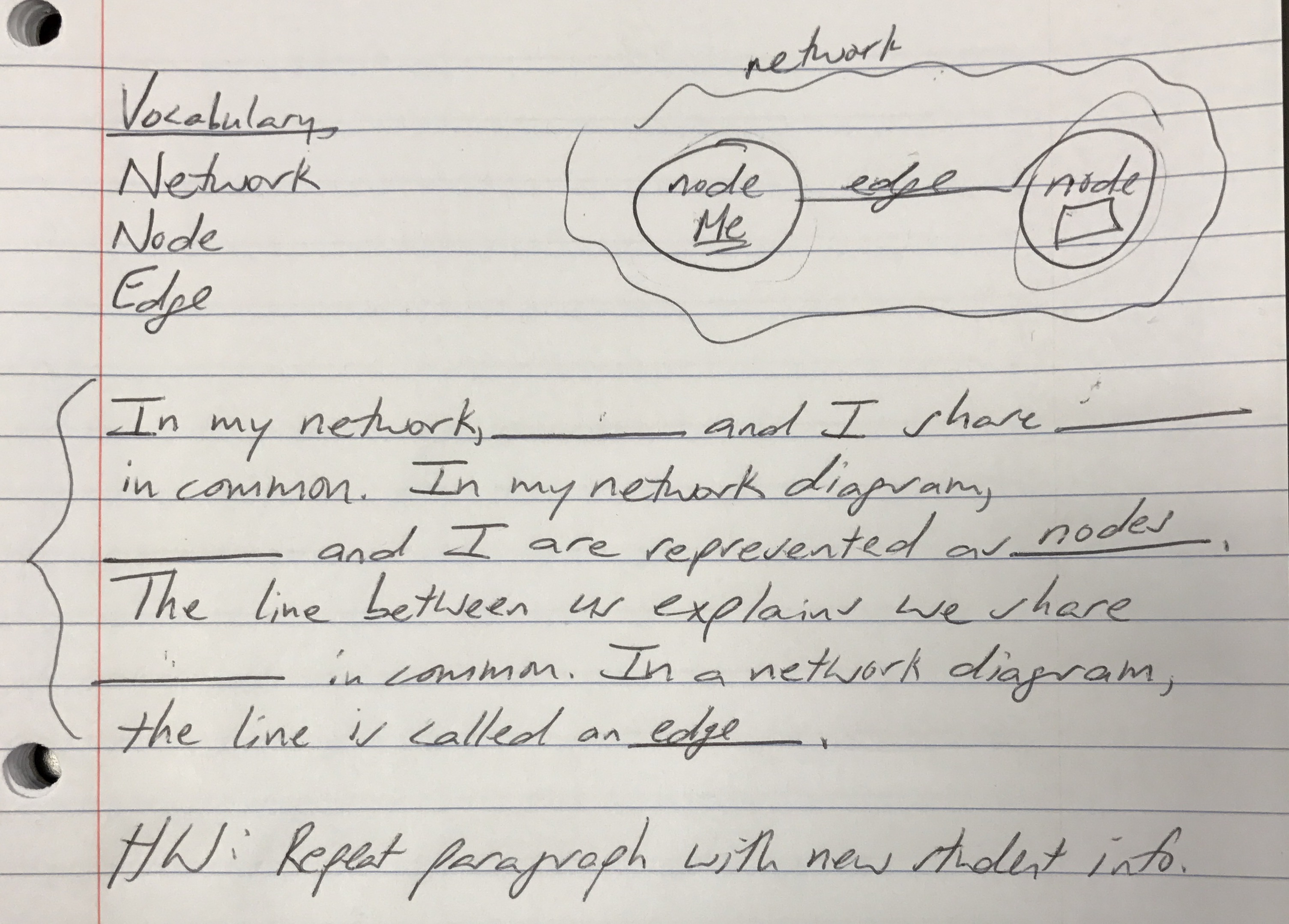
Our Day 2 activity called for students to learn a few new vocabulary words (Network, Node, and Edge) and then apply that learning to construct social networks using their homework from yesterday. Class notes, along with today’s homework (two written paragraphs using information from networks students constructed), are shown below. Click the pictures to view them as full-size images.
Welcome to day 1 of the 2017-18 school year! Today marks the final first day in the long history of Highline High School. I look forward to meeting everyone and sharing a bit about myself before asking you to do the same. Our first day agenda:
a quick starter activity
a meet-the-teacher slide deck with time for student questions
a few nuts and bolts
an explanation of the homework activity that will be due tomorrow
With Internet and telephone service unavailable for most of the morning throughout our school district, and with the temperature in the classroom soaring, we decided to move up our viewing of The Martian to this week.
On our first day of viewing, we watched the first 50 minutes of the movie. Resources for further learning about new concepts presented in the movie during the first segment are provided below:
With the Biology EOC finally in the rear-view mirror, it is time to take what we have learned in Biology class this school year and create something new. Final Projects are all the rage! Select a topic below or create your own. Need a rubric? Create one. Your work will be published to our class website for the world to see!
What is your vision of the ideal high school? How will it work?
How will students learn? How will they demonstrate what they have learned?
What will the school look like?
Justify your vision. What evidence do you have that your solution will improve upon the current school design? How will your vision result in an improved educational experience for the students who attend? Why should existing stakeholders support your vision?
Have strong opinions about a candidate for President in the 2016 election? Use your understanding of biology to explore one or more positions taken by the candidate, then research the topic and write an essay exploring your findings. Your claim must be grounded in fact. Your evidence must be credible. Your reasoning must be logical and rigorous. Your essay should also include a discussion of how science and politics intersect. How do candidates determine their political ideologies? How can voters influence the political process?
Scientists traditionally stay out of politics, choosing instead to let the data stand alone. In your opinion, should science and politics maintain a respectful distance, or should scientists be more vocal in the field of politics? How many scientists hold elected office in local government? At the state level? At the national level? How is science funded? At the national level, 39 members of the US House of Representatives comprise the Committee on Science, Space, and Technology. What is the purpose (jurisdiction) of the committee? How are members appointed? What states or regions are over- or under-represented and what impact might that have on residents and businesses in our state?
Rewilding Burien:
In his TED Talk, British writer George Monbiot introduces us to the concept of “rewilding” – the idea that to promote healthy ecosystems, we must bring back the megafauna and the tertiary consumers that once roamed the land long before humans. Monbiot reminds us that plants native to a given location co-evolved with other species previously living in the same location, so by studying the native plants we can make inferences about those species even if they are no longer found in that location. He also argues that humans may simply need to stop trying to “fix” damaged ecosystems and instead step back and let natural selection and homeostasis determine the shape of future environments.
Apply what you have learned to your favorite place on Earth: Burien! Describe the location as Charles Darwin would have done: what are the major plants, animals, and geologic formations present? How has the environment changed over time? Is the ecosystem currently in balance, and how do you know? From your perspective, what would a healthy ecosystem look like in Burien? Include credible scientific evidence to support your perspective. Finally, create a before and after model of the ecosystem and write a detailed explanation of the differences.
Tools Scientists Use:
Real science requires access to real tools. Scientists working in the lab are surrounded by tools to conduct the experiments that extend knowledge. To prepare for a career in the lab, visit the HHMI Virtual Lab website and select the lab you are most interested in. Download and complete the worksheet corresponding to the lab. While working through the lab, make a list describing the equipment you use. In addition, make a list describing the assays (types of lab experiments) you use and explain why each assay was used.
Where is the line between fact and fiction? How do you know? Watch the Baloney Detection Kit video below and answer the worksheet questions.
Apply your learning to the concept of genetic memory. As scientists and the public struggle to understand the field of epigenetics, the idea of genetic memory has been proposed in which epigenetic modifications to DNA can be passed down through generations, resulting in memories encoded in DNA also being passed down through generations. What do you think? Explore the field of epigenetics and determine the boundaries of what is known (backed by science) and what is conjecture (ideas lacking scientific backing). Are memories encoded in DNA the realm of science or pseudoscience? What exactly are memories?
Not feeling inspired by the existing list of ideas? Come up with your own! Maybe you have an idea for designing a better biology class – let’s hear it! Interested in global warming, vaccines, or the future of space travel? Craft your interests into a solid project and run with it! Speaking of crafting, how about sharing your love of biology within the context of Minecraft? Create a virtual learning environment and inspire future biology students! Perhaps you would rather investigate the biology of your favorite sport? Should Barry Bonds be in the Hall of Fame? Will the NFL develop technology to protect players from concussions? With the Olympics on the horizon, athletes are debating whether to participate and risk exposure to the Zika virus. What is the Zika virus and how does risk of exposure compare to reports of bacteria completely resistant to all known antibiotics? What is the future of medicine, and how will our understanding of the microbiome factor in? A deeper understanding of the bacterial world may pave the way for better understanding soil science: what will future farming look like? How about farming in space or on Mars?
We concluded our Biology End of Course review by watching the PBS video Your Inner Monkey. The video does a nice job of bringing together the key concepts from our units on evolution and central dogma. Tomorrow, students will sit for the EOC.
All three episodes of the movie series are listed below:


 Science with Swart
You must be logged in to post a comment.