All posts by David Swart

High school science teacher

Biological Classification POGIL

We continued our investigation into the history of biological research by moving past Charles Darwin and learning about the work of Carolus Linneaus, the father of modern taxonomy.  To help place the concept of taxonomy into historical perspective, we took a few notes connecting the discovery of the structure of DNA, the publication of Darwin’s work on evolution, and the publication of Linneaus’ work on taxonomy.  Class notes are shown below:

  • Structure of DNA discovered in 1953
    • James Watson (1928- )
    • Francis Crick (1916-2004)
    • Rosalind Franklin (1920-1958)
  • Theory of Evolution, The Origin of Species (published 1859)
    • Charles Darwin (1809-1882)
  • Biological Classification / Taxonomy (Systema Naturae, published 1735)
    • Carolus Linneaus (1707-1778)

After the notes, students each received a copy of the Biological Classification POGIL and we worked through the first two pages together as a class.  Students who would like additional learning about taxonomy are encouraged to watch the Crash Course video below:

Students who complete the POGIL activity early are encouraged to assemble and share with me a Google Slides consisting of organisms from as many different diverse species as possible.  Each slide should include a picture of the organism, it’s common name, and the complete taxonomic naming (from Kingdom through Species).

On Friday, we will review the POGIL and work through the final problem of the (question 23) as a class. For the last few minutes of class, we will review slides 5-8 of a PowerPoint describing complex relationships between organisms.

Students are encouraged to watch a National Geographic video about zombie parasites this weekend.  The presenter, Anand Varma, applies his expertise in photography to the study of parasites.  Mr. Varma travels the world collecting specimen for study, and his ability to apply biological concepts to his work, think creatively, and drive to overcome failure make him and his work truly remarkable.
Darwin’s Voyage

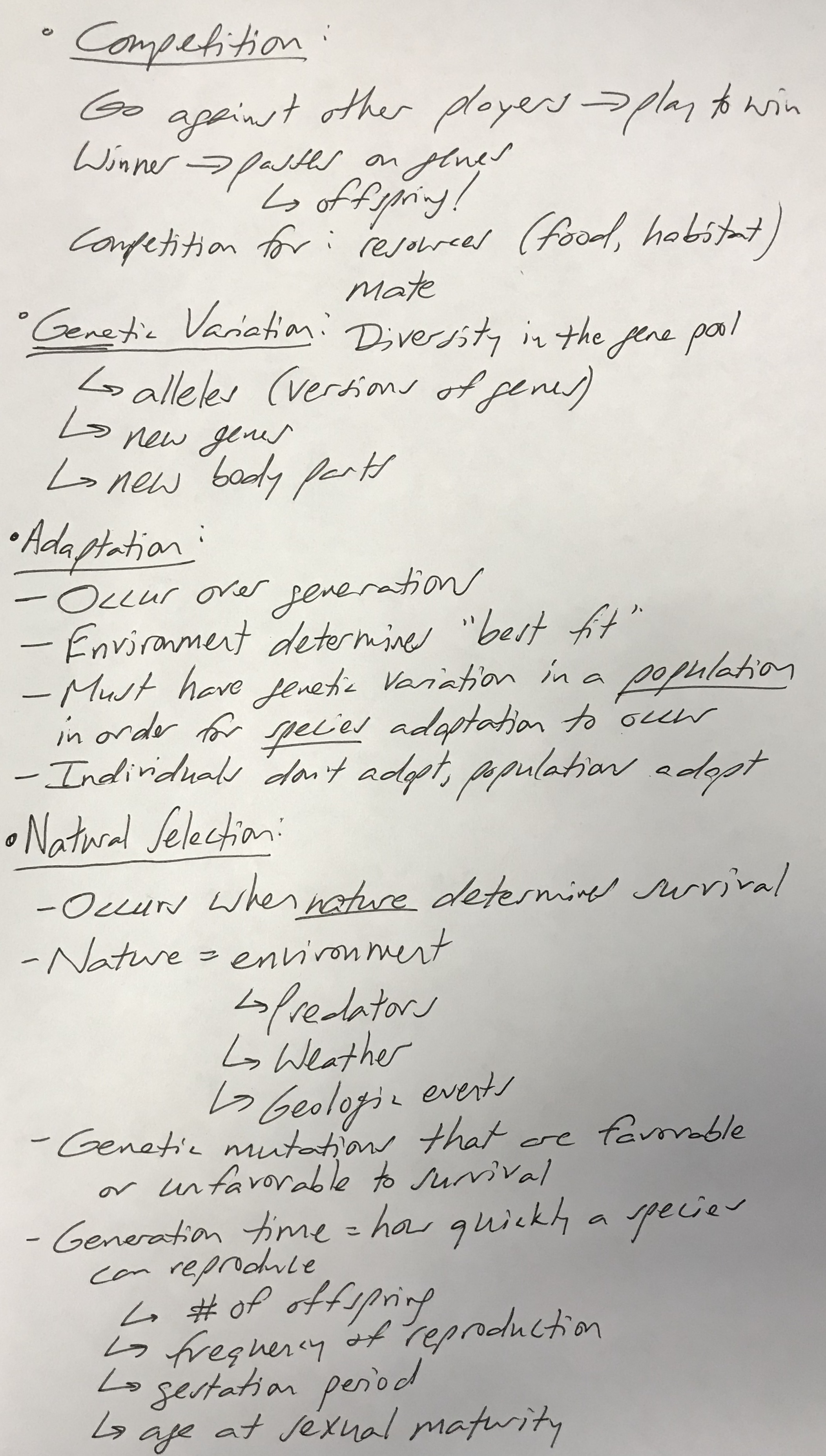
Despite the disruption of multiple fires started by students in the restrooms, we managed to take class notes on the four key facets of evolution studied thus far (pictured below).  A few classes were able to begin the activity below the picture.

A part of Darwin’s journey to developing the idea of evolution was in the Galapagos Islands.  You will start by taking a tour of where he went and what he observed.  Go to Explore the Galapagos on the PBS NOVA website and go through the interactive tour.  Answer the following questions in full sentences below in your lab notebook and turn in for credit:

  1. Where are the Galapagos Islands?
  2. First click on “Explore the Islands” and read about three of the islands.  Summarize one observation for each of the three islands you read about.
  3. Look at “Darwin’s Finches”.  What do you think it means by unique niche, based on what the rest of the paragraph says?
  4. How are the beaks different and why was that important?
  5. Now click on “What Darwin Saw”.  You will be going through his various stages and reading about what Darwin said (if you have headphones you can listen to the interviews as well).  Summarize Darwin’s first impressions (just writing the opening sentence will get you zero credit, click for the full story).
  6. What surprised Darwin on the islands?
  7. What did the tortoises offer the local people?  How did it benefit Darwin?
  8. At first Darwin thought the birds were unrelated, but what ideas eventually came from his observations of the finches?
  9. What was the fallout (or result) of Darwin’s journey?
  10. Go back to the “Explore the Islands”.  Look at some of the interpretative panoramics and the animals.  Pick one (or two for a bonus point) animals and summarize their unique characteristics.

Mystery Solutions

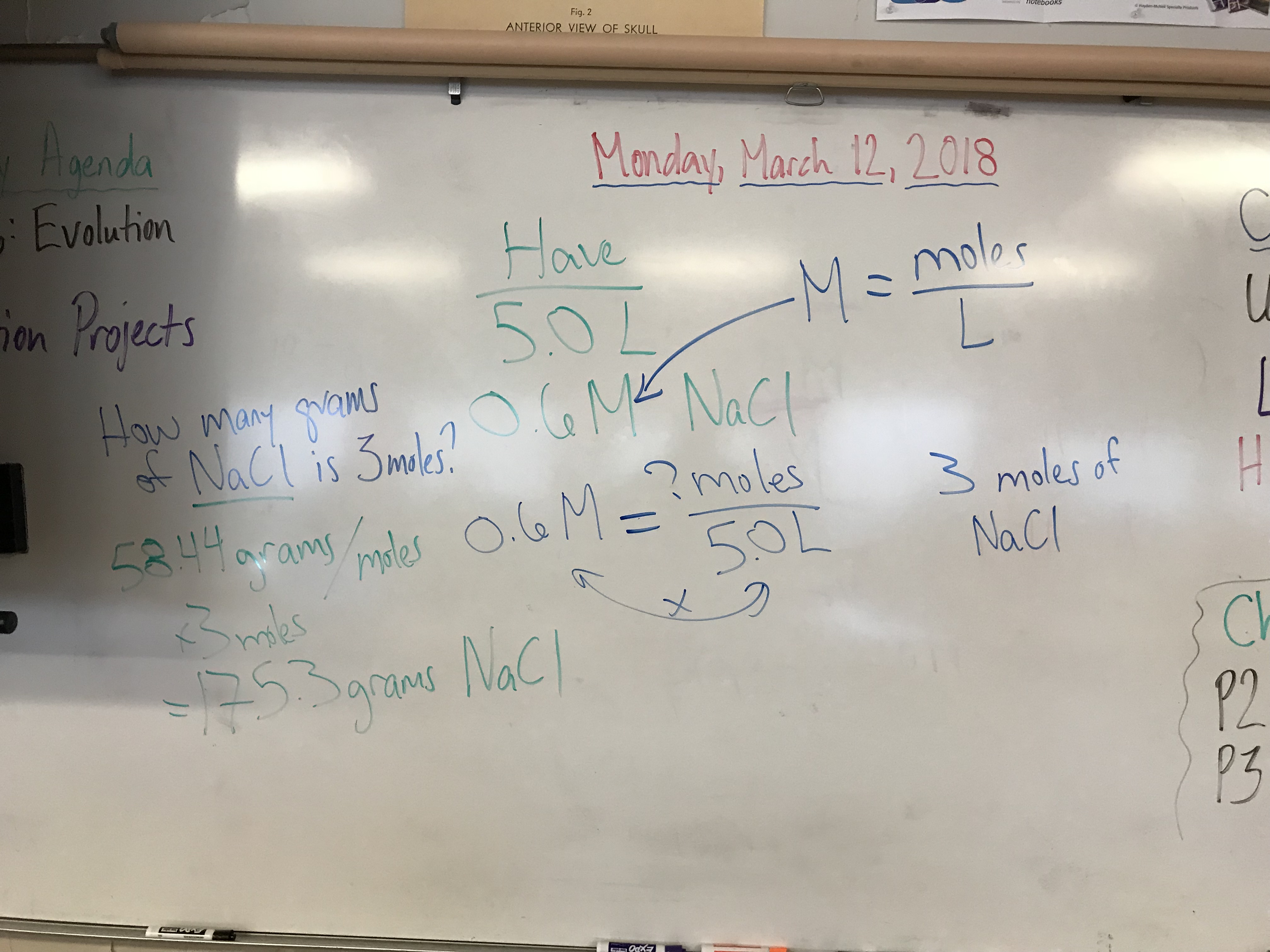
We began class today with the entry task from the Lesson 83 PowerPoint.  The student-driven solution is provided below:

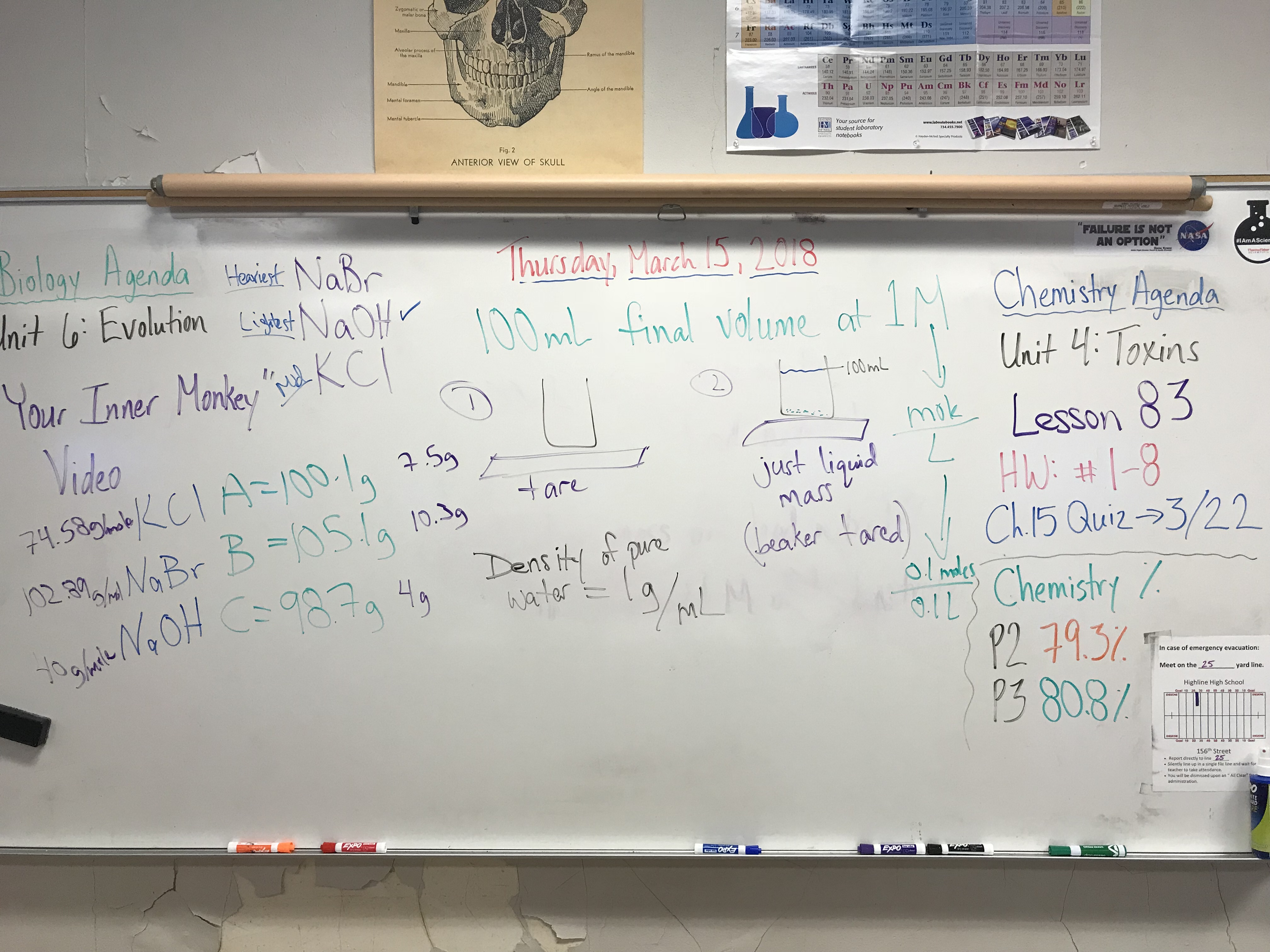
For the remainder of class, students worked through the Lesson 83 Worksheet.  We began with Part A, in which students were tasked with determining which mystery solution matched with one of three chemical formulas.  The mystery solutions each had a different mass, but all three were known to be 100 mL and 1.0 M solutions.  Notes from the white board are provided below.  For homework, students were assigned problems #1-8 from Lesson 83 in the textbook.  Also, students were provided with a printed copy of the Chapter 15 Study Guide and were told about the revised schedule for next week (Chapter 15 quiz on Thursday).

Your Inner Monkey

As a reward for a job well done on the Evolution Project and also because many students were on a field trip, we watched “Your Inner Monkey” in class today.  Students who missed class are encouraged to watch the first 35 minutes this evening and we will finish the rest in class tomorrow.  The video can be accessed for free on the HHMI website.  Students have the option of completing a guided video worksheet for one bonus point.


Preparing Solutions

We took advantage of the gap in AP testing to work through Lesson 82.  The Lesson 82 Worksheet called for students to work in groups to prepare salt solutions and then we measured the specific gravity of each solution using a hydrometer.  Our class results are provided below:

Period 2 Results:

Want 500 mL total volume (water = solvent)
Group grams of salt Specific Gravity Volume (L) moles of salt M
0 0 1.000 0.5 0.00 0.00
7 2.9 1.004 0.5 0.05 0.10
1 8.75 1.012 0.5 0.15 0.30
2 11.7 1.014 0.5 0.20 0.40
5 17.5 1.026 0.5 0.30 0.60
6 23.4 1.034 0.5 0.40 0.80
3 29.25 1.042 0.5 0.50 1.00
4 35.05 1.048 0.5 0.60 1.20
8 43.85 1.052 0.5 0.75 1.50

Period 3 Results:

Want 500 mL total volume (water = solvent)
Group grams of salt Specific Gravity Volume (L) moles of salt M
0 0 1.000 0.5 0.00 0.00
7 2.9 1.002 0.5 0.05 0.10
1 8.75 1.010 0.5 0.15 0.30
2 11.7 1.014 0.5 0.20 0.40
5 17.5 1.024 0.5 0.30 0.60
6 23.4 1.030 0.5 0.40 0.80
3 29.25 1.042 0.5 0.50 1.00
4 35.05 1.050 0.5 0.60 1.20
8 43.85 1.062 0.5 0.75 1.50

For reference, the Lesson 82 PowerPoint is available for download.

Additionally, students are encouraged to practice observing the relationship between moles, volume, and molarity using the University of Colorado Molarity PhET simulation below:

https://phet.colorado.edu/sims/html/molarity/latest/molarity_en.html

Molecular Views

Our work today involved thinking about solutions from a molecular perspective.  Students briefly reviewed yesterday’s Gummy Bear portion of the lab via the ChemCatalyst on slide 3 of the Lesson 81 PowerPoint.  Students then received the Lesson 81 Worksheet and the Particle Views Handout.  The handout was used in Part 1 of the worksheet.  For Part 2, students did the mental work of thinking through how to prepare solutions with different volumes and molarities.  They then observed the outcome of preparing those solutions.  The lesson helped illustrate the connection between molarity (M), particle density, and the number of moles (particle number) in a solution.  Pictures from the white board are shown below.

Solution Concentration

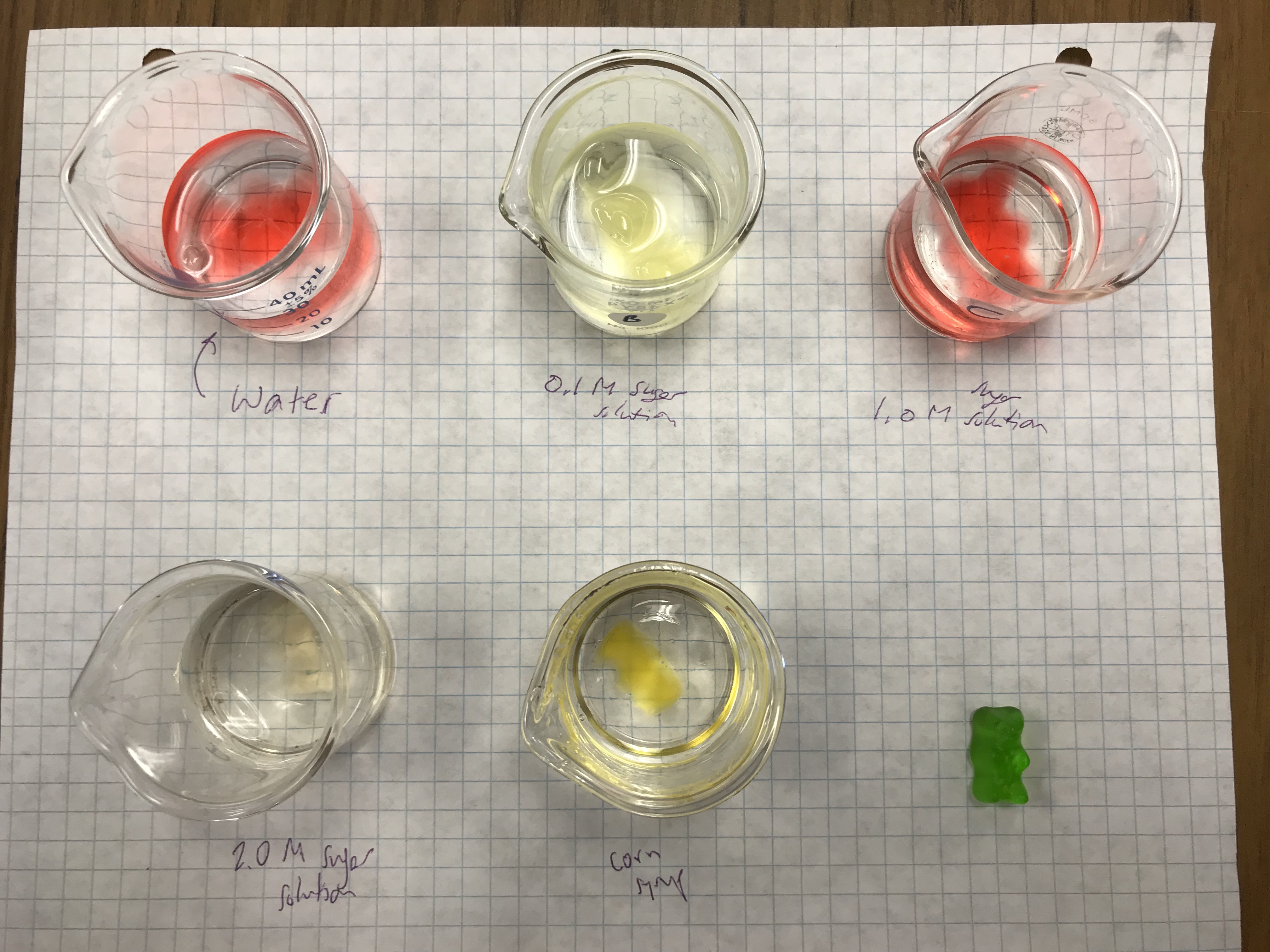
We began Lesson 80 with an entry task (included in the Lesson 80 PowerPoint) in which students were asked to consider the fate of gummy bears placed into solutions containing increasing amounts of sugar.  The resulting discussion allowed us to revisit the concept of osmosis and to model what might be happening in the gummy bears (shown after soaking in solution overnight).

After recording some additional lesson-related vocabulary (solute, solvent, concentration, and molarity), students received the Lesson 80 worksheet and used the remainder of class time to acquire the data and begin filling in the table on the bottom of the front page.  With SAT tomorrow for juniors, we will complete the Lesson 80 Worksheet on Thursday.  Students in class tomorrow will have time to work through the assigned problems from the textbook, problems 1-10.