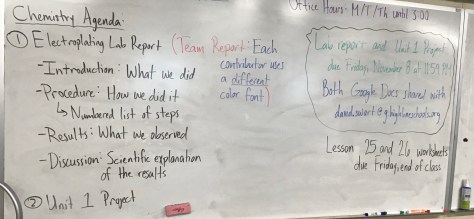
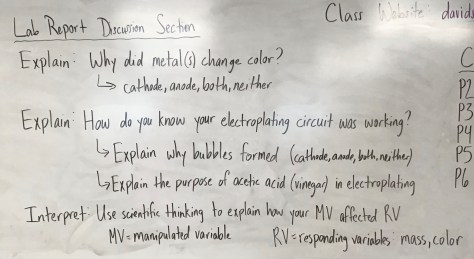
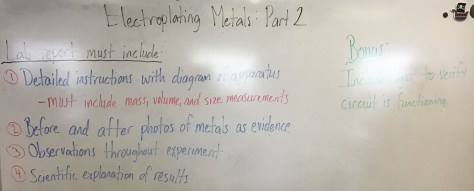
To conclude our electroplating lab, students will collaborate with their lab team to write a team lab report (shared with the teacher as a Google Doc). Each student should use a different color font and team members should work together to determine how to equally divide the work. The lab report is due Friday evening at 11:59 PM for full credit. Late lab reports will receive a maximum score of 60%.
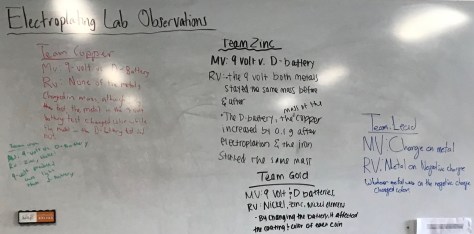
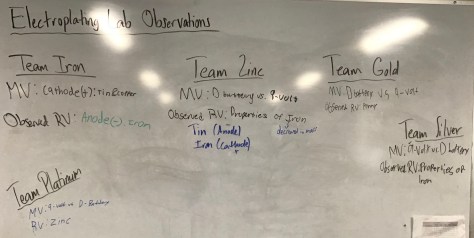
Electroplating Results By Class Period:
Period 2 Electroplating Lab ObservationsPeriod 3 Electroplating Lab Observations
Monday, November 4 (HS-ETS1-1, HS-ETS1-2): Your team is tasked with researching which species of photosynthetic organism is best suited to grow in your company’s aquatic farm. Photosynthetic aquatic organisms consume carbon dioxide during photosynthesis to produce glucose and oxygen, so aquatic farming may help reduce the amount of carbon dioxide in the water and reduce acidification of the surrounding water.
As described in detail on the Unit 1 Project Scoring Rubric, a complete project (Google Doc, Google Slides, video, web page, or poster) must include:
An explanation of ocean acidification and research into sources of ocean acidification.
An explanation of how aquatic farming can help reduce or reverse acidification in the Pacific Ocean.
Your team’s first choice for which organism to farm, along with a description of the criteria (needs) and constraints (barriers to success) for farming the organism.
An explanation of how, when, and where the aquatic farm will be established, how long it would take to impact acidification, and how the farmed organism will contribute to the economy.
Resources provided are examples to help teams get started. High-performing teams will find additional scientifically credible resources.
Projects will be shared with the class on Friday, November 8.
Tuesday, November 5 (HS-ETS1-1, HS-ETS1-2): By the end of class today, student groups should have the following work completion goals:
Ocean acidification research completed
Photosynthetic aquatic organism research completed
Group agreement on how project will be shared with the class on Friday
Wednesday, November 6 (HS-ETS1-1, HS-ETS1-2): By the end of class today, students should have a clearly constructed explanation of the connection between aquatic farming and ocean acidification. A strong explanation will include:
connection between photosynthesis of aquatic organisms, carbon dioxide in the atmosphere and the ocean, and ocean pH
rate of photosynthesis of two or more photosynthetic aquatic organisms researched
Student groups should use this data to inform their choice of organism to farm. Once that decision has been made, groups should research at least three criteria for successfully farming their organism. Groups should also research at least three constraints (challenges) for successfully farming their organism.
Thursday, November 7 (HS-ETS1-1, HS-ETS1-2): For the final work day, students should research the following:
how, when, and where the aquatic farm will be established;
three ways the farmed organism will contribute to the economy;
how long the farm will take to impact acidification
Finally, the presentation should be completed and practiced in advance of sharing with the class tomorrow.
Friday, November 8 (HS-ETS1-1, HS-ETS1-2): After working incredibly hard this week, students were rewarded with one final work day to prepare for presentations that will take place next Tuesday. Today, students will complete a worksheet where they share their experience working with their team members, and the information will contribute to the individual scores for the project. By the end of today, students should have presentations complete, with the following information included in the presentation:
Explanation how ocean acidification happens and why it is a problem
Research about the photosynthetic organism selected for farming
Connection between a) photosynthesis of the selected organism, b) carbon dioxide in the atmosphere and the ocean, c) and ocean pH
Where the aquatic farm will be located
How the farmed organism will contribute to the economy
Practice! Practice! Practice! Students groups will have 5 minutes
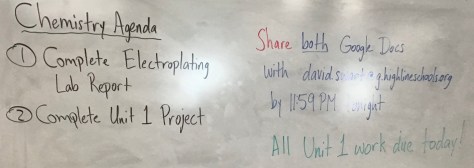
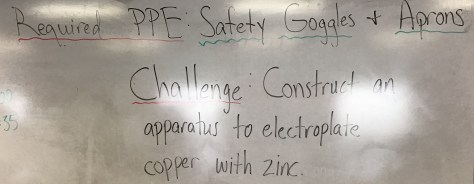
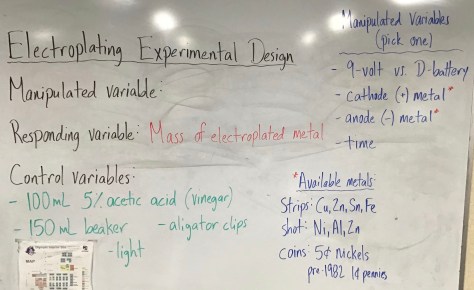
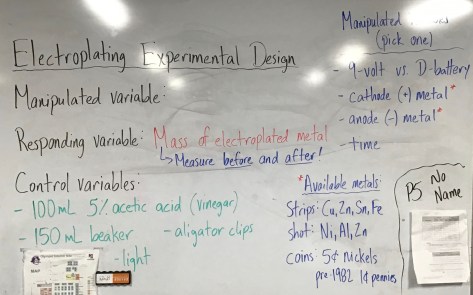
To complete Lesson 27, students were challenged to complete the task outlined below, with a group lab report (due tomorrow) documenting the experience and explaining the learning:
For our final lesson of Unit 1, the concept of electroplating metals was introduced by watching a short video featuring a garage-style setup with a guy who uses a spork and pickle juice to electroplate a part of his cart project:
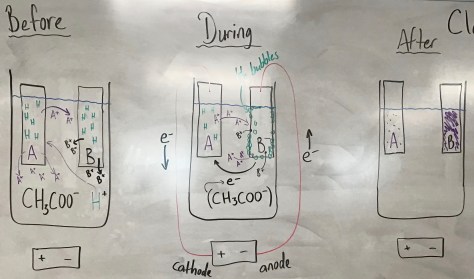
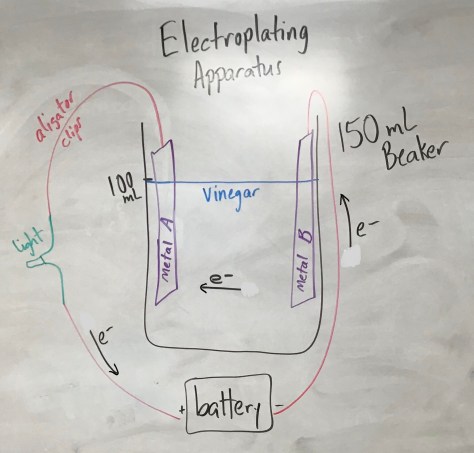
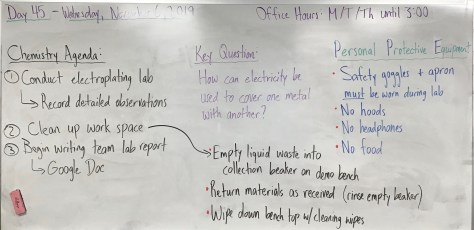
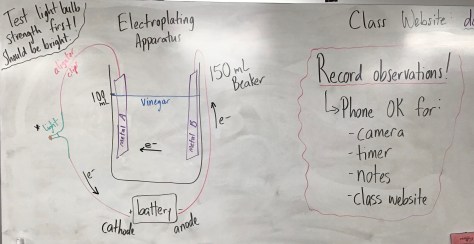
After the video, we discussed how to set up an electroplating apparatus (pictured below) and also discussed safety concerns and required personal protective equipment to be worn during the lab tomorrow (goggles and lab apron required, hair tied back, closed-toe shoes). Students then worked with their table team to design an electroplating experiment and write up a procedure to follow tomorrow.
For the Wednesday lab, students must carefully document all aspects of their work in preparation for writing a lab report. Students who finish early may begin writing the lab report.
The Lesson 26 PowerPoint will introduce students to the four models of chemical bonding. Students will also receive a handout of the models with additional information. After the PowerPoint, students will work in pairs to organize the Substance Cards and record their learning on the Lesson 26 worksheet.
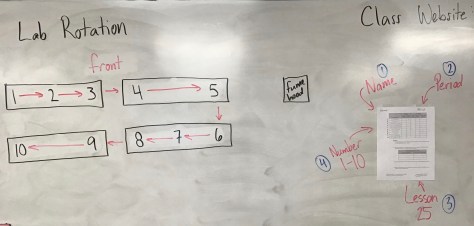
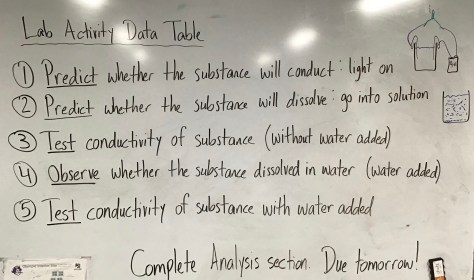
We enter the final chapter in Unit 1 with the Lesson 25 PowerPoint, introducing students to the concept of classifying substances based on properties of matter like conductivity and solubility. After slide 6 in the PowerPoint, students will receive the Lesson 25 Worksheet and then work in groups of 4 students to test the conductivity and solubility of the substances listed on the worksheet. By the end of class, students will compile all of the data from the lab into the table on page 2 of the worksheet.
Monday, October 28 (HS-LS1-6): Today marks the final Monday of the 1st Quarter. We began class with a review of the Egg Lab experiment conducted last week, focusing on the data collected on Friday. We drew models to show the flow of water across the cell membrane when the cell was placed in corn syrup. Next, students were given an open-notes pop quiz designed to evaluate both understanding and engagement. Students all received the Dehydration Synthesis Gizmo with remaining class time set aside to begin working on the Gizmo. Students who complete the Gizmo by next Monday will receive bonus credit.
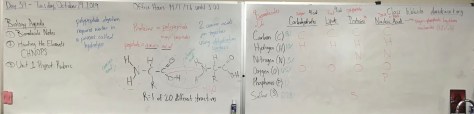
Tuesday, October 29 (HS-LS1-6): As we conclude our study of how organisms live and grow, we must answer the question: how do cells build new molecules with the nutrients they acquire following digestion? To address this question, students consider the elements found in the four major classes of biomolecules:
Carbohydrates: carbon (C), hydrogen (H), and oxygen (O)
Lipids: carbon (C), hydrogen (H), and oxygen (O)
Proteins: carbon (C), hydrogen (H), oxygen (O), and nitrogen (N), and sulfur (S)
To understand the process of building biomolecules with atoms of elements obtained after the digestion process, students will learn about dehydration synthesis. Students will also learn about hydrolysis, the process of apart polymers to produce monomers while consuming water.
Notes from class:
Next, we watched a segment of the NOVA video Hunting the Elements, beginning at 58:05 and ending at 1:18:00, and students were tasked with keeping track of how much of each element are present in the human body.
Finally, students will receive the grading rubric for the Unit 1 Project.
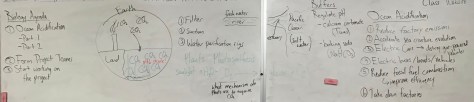
Wednesday, October 30 (HS-ETS1-1, HS-ETS1-2): As carbon dioxide levels increase in the atmosphere, the oceans absorb carbon dioxide and become more acidic. When ocean water becomes more acidic, the shells of young shelled sea creatures fail to form properly, often dissolving before the animals can mature.
With that background, we watched the video about ocean acidification below:
After the video, we took class notes:
Next, we watched the video below that focused on solutions to ocean acidification:
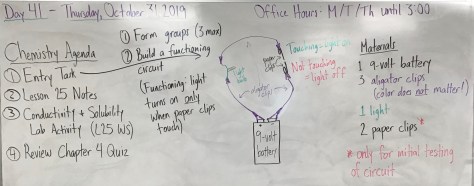
After a brief discussion, class ended with students tasked with reviewing the rubric in preparation for forming project teams tomorrow.
Your team is tasked with researching which species of photosynthetic organism is best suited to grow in your company’s aquatic farm. Photosynthetic aquatic organisms consume carbon dioxide during photosynthesis to produce glucose and oxygen, so aquatic farming may help reduce the amount of carbon dioxide in the water and reduce acidification of the surrounding water.
As described in detail on the Unit 1 Project Scoring Rubric, a complete project (Google Doc, Google Slides, video, web page, or poster) must include:
An explanation of ocean acidification and research into sources of ocean acidification.
An explanation of how aquatic farming can help reduce or reverse acidification in the Pacific Ocean.
Your team’s first choice for which organism to farm, along with a description of the criteria (needs) and constraints (barriers to success) for farming the organism.
An explanation of how, when, and where the aquatic farm will be established, how long it would take to impact acidification, and how the farmed organism will contribute to the economy.
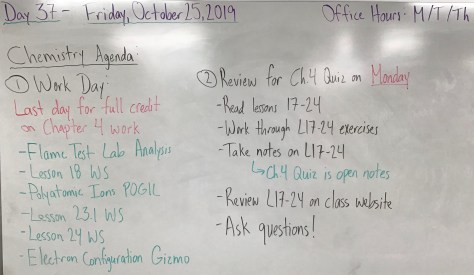
Students had the short Friday class period as a work / review day to catch up on all missing work and to prepare for Monday’s Chapter 4 Quiz. All work must be turned in today to receive full credit. After today, assignments will receive a maximum score of 60% credit.
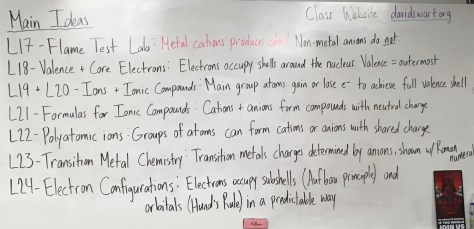
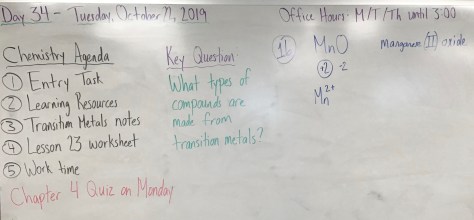
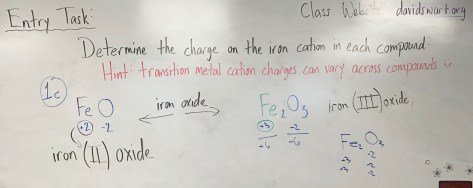
Today we learned about how to name compounds that involve transition metals. To help launch the lesson, students watched a video by Tyler DeWitt titled Transition Metals in Ionic Formulas:
After watching the video, we practiced writing ionic formulas with transition metals via the Lesson 23.1 worksheet.
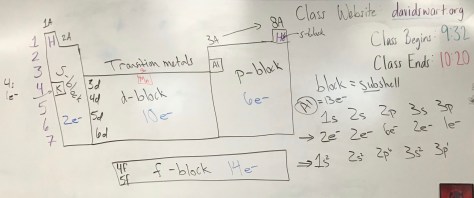
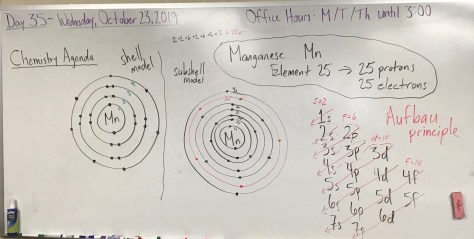
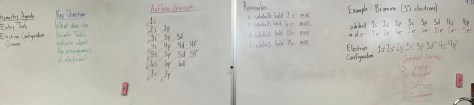
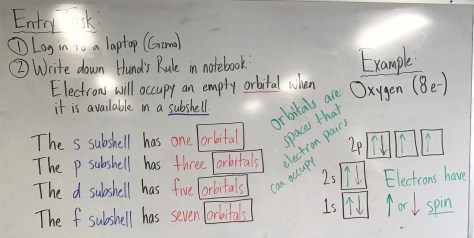
Notes from class:
Extend your learning!
Students are encouraged to review lesson content by watching the videos below:
Real-world application:
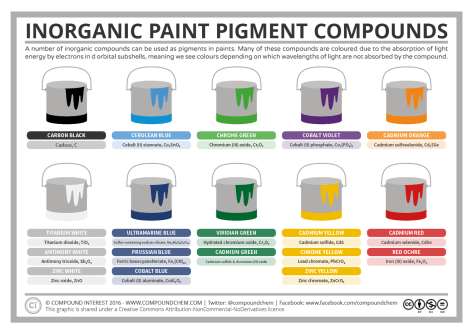
Click on the image below to learn more about how transition metals are used in the process of coloring paint.
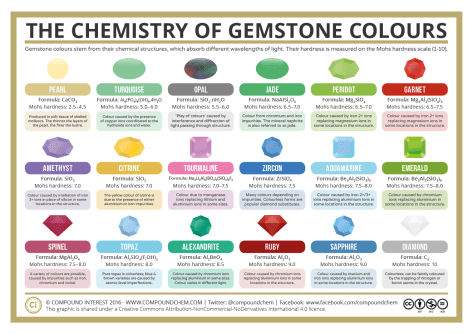
Next, click on the image below to learn how transition metals impact the color of gemstones:
What do you notice about the two different images? How can different transition metals turn different materials (paint and gemstones) similar colors? How do similar chemical formulas result in different colors? To help answer this, consider the difference between paint and gemstones: you light observes light reflected by both substances. Does light interact with paint and gemstones differently?

 Science with Swart
You must be logged in to post a comment.