
Tag Archives: polarity

Molecular Structure and Properties: Phase, Size, Polarity, and Smell

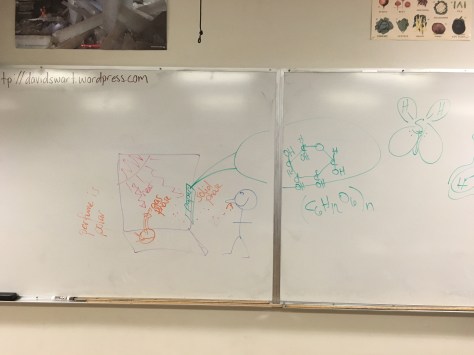
Chapter 8 concluded with the Lesson 46 PowerPoint and Lesson 46 Worksheet.  Lesson 46 brought together the various concepts needed to understand how molecules with certain properties can be detected by our noses, with our brain recognizing those molecules as having a specific smell.  The ChemCatalyst asks students to model why perfume molecules can be smelled from across a room, but paper cannot (both placed near a sunny window).  We sketched out a drawing of the scenario and modeled the response on the white board (pictured below):
IMG_0426

Molecular Structure and Properties: Polar Molecules and Smell

We continued our study of polarity, this time exploring how the polarity of molecules might impact our ability to smell the molecule.  Through the Lesson 45 PowerPoint, students learned that polar molecules are more likely to be detected by the nose as something with a scent although there are still polar molecules (like water) that do not smell.  Students worked in pairs to cut out the molecules in the molecules handout and used the molecules to complete the Lesson 45 Worksheet.  Students who would like to explore the polarity of molecules further are encouraged to visit the University of Colorado’s PhET molecule polarity simulation (or just click below).

Molecule Polarity

Click to Run

Molecular Structure and Properties: Electronegativity and Polarity

We began class with a Crash Course chemistry video about polar and non-polar molecules:

We then worked through the Lesson 43 PowerPoint and followed that with the Lesson 43 Worksheet and accompanying cartoon.  One of the vocabulary terms, dipole, is introduced in the Crash Course video along with the concept of dipole moment.  For more on dipole moment, check out the Khan Academy video below:


Dipole moment: Predicting the molecular dipole moment based on the molecular geometry.

https://www.khanacademy.org/embed_video?v=q3g3jsmCOEQ

For homework, students are assigned questions 2, 4, and 6.

Molecular Structure and Properties: Attractions between Molecules

Chapter 8 began with a lab designed to introduce students to the concept of polarity.  Students filled burets with water, vinegar, and vegetable oil and observed the path of the liquids in the absence or presence of an electrically charged wand.  The wand consisted of a long balloon rubbed vigorously on students’ hair to generate a static charge (build-up of electrons) on the balloon.  Students then observed how the negatively-charged balloon “pulled” the stream of water toward the balloon (pictured below along with the lab set-up).  Students worked through the Lesson 43 Worksheet while completing the lab.  After the lab, we reviewed the key vocabulary and concepts presented in the Lesson 43 PowerPoint.  For homework, students are assigned questions 4-6.