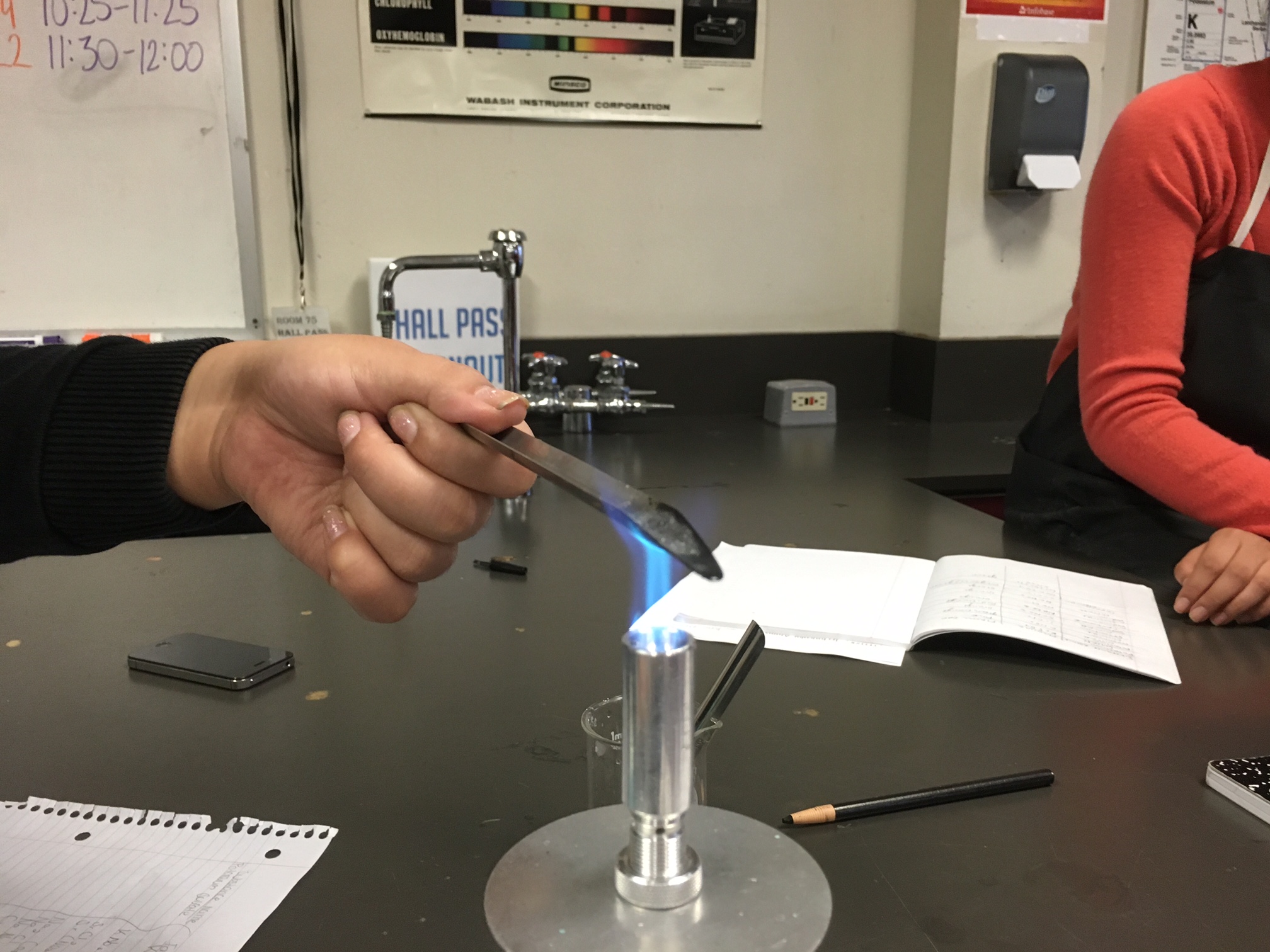
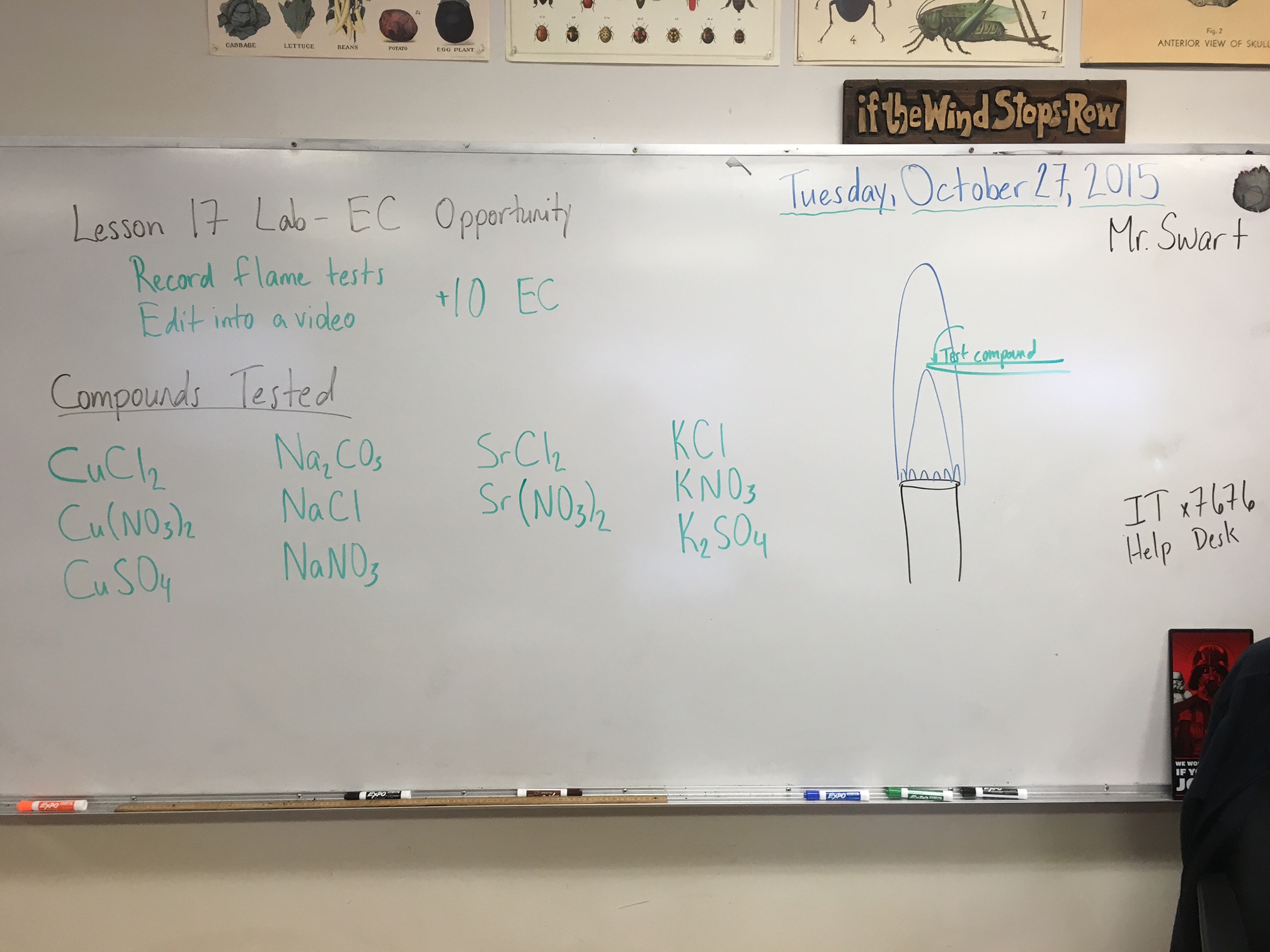
We began Chapter 4 with the Flame Test lab. We reviewed the safety requirements and lab mechanics. There were stations set up around the room with portable Bunsen burners, chemicals to burn, and equipment to conduct the flame test. Students recorded their results as described on the Lesson 17 Worksheet. Students were also offered 10 points of extra credit for taking video of the flame tests and editing them together into a video. Students also received a print-out of the electron structure of a sodium atom, showing what happens when the outer shell electron of sodium is excited. The lab took most of the class period, so we will discuss results tomorrow. Students should complete as much of the Lesson 17 worksheet as possible, read Lesson 17 in the textbook, and answer questions 1 and 2 in the textbook.
Conducting the flame testFlame Test lab safety equipmentCompounds tested
We continued our exploration of the Periodic Table by working through the first 13 slides of the Lesson 10 PowerPoint. Students then worked through most of the Lesson 10 worksheet with their groups from yesterday. We will complete both the slide deck and the worksheet activity tomorrow.
Update 10/2 – Students completed the Lesson 10 worksheet in class and were also assigned the Lesson 10 questions from the textbook. In advance of Monday’s Chapter 2 quiz, students received practice copies of the Chapter 2 Multiple Choice and Short Answer quizzes. Students were also encouraged to work through the Chapter 2 review questions on page 49 of the textbook. The review questions and practice quizzes are not assigned and do not need to be turned in for credit.
In preparation for Lessons 9 and 10 in which the Periodic Table is introduced, students watched the first half of the PBS Nova video, “Hunting the Elements” – we finished at the 48 minute mark today. Students will have a substitute teacher tomorrow and will finish the video in class.
Updated 9/29: Special thanks to our substitute, Mr. Burke. He informed me students were able to watch through the 1:29:00 mark of the video. Students are encouraged to finish the video outside of class. Students should read Lesson 9 before class tomorrow and come prepared to extend their learning of the Periodic Table.
We began class by assembling a list of the elements and compounds observed yesterday:
Vial
Name
Chemical Formula
Description
1
Aluminum
Al
silver pebbles
2
Silicon
Si
shiny dark silver jagged rocks
3
Zinc
Zn
bluish-grey with patina
4
Sulfur
Si
yellow shards, rotten egg smell
5
Zinc
Zn
corroded
6
Zinc
Zn
silver frosted corn flakes
7
Sodium Chloride
NaCl
clear liquid
8
Trisodium Phosphate
Na3PO4
clear liquid
9
Sodium Nitrate
NaNO3
clear liquid
10
Sodium Fluoride
NaF
clear liquid
11
Aluminum Chloride
AlCl3
misty blue liquid
12
Copper Chloride
CuCl2
transparent blue
13
Copper
Cu
copper colored beads
14
Calcium Sulfate
CaSO4
white powder
15
Magnesium carbonate
MgCO3
Baking powder (creamy white)
16
Vinegar (acetic acid)
C2H4O2
Sour smell, clear liquid
17
Calcium Carbonate
CaCO3
Large greyish-white rough rocks
18
Calcium Chloride
CaCl2
Compressed white pellets, dusty
Note: The numbers in the chemical formulas should be written as subscripts.
After the review, students received the Lesson 7 worksheet, the copper cycle experimental steps handout, and the Lesson 8 worksheet. We decided to skip the lesson 7 worksheet because we do not currently have access to reliable fume hoods (required for the copper cycle lab) and because the lesson 8 worksheet includes students responses from the lesson 7 worksheet. After reviewing the content in the Lesson 7 PowerPoint, we watched two versions of the Copper Cycle Lab on YouTube (below):
Students should read through Lessons 7 and 8 in the textbook and complete the questions at the end of the lessons, and be prepared to ask questions about the content in class tomorrow.
We began the week with Lesson 6, the first lesson Chapter 2. Students were introduced to the language of chemistry, learning how chemical formulas for compounds are written as collections of elements. The Lesson 6 PowerPoint defines several important vocabulary terms and prepared students for the lab activity (Lesson 6 worksheet). For the lab, there 18 different solid and liquid elements and compounds for students to observe (different from those pre-filled on the worksheet). The observations consumed the remainder of the class period, and students were asked to read Lesson 6 in the textbook in preparation for completing the lesson tomorrow during class.


 Science with Swart
You must be logged in to post a comment.