Category Archives: Uncategorized

Central Dogma: Cystic Fibrosis Case Study

In today’s lesson, we used a case study about cystic fibrosis as the mechanism to:

  • review the stop codon;
  • connect the concepts of protein structure and function;
  • review how R groups differentiate amino acids;
  • review how R group interactions result in protein folding;
  • discuss “structure equals function”;
  • bring a human face to a genetic disease;
  • and help students recall the mechanism of genetic inheritance.

For the entry task, students were challenged to consider how genes begin and end.  We discussed how mRNA sequences always begin with AUG (which codes for methionine, and amino acid which may also occur elsewhere in a protein).  Students were then reminded of the three “stop codons” and we reviewed how those work to release a protein from the ribosome.  We reviewed the structure of amino acids, focusing on the 20 different R groups and how those R groups each have different properties.  The interactions between R groups determine protein shape, and shape determines protein function.  When the sequence changes, the shape changes, thus changing the function of a protein.  We then moved into the cystic fibrosis case study, first watching the video below and then working through the lesson PowerPoint.

Pictures from the white board today:

Central Dogma: Strawberry DNA Lab Results

With the short class period, we briefly reviewed the science behind the strawberry DNA extraction solution by watching a segment of the video below (beginning at about the 3:00 mark):

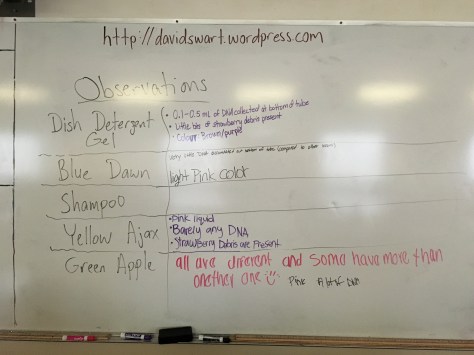
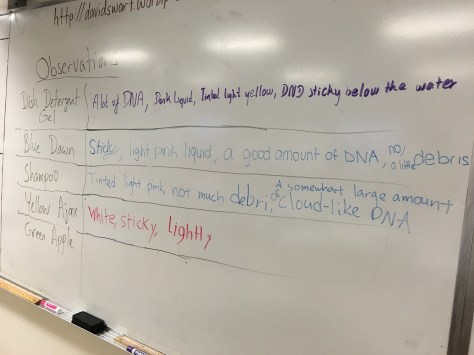
Students then located their DNA samples from yesterday.  Although our microcentrifuge stopped working toward the end of 3rd period, students had the opportunity to observe their samples and use laboratory-grade micropipettes to transfer a small volume of their DNA samples to glass slides.  The samples were visualized using our class digital microscope connected to the projector for all to see.  Students in 2nd and 3rd period were able to compare findings after centrifuging their samples, while students in 4th and 5th periods had more time to prepare and observe samples under the microscope.  Notes from the whiteboard, as well as a selection of microscope pictures (some potentially showing several DNA strand clusters and others showing cellular debris with some possible DNA strand clusters), are shown below:

File_000
Second Period Observations
File_001
Third Period Observations


Weather: Weather Science

We launched Unit 3 with an overview of how to make sense of the various types of weather maps used to predict weather.  The Lesson 49 PowerPointLesson 49 Worksheet, and the Weather Variables handout are available for download.  For more information about the jet stream, check out the short video below:

For weather forecast data, visit the University of Washington Atmospheric Sciences Virtual Map Room.  Lesson 49 textbook questions 1, 2, and 6 were assigned as homework.  To help connect the concepts of temperature, volume, and pressure, we also watched Kevin Delaney performing on Jimmy Fallon:

Molecular Structure and Properties: Electronegativity and Polarity

We began class with a Crash Course chemistry video about polar and non-polar molecules:

We then worked through the Lesson 43 PowerPoint and followed that with the Lesson 43 Worksheet and accompanying cartoon.  One of the vocabulary terms, dipole, is introduced in the Crash Course video along with the concept of dipole moment.  For more on dipole moment, check out the Khan Academy video below:


Dipole moment: Predicting the molecular dipole moment based on the molecular geometry.

https://www.khanacademy.org/embed_video?v=q3g3jsmCOEQ

For homework, students are assigned questions 2, 4, and 6.

Energy, Matter, and Organization: Nutrient Cycling Quiz

To conclude the biogeochemical cycle poster project, students each reviewed two posters from groups other than their own.  The review consisted of a worksheet with one half containing key items that must be included on each poster for full credit (turned in for participation credit).   The lower half of the worksheet included feedback questions that were left with the posters and provided to the groups for feedback.  Students then received a take-home quiz consisting of an article about the 2015 Gulf of Mexico dead zone and a quiz with questions connecting the nitrogen, carbon, and water cycles with photosynthesis, cellular respiration, and algal blooms.  The quiz is due Monday.

Molecular Structure and Properties: Shape and Smell

For Lesson 40, students worked in small groups to organize a set of 24 cards containing compounds with different shapes and functional groups.  The Lesson 40 PowerPoint includes a nice graphic organizer for studying the relationship between molecule name and functional group.  The Lesson 40 Worksheet and Card Sort are available for download.  For homework, students are assigned questions 1, 2, and 5.

Molecular Structure and Properties: Space-Filling Models

Lesson 39 introduces students to the concept of space-filling models.  The lesson calls for students to use space-filling models which we do not have access to at our school.  Rather than continue to use the ball-and-stick models, students instead used MolView, a free software program available online.  Using MolView, students searched for the compounds in the Lesson 39 Worksheet using the search tool.  They then visualized the molecules as space-filling models using the van der Waals Spheres option located under the Model tab.  Although not particularly helpful, the Lesson 39 PowerPoint is included.  For homework, students are assigned questions 3 and 4 from the textbook.

Molecular Structure and Properties: Molecular Shape

We returned to the molecular modeling kits in Lesson 38, this time using the kits to learn about the shape of molecules.  We worked through the Lesson 38 PowerPoint, learning vocabulary terms to describe molecular shape.  Students then worked in small groups to complete the Lesson 38 Worksheet.  For homework, students were assigned textbook problems #1-6.  Notes from the whiteboard are shown below:

Energy, Matter, and Organization: Photosynthesis & Cellular Respiration POGILs

For the next three days, students will learn about leaf structure, photosynthesis, and the connection between photosynthesis and cellular respiration.  Students will work in pairs to complete two worksheet packets, and those who finish early will have the opportunity to complete one or more related labs.

For day 1, the entry task called for students to answer (through writing) the following:

  1. What is photosynthesis?
  2. Why is photosynthesis important?
  3. Write the equation for photosynthesis (bonus: include pictures!).

Student work is pictured below:

After the share-out, students watched the Crash Course: Plant Cells video (below) which served as a refresher to plant cells and as an introduction to photosynthesis.  After the video, students worked in pairs on the Photosynthesis POGIL worksheet packet.

For Day 2, students reviewed the vocabulary terms of exothermic and endothermic within the context of photosynthesis, cellular respiration, and combustion.  Notes from the entry task are pictured below.

After the entry task, we watched the video about photosynthesis by Bozeman Science.  Students need to know the first 4.5 minutes of content, but the remaining content (which students wanted to watch) is beyond the scope of our class.  After the video, students had the remainder of class time to work on the Photosynthesis POGIL Worksheet Packet from yesterday.

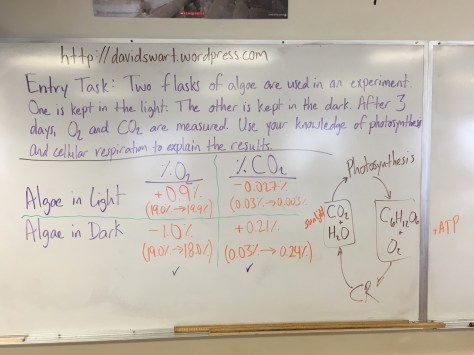
For Day 3, we connected the processes of photosynthesis and cellular respiration first through our entry task and then through a Photosynthesis and Cellular Respiration POGIL worksheet packet.  The entry task and white board notes answering the response are pictured below:

IMG_0372

IMG_0373

IMG_0374

For students looking to dig into cellular respiration at the molecular level, the Crash Course and Bozeman Science videos are provided below:

Molecular Structure and Properties: Electron Domains

We began the day with a brief review of Lesson 36 (the last slide of the PowerPoint) before transitioning to the Lesson 37 PowerPoint.  Students learned about electron domains and how they affect the shape of a molecule.  They then worked in pairs on the Lesson 37 Worksheet, substituting the molecular modeling kits for the entire activity (no candy in our classroom).  Students also received a copy of the January homework calendar which outlines the schedule along with assigned homework through the end of the month (and thus the end of the semester).  The assigned lesson 37 textbook questions are #3-6, 8, and 9.