
With the hugely successful Career Fair extending Advisory today, we used the 25 minute class period for a quiz covering cellular respiration, body systems, biomolecules, and feedback.
Category Archives: Organization
Energy, Matter, and Organization: Biomolecules Reading
To reinforce learning from the video yesterday, we reviewed how the digestive system processes biomolecules into subunits which are then recycled into new biomolecules. White board notes are shown below:


After, students worked on the Biomolecules Reading assignment in Google Classroom. Students have the option of completing the reading and Google Doc worksheet alone, in pairs, or in groups of four. However, each student must turn in an assignment.
Energy, Matter, and Organization: Biomolecules
We began the day with an entry task designed to pull forward student learning about cellular respiration just before the Thanksgiving holiday break. The white board summary showing the entry task, as well as the formulas for both cellular respiration and photosynthesis are shown below:


We then transitioned to a class assignment where students were divided into four teams, with each team responsible for answering one quarter of the worksheet questions answered in the Crash Course Biomolecules video (below). After the video, student groups worked together to talk through their responses to ensure consistency. Finally, students re-grouped in order to share answers, thus serving to review the video content and provide students the opportunity to discuss and debate answers.
Energy, Matter, and Organization: Food: Our Body’s Source of Energy
Special thank you to Mr. Frank for helping guide my biology students through the day. Students are expected to adhere to our new seating chart and use class time efficiently to complete the following work:
- Finish the Relating Nutrition & Chronic Disease worksheet packet from yesterday. The packet should be turned in when completed.
- Complete the Google Classroom assignment Food: Our Body’s Source of Energy reading and Google Doc worksheet.
- Students who finish should ensure they have competed the previous Google Classroom assignment Why Can’t You Hold Your Breath Forever?
- The next assignment will be the Molecules Reading assignment already loaded in Google Classroom.
Energy, Matter, and Organization: Relating Nutrition & Chronic Disease
After the nice long Thanksgiving holiday weekend, we returned to our study of energy, matter, and organization by connecting our previous work deducing the formula of cellular respiration with the study of nutrition. Students were tasked with completing the Relating Nutrition & Chronic Disease. They were also encouraged to use the USDA’s National Nutrient Database to look up the nutrient content of any ingredients not listed in the worksheet packet.


Energy, Matter, and Organization: How Humans Obtain Energy – Initial Model
Our work today is to organize student prior knowledge of how humans obtain energy into a model that can be revised over the course of the unit. Recent learning from the Strength video and worksheet from Monday should be used to help students fill out the initial model worksheet. The worksheet must be turned in at the end of class, so students should work efficiently to:
- Select one of the four scenarios from the video
- Review that scenario by watching that segment of the video (see Monday’s post for a link to the video)
- Draw and label the body systems involved (including the major organs of the body systems) on the worksheet
- Explain how the person in the scenario both gets and uses the energy and matter needed to survive in the scenario.
- Complete the three questions on the back of the worksheet, answering as completely as possible.
- Turn in the worksheet at the end of class for credit.
For a review of body systems, visit the website InnerBody.com and watch the Crash Course body systems videos to learn more about body systems relevant to the selected scenario.
Energy, Matter, and Organization: Human Strength Video
To introduce our second unit, students watched the Discovery Channel video Human Body: Pushing the Limits – Strength and completed worksheet questions. Note: The worksheet will be entered as an assignment in the grade book, so students should turn it in upon completion.
The entire video is available to watch online on the Daily Motion website. For students having difficulty accessing the video using a Chromebook, here are segments of the video found on YouTube containing the majority of the important video content.
Cells & Homeostasis: Cell Organelles Quiz
We wrapped up our week of studying cells and their organelles with a quiz. After the quiz, students received their egg for the egg lab. The wrote their name, class period, and starting mass (in grams) of their egg on a plastic cup, filled the cup with enough vinegar to cover the egg, and then wrapped plastic wrap over the cup to help seal in the vinegar. The egg shells quickly began to bubble as the vinegar began dissolving the shells. We will observe the eggs Monday and continue the egg lab then. Time permitting, students were treated to another Jimmy Fallon video featuring Kevin Delaney:
Cells & Homeostasis: Cell Organelle Networks
Students received their quizzes from last Friday and we reviewed how to analyze network diagrams. Students learned that when analyzing an edge between two nodes, the arrow of the edge points to the receiving node. For example, of Student A calls Student B, the students would be nodes, and the edge would start at Student A and point toward Student B.
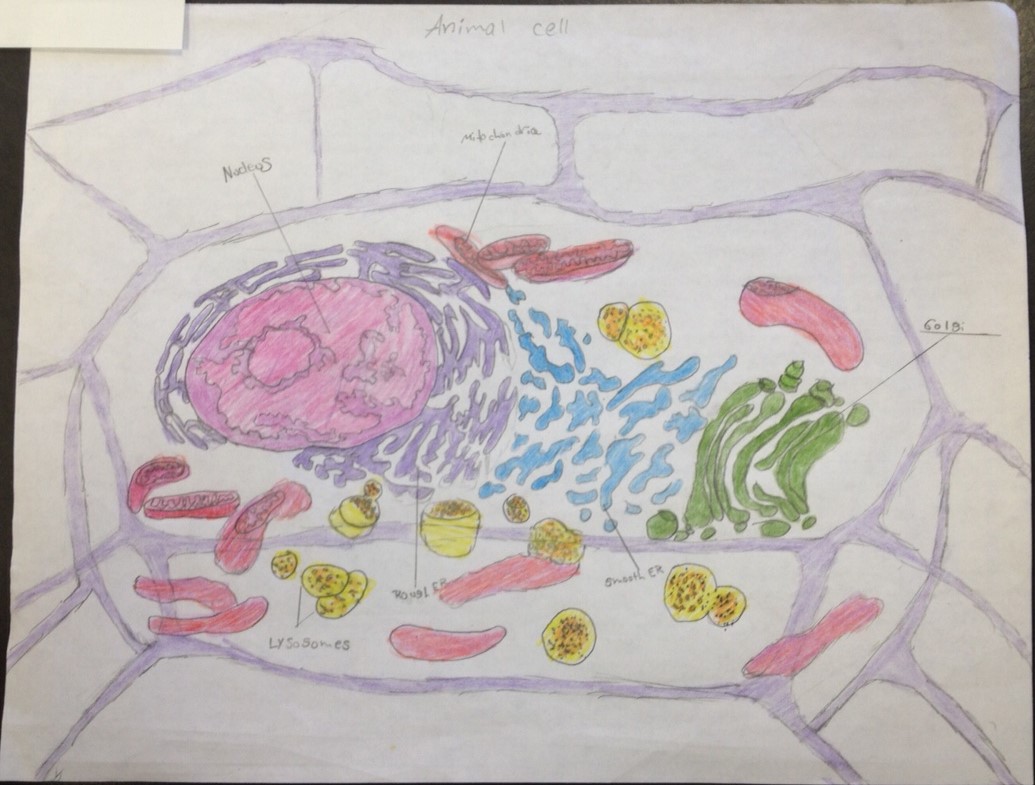
Next, students had time to complete and/or review their organelle flash cards from yesterday. Students were told yesterday that the flash cards were due today, but with the Illuminate website down for much of the day, students received an extra day to complete the flash cards with the expectation that Illuminate is back up reliably tomorrow. Students then worked in small groups of 3-4 and were assigned to draw either a plant cell or an animal cell. First, the drawing must include all of the organelles found in the assigned cell type. Second, students must research interactions between the organelles. Finally, students will use their drawing to construct a network diagram, with each organelle serving as a node, and the relationships between the organelles serving as the edges. Each node must have at least one edge originating from it. Students were permitted to use all available resources, including the class textbook, the purple book (Inside the Cell), and scientifically reliable websites accessed from their phones. Students will have the class period tomorrow to complete the project and Chromebooks will be available. Students are encouraged to research relationships between the organelles as homework this evening.
Student Work Examples:


Cells & Homeostasis: Organelle Flash Cards
Students had two major tasks today:
- Complete the reading from yesterday (pages 6-13 from Inside the Cell), complete with summaries of each section written in the lab notebook for each student.
- Create flash cards as shown in the picture below:
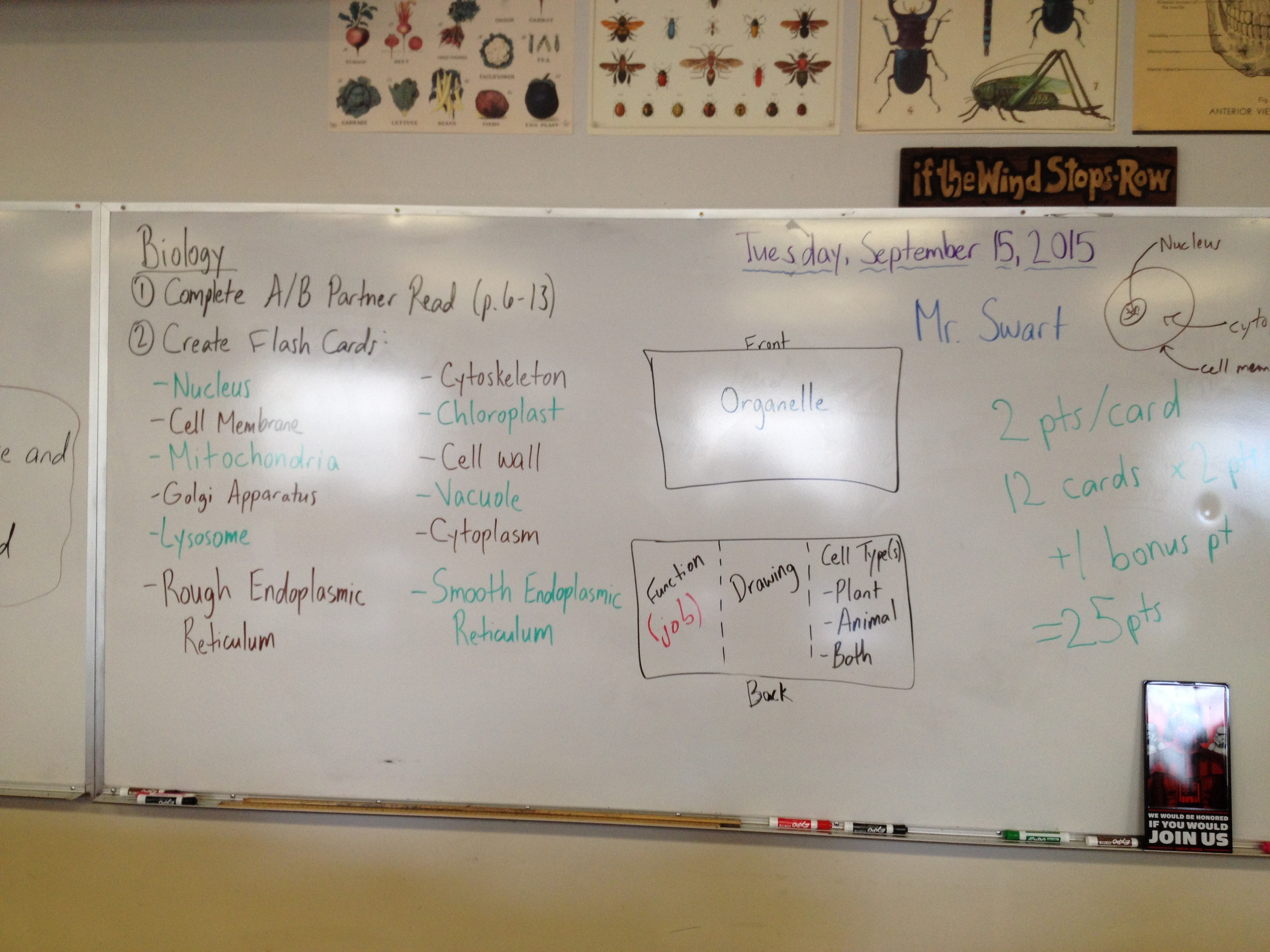
A complete set of 12 flash cards for each student are due at the beginning of class tomorrow (one card for each of the 12 organelles). Students should use their textbook if they have one at home, the online version of Inside the Cell, and any other scientifically valid resources. The National Science Foundation has an excellent interactive resource called A Tour of the Cell that students might find useful.
 Science with Swart
You must be logged in to post a comment.