Category Archives: Matter

Energy, Matter, and Organization: Biomolecules Reading

To reinforce learning from the video yesterday, we reviewed how the digestive system processes biomolecules into subunits which are then recycled into new biomolecules.  White board notes are shown below:

After, students worked on the Biomolecules Reading assignment in Google Classroom.  Students have the option of completing the reading and Google Doc worksheet alone, in pairs, or in groups of four.  However, each student must turn in an assignment.

Energy, Matter, and Organization: Biomolecules

We began the day with an entry task designed to pull forward student learning about cellular respiration just before the Thanksgiving holiday break.  The white board summary showing the entry task, as well as the formulas for both cellular respiration and photosynthesis are shown below:

We then transitioned to a class assignment where students were divided into four teams, with each team responsible for answering one quarter of the worksheet questions answered in the Crash Course Biomolecules video (below).  After the video, student groups worked together to talk through their responses to ensure consistency.  Finally, students re-grouped in order to share answers, thus serving to review the video content and provide students the opportunity to discuss and debate answers.

Energy, Matter, and Organization: Food: Our Body’s Source of Energy

Special thank you to Mr. Frank for helping guide my biology students through the day.  Students are expected to adhere to our new seating chart and use class time efficiently to complete the following work:

  1. Finish the Relating Nutrition & Chronic Disease worksheet packet from yesterday.  The packet should be turned in when completed.
  2. Complete the Google Classroom assignment Food: Our Body’s Source of Energy reading and Google Doc worksheet.
  3. Students who finish should ensure they have competed the previous Google Classroom assignment Why Can’t You Hold Your Breath Forever?
  4. The next assignment will be the Molecules Reading assignment already loaded in Google Classroom.

Energy, Matter, and Organization: Relating Nutrition & Chronic Disease

After the nice long Thanksgiving holiday weekend, we returned to our study of energy, matter, and organization by connecting our previous work deducing the formula of cellular respiration with the study of nutrition.  Students were tasked with completing the Relating Nutrition & Chronic Disease.  They were also encouraged to use the USDA’s National Nutrient Database to look up the nutrient content of any ingredients not listed in the worksheet packet.

Energy, Matter, and Organization: Organizing and Summarizing

We used our time in class today to organize and summarize learning thus far on Unit 2.  Students have had several assignments and many needed some additional time to complete their work.  The goal by the end of class was to identify all of the work from the unit, summarize the key findings into a narrative, and store the work in student folders that will be kept in the classroom.  The folders will serve as a portfolio and as an organizational tool.  They will also allow students to easily present their work on the current unit during the Student-Led Conferences scheduled for this evening (from 2:30-6:00) and tomorrow (from 4:00-7:30).  Tomorrow we will share out as a class and come up with a common narrative to help students retain our learning over the long 5-day Thanksgiving weekend.

Energy, Matter, and Organization: Connecting CO2 and pH with Exercise

We began class with a discussion of of the reading from yesterday.  The discussion focused on helping students understand how to read the questions, how to formulate a response, and the expectation of the quality and depth of thinking expected of a high school student of biology.  Notes from the white boards are pictured below:

After the discussion, students conducted an experiment designed to test the effect of exercise on the amount of carbon dioxide exhaled.  The experiment introduced students to the concept of cellular respiration (vocabulary they will learn soon) by studying the intersection of the cardiovascular and respiratory body systems.  Students measured pH as a surrogate measure of carbon dioxide output by exhaling into a straw placed in a cup of distilled water.  To measure pH, students used probeware connected to hand-held computers.  They measured the pH of the water before and after exercise, writing down their procedure and optimizing the procedure during the class period.  Students obtained data demonstrating a correlation between exhaled carbon dioxide and decreasing pH.

Students wishing to understand the chemistry behind our experiment should visit NOAA’s Ocean Acidification website.  The Smithsonian Institute also has an excellent collection of content explaining ocean acidification that includes some videos about how sea life is affected by increasing carbon dioxide in the atmosphere.

Energy, Matter, and Organization: How Humans Obtain Energy – Initial Model

Our work today is to organize student prior knowledge of how humans obtain energy into a model that can be revised over the course of the unit.  Recent learning from the Strength video and worksheet from Monday should be used to help students fill out the initial model worksheet.  The worksheet must be turned in at the end of class, so students should work efficiently to:

  1. Select one of the four scenarios from the video
  2. Review that scenario by watching that segment of the video (see Monday’s post for a link to the video)
  3. Draw and label the body systems involved (including the major organs of the body systems) on the worksheet
  4. Explain how the person in the scenario both gets and uses the energy and matter needed to survive in the scenario.
  5. Complete the three questions on the back of the worksheet, answering as completely as possible.
  6. Turn in the worksheet at the end of class for credit.

For a review of body systems, visit the website InnerBody.com and watch the Crash Course body systems videos to learn more about body systems relevant to the selected scenario.

Energy, Matter, and Organization: Human Strength Video

To introduce our second unit, students watched the Discovery Channel video Human Body: Pushing the Limits – Strength and completed worksheet questions.  Note: The worksheet will be entered as an assignment in the grade book, so students should turn it in upon completion.

The entire video is available to watch online on the Daily Motion website.  For students having difficulty accessing the video using a Chromebook, here are segments of the video found on YouTube containing the majority of the important video content.

https://www.youtube.com/watch?v=pgtfDT8Uqew

https://www.youtube.com/watch?v=I7cnekKG_7o

https://www.youtube.com/watch?v=7Wbs6DJkwEU

Matter, Atomic Structure, and Bonding: Conservation of Mass Lab

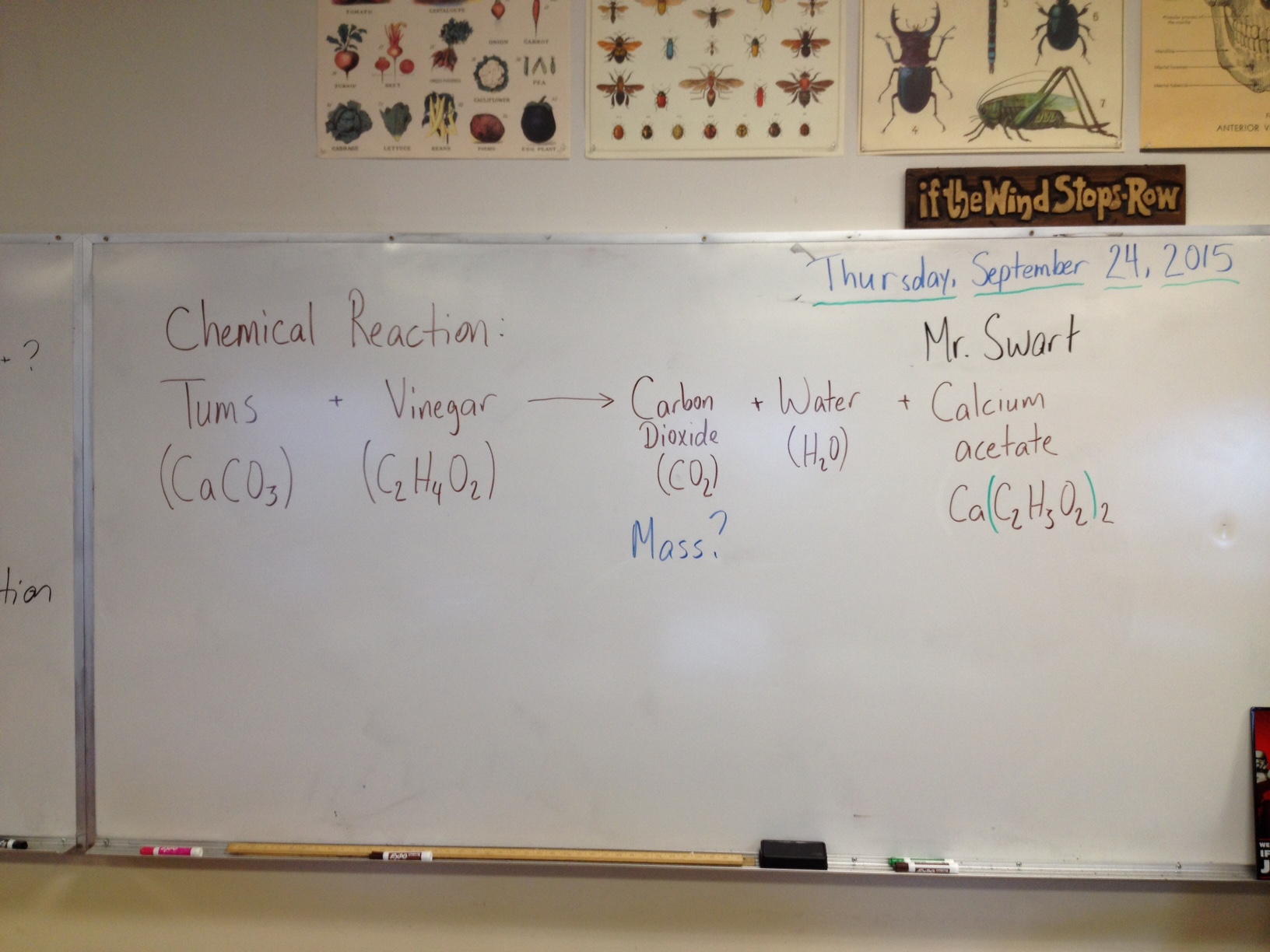
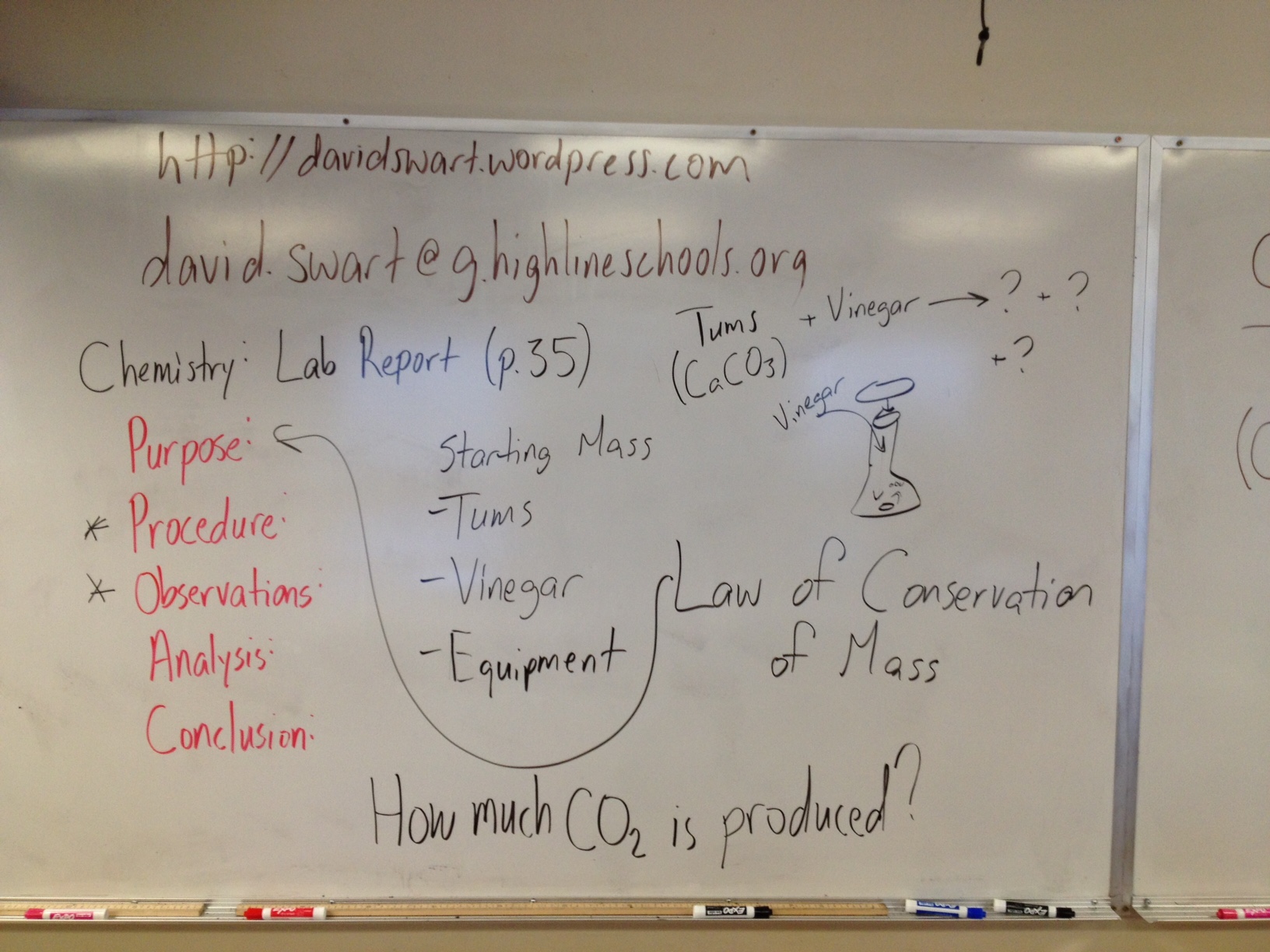
Following up on the conservation of matter lesson from yesterday, students worked in groups to conduct a similar experiment to the baking soda and vinegar demonstration.  Today, students were tasked with experimentally testing the law of conservation of mass by mixing known masses of vinegar and Tums (calcium carbonate), then capturing the carbon dioxide released in the experiment in a balloon placed over the flask.  They were tasked with determining how much carbon dioxide is produced but the challenge was that, unlike the demonstration yesterday, they could not simply allow the carbon dioxide to escape into the atmosphere.  After much trial and error, students gained practical experience working with various pieces of glassware, reagents, the digital balance, thinking through order of experimental operations, recording observations, and sharing their understanding of what was happening during the chemical reaction.  We concluded with a discussion of the chemical reaction (pictured below).  Students will meet tomorrow in the library computer lab to compile their findings into a lab report.  Students were encouraged to take pictures or video into their investigation today and those can be incorporated into the lab report.

IMG_7043 IMG_7044